
From the Wikipedia: Globster

I’m not going to lie: Today’s “From the Wikipedia” does indeed stem from a chain of Wikipedia links related to Rex Ryan’s Gatorade shower last night.
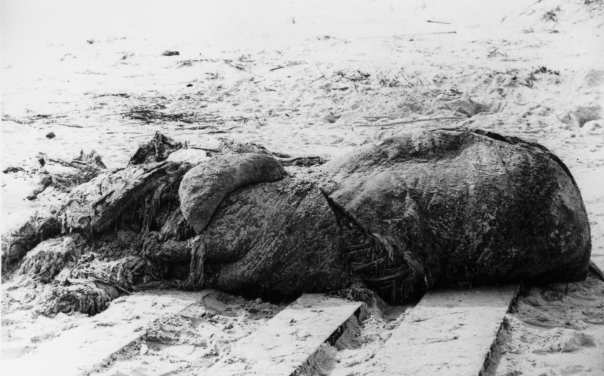
From the Wikipedia: Globster.

Before today, I had never heard of Globster. This is odd and somewhat troubling, as I consider myself an amateur expert in cryptozoology. Anyway, globster is the term given to any unidentified mass of organic material that washes up on the ocean shore, usually leading to wild and hilarious speculation.

Usually, it turns out, globsters are leftover adipose tissue from dead sperm whales, as was the case with the Chilean Blob of 2003, the Nantucket Blob of 1996, and Bermuda Blobs 2 and 3 in 1995 and 1997, but oddly not the original Bermuda Blob — that was a dead shark.

In rare instances, though, as in both the original Tasmanian Globster and Tasmanian Globster 2: Revenge Of Tasmanian Globster, the globster appears to have organs or flippers or tusk-like protuberances and could be more than just the remains of some massive dead sea creature we already know about; it could be the remains of some massive dead sea creature we don’t even really know about yet.

Like the Stronsay Beast. That do anything for you? No? Maybe a gigantic octopus then. Or Trunko.

They all could be out there, in the sea, just begging for us to study them and hopefully domesticate them in some way we haven’t figured out yet. And then they wash up dead on shore, and people are just like, oh hey, it’s just another globster, probably just some adipose tissue from another dead sperm whale.

But what if those are the keys to unlocking the mysteries of the deep, and we’re just dismissing them as more dead whale fat? Maybe if we could come up with a name less silly than “globster,” we’d take them a little more seriously.

Fun with baseball-reference comps

I’ve already said my piece about Daniel Murphy this offseason, but I did that — I think — before his list of most similar batters through Age 24 on baseball-reference came out. So I figured I’d take a look at those and consider Murph’s future once more.

With some of these guys, it’s hard to tell exactly why baseball-reference deemed them reasonable comps — especially 1880s stud Harry Stovey. But I am not here to doubt baseball-reference.

Lee May — the top comp — had a season pretty similar to Murphy’s as a 24-year-old in 1967, then busted out to hit 162 home runs and post a 130 OPS+ over the next five seasons. Never did walk much, but I imagine Mets fans would sign up pretty quickly for that type of production from Murphy.

Bob Chance tallied 106 more at-bats in his career. Adam Lind broke out with 35 home runs for the Blue Jays as a 25-year-old last year. Stovey retired as the all-time leader in homers and stolen bases in 1893. Jeffrey Hammonds had a couple of nice seasons, but could never stay healthy for a full one. Norm Siebern took a step back at age 25 then earned three All-Star nods in the early 1960s.

Conor Jackson followed his decent but unspectacular Age-24 season with similar ones at 25 and 26 before falling victim to valley fever in 2009. Jack Fournier spent the rest of his career mashing in one league or another. Reid Nichols most decidedly did not.

What do these men have in common other than presence on Murph’s most similar list? Not much. Through roughly 600-700 plate appearances through age 24, they had all managed to not embarrass themselves as Major Leaguers, and that’s really it. Stovey, Fournier, and to a lesser extent Siebern and Ross had distinguished themselves by that age, and so probably are not the best comps for Murphy.

As for the rest? Well, no one could tell what the future held for them when they were only 24. And so it is for Murphy. Sure, May and Lind had better histories of Minor League production, but Murphy’s got that businesslike persona and disciplined approach everyone seems to like so much.

Based on the baseball-reference comps alone, eliminating the four guys that don’t seem right, I’d say there’s a 33 percent chance Murphy becomes a legitimate slugger, a 33 percent chance he really contributes anything, a 16.67 percent chance he becomes a decent but injury prone player, and a 16.67 percent chance he has two more decent seasons then succumbs to valley fever.

Of course, it doesn’t really work like that. The point is that, while it might seem easy to judge a player on his first 707 plate appearances, it’s just not.

I’m not certain Murphy is the answer moving forward for the Mets at first base, but since he’s young, inexpensive, and appears able with the glove, he should be given the chance to play himself out of the position in 2010. A right-handed hitting complement like Ryan Garko would be a nice acquisition, but Murph is too young to be given up on entirely.

Rex Ryan speaks!

Doin’ my duty:

SNY will air Rex Ryan’s news conference live at 4 p.m. The conference will re-air at 6:30 p.m. as part of SNY’s Jets Open Mic.

Rex Ryan usually says interesting things, and the Jets are in an interesting position, so it should be interesting. Watch and enjoy.

Hopefully he doesn’t have a cold from the Gatorade bath he got last night with the Jets ahead 37 points late in the fourth quarter. I know it’s tradition and all, but that seemed a bit cruel, given the five-degree wind chill.

Items of note

I didn’t sleep at all last night because I was so geared up about the Jets. Everything is wonderful and nothing hurts. The Jets are in the playoffs. Oh, happy day.

Jason Bay and I have something in common: We both stole wiffleball equipment from our colleges. Wiffleball and baseball require different skill sets, but I’ll go out on a limb and guess he’s a much better wiffleball player than me. They’re not completely different skill sets, after all.

The way I see it, Ben Sheets offers by far the most upside of the pitchers left on the market. The Mets need innings, too, but the more I think about it, the more I’d lean toward Sheets among Sheets, Joel Pineiro and Jon Garland, given their reported demands.

Danilo Gallinari’s dunk? Cool. Post-dunk pose got lost in translation, though.

Mets, Molina continue slowest-ever game of Chicken

Every time I read an update on the Mets’ pursuit of Bengie Molina, I think about the following scene from the best television show of all-time:

The latest report — the one linked above — says the Mets are willing to give Molina a one-year deal with a vesting option, but Molina is holding fast in his demand for three years. Obviously.

I spend a lot of time making fun of Molina in this space because he’s incredibly slow and he’s not fun to watch and he’s an old, overweight catcher, but I don’t actually think a one-year deal for the man would be the worst thing in the world. He’ll be a catcher, and he’ll hit a few home runs, and he won’t get on base enough to clog up the basepaths.

That would be, I suppose, the baseball equivalent of the end of the scene linked above, which unfortunately is not included in the clip — GOB and Buster plow into each other in slow motion. It is silly, but ultimately harmless.

The vesting option is troubling, and it seems as though vesting options may be becoming Omar Minaya’s new folly of choice, but without the details it would be hard to analyze.

Going past one guaranteed year, though, for a 35-year-old catcher who is pretty obviously not in prime physical condition, doesn’t strike me as a good idea. Not when Josh Thole is readying himself in Triple-A, or when both Joe Mauer and Victor Martinez could be free agents next offseason, or when the catcher in question isn’t that good to begin with.

Defenders of the deal point to Molina’s ability to handle pitching staffs. Always. And that’s nice. All I can say to counter that is that people said the exact same thing about Brian Schneider two years ago, only to have Dan Warthen throw Schneider under the bus for the same quality this season.

Handling a pitching staff, I would guess, is the type of thing to which there is actual value, but for which a catcher’s ability varies greatly by situation and pitcher and is impossible to completely define. Maybe Brian Schneider really was great for the Nationals’ young pitchers in 2007, and heck, maybe he was great for Mike Pelfrey in 2008, but for some reason his Brian Schneider Staff-Handling Magic Dust was not as effective on John Maine and Oliver Perez. Maybe Bengie Molina’s will be, or maybe it won’t be, or maybe it’s nonsense. Since it’s not something I imagine could ever be properly evaluated, it’s not something I would ever recommend paying for.

I imagine if the Mets sign Molina, he proves to be a nice guy, and Perez gets off to a nice start, you’ll hear a ton of talk about Molina’s positive influence on Ollie. Then, when Perez inevitably tanks, no one will say anything about how Molina has stopped being able to handle him. That’s how these things work.

Again, that’s not to say they’re not there. They are, I’m sure. But we never really know to what extent, and so mostly they just make for good stories.

Anyway, none of that will matter until someone chickens out and gives in to the other’s demands or they agree on a compromise. The Mets have more leverage as long as Miguel Olivo and Rod Barajas are still available, but Molina can lord over the Mets his indisputable Bengie Molina-dom, which they apparently value.