
Outstanding work from Twitter Mets expert @tweetthemets putting together this chart, which should — but definitely won’t — put to bed the incessant “As Jose Reyes goes…” refrain.
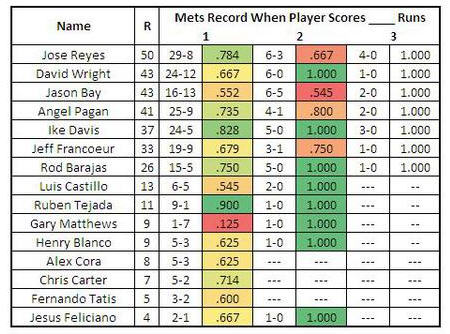
This echoes a post I made a month ago. When players on the Mets score runs, the Mets tend to win. When players on the Mets score two runs, the Mets tend to win even more frequently. When players on the Mets score three runs, the Mets always win.
Should that take away from Jose Reyes? No. Jose Reyes is awesome, and a huge part of the Mets’ success over the past month and a half. But there’s no need to cite meaningless and decontextualized statistics to try to quantify Reyes’ import to the team. He’s a 27-year-old All-Star shortstop. He’s a good hitter, a good fielder and one of the game’s very best baserunners. Even when he doesn’t score a run he’s helping the team win.
Why do the Mets have a better record when Ike Davis scores a run than when Reyes or Jason Bay scores a run? I’m going to go with “random noise.”
The funniest — and hell, perhaps the most telling part of this graph — is that the Mets somehow managed a losing record when Gary Matthews Jr. scores a run. Obviously a lot of that is randomness, too, but a lot of it is probably that even when Matthews happened to find home plate, he was so bad in every other aspect of the game that the Mets couldn’t overcome it.
 Tedquarters
While I agree with you in general about meaningless decontextualized statistics, I’d at least be curious to see a “zero runs” column on that chart too. I wonder whether Reyes (i.e., your leadoff hitter, whose “job is to get on base and score runs” (though of course that is also everyone else’s job too)) not scoring runs is more harmful to the team than, say, Davis not scoring runs.
That’s an excellent question. By my count, the Mets are 12-23 when Reyes doesn’t score, as compared to 15-19 when Davis doesn’t score, 20-22 when Wright doesn’t score and 15-20 when Pagan doesn’t score.
But it’s hard to say that means anything, because Reyes was struggling at the beginning at the same time the Mets were struggling. Of course, maybe the Mets were struggling because Reyes was struggling.
Thanks for taking a look at that. Seems like overall it’s still too small a sample size to mean anything. If someone put together an analysis, over Reyes’ entire career, comparing the Mets’ record when Reyes scores 2 runs to their record when any other player scores 2 runs. I’d have to guess they’d be pretty comparable, because, you know, two runs are two runs.