
At its core “The Grand Design” is an examination of a relatively new candidate for the “ultimate theory of everything,” something called M-theory, itself an extension of string theory, which tries to reconcile general relativity and quantum mechanics. “M-theory is not a theory in the usual sense,” the authors write. “It is a whole family of different theories.” According to M-theory, “ours is not the only universe,” the authors say. “Instead M-theory predicts that a great many universes were created out of nothing.” The image that comes to mind here, others have written about M-theory, is of a God blowing soap bubbles.
But Mr. Hawking and Mr. Mlodinow assert that “their creation does not require the intervention of some supernatural being or god. Rather, these multiple universes arise naturally from physical law. They are a prediction of science.” Many of these universes would be quite different from ours, they add, and “quite unsuitable for the existence of any form of life,” or at least any form of life remotely like ours.
M-theory, if it is confirmed, would be “the unifying theory Einstein was hoping to find,” the authors write. But it’s a somewhat disappointing theory, a patchwork quilt rather than a fine, seamless garment.
OK, let me make this perfectly clear: I am in no position to reasonably doubt Stephen Hawking. Through endless Wikipedia tangents, I’ve tried to wrap my mind around theoretical physics, and I pretty much can’t do it. It seems like it’s the type of thing you’d need to be a physics major in college to fully grasp, and I was an English and music guy. I am not qualified to be discussing this.
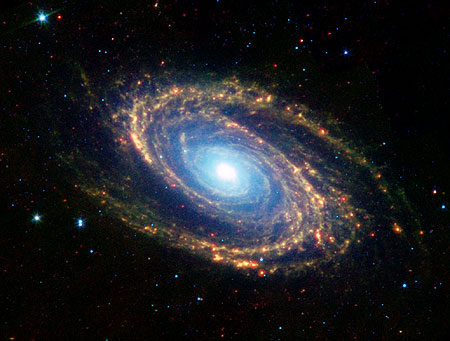 But my understanding of M-theory is that it’s an attempt to explain everything we know about how the universe started under the terms of everything we know about how the universe currently functions, at the atomic level, on Earth, in deep space, everywhere.
And all that stuff is complicated, so you kind of work backwards to reconcile everything and settle on a pretty convoluted-sounding conclusion that states there are 11 dimensions, a bunch of them unknowable and unprovable, and you just kind of have to believe they exist because it’s the only way we can figure out to make sense of this all.
Again: I’m oversimplifying and talking out my ass about something I don’t really understand at all. But I read a pretty awesome article in Discover a couple months ago (which is unfortunately not online) that suggested a controversial counter to M-theory.
Some say the laws that govern our universe could have changed over time since the Big Bang, sort of like evolution, except without the whole survival of the fittest part. And so, they say, the scientists trying to use the physical forces as they currently exist to explain what happened eons ago are looking at it the wrong way.
That seems to make sense to me, uninformed though I am. It’s a difficult thing to even think about, but if all of the galaxies in the universe were once compressed into one dense mass, it seems believable that the physical laws governing that mass might be different from the ones governing everything now. Does that make any sense?
Maybe not. No more theoretical astrophysics. The game’s on.
 Tedquarters
The Science Channel has been running a series called Through The Wormhole over the Summer and it has been outstanding. Check it out if you want some additional theories about time travel, creation, etc. Very entertaining stuff presented in easier to understand terms.
Yea thats one of the show I was referring to in my comment below. Discovery ran that 4-5 part series with Stephen Hawking a few months ago as well.
I have also tried to wrap my arms around theoretical physics, even just in a simple sense, but its almost impossible. Although I must say over the last year or so, there have been a number of good TV shows and series on channels like Discovery, Science Channel, Nat Geo discussing all these topics.
physics is easy to understand. There are fundamental laws to follow.
The logic of Jerry managing? Now that is impossible for a normal mind to grasp.