
For the marquee attraction of media day is Ben Roethlisberger. The Steelers’ quarterback will again face questions about his four-game suspension for violating the NFL’s personal conduct policy resulting from an alleged sexual assault on a drunk, underage coed in the bathroom of a Georgia nightclub. This was his first step on his road back to Super Bowl glory. These questions and the way Roethlisberger answers them – or doesn’t – will be another part of the alleged redemption process. It’s not like Roethlisberger hasn’t had to answer questions on this subject before. The difference here is the interview is not being conducted in a police station or some locker room. Tuesday’s session will be held on the biggest of all stages inside Cowboys Stadium. And unlike situations where he’s strictly dealing with football media, the interlopers Golic dismissed will be asking questions about Roethlisberger’s controversial, sleazy past. “That’s why he needs to show regret, but determination as well,” said a public relations executive who counsels athletes and media honchos. “He has a chance to reach a wider audience. He needs to be humble and respectful.”
– Bob Raissman, N.Y. Daily News.
The thesis of Raissman’s column, I’m pretty sure, is: The way Ben Roethlisberger responds to media inquiries today about his alleged sexual assault of a 20-year-old girl in March will show whether he has learned a lesson from all the fallout from that event.
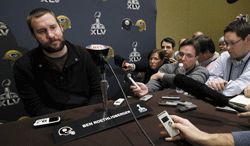 So begins an inevitable week-long what-the-f**k-athon, in which sports reporters everywhere feel obligated to mention Roethlisberger’s recent history, but carefully avoid coming right out and calling him a rapist since, as we know, he was ultimately not charged with anything besides violating the NFL’s nebulous personal-conduct policy.
It is hard to fault the columnists in this case. Roethlisberger is the quarterback on a Super Bowl-bound team. If they ignored the pesky detail of his sexual-assault charge wholesale, we’d accuse them of whitewashing their coverage, of ignorance, and maybe of some subtle racism too. But if they assume guilt where the courts and cops could not prove it, they sidle up toward libel, and that’s also bad.
So we’re left with suggestions that the way Roethlisberger handles the media during Super Bowl week has any bearing at all on how he now feels about, or what he may have learned from his alleged misbehavior, even though it doesn’t. And implications that if he helps the Steelers win the Super Bowl, Roethlisberger will redeem himself to the city of Pittsburgh, even though no one ever claimed he raped Pittsburgh.
Unlike the standard NFL offseason marijuana-possession arrest, the crime for which Roethlisberger was detained and questioned had a real victim, a college student that — without recanting her accusation — asked the district attorney not to pursue charges against the quarterback out of concern for her own privacy.
And so it’s somewhere between puzzling and terrible that the same media types that have no trouble drumming up sanctimony over allegations of performance-enhancing drug use tread lightly around similar sentiments when covering a guy accused of sexual assault. I’m not one for sweeping value judgments, but I can say without hesitation that rape is worse than using steroids. Way, way, way worse.
Again, we don’t know what Roethlisberger did or didn’t do in Milledgeville, Georgia. We know there is a lot of evidence and a group of eyewitnesses that suggest he attempted to either intimidate or force a drunk girl into having sex with him. It is an act and a behavior that lies so far outside the boundaries of sport that it’s plain absurd to expect the outcome of a game — no matter how big — or the content of an interview to demonstrate anything meaningful about the perpetrator’s past and future conduct and lifestyle.
But I suppose that doesn’t make for a good story or a compelling column.
 Tedquarters