
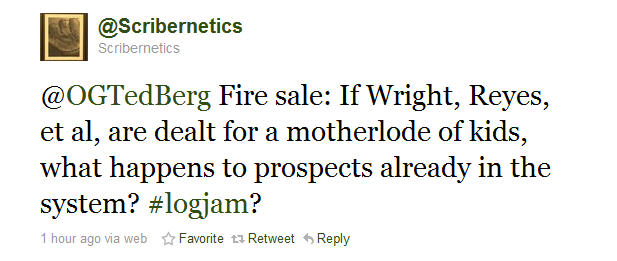
There were a couple of trade-deadline questions; I’m going with this one. First off, I would be shocked if David Wright gets traded. I don’t think anyone should ever be considered “untouchable” by any means, but it seems like you’re going to need to get a hell of a lot back for Wright, considering he’s a) awesome and b) under contract for 2012 with a reasonable team option for 2013. He’s a big enough piece that it’s going to require a lot back, and deals that big are difficult to hammer out in ways that appear to benefit both sides.
As for Jose Reyes, Carlos Beltran, Francisco Rodriguez: Who knows? If the Mets are out of it and Beltran is healthy they’ll undoubtedly try to move him, since he has a clause in his contract that prevents the club from collecting compensatory draft picks. But it’s tough to move players with contracts his size (or ridiculous vesting options, for that matter). I’ve long held that approaching the deadline as a “buyer” or “seller” is a bad way to do it; teams should merely look to exploit inefficiencies to best benefit the club, however that may be.
Anyway, to answer the question: I wouldn’t be too concerned about that. As long as there are physical places on Minor League (or Major League) fields to put them, there’s never any issue with a logjam of prospects. I had a brief Twitter exchange the other day with a reader who wondered why the Mets ever kept Brad Emaus around in the first place, since Reese Havens is the second baseman of the future.
How often do prospects actually work out? Very rarely. And it’s really, really difficult to predict which will become stars, which will become average Major League contributors, and which will become total scrubs.
Consider this: Before 2001, Baseball America ranked Albert Pujols the No. 42 prospect in baseball. Now granted, Pujols only had one year of Minor League experience at that point and most of it was in A-ball. But pretty much as soon as the 2001 season started, Pujols got about establishing himself as the best player in baseball. This is not to fault the magazine, only to serve as an example of how difficult it is to predict these things: Baseball America thought there were 41 prospects more likely to be stars than Albert Pujols when Pujols was already ready to start being Albert Pujols. Alex Escobar was ranked 18th that year.
Point is, there’s no sure way of knowing which of your prospects turn into Albert Pujols and which turn into Alex Escobar. You can scout and measure and speculate, but it’s never smart to put all your eggs in one basket — especially when, in Havens’ case, the basket so frequently needs mending. The best way to ensure that some of your prospects turn into stars is to collect as many promising young players as you can and give them opportunities to prove themselves.
If you wind up with two guys who look like great Major Leaguers at the same position, that’s a good problem to have. You cross your fingers and trade one to upgrade at some other position.
It’s funny to me to read Mets fans saying Mike Pelfrey never made good on the hype. Yeah, Pelfrey was a top pick and we all hoped he’d be an ace. But a league-average innings eater is nothing to sneeze at, considering how many high picks fall apart and never contribute anything to their Major League clubs.
Meeting time. More Q&A to follow.
 Tedquarters