
R.A. Dickey is a man with distinguishing taste in cheese.
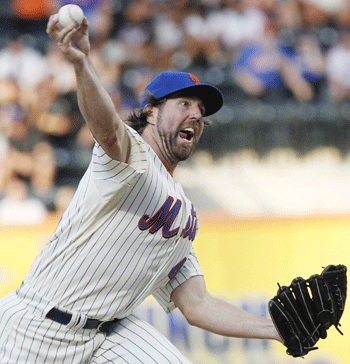 In March, after a video interview with Dickey about his signature array of knuckleballs, I asked him about The Dickster — his personalized sandwich, first Tweeted by Newsday Mets beat reporter and sandwich enthusiast David Lennon.
Dickey told me the Dickster contained turkey, bacon, lettuce, cheese and mayonnaise. As he stepped into the Digital Domain Park clubhouse, I realized I had slipped in my duties as a vigilant sandwich blogger.
“Hey, R.A.,” I called after him. “What type of cheese?”
“Havarti,” he said with a grin.
Not Swiss or cheddar or American or even Muenster or provolone. Havarti: A subtle, buttery Danish cheese, specific enough to suggest it was chosen after careful consideration.
Fangraphs’ pitch-value stat calculates the runs above or below average produced by every pitcher’s offerings. When averaged out for every 100 times the pitch is thrown, the stat shows some predictable returns: Cliff Lee has the game’s most effective slider*; Cole Hamels’ changeup prevents more runs than any other; Roy Halladay throws the most devastating curveball.
Fastball values per 100 pitches tend to be less extreme, somewhat predictably, since the fastball is typically not used to deceive hitters so much as to establish the timing that pitchers hope to betray with breaking balls and offspeed stuff. Still, most of the names near the top of the wFB/c (fastball value per 100 pitches) leaderboard for 2011 should be familiar to anyone who has been following the postseason: Lee, Ian Kennedy, Doug Fister and Justin Verlander sit at places 2-5 on the list.
But atop that mountain of all-stars and Cy Young favorites stands our literary knuckleball, Mr. Robert Alan Dickey. At an average of 84.4 miles per hour, Dickey’s fastball was among the very slowest in the Majors in 2011. But according to the stat, the pitch was 1.84 runs above the average fastball per every 100 times he used it.
Before the Mets’ final game of the season, I presented that information to Dickey.
“Does that surprise you?” he asked.
“It’s the way I use it,” he said. “I might throw six or seven fastballs a day, maybe 10. Usually when I’m throwing it, it’s in counts when they’re not swinging or I’m surprising them with the pitch.”
Despite the well-documented lack of an ulnar collateral ligament in his throwing elbow, Dickey once threw fastballs that reached the mid-90s. In his rookie season with the Rangers in 2003, Dickey still averaged 89.4 miles per hour with his fastball. The pitch’s velocity has withered with the effects of time and a shift in focus, but its effect is amplified by the contrast with his trademark knuckleball.
“It is such a drastic difference from a knuckleball,” he said. “If you see six knuckleballs in an at-bat–”
“The fastball looks like it’s coming in at 110?” I asked.
“I’ve had hitters on the opposition tell our first baseman that,” he said. “So I know it’s effective if I use it correctly.”
For Dickey, the transition from relying on velocity — as he could from his earliest playing days — to relying on deception was not easy.
“Leaving who you were behind and knowing you’re never going to be that person again is tough,” he said. “You have to put your ego on the back burner and embrace something new, and that’s a real challenge.”
This winter, Dickey will re-read Ernest Hemingway’s “The Snows of Kilimanjaro,” and endeavor to climb that mountain. Before he rejoins the Mets in Port St. Lucie in February, he’ll read a Shakespearean comedy — either Much Ado About Nothing or A Midsummer Night’s Dream, he expects — then a few more books from his lengthy reading list.
There are many reasons we like R.A. Dickey. First and foremost: He is a good pitcher on our favorite baseball team. He has led the Mets in ERA+ in both his seasons with the club so far.
He does that while primarily throwing the knuckleball, that last vestige of hope for a Major League career for all of us who could never throw 95 (ignoring, of course, that we could never throw 85 either). Dickey himself put it well, in an interview with Sam Page last offseason: “It’s almost a blue-collar pitch. You’re in the seats and you watch me or [Tim Wakefield] or whoever throw and you’re like, ‘There’s a chance that I could do that.'”
Then there’s all the rest, the stuff that elevates him to folk-hero status in certain sections of the fanbase: He reads books, he rides a bike to Spring Training, he wants to be a ballboy at the U.S. Open, he has a cool beard, he makes a funny face when he pitches, his mom reads Amazin’ Avenue, he loves Star Wars.
Dickey is, on the field and off, an interesting dude. And I suspect we identify with him at least a bit because we all fancy ourselves interesting as well. He is the guy whose fastball is his change-of-pace pitch, subtle Havarti in a league long on assertive cheddar.
*- Technically, Wandy Rodriguez’s slider was worth way, way more on average than any other pitcher’s, but he threw it so infrequently that it seems more likely the pitchFX data used to determine the stat registered a handful of Rodriguez’s curveballs as sliders.
 Tedquarters