
The Albert Pujols vs. Babe Ruth debate was silly enough that I figured I’d drop it and move forward, but then someone mentioned it today in an email and now I’m fired up. And I know the game has changed so much as to make the whole conversation essentially pointless, but whatever. It’s on my mind.
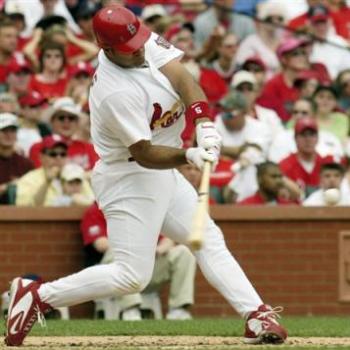 So I’ll state this again: Albert Pujols is a better hitter than Babe Ruth was.
Not relative to their eras. No Major Leaguer was ever better than Ruth when held up against the players against whom he played. That much is obvious. But I’m talking about right-now Albert Pujols vs. 1930 (or 1927, or 1920, or whenever) Babe Ruth.
And not “oh but what if Ruth had this advantage or that advantage that Pujols now has?” He didn’t. That’s part of the point. I’m talking time-travel scenario: Ruth hits his third home run of the 1928 World Series and as he crosses the plate is magically transported to April, 2011, then gets traded to the Cardinals since the Yanks already have Nick Swisher.
Ruth doesn’t match Pujols in 2011. No way.
Let’s consider some of the factors. The only reason I didn’t pursue these in more depth the last time around is that I thought I was making a pretty obvious point.
There were only 16 teams then and there are 30 now, so that might mean Ruth faced a higher concentration of talent. But consider that by the 1930 US Census, there were 122 million people in the country, compared to 308 million in 2010.
There are nearly three times more people in this country now, and nearly all of them grow up exposed to baseball in some form or another. In 1930 there were no Major League teams west of St. Louis, and lots of people in the U.S. still got polio and stuff. It was a very different time, and one in which the road to the Majors was more difficult to traverse.
Obviously a lot of people still played baseball, and yeah, back then baseball didn’t have to compete with as many other sports for a young athlete’s attention. Still, there was certainly nothing like the type of youth baseball structure we have now, with the fundamental instruction and competition that begin when kids are 5 or 6.
If a kid in the US has the ability and desire to become a Major League Baseball player in 2011, he will almost certainly get an opportunity to prove himself in organized ball with somewhat knowledgeable coaches, not by impressing the townsfolk playing against old men in the local farm-league game. Professional-caliber players can’t slip through the cracks these days.
And that doesn’t even consider the impact of the game’s global popularity on the Major League talent pool. 125 guys from the Dominican Republic alone played in the Majors in 2011. You know how many foreign-born players there were in 1930?
Six: Two from Cuba, two from Canada, one from Norway and one from Austria-Hungary. Six dudes born elsewhere, and no doubt at least a few of them grew up in the ol’ U.S. of A.
But that’s all just about the talent pool. What about the game itself?
In 1930, teams scored on average 5.55 runs per game. In 2011, it was 4.28. Pitchers walked guys at about exactly the same rate, but struck out about half as many as they do now. Teams got more hits but fewer home runs, and defenders made nearly twice as many errors.
You can explain all that in a variety of ways: Maybe guys struck out less because they were more focused on hitting for contact than power, and maybe official scorers of the 1930s were harder on infielders.
But the way it looks to me, and the explanation I’m certain is correct, is that the Major League game was just crappier across the board in 1930. I’m sorry if that offends your sense of nostalgia.
Pitchers struck out fewer batters because they couldn’t boast the same arsenals as their 2011 counterparts, and more balls in play meant more hits and more errors because the fielders weren’t very good either. Not by today’s standards, at least.
I could go on, but I’m getting bored and I imagine I’ve long since lost you. But the important thing is this: Major League Baseball keeps getting better. As the talent pool grows, so does the competition for spots on rosters. Advancements in medicine, nutrition, scouting and communications help players become faster, stronger and smarter.
That’s not to take anything away from Ruth. Ruth was unutterably awesome, and deserves any praise directed his way. I have, and probably will again, called him the greatest player ever, because I think that term implies “relative to his competition.” But it is only relative to his competition that he is the greatest player ever.
 Tedquarters