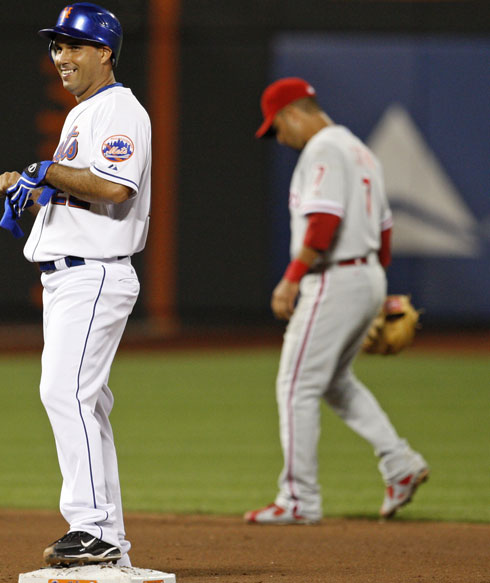
Fun with Mike Pelfrey’s Fangraphs page

Mike Pelfrey’s 2010 success is all the rage these days in the blogosphere and local papers, and probably comes as a surprise to all those who raged over his mostly defense-induced struggles from 2009.

So what’s made the difference? No surprises, really: Pelfrey’s getting a bit lucky, benefiting from a better defense, and using his new splitter to induce more weak contact and swinging strikes than ever before.

Big Pelf has yielded a .279 batting average on balls in play, well below his career .311 rate. That’s at least partly due to a slight uptick in Pelfrey’s trademark groundballs — he’s now inducing 52.5 percent, up from a career 50.3-percent rate. It also can’t hurt that the Mets’ defense has played, statistically, significantly above average this season after being third worst in the Majors last year.

Still, while Pelfrey is certainly enjoying the return of Jose Reyes behind him, it’s probably unreasonable to expect him to continue yielding so few hits. At some point, a few more balls will drop in or squeak by defenders.

The good news is Pelfrey’s better prepared to handle that situation because he’s missing more bats. The big Kansan will never be Tim Lincecum, but he’s striking out 6.5 batters per 9 innings, more than a full batter more than his career average.

That’s good, and likely largely due to Pelfrey’s new splitter. The pitch has been, on average, his most effective offering this year. It will be interesting to see if hitters learn to lay off the ball as it dives out of the zone once the new-look Pelfrey has been around the league a couple of times, but at the very least the effective splitter must make Pelfrey’s heater a bit more difficult to time.

All the fancy stats — FIP, xFIP and tRA — show that Pelfrey’s been pitching significantly better than he ever has before. That’s no stunning insight, of course, but the stats seem to indicate real improvement and not plain luck or random fluctuation.

The media bias

This was supposed to be an SNY.tv column before I had some tech issues. It might be up there later, but I’m impatient, so here it is:

I could use this column to weigh in on Mike Francesa’s recent dismissive comments about Matt Cerrone and MetsBlog, but the post would be silly and my motivations transparent. If you read this blog or Matt’s blog with any regularity, you probably know that Matt is my colleague and buddy. Mike Francesa once read a report I wrote about Billy Wagner on his radio show word for word without crediting me or SNY.tv. So I am biased.

On that topic, though, I do feel an urge to respond to the outpouring of comments like this one that seems to follow any criticism — legitimate or otherwise — of MetsBlog or TheKnicksBlog or any new-media outlet that appears to straddle the line between journalism and fandom.

The image above is not a cube. A cube, by nature, exists in three dimensions and has volume. What you see there is merely a collection of connected lines that appear to have depth because of an optical illusion. You likely see one face of the cube in the foreground and the other in the background, and if you focus you can imagine them reversed. But it is difficult to look at the image as a series of lines on a flat surface without perceiving the illusion of depth.

Here’s the fascinating part: That’s not a universal phenomenon. It’s cultural. Because we live in a society awash with similar two-dimensional representations of depth — in art, on television, in advertisements, everywhere — our brains have learned to read depth into that image. But people from vastly different visual cultures would not see it the same way.

We are all biased in ways we never consider and rarely recognize. Our value systems, backgrounds, upbringings and experiences impact our perception just as our beliefs and opinions do. I am conscious of the specific source of my bias in the minor dustup between Cerrone and Francesa but not of the myriad deeply ingrained ones shaping the way I perceive absolutely everything.

There is no such thing as unbiased journalism because there is no such thing as unbiased anything. The ideal of disinterested reporting, though noble in theory, is misguided, especially with the world so dominated by randomness. We see stories develop and we want them to be true, so we draw inferences and connect dots and work to confirm them as reality.

That’s not to say journalists should abandon their pursuit of the truth, and I certainly don’t aim to suggest that most journalists are not conscious of any of their biases. Absolute facts must exist somewhere, and the journalist’s job is to wean them as best he can from the mire of his own perception.

And to me, the best possible first step toward that goal is honesty: exposing our affinities, reflecting as often as we can on our motivations, and disclosing the breadth of our intentions. That’s why, though I am naturally disinclined to being a company man, I believe in the work Cerrone and all of our SNY.tv bloggers are doing.

Admitting their fandom does not in any way prevent them from criticizing their favorite teams or those teams’ managements; it merely strips away the artifice that suggests people covering a team should have no vested interest in its success or failure. I know from reading TheKnicksBlog that Tommy Dee wants to see the Knicks win, so I trust that the moves he suggests and ideas he forwards are ones he believes will benefit the team. Certainly his perspective is skewed by the fact that he roots for the team, but he has never suggested otherwise.

I don’t mean this to slight traditional reporters, and I hope it doesn’t sound like any sort of pretentious new-media manifesto — I would be foolish to suggest I know what makes for a successful Web enterprise with the Internet still in adolescence. And I understand how anyone raised or trained in more traditional forms of media might struggle with the concept of fans providing news filtered through their own perspectives. But again, all media, and everything else, is filtered through someone’s perspective.

A common talking point among media-savvy Mets fans is the idea that reporters covering the team too frequently give passes to Jerry Manuel and Jeff Francoeur because they supply great quotes to fill newspapers. I will not argue that. But I will ask this: Is it conscious? Does a newspaper columnist lay off Francoeur when the right fielder is not hitting because he is aware that Frenchy makes his job easier, or is he, without knowing it, simply not inclined to rip a guy who just looked him in the eye, smiled and laughed at his joke?

I don’t know. I can’t answer for that columnist, just as I can’t speak for any other SNY.tv blogger. I only represent myself, and I know that the content on these sites, presented without pretense, does not bug me at all. Rather, it mostly strikes me as forthright, and eliminates any concern that the writer might be operating under anything but his stated motivations.

Then again, I’m probably biased.

Jerry Manuel’s bullpen management in graphic form

Go check out the graph at Beyond the Boxscore charting relief appearances per game for each Major League team. Then consider this: By ERA+, the Brewers, Pirates and Dodgers — the teams nearest the Mets at the bottom of the list — all have terrible to below-average pitching staffs. And the Dodgers are managed by noted bullpen-abuser Joe Torre. The Mets’ staff, hard as it may be to believe, has been slightly above average this season.

Groundbreaking bird has terrible taste in music

I phoned up the bird shelter in Indiana where Snowball lived and talked to the director who told me his story. A man had dropped him off with a CD and the comment, “Snowball likes to dance to this.” One day, Irena Schulz, the proprietor, played “Everybody” to amuse the abandoned creature. And Snowball began to move. Irena then made the YouTube video, which immediately went viral. Millions saw it.

“Let’s design an experiment to see if this is real,” I proposed to Irena, who had a science background herself. We took the Backstreet Boys song, sped it up and slowed it down at 11 different tempos, then videoed what Snowball did to each. For 9 out of the 11 variations, the bird moved to the beat, which meant that he’d processed the music in his brain and his muscles had responded. So now we had the first documented case of a nonhuman animal who, without training, could sense a beat out of music and move to it.

Neuroscientist Aniruddh Patel, as told to the New York Times.

Now dance, bird!

From the Wikipedia: Tadeusz Kosciuszko

I started this yesterday for Memorial Day but ended up spending most of the day in car dealerships trying to take advantage of some Memorial Day sales. From the Wikipedia: Tadeusz Kosciuszko.

In English, he is Thaddeus Kosciusko. In Lithuanian, he is called Tadas Kosciuška. In Belarusian, his name is Tadevush Kasciushka. On TedQuarters, he is known as a complete badass.

Kosciuszko was born to parents of modest nobility in the mid-18th century near the now-abandoned village of Mereczowszczyzna in the Grand Duchy of Lithuania. He was educated in Warsaw, and when civil war broke out in his homeland, he left for Paris to continue his studies. He returned to the Polish-Lithuanian Commonwealth in 1774 and took a position as a tutor for the family of a provincial governor. Kosciuszko fell in love with the governor’s daughter, Ludwika, but got jumped by her father’s goons when they tried to elope.

Jilted by forbidden love, Kosciuszko emigrated to the British colonies in North America to join the struggle for independence. He read the Declaration of Independence shortly after his arrival and was so impressed with the document that he went to discuss philosophy with Thomas Jefferson in Virginia, because apparently Thomas Jefferson was a pretty accessible dude.

Congress appointed Kosciuszko an engineer in the Continental Army, and he went about employing all sorts of battle and defense tactics that the Wikipedia explains in great detail. Kosciuszko was a smart guy, and was credited with choosing the Americans’ position at Saratoga and setting up an impregnable defense that helped the young nation win the battle widely considered the turning point of the war.

Kosciuszko continued to serve the Continental Army until the war’s end, and supposedly set off a fireworks display in Charleston to celebrate the signing of the Treaty of Paris, because Tadeusz Kosciuszko appreciated some good pyrotechnics. He was promoted to brigadier general and granted American citizenship shortly after the war, and given a tract of land in Ohio for his efforts in the revolution.

Kosciuszko didn’t remain in his new homeland for long, though. He soon returned to Europe to advocate for serfs’ rights and fight against the Russian occupation of his homeland. He emigrated again to the United States before the turn of the century, but once more returned to Europe to work for Polish independence.

Jefferson called Kosciuszko “as pure a son of liberty as I have ever known,” and indeed, Kosciuszko was apparently more dedicated to the ideals set forth in the Declaration of Independence than even Jefferson himself. Kosciuszko named Jefferson the executor of his will and left his American property to be used to buy the freedom of Jefferson’s slaves and pay for their education. For some reason not stated on the Wikipedia, Jefferson claimed he was unable to act as the executor, and none of the commodities that Kosciuszko earmarked for freeing and educating slaves were ever used for either purpose.

Kosciuszko’s name is familiar to Brooklyn-Queens Expressway riders because of the bridge in his honor linking, well, Brooklyn and Queens. I have long held that a roadway — especially in this area — is a terrible way to pay tribute to a hero of Kosciuszko’s stature, since the name will inevitably be cursed far more often then it is praised. No one ever says, “oh, what a touching tribute to Major Deegan.” And indeed, though the Kosciuszko Bridge offers perhaps the area’s most spectacular view of the Manhattan skyline, it is more often linked with perpetual traffic.

That’s unfortunate, because Tadeusz Kosciuszko was a great war hero and champion of social reform, an immigrant who made enormous contributions to the foundation of the United States, and a man who appropriately appreciated the awesomeness of fireworks.

Obligatory Ollie Perez post

The Mets, incidentally, need someone in Perez’s spot who can not only be a pressure valve for the unholy workload Jerry Manuel is foisting upon his other relievers, but can be a reliable sixth starter. The good part about R.A. Dickey and Hisanori Takahashi succeeding early on is obvious, but the negative will become clear should the Mets have any additional pitcher injuries (or should Jon Niese fail to return this weekend, as expected)….

Show Oliver Perez the door. He’s making his $36 million either way. That’s a sunk cost. And he still might have some magic left in that arm. There’s simply no way to coax it out of him in the present circumstances.

Howard Megdal, SNY.tv.

If Howard — who just might be Ollie Perez’s biggest fan — is calling for his head then it’s pretty clear Perez’s ship has left Queens. Only it hasn’t, of course. It remains docked pathetically in the bullpen, occasionally sputtering out to the mound when the Mets need a tug, then breaking down itself as soon as its put to work.

I don’t know that there’s a Mets fan out there who thinks Perez should still be on the team, so I’ll spare you the list of reasons he does not deserve a spot on the 25-man roster. Howard brings up sunk cost, though, and since the team’s inability to grasp that concept has been one of my favorite points of contention since my first days writing on the web, I figured I’d go over it again here.

Adam Rubin nailed it today, so you should probably check that out. Mike Lupica, on the other hand, wrote that it will cost the Mets $20 million to cut Perez.

This is mostly semantics, but that’s not really the case. It cost the Mets $36 million (committed over three years) to sign Perez before the 2009 season. Cutting him is almost free. All $36 million were as good as gone as soon as he inked the deal, so if the Mets think they can find a better player to fill his roster spot over the next season and a half, the money Perez is owed is immaterial. The only cost to the Mets is the salary of the replacement player on the roster, presumably the Major League minimum.

Mets fans and media love to point to the example of the Angels and Gary Matthews Jr. when discussing sunk cost, and it is a good one. But — semantics again — the wording often bothers me. I brought this up in my piece for the Amazin’ Avenue Annual:

When the Mets acquired Matthews from the Angels, his old team agreed to pay all but $2 million of the $23.5 million he is owed over the remaining two years of his contract. So the deal brought a fair share of Internet snark that suggested the Angels had paid $21.5 million for Brian Stokes, a marginal middle reliever.

But that’s not really what happened. Matthews, relegated to a backup role behind Torii Hunter in Anaheim, was more or less worthless to the Angels, even if they had committed to paying him $23.5 million more. Since that money was, in theory, gone — stricken from their coffers as soon as they ill-advisedly signed it away to Matthews — it’s probably more accurate to say they got $2 million of salary reliever from the Mets over the next two seasons, plus Brian Stokes, in exchange for Gary Matthews. And when you put it that way, the deal looks better for the Angels.

The Mets probably won’t find anyone to provide any relief for Ollie though. But since Ollie himself can’t provide any relief either, it’s time to let him go. If he succeeds elsewhere, he succeeds elsewhere. There is very little to suggest that will happen, and if by some strange chance it does, it will be downright silly to fault the Mets for assuming it wouldn’t.


Now I really want to see the KISS jerseys

So, the Ports are staging a Salute to the Beatles Night on Saturday with a fireworks finale….

In truly hip style, the players will wear colorfully psychedelic, peace-and-love era uniform tops….

“We haven’t done the Beatles before,” said Elaine Jastineau of OT Sports, the Burlington, N.C., company where Adam McCauley designed the handcrafted double-knit jerseys. “We’ve done ‘Star Wars’ nights, Led Zeppelin, ‘Sweet Home Alabama’ and tuxedo tops when a couple got married at the ballpark. We just Google some album-cover stuff, throw it together on the jersey, sometimes tweak it a bit and go from there. To me, it looks very ’70s-ish. The clothes people wore back then had a lot of wild, patterned, flowered stuff.”

Tony Sauro, Recordnet.com.

LSD not included, presumably. There’s a lot of good Minor League baseball-y stuff in that article so it’s probably worth checking out, but here’s what the jerseys look like if you don’t:

Yikes. Not sure if they’re planning on printing names on the top, but if I were a Stockton Port I’d definitely attempt to change my last name to “Mustard” for the day.

Hat tip to Baseball Think Factory for the link.

Hero deemed ‘revolting,’ ‘disgusting’ for enjoying pork

This is everywhere today, but it’s not here yet:

I can say from experience that people will do some outrageous, bizarre things when they see a news camera. Believe me, I’ve been on both sides of the interaction.

Most of the times it’s plain jackassery from people who are way too excited at the prospect of getting on TV. We filmed a segment in Philadelphia in 2008 and had to shoot our wrap about 15 times because idiotic Phillies fans kept interrupting. It was annoying, mostly because no one did anything funny, they just harassed us and gave us the finger and such.

But eating a pork chop out of a reporter’s hand is funny. Not revolting or disgusting, funny. And Jones and Michael Kay only made it funnier by getting so broken up about it. “OH MY GOD!”

Apparently that guy was pestering Jones all game — which really makes you wonder why she’d keep doing standups from right in front of him — but there’s just nothing gross about an hour-old pork chop. Pork chops are delicious, and Kim Jones got what she deserved for waving it around in that guy’s face for so long.

Also, I’ve got to get to Target Field. Pork chop on a stick!