The remoulade of the damned

Bacon also resides within the lugubrious center, though not much bacon (no doubt trying to keep the sandwich at a trim 540 calories, of which 520 are from fat, I’m sure).  There’s also a “secret sauce” which seems to consist of mustard, mayo, Elmer’s Glue, and death.  The remoulade of the damned, essentially.

Dan Szymborski, Perpetual Post (some language NSFW).

Dan and I wrote a joint review of the Double Down for Perpetual Post this week. My half is pretty similar to the one I posted here a couple weeks ago (except with saltier language) because, admittedly, I have not eaten another Double Down since. I mostly just wanted to title a post “the remoulade of the damned.”

Ike psych

There’s little enough right now for us humble fans to look forward on a day-to-day basis that we can appreciate watching a guy like Davis develop on the big league stage. For all the front office fumbling, bringing this kid up despite his need for a little more development in the minor leagues will at least energize the fanbase.

NeverSeenThemWinOne, comments section this morning.

With increasing frequency, I’m finding that the reactions to posts here don’t seem to follow my original intentions when making said posts. Obviously, this reflects poorly on me and my ability to communicate whatever the hell it is I’m trying to say, but I think I’ve identified the problem. I’m adjusting to the (awesome) rigors of my schedule during the baseball season while trying to maintain some consistent flow of content here, and I think too often I’m crapping out half-formed thoughts and assuming readers can somehow divine what I’m getting at.

But whatever. You probably don’t care much about that stuff, so here’s this stuff:

To be clear, like NeverSeenThemWinOne, I am extremely excited to see Ike Davis playing for the Major League Mets every day. Though I have reservations over whether he’s actually ready to hit lefthanders and lay off breaking pitches, I want very much to see him try.

And I recognize he is a massive upgrade over Mike Jacobs, both in actual on-field value and in asses-in-seats production. Watching Mike Jacobs’ approach at the plate was starting to make me not want to watch baseball at all, or at least change the channel while he was hitting or something, and that’s terrible.

And Fernando Tatis, nice and versatile player though he may be, is just not exciting to watch play for a 5-8 team. I know exactly what I’m going to see out of Fernando Tatis, and though it’s decent, and probably better than a lot of people realize, it’s still not exceptional.

I don’t know exactly what I’m going to see out of Ike Davis, and that’s what makes it fun. I know how infrequently prospects actually pan out, and I realize, from a rational perspective, that we will be lucky if Davis turns out to be a deserving but unspectacular Major League regular like Paul Konerko or someone.

But I can cling to the small hope that Ike Davis is a Hall of Famer because he hasn’t done anything yet to show me otherwise.

Mike Jacobs? Not a Hall of Famer. Fernando Tatis? Not a Hall of Famer.

On a team like this one, I’ll root for uncertainty over the certainly bad or the certainly not-so-good anytime, especially when the uncertainty comes in the form of a young, highly touted homegrown player.

It’s a thrilling thing, and the Mets-fan side of me is absolutely thrilled. I don’t think he’ll hit .500 all season and I don’t think he’ll provide enough to make the team a great one, but I know he’ll make me more excited to tune in every night, and that means something too.

The post last night just aimed to point out that with this franchise, the way things are going these days, even something indisputably invigorating like the top hitting prospect ascending to the big leagues comes somehow mired in confusion and doubt. That part sucks. But the rest of it is awesome, no doubt.

Quotes about and from Ike Davis

It was everything Ike on Monday at Citi Field. You’ll read way more in the papers, I’m sure. Here’s about 1/100th of the things said by and about Ike Davis:

“It was evident that we needed left-handed power. We expected to get that from Mike Jacobs. And maybe the inconsistency of play there, or him just not getting off going right, made that a glaring weakness for us. And when you hear that a guy down there [in Triple-A] is hitting tape-measure shots, you kind of put a hint in and say, ‘Hey, man. What do you think, bro? I need a little help here.'” – Jerry Manuel.

“We’ve been looking forward to seeing him here.” – Angel Pagan.

“This is awesome.” – Ike Davis.

Chapter one

The Ike Davis story doesn’t start with his home runs shattering car windows in his team’s executive parking lot, like the Jason Heyward story does. That’s too perfect, almost too folksy a beginning for a player breaking into the Majors with the 2010 Mets.

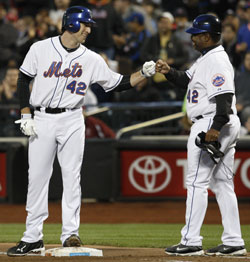
The Ike Davis story starts with a team putting faith in a backup first baseman recently cut by the Kansas City Royals, coming off two straight seasons with sub-.300 on-base percentages. It starts with a bizarre 20-inning game that depleted the Mets’ bullpen and forced them into a roster move, setting off the chain of events that would lead Davis to Flushing.

It starts with confusion. Confusion over whether the Mets are rushing yet another prospect, confusion over what the team intends to do with the injured Daniel Murphy and, heck, confusion over why Davis was penciled into the Triple-A Bisons’ starting lineup and at Coca-Cola Field in Buffalo before he knew he was bound for Citi Field on Monday.

And it starts with doubt. Doubt that Davis will hit Major League lefties or lay off Major League curveballs, doubt that he’ll make much of a difference in the Mets’ pennant hopes even if he does succeed, and hell, doubt that the team’s’ front office operates with some semblance of a cohesive plan and is not simply fueled by a haphazard series of reactive moves.

Then it started with a single.

Davis may struggle with big-league pitching as some expect him to, show the world he needs a little more development time and provide the Mets an easy decision when Murphy is ready to return from his knee injury in a few months. Or he may mash the ball the way he did all spring and the way he did in his first 10 games in Triple-A in 2010, and stick with the club for good.

For now, the Mets’ top hitting prospect is the Mets’ starting first baseman. The first chapter of the Ike Davis story is underway.

Seriously

Rays’ manager Joe Maddon likes to wear a hoodie over his jersey — or more likely, over a t-shirt in lieu of a jersey. Major League Baseball has put the kibosh on that, however, telling him that the hoodie is not approved for on-field wear. Maddon said he’ll stop wearing the hoodie….

I think managers should be able to wear anything they want to. Maybe we’d get some style out of these guys.

Craig Calcaterra, Hardball Talk.

When I read the top, newsy part of this story, I figured I’d link to it as an excuse to make the point that managers should be able to wear anything they want. Then I read to the bottom and found that Calcaterra said just that.

But I mean, duh. I guess I can sort of abide having the base coaches wear uniforms, since they’re on-field personnel and all. But baseball pants really aren’t very flattering, and I imagine Razor Shines could come up with something still a little more dashing — but still appropriate for on-field use — if left to his own devices.

And managers? The tradition dates back to player-managers, but at this point there’s really no good reason for the manager to be in uniform. Let’s see some seersucker suits.

John Harper on Jenrry Mejia

Indeed, there appear to be enough dependable arms that they won’t need Mejia to be the primary setup man, and the rookie was only supposed to stay in the majors at age 20 if he played a pivotal role in the pen.

So send him down now, build him back up as a starter in Triple-A and maybe by mid-June Mejia could be ready to take a spot in the rotation and make an impact.

John Harper, N.Y. Daily News.

It looks like the newspapers are catching up with the blogosphere on this issue, and, well, great.

And it could turn out that the Mejia-to-the-bullpen experiment, if the Mets send him down and stretch him out soon, ultimately only worked to give him a taste of Major League hitters while simultaneously limiting his 2010 innings total.

Granted, relief appearances are not the same as innings thrown by a starting pitcher. And given Jerry Manuel’s tendency for overworking his relievers for stretches of the season, it’s reasonable to worry about Mejia remaining (for now) in his manager’s care without any apparent set of front-office mandated rules governing his use.

But since last we heard — per Gary Cohen, during a game on SNY a few nights ago — Manuel is the biggest and perhaps only advocate for keeping Mejia on the Major League club, I have to imagine the manager will change his tune or be voted down as it becomes clearer that the Mets will eventually need starting-pitching help. Or, you know, he’ll be replaced by someone with more of a longterm stake in the team’s success.

The big first-base shuffle

The Mets could have optioned Jacobs to Buffalo immediately, but designated him for assignment instead. That way, there would be no chance of a scene if Jacobs decided not to report after reflecting on the situation. Jacobs indicated he would go to Mets’ top minor league affiliate if playing time existed — which should be the case once Davis is promoted.

“I’m not going to go down there and sit on the bench, I’ll tell you that,” Jacobs said. “That’s for sure. I’m definitely not going to waste my time doing that.”

How Davis performs could have interesting ramifications for Murphy. Poised to be the Opening Day first baseman, Murphy suffered a sprained medial collateral ligament in his right knee during a rundown the final week of spring training. If Davis takes off, a team source speculated that Murphy could even find himself at Buffalo. There, Murphy could primarily play first base, but also be exposed to second base and the outfield to improve his versatility for an eventual utility role.

Adam Rubin, ESPNNewYork.com.

OK, obviously the most important tidbit here is that Ike Davis is apparently on his way up to the big club, and soon. I figured the front office was being careful about starting the prospect’s arbitration clock and would wait at least a little longer, but then, when has this front office really been careful when it comes to saving money, especially down the road?

Regardless, if Davis is as good as the Mets and their fans hope he is, the club will likely lock him in to a contract that extends beyond his arbitration years at some point early in his career, as is the trend with young players. But I’m getting ahead of myself. He hasn’t even been added to the 40-man roster yet.

When that happens, he’ll be an upgrade over Jacobs, for sure. How big an upgrade depends on a couple of factors. Davis struck out a lot last season in Double-A and struggled against left-handers. He hasn’t done much of either in his first 10 games at Triple-A, but it is a tiny, tiny sample: Far too small to adequately judge any improvement in those areas.

At whatever level, Davis should be playing everyday to develop those skills (and all of them, really), so assuming he’s actually Queens-bound, we should soon get a good sense of whether Davis can handle Major League southpaws. Of course, that’s making the giant assumption that Jerry Manuel and Omar Minaya do right by their top prospect and don’t platoon him with Fernando Tatis.

I lobbied for Chris Carter a bit on Twitter yesterday. The way I see it, Carter, a proven Triple-A hitter, represents a nice stopgap option for the Mets until Murphy returns, and should probably be given a chance to succeed in the Majors, since the Mets don’t have many more inspiring options.

I’m not about to claim Carter’s a better player than Davis, though, and since I’m plain-old Mets-fan excited about seeing Davis at Citi Field, I’m not going to argue against his promotion. If there’s one top prospect that should be spending more time in the Minors developing his game, it’s certainly not the one who will be playing everyday.

As for Jacobs: Jeez. “No chance of a scene”? “Waste my time”? I’m sorry. I know you once hit 32 home runs in the big leagues, bro, but you’re also rocking a .671 OPS from first base this season. And for those who want to — rightfully — point to a small sample size on Jacobs’ line so far, consider this: Jacobs hit .208/.296/.375 for the Mets this season, and .228/.297/.401 for Kansas City in 2009. Almost identical. Mike Jacobs spent all of 2009 hitting like we watched him hit for the past two weeks. That’s how you get cut by the Royals. And the Mets. The deepest recesses of baseball ignominy.

And as for Murph? I like Murph. I want to see Murph play, because, as I’ve now written about a million times, I don’t believe one full season of Major League at-bats at 24 is a good indicator of anything, and I’m holding out hope that Murphy can be a decent low-cost contributor for the Mets. That’s not going to happen if he never gets a chance, of course, but if the club would actually consider moving him to a super-utility role, I’m all for it.

From the Wikipedia: Jumping the Shark

You’ve all heard the phrase by now, and I’m sure you all know the derivation. But I’ve got a lot of opinions I’d like to share.

From the Wikipedia: Jumping the shark.

The idiom “jumping the shark” refers to the moment a once-successful enterprise goes permanently and irreparably wrong. It was invented by the roommate of someone named Jon Hein in 1985 to refer specifically to the point in television series when plots and characterizations begin spiraling towards the absurd, unlikely and downright terrible.

The phrase specifically refers to a moment in a 1977 episode of Happy Days when Fonzie jumped over a shark on water skis.

For a while, jumptheshark.com was a popular website1 that allowed users to vote on when various TV series jumped the shark. The site has since been swallowed up by TVGuide.com, and indeed, the phrase has fallen out of popular favor.

This part is not on the Wikipedia, but nowadays, whenever anyone uses the phrase “jump the shark,” someone else will counter that the phrase is overused, and probably joke that saying something has jumped the shark has itself long since jumped the shark. I would — and have — argue that joking that the phrase jump the shark has jumped the shark has also jumped the shark.

It’s a shame, though. Whether or not the phrase is trendy, it describes a real phenomenon, and one I don’t think is limited to television series at all.

I’ll confess I still use the idiom pretty frequently, and I have certainly blurred its meaning beyond Hein’s original intent. To me, “jumping the shark” refers to anytime a creative process of any type has been dragged out longer than it should be, and I rarely identify a specific moment. I can remember pointing to bands, writers, classes, and even friendships that jumped the shark.

Basically, anytime it becomes clear that someone is trying too hard, working either to recapture and imitate past successes — thus often drifting into self-parody — or pushing to create in a realm too many steps beyond the limits imposed by reality, he is probably jumping the shark.

Of course, maybe that’s not jumping the shark at all, per its original definition. But that’s the best term I’ve got for the thing I’m talking about, so it’s the one I go with.

And I bring it up now because it strikes me as very likely that the Omar Minaya/Jerry Manuel administration jumped the shark Friday night, if it hadn’t already.

1– Big news for editors, as of Friday. Web sites are now websites.