Loud noises

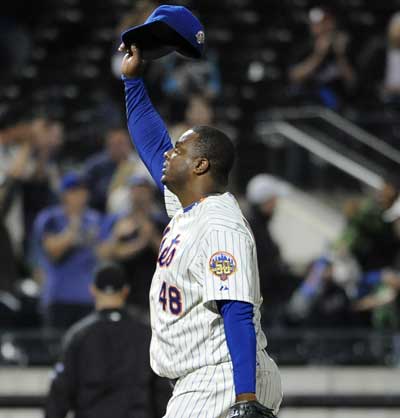
During an otherwise awful night for the Mets, Terry Collins and David Wright got into a bit of a spat in the dugout that turned out to more or less embody what we like about both men. Patrick Flood has all the details and the interpretation.

For what it’s worth, David Wright seems like — understandably, and smartly — a pretty guarded guy, but absolutely every bit of evidence we have suggests he really, really loves playing baseball. Like even more than most professional baseball players. That’s awesome, and so is David Wright. Also, he’s hitting .408.

A couple weeks ago, I pointed out that you could isolate stretches of Wright’s merely good but not totally awesome 2009-2011 campaigns in which he fared as well as he had in his first 20 games of 2012. That’s still true: In 33 games from May 30 to July 5 of 2010, Wright posted a .414/.456/.662 line. And over a 38-game stretch from May 4-June 16, 2009, Wright hit .415/.503/.606. Maybe you could find another if you play around with the baseball-reference gamelogs. Which is to say, again, that this is a small sample size and maybe this is the best Wright will hit all season, and maybe he’ll go into an awful slump soon and people will start crying “traid” again.

But those are arbitrary endpoints, and there’s no arguing that it’s encouraging he’s started this season this way. Obviously.

Actually, here’s something funny: Wright has been so good in the first 33 games of this year that if you tack them on to the 102 games he played last year, it makes for a .291/.381/.470 line with a 139 OPS+, or a hell of a lot like vintage David Wright.  The power’s not where it was from 2005-2008, but that’s the case around the Majors.

As for Collins: The only blowback I’ve seen to his removal of Wright and Murphy from last night’s game is that it sends a negative message to the rest of the players if he’s only protecting his two best hitters. Yeah, whatever. Maybe they’ll see the type of treatment they’d get if they became one of the team’s best hitters.

How can hip hop be dead if Wu Tang is forever?

The town of Sandwich is celebrating the 250th anniversary of the invention of the sandwich this weekend, but it’s a sham. For one thing, it sounds like they don’t know for sure what day the fourth Earl of Sandwich first ordered meat between bread, just that it happened in 1762.

For another, the sandwich is not something that could have been invented. The sandwich is transcendent, and John Montagu was just the medium through which it arrived in high-society England and got its name. Even the BBC article quotes a “foodsmith” who says, “Other people were probably eating in that way anyway but they were people who weren’t written about.”

The Wikipedia says an ancient Jewish sage named Hillel the Elder “wrapped meat from the Paschal lamb and bitter herbs between two pieces of old-fashioned soft matzah.” And I suspect that as long as people have had meat and bread, people have been wrapping meat in bread. It’s an instinct that exists in all of us.

All that said, a weekend-long sandwich festival doesn’t sound like such a bad thing. And they’re staging re-enactments — plural — of the moment Montagu ordered his food in bread, which will probably be hilarious.

Saves are stupid

OK, look: Once Terry Collins said he was going to use Frank Francisco as his closer before last night’s game, he practically had to use Frank Francisco as his closer in last night’s game. He doesn’t owe Francisco much after the reliever’s performance over the weekend, but a big part of a manager’s job is keeping his players happy, and rolling back on his word with a pitcher with shaken confidence would not be the best way to do that. Plus, pretty much everything in Francisco’s history — not to mention his contract — suggests he’s a hell of a lot better than he has been for the Mets in 2012, so getting him straightened out should be a priority for the team if it aims to have a fully functioning bullpen later in the season.

But saves are stupid, and managing to the stat — as is typical in Major League bullpen usage — is ludicrous. Presumably you know this. Everyone knows this. And yet it still happens everywhere with no signs of stopping, and for all the vitriol spilled over stats that actually correlate to meaningful baseball events. there seem to be shockingly few outbursts about this nagging and ubiquitous silly habit.

Here’s the deal, in case you’ve missed it: Since the dawn of the one-inning closer, teams maintain their ninth-inning leads at exactly the same rate they did before the dawn of the one-inning closer.

The argument for defined bullpen roles is that relievers like to know the jobs they’ll be asked to do when they get to the ballpark. And that makes some sense. If I showed up to work one day and my boss said, “hey Ted, instead of being an editor today, we need you to operate the lights at the studio,” I’d get all worked up, plus I’d probably suck at it. I have no idea how to do that.

But then getting guys out in the ninth inning doesn’t seem like an appreciably different task than getting guys out in the seventh inning, it just happens at a different time. Certainly there are some differences in mental and physical preparation. But maybe if instead of telling a reliever his responsibility is the eighth inning or the ninth inning when his team is ahead, the team told him his responsibility is to pitch in relief if necessary on Wednesdays, Fridays and Sundays, he might still feel comfortable that he understands his task. I don’t know; I’ve never been a Major League reliever.

There’s a money thing too, of course. Closers get paid lots of money, so presumably relievers want closers to exist so they can earn the role and get the big bucks. But it seems likely that if some better stat than saves came into widespread use for assessing relievers, it would soon be used to compensate relievers, and with the amount of money in baseball there’d no doubt be plenty of handsomely paid bullpen arms regardless.

Point is, if the Mets weren’t committed to having a closer to aggregate saves — as basically all teams are — and committed specifically to using Frank Francisco as their closer, they almost certainly would have left their best reliever, Bobby Parnell. in last night’s game to face the middle of the Brewers’ order in the ninth after he retired the two batters he faced in the eighth on only five pitches.

But since it was important to use Francisco as the closer and give him the save opportunity because he’s the closer, they wound up not only using their third reliever of the night for the ninth, but needing to warm up their fourth — Jon Rauch — when Francisco struggled. And from here, it seems hard to figure how whatever advantage gained from having relievers know their roles isn’t more than mitigated by that type of forced inefficiency in their usage.

History of the taco

Yossarian passes along this interesting read about the history of the taco, including Glen Bell’s role in bringing it to the masses. The expert interviewed suspects that the term “taco” comes from Mexican mining communities and is named for a way gunpowder was wrapped to blast holes in rock. So tacos were born of explosives. Somehow this makes me like tacos even more, which I didn’t think possible.

And you complain about Thole…

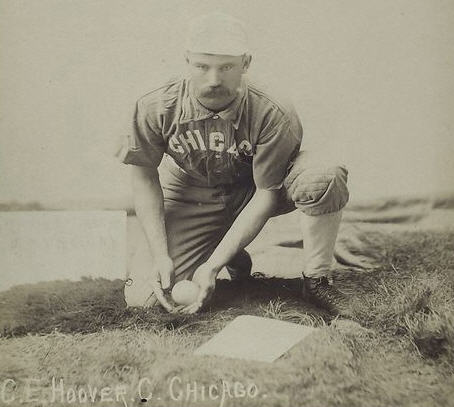
On a tip from Craig Calcaterra, I was checking out BuzzFeed’s 21 Weirdest Things about Old-School Baseball and this terrifying looking mustache man caught my eye:

That is, I assume, Charlie Hoover, the only C.E. Hoover to ever play professional baseball, according to baseball-reference.com. Hoping, in accordance with his name, Hoover would turn out to have been a good defensive player, I looked up his stats. He was not.

In his one full season in the American Association, Hoover played in 71 games, 66 of them behind the plate. In those 66 games as a catcher, he made 34 errors and allowed 58 passed balls.

Of course, those numbers aren’t atypical for the American Association, when games must have been so excruciating to watch it’s a wonder baseball even caught on. Hoover’s teammate Herman Long, a rookie shortstop nicknamed “Germany,” made 122 errors in 136 games, leading the league*.

And two catchers allowed more passed balls than Hoover did that season. Louisville backstop (to use the term loosely) and incredible mustache-haver Farmer Vaughn allowed 60 passed balls in 54 games behind the plate. His teammate, fellow mustache man Paul Cook, allowed 77 passed balls in 74 games at catcher to lead the league. Perhaps they were mesmerized by pitcher Guy Hecker’s razor-sharp mustache.

If you took in a Louisville Colonels game in 1889, it was better-than-even-money there was a passed ball. Also, they probably lost. The Colonels finished 27-111 that season. The upside is that 65 of their games were managed by an outfielder named Chicken Wolf. Chicken Wolf also had an amazing mustache.

As for the passed balls: Catchers didn’t wear shin guards until 1907 and, according to this, the chest protector was first invented in 1886, so depending on how quickly that caught on, it’s possible ol’ Charlie Hoover was out there behind the plate wearing little more than a mask, a mitt and what you see above. Except he wasn’t wearing that uniform in the American Association — he played for the Kansas City Cowboys. His lone season playing in Chicago came in the single-A Western Association in 1888.

*- For the sake of the disappointingly clean-cut shortstop Long’s honor, it’s worth noting that he also led the league in putouts by a pretty wide margin and finished third in the league in stolen bases, so it seems likely his high error total was at least in part due to his range. You get to the most balls in 1889, you boot the most balls in 1889. Like, 122 of them. Also, perhaps he was distracted on throws by first baseman Dan Stearns’ enchanting mustache.

Sandwich of the Week

Thousands? CLOCK!?

The sandwich: The James from City Sandwich, 9th Ave. between 45th and 46th streets in Manhattan.

The construction: Roast beef with melted mozzarella, broccoli rabe, roasted peppers and olive oil on a hero. It’s supposed to come with sauteed onions, but I ordered mine without them.

Important background information: It’s probably by coincidence, but I’ve been winding up in more and more sort of high-endish, European-inspired sandwich shops lately. This is not a bad thing, as they often serve good sandwiches. They mostly boast various imported and/or otherwise exotic cured meats, fancier cheeses than you usually get on a sandwich, and extremely hearty bread.

The bread in many of those places, I find, often actually takes away from the sandwich. It’s delicious, fresh bread and something (like most things) I would love slathered in butter, but it’s so thick that it’s sort of a bear to eat as a sandwich and sometimes even rough on the roof of the mouth. Also, many of those places seem to think importing fancypants meats and cheeses and serving them on giant loaves of bread means they can get away with using like two thin slices of meat per sandwich, and this is America bro.

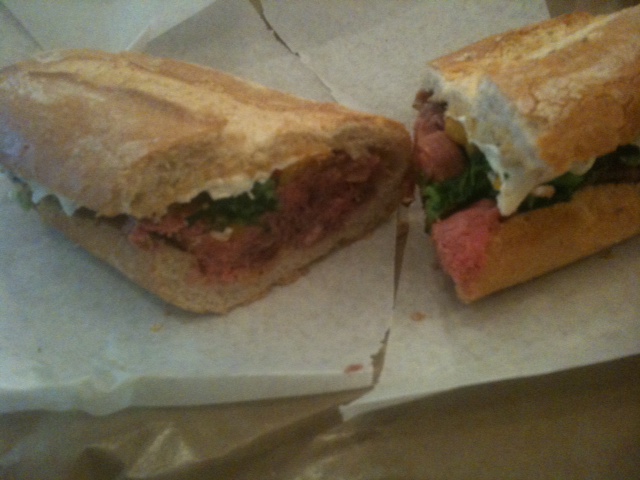
What it looks like:

How it tastes: Delicious.

I went into City Sandwich knowing that it boasted Portuguese and Italian influences, concerned about that bread thing. But City Sandwich removes the inside from their loaves, creating a strong, crispy-crusted but not too bready platform upon which the sandwich is built.

Also, it’s toasted. And in combination with the roast beef, it creates an awesome, underrated sandwich effect that I fear I haven’t spent enough time discussing here: the mix of hot and cold ingredients. The roast beef here is cool, like you’d get at a deli where it’s kept in the fridge before it’s sliced. And with the warm, toasted bun and the melted mozzarella, you’re getting not only a combination of flavors and textures but also temperatures. And it’s good.

The fresh mozzarella is amazing, like most fresh mozzarella. City Sandwich does a good job with the broccoli rabe and roasted pepper, too. I think some places, when adding an uncommon ingredient like broccoli rabe, tend to go overboard with it to rub it in your face like, “hey man that’s right it’s broccoli rabe look at me look at me look at me.” But not here. It’s chopped up small and cooked tender, and there’s just enough of it to give the sandwich a little bit of its bitter flavor without making the whole thing just taste like broccoli rabe. There are a few more roasted peppers, but they’re in perfect proportion to the rest of the sandwich and add a nice sweetness.

Oh, and the roast beef! It’s really good. Roast beef can be kind of a crapshoot everywhere and I’m working with a one-sandwich sample size, but the roast beef on my sandwich was sliced extremely thin and served incredibly rare — real nice and pink, and extremely tender.

There was olive oil on there too. It must have done its job because at no point while eating this sandwich did I think, “this sandwich could be or should be wetter.” But because of the stronger flavors (and the way I normally associate olive oil with roasted pepper flavor, I suppose), the olive oil didn’t really stand out. More of a glue guy.

What it’s worth: The James cost $8.95 plus tax, and it was huge. It probably could have been two small meals but it was good enough that I wanted to keep eating.

How it rates: 88 out of 100. This sandwich lacked that extra, transcendent element to take it to the Hall of Fame level, but it’s delicious nonetheless. I will be trying other sandwiches at City Sandwich after future appointments at my doctor’s office nearby.

Thanks to Mark for the tip on this one.