“Now this is a table for Shaq,” said a girl with day-glo orange hair and tattered leggings to a man in a black jacket with all sorts of extraneous zippers.
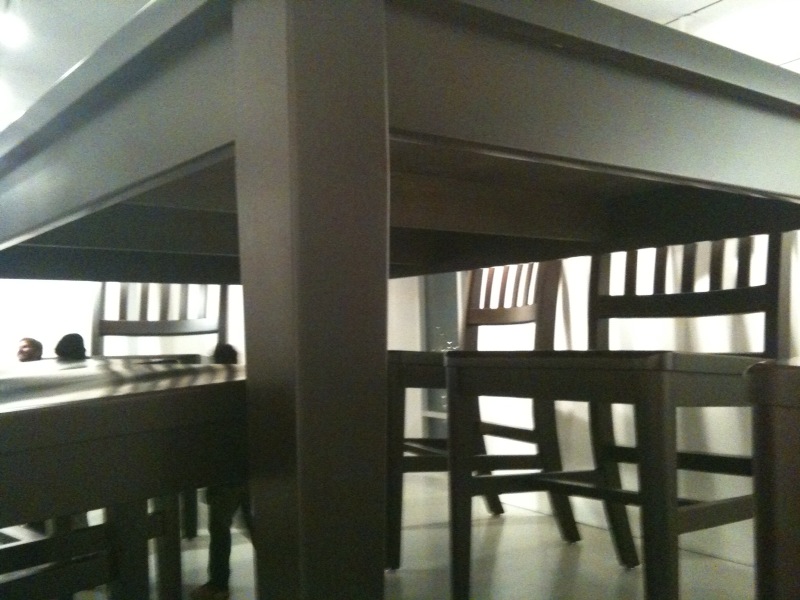
They stood under Robert Therrien’s No Title (Table and Six Chairs) and gawked at the massiveness of the work. The piece is not hard to describe: It is a plain-looking table and six chairs, just tremendous. The seat of each chair stood nearly five feet high, the back stretching to just shy of 10 feet, almost scraping the ceiling. The table — like the chairs, made of aluminum painted to look like dark wood — stood almost as tall, at about nine feet. And, at 12 feet wide and 18 1/2 feet long, its awesome dimensions tested the confines of what should have been a large gallery space at the FLAG Art Foundation in Chelsea.
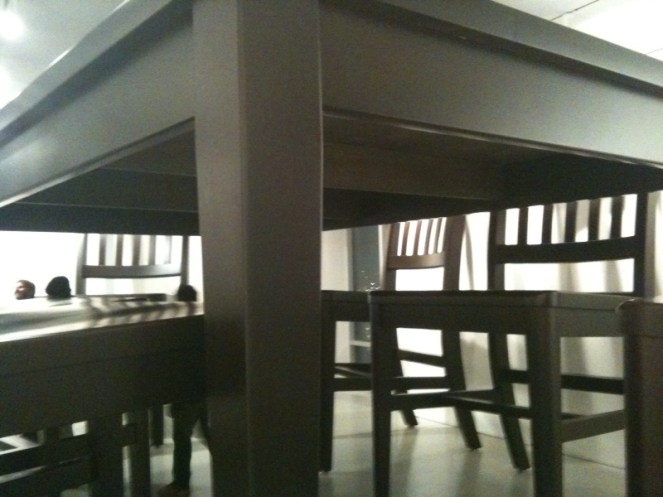
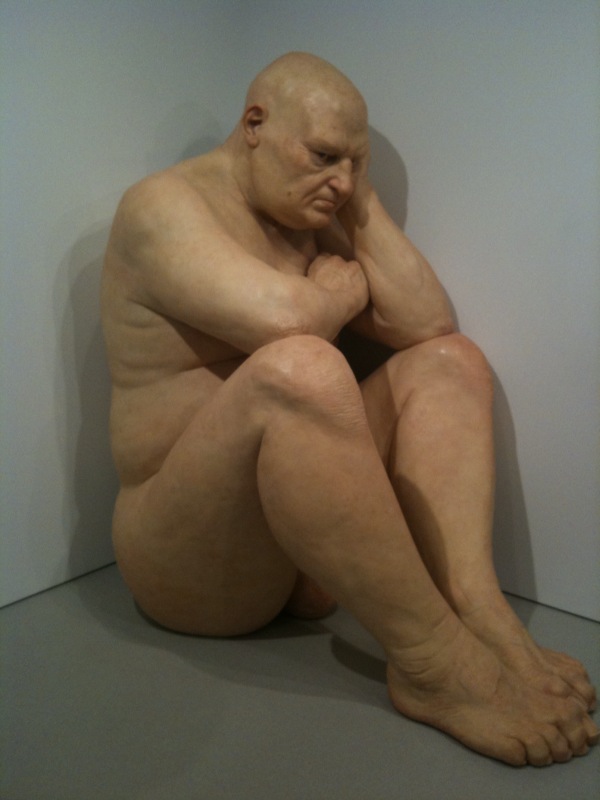
Size Does Matter, the first art exhibition curated by Shaquille O’Neal, opened Friday night to a large crowd that appeared to be some mix of New York aesthetes, curious hipsters and intrigued basketball fans. It was difficult to tell — in Manhattan, one person could easily be all three — and there was no dominant draw among the few people I asked. Some came because it was Shaq’s art show, for sure. Others came to see the works on display from high-profile artists like Jeff Koons and Ron Mueck. One noted “all the buzz” around the show.
 Hype breeds hype and crowds attract crowds. Shaq curated an art exhibit and landed some big-name works, and a bunch of people showed up. No surprises there, I guess.
Though Shaq himself is colossal, the exhibition was more than just impressively huge things. There were tiny things too — like Willard Wigan’s (literally) microscopic sculptures of the Obama family and Shaq inside the eyes of needles, and Jim Torok’s Self Portrait with Yellow Sunglasses.
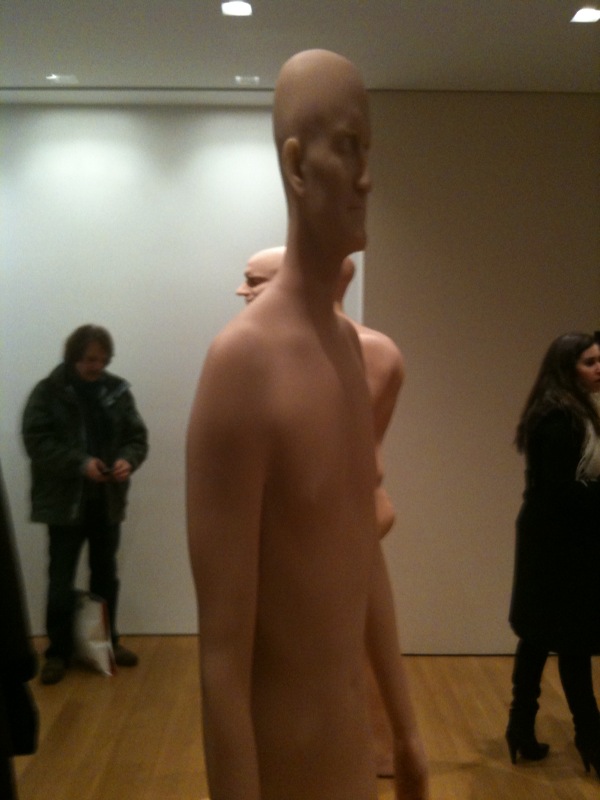
More than anything, though, the show was about jarring proportions. Richard Dupont’s Untitled (Terminal Stage), which cannot really be adequately represented by a photograph, featured three sculptures, modeled after the artist, in cast polyurethane resin, set up a few feet apart from one another in a triangle.
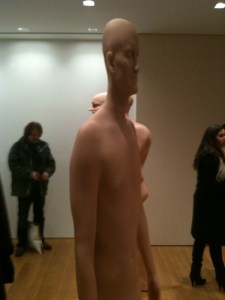 Though from some angles, the sculptures might look identical — and in realistic human scale — each was skewed in some unique way so that, from a certain perspective, it looked like it was being viewed through a funhouse mirror or, as one onlooker said, “through someone else’s glasses.”
It was fascinating to behold, and to feel my eyes try to adjust and process information that clearly did not connect with my brain’s long-conditioned notion of what humans and sculptures of humans should be shaped like.
And it was even more fascinating, of course, to watch other people go through the same process.
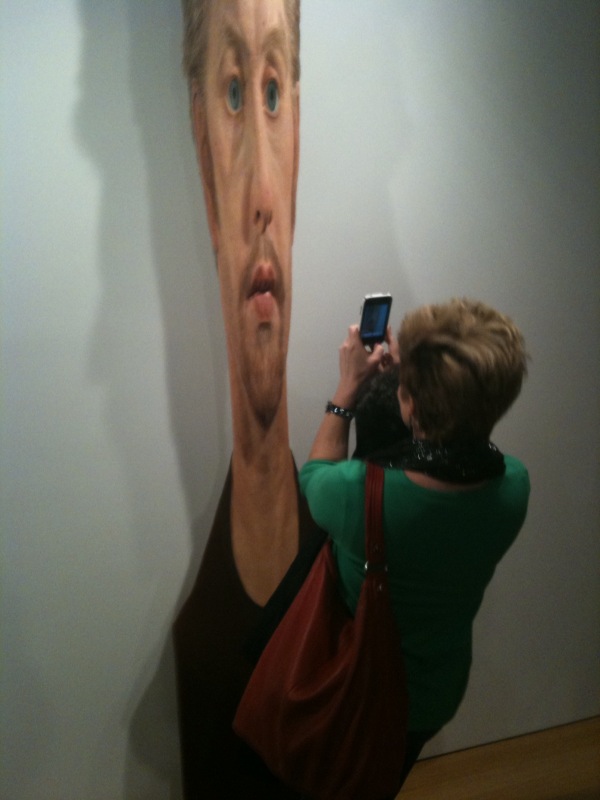
Evan Penny’s amazing Stretch #2, while not as dizzying, inspired a similar reaction. A nine-foot tall silicon sculpture of a stretched head, the work impressed crowds and baffled amateur photographers.
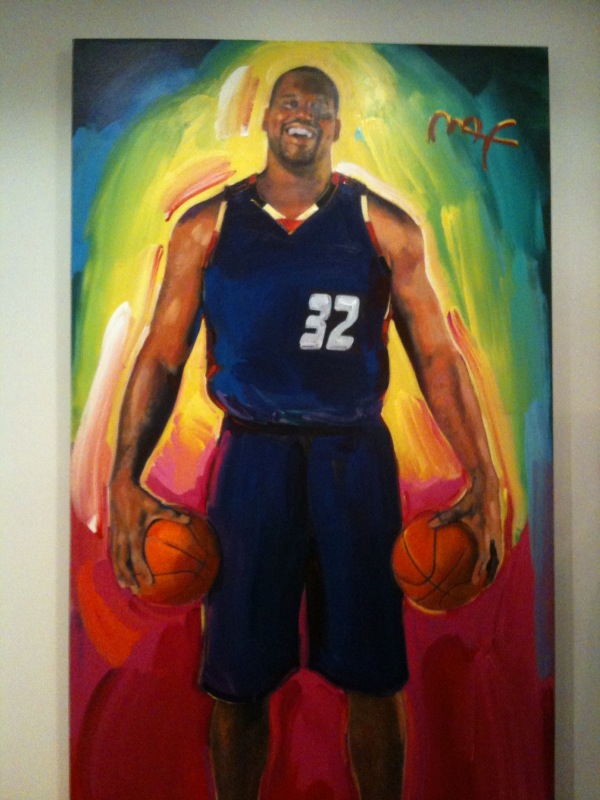
There are traces of Shaq’s persona throughout the exhibit, beyond just the life-size portrait of a smiling Shaq by Peter Max that graces the gallery’s reading room.
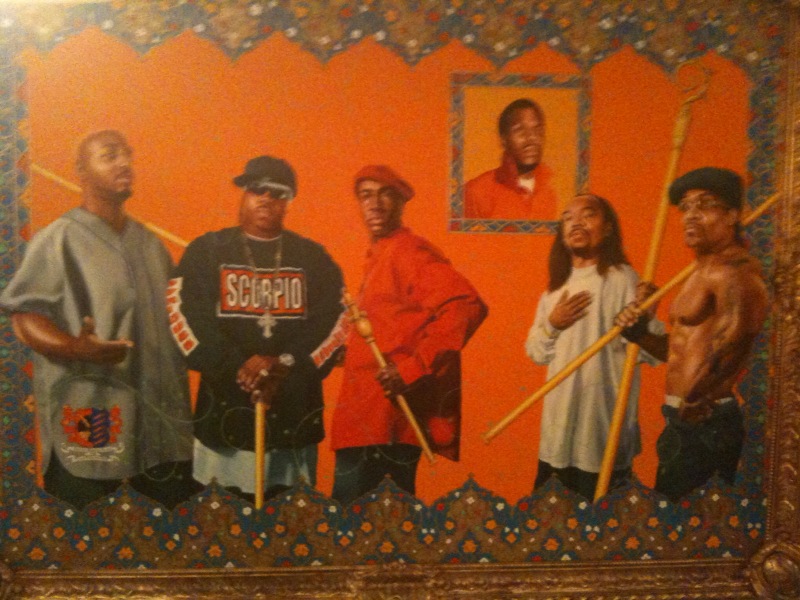
A photograph from Paul Pfeiffer’s basketball series, Four Horseman of the Apocalypse, is on display, as is a reminder of one of Shaq’s previous forays off the basketball court: his hip-hop career. Kehinde Wiley’s portrait, Grand Master Flash and the Furious Five, hangs directly across from Max’s piece.

Still, even with two floors packed with cool pieces to look at, I kept going back to Therrien’s table.
It’s tough to say, with a work like that, who should get credit for the way it’s displayed, and whether it’s even reasonable to assess a piece based partly on the room that contains it. The Internet shows me that the same work has previously been shown in much bigger rooms, and even outdoors.
But someone — presumably Shaq himself — chose to show Therrien’s piece in a Manhattan space probably not really suitable for works of its scale. And someone set it up in that particular room at the FLAG Art Foundation, alone, filling every last bit of it, each chair sitting mere inches from the wall. At some step along the line, someone — or some collection of someones — made conscious choices to cram that table and those chairs in that space, and so I think it’s reasonable to assess its effect as displayed, even if its not necessarily the original one Therrien intended.
Because that table moved me in a way I did not honestly expect to be moved by Shaq’s art exhibition. Looking up at the tremendous table jammed into the room, and seeing all the people coming in and staring and laughing and taking pictures with it, it made me feel Shaq somehow, for a fleeting second, and it was so damn sad that I had to brace myself against the wall.
How uncomfortable must it be, sometimes, to be that big? How claustrophobic? Our world is not built for 7’1″, 350 pound men, just as that room was not built for an 18 1/2 foot-long table. What desk did Shaq sit at in middle school?
The Shaq we know, his public persona, is playful, and the work is a playful piece, too — make no mistake. It’s a giant dinner table, after all. It’s fun. But something about all the people enjoying it, reveling in its gentle giantism, made me wonder if Shaq ever wants to hide. You can’t hope to blend in when you’re 7’1″ and 350 pounds. Maybe on the court in the NBA, but never once the game is over.
And when I thought about it that way, it made perfect sense that Shaq’s art exhibition would not be a mere celebration of big things, but a more complex exploration of scale and perception. Shaq’s sheer size is a big part — maybe the biggest part, no pun intended — of what made him a great basketball player and of what makes him so entertaining a character. But I would venture to guess it has also complicated his life in ways I cannot entirely comprehend.
I don’t know. Maybe it’s just a big table.
It all made me remember this tweet from the Big Aristotle himself, though:
If u feel alone and by yourself, look in the mirror, and wow, there’s two of you. Be who you are. Who are you. I am me. Ugly, lol. Shaq
Smile, Shaq. You’re money.

Seriously, the iPhone pictures here don’t do these works justice. If you’re in New York, go see the show. It’s at 545 W. 25th St, between 10th and 11th, it’s free, and it’s open Wednesday-Saturday from 12-5 p.m.



 I wrote my final grad school paper on the Bird’s Nest stadium that was, at the time, under construction for the 2008 Olympics in Beijing. I touched on some of
  For years I’ve maintained that everything Shaq does is art, and now he’s taking it up a notch:
 Tedquarters