I shared this on Twitter last night but in case you’re not on there. Look at that thing! Look at that guy!
“Winemaker Jeffrey Stambor” obviously Jerry Seinfeld in a ridiculous, bushy fake mustache
1
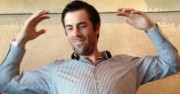
I shared this on Twitter last night but in case you’re not on there. Look at that thing! Look at that guy!
Have we heard the last (truly memorable) word from Hollywood?
Probably not, but it’s been a while since the movies had everybody parroting a great line.
Like, say, “Go ahead, make my day.” That was from “Sudden Impact,” written by Joseph Stinson and others, more than 27 years ago.
Sticky movie lines were everywhere as recently as the 1990s. But they appear to be evaporating from a film world in which the memorable one-liner — a brilliant epigram, a quirky mantra, a moment in a bottle — is in danger of becoming a lost art.
– Michael Cieply, New York Times.
For what it’s worth, I don’t really buy it. I think — as a couple of the experts in the story suggest — it probably takes time for the transcendent and lasting movies quotes to separate from the mire. Saying that we simply don’t make quotable movies anymore strikes me as senseless nostalgia.
I will offer this, though: There are some reasonable explanations, if it’s the case that movies are no longer as universally quotable. For one, Hollywood studios now rely on foreign box offices for 68% of ticket sales, creating more pressure to make blockbuster movies that will succeed in translation and so perhaps less emphasis on dialogue.
Plus — and I think more importantly — the era filled with supposedly unquotable movies covered in the article has seen the rise of great TV.
Thanks to more competition among satellite and cable providers, we have more channel options. There is undeniably better and bigger-budget programming on those channels, and HDTV technology allows us to enjoy that programming in quality that rivals or betters the cinema from the comfort and convenience of our living rooms.
And when I think about it, while I really don’t quote a ton of movies from the last few years, I quote The Wire, The Office, Park and Recreation and Arrested Development almost constantly.
Hat tip to Jonah Keri for the link.
Starch grains found on 30,000-year-old grinding stones suggest that prehistoric man may have dined on an early form of flat bread, contrary to his popular image as primarily a meat-eater.
The findings, published in the Proceedings of the National Academy of Sciences (PNAS) journal on Monday, indicate that Palaeolithic Europeans ground down plant roots similar to potatoes to make flour, which was later whisked into dough.
– Reuters.
Of course he did. Of course he did. C’mon. And though it’s not stated in the article, I can personally guarantee you that, with enough digging, archaeologists will uncover evidence that prehistoric man wrapped his meat in that prehistoric bread.
 You think prehistoric man, our forefather, was smart enough to hunt and gather and reproduce successfully — spawning our whole society here — and didn’t recognize the importance and deliciousness of the prehistoric sandwich? Not a chance.
I’ve made this point before: Survey humanity. Just about every culture wraps some sort of protein in some sort of starch. We call it a sandwich and credit it to John Montagu, the Fourth Earl of Sandwich, but that’s a cultural and semantic distinction, and one that vaguely discredits the fine work done by visionaries like Hillel the Elder.
The desire to package meat in bread is baked — pardon the pun — into our very constitution. When scientists eventually sequence the entire human genome, perhaps they’ll discover the section that makes us enjoy sandwiches so thoroughly.
I surmise that prehistoric man probably bit into some meat one day and said, “Damn, this meat is delicious, but I really wish there were some sort of crusty, flaky, milder-tasting starch-based food product to accompany and surround it, creating a synergistic relationship in terms of both flavor and convenience,” then went out and created bread.
Except he probably didn’t say it exactly like that. Did prehistoric man have language? Who has got time to look up a thing like that at a moment like this? The important thing is bully to that guy for obviously desiring something that didn’t even exist yet, though I imagine bread and bread-like products would have been invented one way or the other, because, like I said, desiring burritos is clearly an invariable aspect of the human condition.
Here’s how he showed up to accept his Scream Award on Saturday night:
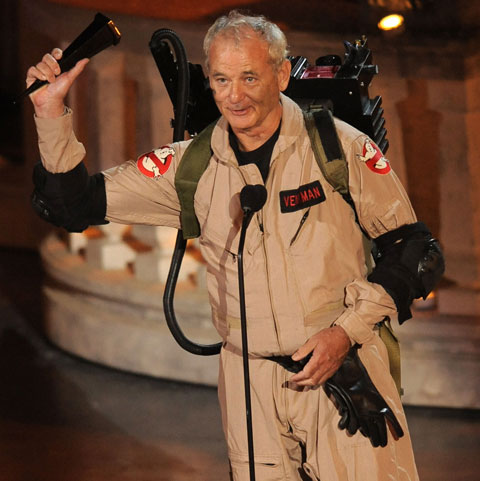
No word on how he got through security wearing an unlicensed nuclear accelerator on his back.
Stock rising: Justin Bieber. Stock falling: Tom Brady. Watch the video.
Very quotable episode. Best I’ve seen in a while, though I haven’t watched The Simpsons regularly in ten years.
I <3 Wipeout. Last year I wrote: “ABC’s obstacle-course show Wipeout is the most amazing television program I’ve seen in years. It captures exactly what everyone loved about America’s Funniest Home Videos but cranks up the all-important ratio of projectiles-to-the-crotch per minute (PtC/M). It’s essentially the apotheosis of The Simpsons‘ classic “Man Getting Hit By Football,” and proves once again that there’s nothing more entertaining than watching people endure hilarious agony.”
The car is a project of Google, which has been working in secret but in plain view on vehicles that can drive themselves, using artificial-intelligence software that can sense anything near the car and mimic the decisions made by a human driver.
With someone behind the wheel to take control if something goes awry and a technician in the passenger seat to monitor the navigation system, seven test cars have driven 1,000 miles without human intervention and more than 140,000 miles with only occasional human control. One even drove itself down Lombard Street in San Francisco, one of the steepest and curviest streets in the nation. The only accident, engineers said, was when one Google car was rear-ended while stopped at a traffic light.
Autonomous cars are years from mass production, but technologists who have long dreamed of them believe that they can transform society as profoundly as the Internet has.
OK, a lot of stuff here. I’ve made no secret of the fact that I’m pretty much terrified of Google, for a variety of reasons. Their corporate mantra, after all, says, “Don’t Be Evil,” which suggests they’ve at least considered being evil. So I’m a little concerned to hear they’re testing debatably legal robot cars in secret on the streets of San Francisco. Believe me, the last thing we want is Google partnering with the machines this early in the game.
 Second, I happen to love driving, but I’ve endured the particularly harrowing trek from New York to D.C. enough times to have considered at length the possibility of a self-driving car.
And it strikes me that it’s not really worth putting one on the road unless it is absolutely foolproof and requires almost no human interaction beyond initial directional programming. It will be far too tempting to sleep, eat, text, drink — whatever — in a self-driving car, so it seems like the first step is entirely eliminating the need for an alert driver. Especially since once we all get used to having our cars drive themselves — and new drivers come of age never knowing any different — our skills behind the wheel will atrophy.
My friend Charlie and I once envisioned some sort of motorized track along the side of interstates — sort of a glorified version of the car-wash thing — to let drivers coast along at 40 mph or so while they snoozed in their seats overnight. But then we never came up with a good plan for how you get on or off that thing, or how to avoid the inevitable pileups at the end.
Famed British occultist and much-ballyhooed enchanter of rock legends Aleister Crowley also made a killer rice pilaf.
I just Tweeted about this, but I’ll mention here: Thanks to deft TiVo juggling, I somehow managed to get this deep into the postseason without seeing the new Joe Girardi/Mariano Rivera Taco Bell commercial — in which Rivera is called in from the bullpen (here, a table in the corner of Taco Bell) to help a customer finish his XXL Chalupa — until this morning.
Obviously the XXL Chalupa is notable, and I owe you a writeup about that and the two new taco sauces, all of which I hope to eat at some point today and discuss here early in the week.
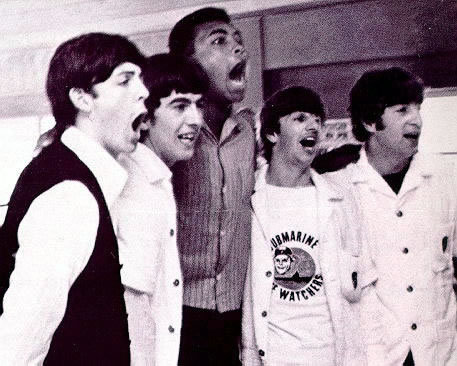
But the real story here is that we now have documented evidence that the great Rivera has been in the perhaps equally great Taco Bell. It is a historic confluence of awesomeness on par with the time the Beatles met Muhammad Ali.
 Tedquarters