
From the Wikipedia: Action Park

Originally posted Dec. 30, 2009:

Today’s From the Wikipedia comes upon request by multiple readers, but does not aim to make light of the numerous deaths — at least six, according to the Wikipedia — that occurred at the theme park in question.
It does very much aim to make light of the horrible, horrible planning that led to said deaths, and I sincerely apologize if anyone out there lost a loved one due to the carelessness and downright stupidity involved in the creation of these rides. Death due to any circumstance — theme park mishap, bear attack, leprosy, whatever — is tragic and not funny, and please do not take this post to imply otherwise.

From the Wikipedia: Action Park.

Action Park was a water park and motor-themed park that opened in Vernon Township, New Jersey in 1978 and stayed open, against all odds, for 18 years. I’ll quote the Wikipedia directly:

Many of Action Park’s attractions were unique. They gave patrons more control over their experience than they would have at most other amusement parks’ rides, but for the same reason were considerably riskier.

In other words, unlike most theme parks, Action Park made no attempt to idiot-proof its rides. Then, as if to tempt fate, they put it right in the middle of New Jersey.

(That’s not to say, of course, that everyone in New Jersey is an idiot. Plenty of the most brilliant readers of this very blog are from Jersey. It’s just that every place in the world has idiots there, and the suburban New York variety of idiot is a particularly brazen and callous idiot, like the cast of Jersey Shore or 30 percent of the drivers on the Turnpike — precisely the type of idiots that strike me as likely to injure themselves if trusted with their own safety on theme-park rides.)

Oh, and they served beer there. Brilliant.

The Action Park Wikipedia page is amazing. Absolutely, blisteringly amazing. It basically goes into detail about how every single ride contained serious design flaws that led to injuries. It’s far too long to even summarize here.

The best part is that I remember most of them. I used to go with my family about once a summer. On my block, we called it “Traction Park,” though other nicknames listed on the Wikipedia include “Class Action Park” and “Accident Park.”

We called it Traction Park and we went anyway, because no matter how dangerous it was, Action Park was still really, really fun.

The Wikipedia mentions that the Go-Karts were regulated by governor devices which limited their speed to 20 miles per hour, but that park employees knew how to disable the governors so they could race the Go-Karts at up to 50 miles per hour when the park was closed.

I didn’t know that backstory, but I’ll tell you this much: I sure remember that every once in a while, one Go-Kart in the race would be zipping around the track about twice as fast as the rest. No joke. Amazing. My dad got one once. He was terrified, but at the same time really proud to have so handily beaten my brother and me in the Go-Kart race.

Even the mini golf course at Action Park was dangerous. Why? You guessed it: Snakes.

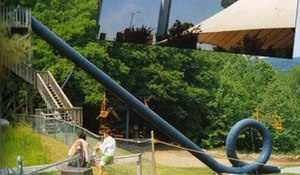
The biggest and best symbol of all that was awesome and ridiculous about Action Park was the looping water slide. A water slide with a loop-de-loop. How would that even work? You’re not harnessed into anything, like you are on a roller coaster. Doesn’t seem to make any sense, right? But it made perfect sense at Action Park.

The Wikipedia claims it was actually operated on occasion, but I never saw it open. And anytime you asked anyone about why it was closed, you always heard the same thing:

“Some fat guy got stuck in there and drowned.”

It turns out that was probably an urban myth, as were the stories that crash-test dummies sent down the tube to test it out came back dismembered. But who really thought a looping water slide was a good idea?

The Action Park people, that’s who.

Some of the Action Park rides are still open today at Mountain Creak Waterpark, but the Wikipedia mentions a “vastly increased emphasis on ride safety,” which I’ll take to mean they’re “incredibly lame now.”

From the Wikipedia: Graham Cracker

I was enjoying some graham crackers last night and got to thinking, “man, if graham crackers are called that because they’re made with graham flour, and graham crackers are delicious, why don’t we have more stuff made with graham flour? Where’s the graham cake and graham cookies?”

So I consulted the Wikipedia, only to find that the history of the graham cracker was way more interesting than I expected.

From the Wikipedia: Graham cracker.

Graham crackers were invented in 1829 in Bound Brook, New Jersey, by a Presbyterian minister and early dietary reformer named Sylvester Graham. Graham accurately argued that white bread from commercial bakeries, growing in popularity at the time, contained unhealthy additives and lacked the nutritious value of bread made from whole-grain flour.

Only Graham had more in mind than helping Americans enjoy the cardiac and gastroenterological benefits of a high-fiber diet. He believed that healthier lifestyles would cleanse his congregants of lustful thoughts, and in particular quell one indecent but ever-popular habit he referred to as “self-abuse.”

So to stop people from touching themselves, Graham began producing flour that incorporated course-ground wheat germ and bran in addition to the fine-ground endosperm of white flour. From this he created graham crackers — originally marketed as “Dr. Graham’s Honey Biskits” — to be a staple of his eponymous diet.

Graham’s followers, called Grahamites, reaped the rewards of frequent bathing and the daily brushing of teeth — neither yet a common custom in the early 19th century — believing uncleanliness to be a source of impure thoughts. Per the Wikipedia, Graham “felt that all excitement was unhealthful, and spices were among the prohibited ingredients in his diet.” The Graham diet grew popular enough that it became mandated at Oberlin College, where a professor was fired for bringing contraband pepper to faculty meals.

The Grahamites ate tons of graham crackers and tried to suppress carnal urges until Graham himself died at age 57 in 1851. But Reverend Graham’s beliefs later caught on with the brothers Kellogg, who invented Corn Flakes in the 1890s in part because they thought their cereal would help extinguish sexual desire.

Yes, if you’re playing at home: Both graham crackers and Kellogg’s cereal are named for people who thought they could end the masturbation epidemic with bland foods.

Of course, the delicious graham crackers we enjoy today would have the Reverend Graham spinning in his grave (while taking care not to arouse himself in the process). Most mass-marketed graham crackers are made with far more sugar-type stuff and far less whole-wheat flour than the originals. Many do not use graham flour at all, which answers my graham-flour question that started the Wikipedia tangent.

And today the Internet delivers all sorts of vile and debased porn instantly to every corner of the country, and we coat graham crackers with an impious amount of sugar to serve them as breakfast cereal and crush them up to use as crusts for sinfully rich cheesecake. Because this is America, bro.

Wikipedia either wrong or missing vital information

OK, so don’t ask how I got there, but I wound up on the Wikipedia page of Charles Osborne, an Iowa man famous for a bout of hiccups lasted 68 years.

But here’s the thing: According to the Wikipedia, Osborne’s hiccups ended in 1990, but he died in 1991. What gives?

Also, I imagine Osborne’s life would have been a whole lot less complicated if someone told him about the so-called Morrison Method, as practiced by my high-school band director and named for some kid named Morrison that must have gone to my high school years before me. Turns out drinking a glass of water while someone plugs your ears cures the hiccups every time. Only problem is it’s so silly that you often giggle enough to get the hiccups again.

Maybe Osborne came to enjoy having the hiccups. They were his claim to fame, after all. And maybe he woke up one day in 1990 without the hiccups like, “oh, man, no more talk-show spots for me!”

But probably his relationship with the hiccups was a bit more complicated than that.

From the Wikipedia: Man vs. Wild

I have never seen this show. Maybe it is good.

From the Wikipedia: Man vs. Wild.

OK, here’s the thing: Man already beat wild. Beat the living tar out of it. Man beat wild so thoroughly that we have to set up parks and wildlife preserves just to make sure man doesn’t beat wild all the way into oblivion. A TKO. Not the type of outcome that merits a rematch.

We haven’t yet figured out how to deal with the various difficulties posed by the proliferation of our own species. But wild — as long as we’re defining “wild” as something distinct from “man” — for most of us, is taken care of.

I am fortunate to spend nearly every night in a bed under the shelter of a roof with the temperature regulated at around 65 degrees by either air conditioning or heat. Every weekday I wake up, check my email, take a shower, eat breakfast, and walk to the train station unimpeded by nature. Sometimes it rains, but I can prepare for that. I get on the train and it speeds to New York City, where I then proceed to my office undeterred by fauna or flora.

In day-to-day life, the only time I could ever be reasonably endangered by wildlife is if I hit it with my car. About once every five years I get stung by a bee and it hurts for a few minutes. My neighbor’s dog bit my wife in the leg while she was out running last week; she got a small cut and a bruise but she was able to finish her jog.

In my kitchen, I have the flesh of at least eight different types of animal. Eventually I’m going to eat it. But it’s no rush — I have a freezer, an innovation that ensures I can keep food for months without it spoiling. I never need to hunt or forage. At a supermarket within a mile of my home, I can use paper money or a plastic card to purchase everything I need to keep me sustained.

According to the Wikipedia, on the show Man vs. Wild this guy Bear Grylls gets “stranded” in a different remote location every episode. That never happens to me. He’s not really stranded, either, of course. He’s there with a whole production crew, there’s often a helicopter nearby, and supposedly he sometimes spends nights in hotels. Those probably have mini-bars and breakfast buffets in case he gets hungry.

Apparently Grylls is briefed on the dangers present in each locale beforehand by a local expert. If you are ever really going to be stranded somewhere, make sure to hook up with a local expert first, because I bet that background information is awfully convenient.

But again, if you’re lucky enough to be in some situation that permits you to be reading this website on a Tuesday afternoon, you probably run little risk of being involuntarily ditched in any remote location, or even voluntarily winding up alone in any remote location unless you specifically want to test your so-called “survival” skills. And because of that, it seems weird to call them survival skills at all. Optional recreational strategies, really.

I live a remarkably sheltered life — as evidenced, like I said, by the suburban shelter under which I rest at night. One time I had to hitchhike on the side of I-95 and another time I had to pull out some Die-Hard stuff to break into my own apartment via the fire escape when I had been locked out. But really, the only survival skills I have ever needed are the ones that have helped me land and maintain a job in this economy, and the ones, I suppose, that prevent me from killing myself with drugs, alcohol and deep-fried food.

Perhaps that’s pathetic and I am somehow less masculine for having no urge to convene with nature in the pseudo-dangerous way Grylls apparently favors. Or maybe our forefathers, the real frontiersmen of yesteryear, would — once they came to grips with the oddities of time travel, electricity and broadcast television — watch Man vs. Wild and yell, “Holy hell man, what are you doing? We did this so you don’t have to, you crazy bastard.”

Anyway, the show has been on for six seasons so a lot of people must find it pretty entertaining. Not trying to hate or anything. Just sayin’s all.

Hey Rube

Over at the always-enjoyable Not Just a Mets Blog, Cory Abbey finds a particularly awesome and baseball-themed Wikipedia page. Not only did Rube Waddell once pitch both ends of a 22-inning doubleheader so he could enjoy a weekend fishing trip (most baseball-in-1900iest thing that’s ever happened?), he often left games to chase fire engines and played football for Connie Mack in Elmira in part because Elmira had one of the country’s leading manufacturers of fire engines. It’s an extensive and fascinating Wikipedia entry.

¿Quien es el Gocho?

If you follow Johan Santana on Twitter — which you should, because it’s Johan Santana — you may have noticed that he recently changed the “name” part of his profile to say “El Gocho believe it!”

Santana also has “El Gocho” embroidered in script on his glove.

So what does it mean? Technically it comes from a word for pig. But a brief Internet search reveals that it was the nickname of former Venezuelan President Carlos Andres Perez, and that it is Venezuelan slang for a native of the Andean parts of Venezuela from which Santana hails. In fact, by this list Santana is the only active Major Leaguer from Merida, Tachira or Trujillo, the nation’s Andean states. He comes from Tovar, a town of about 33,000 in Merida.

The term “Gocho” has its own page on the Spanish-language Wikipedia, and using Google Translate reveals it is at least vaguely controversial. Some people believe it has a derogatory connotation and suggests that Andean Venezuelans are less sophisticated than their urban compatriots. Others claim to say it with love.

I guess a decent comp in American English would be the word “hick,” since plenty of people use it dismissively while others proudly self-identify as hicks. Santana probably uses it with a touch of irony, since he’s undoubtedly a smart dude, and you’ve got to be pretty sophisticated to pull off a vest like that.

Another fun fact revealed from a Johan Santana-related Wikipedia tangent? Santana was discovered and signed by Astros scout Chance Partin, the brother-in-law of Cheech Marin.

From the Wikipedia: Tristan de Cunha

Tristan de Cunha was in the news a couple of weeks ago due to an oil spill, and my man Ted Burke tipped me off to its Wikipedia page.

From the Wikipedia: Tristan de Cunha.

Tristan de Cunha is the name given to both an archipelago in the South Atlantic and the main island of the group, the only one that is inhabited by people. The “big” island of Tristan de Cunha is nearly twice the size of Manhattan and, with roughly 275 residents, has about .02% of Manhattan’s population. Everyone in Tristan de Cunha lives in the largest city, Edinburgh of the South Seas — known locally as “the Settlement.”

The island is the most remote inhabited island in the world. It lies 1,750 miles west of South Africa and 1,510 miles south of Saint Helena, with which it is linked (along with Ascension Island) as part of a British territory. The territory is called “Saint Helena, Ascension and Tristan de Cunha,” which is pretty much the least clever you could possibly come up with for it. It used to be known only as “Saint Helena and Dependencies,” but in 2009 someone determined that the 275 people in Tristan de Cunha and the 880 people on Ascension Island deserved equal footing with the 4,255 people on Saint Helena.

Tristan de Cunha is represented by the governor of Saint Helena, which you figure must be something of a logistical nightmare because Tristan de Cunha is really hard to get to. You can only get to and from the island by boat and you pretty much have to boat to South Africa before you go anywhere. One boat trip a year connects Tristan de Cunha with Saint Helena and Ascension.

Of course, it’s probably not too difficult to govern a population that’s roughly the size of a suburban high school, especially when you figure everybody knows everybody and many of them are related. In fact, residents of Tristan de Cunha have only eight last names, seven of which came from its original 15 settlers. The eighth is Patterson, because a woman from the island left and brought back a husband named Patterson. The Settlement has one full-time police officer and one resident doctor.

The islands were discovered and named in 1506 by Portuguese explorer Tristão da Cunha. Apparently he also wasn’t particularly clever, though I guess it’s hard to fault someone for naming an island group for himself.

The islands pretty much just sat there until 1810, when a guy named Jonathan Lambert from Massachusetts showed up, claimed all the land for himself and renamed the islands “The Islands of Refreshment,” which sounds like something from a Fruitopia commercial. The Wikipedia does not say how Lambert came to Tristan de Cunha or how many people accompanied him, nor does it provide any detail of the boating accident that killed him two years later in 1812.

It is at least a tiny bit suspicious that in that same year, the United States military began using the islands as a base for the War of 1812, which also lacked a clever name. In 1816, the British formally annexed the islands to prevent the French from using them as a base to help Napoleon escape from his exile on Saint Helena, which, as mentioned, is over 1500 miles away. The Wikipedia does not detail how that would have worked, exactly, nor why the most remote inhabited island in the world would be a significant upgrade from exile.

Oh, one of the other islands in the Tristan de Cunha group is called “Inaccessible Island.” The Wikipedia entry contains this gem: “Attempts to colonise Inaccessible Island failed.”

Historically, the island has mostly been used for military stuff. Until at least World War II, its currency was potatoes.

One time a prince visited Tristan de Cunha, and Lewis Carroll’s younger brother lived there for a few years. It is not a great place for celebrity spotting.

It is a good place for bird-watching, farming, lobster fishing and philately. The Wikipedia says that the sale of postage stamps to overseas collectors is one of the main sources of foreign income to Tristan de Cunha.

The smattering of people that live on Tristan de Cunha speak a dialect of English. Because three of the original 15 settlers had asthma, many Tristanians suffer from the disease, much in the same way many Amish have polydactyly. Tristan de Cunha’s flag features a rock lobster, which is also the name of a song by the B-52s.

Walt “Clyde” Frazier owns these boots, obviously

The Knicks are in the playoffs. For insight on that from people who actually have interesting things to say about NBA basketball besides “OHHH!” and “WOW!” and “WHY IS NO ONE PLAYING DEFENSE!?” check out Tommy Dee and his crew at TheKnicksBlog.com.

And if you haven’t used up your allotment of Times articles for April, check out this feature about Walt “Clyde” Frazier’s wardrobe. Sadly, it is shorter than book-length and thus can not portray the full awesomeness of Frazier’s suits. It does have a photo gallery, thankfully.

Fun fact: Per Frazier’s Wikipedia page, he earned the nickname Clyde for wearing hats similar to the one Warren Beatty had in Bonnie and Clyde, which makes sense.