From the Wikipedia: Jumping the Shark

You’ve all heard the phrase by now, and I’m sure you all know the derivation. But I’ve got a lot of opinions I’d like to share.

From the Wikipedia: Jumping the shark.

The idiom “jumping the shark” refers to the moment a once-successful enterprise goes permanently and irreparably wrong. It was invented by the roommate of someone named Jon Hein in 1985 to refer specifically to the point in television series when plots and characterizations begin spiraling towards the absurd, unlikely and downright terrible.

The phrase specifically refers to a moment in a 1977 episode of Happy Days when Fonzie jumped over a shark on water skis.

For a while, jumptheshark.com was a popular website1 that allowed users to vote on when various TV series jumped the shark. The site has since been swallowed up by TVGuide.com, and indeed, the phrase has fallen out of popular favor.

This part is not on the Wikipedia, but nowadays, whenever anyone uses the phrase “jump the shark,” someone else will counter that the phrase is overused, and probably joke that saying something has jumped the shark has itself long since jumped the shark. I would — and have — argue that joking that the phrase jump the shark has jumped the shark has also jumped the shark.

It’s a shame, though. Whether or not the phrase is trendy, it describes a real phenomenon, and one I don’t think is limited to television series at all.

I’ll confess I still use the idiom pretty frequently, and I have certainly blurred its meaning beyond Hein’s original intent. To me, “jumping the shark” refers to anytime a creative process of any type has been dragged out longer than it should be, and I rarely identify a specific moment. I can remember pointing to bands, writers, classes, and even friendships that jumped the shark.

Basically, anytime it becomes clear that someone is trying too hard, working either to recapture and imitate past successes — thus often drifting into self-parody — or pushing to create in a realm too many steps beyond the limits imposed by reality, he is probably jumping the shark.

Of course, maybe that’s not jumping the shark at all, per its original definition. But that’s the best term I’ve got for the thing I’m talking about, so it’s the one I go with.

And I bring it up now because it strikes me as very likely that the Omar Minaya/Jerry Manuel administration jumped the shark Friday night, if it hadn’t already.

1– Big news for editors, as of Friday. Web sites are now websites.

From the Wikipedia: Piggy Bank

The end of a long, strange Wikipedia journey.

From the Wikipedia: Piggy Bank.

I assume everyone here knows what a piggy bank is so I’m not going to bog you down with too many details: It’s a pig-shaped receptacle for storing money. Some people collect them, because some people will collect just about anything.

What I didn’t know until I checked the Wikipedia was that the piggy bank is apparently meant to be a pedagogical tool. That’s why, with traditional piggy banks, you can’t ever take money out until you smash them because you’re ready to take all the money out. Piggy banks with rubber stoppers on the bottom so you can open them are newfangled b.s.

So what lesson are we trying to teach our children with piggy banks? A massively important one: Scrimp and save to slowly compile a sizable nest egg, then blow it all in one fell swoop. Literally break the bank, children.

Also, maybe there’s some lesson in there about how it’s wise to tie up your fortune in hog futures. I think back in the day swineherds had something to do with fostering the popularity of the piggy bank.

Oh, and whose bright idea was it to start storing coins in pigs? Someone who mistranslated something. According to the Wikipedia, in Middle English the term “pygg” referred to a type of clay used to make kitchen pots and jars, some of which were used to store change, or pieces of eight, or whatever the hell they called coins when people spoke Middle English.

At some point along the line, someone thought “pygg jar” meant “pig jar” and they started making jars shaped like pigs, and I guess, I don’t know, one thing led to another and we ended up with piggy banks. Sounds like a pretty stupid story, to be honest.

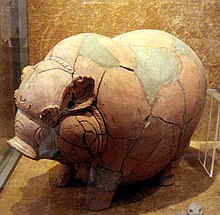
What’s bizarre is that Indonesian people, totally unrelated to the Middle English translation mishap, stored their money in terracotta likenesses of wild boars as far back as the 15th century A.D.

Wild Boary Banks, of course, are the far more badass cousins of the Piggy Bank, but I’m honesty skeptical that Indonesian people and English people both decided to start stuffing coins in clay swine without somehow consulting one another at some point along the way.

I mean, there’s just not enough about a pig or a wild boar that says, “make a statue of me and stick money in it” that would entice two cultures half a world apart to independently start doing so.

I don’t mean to doubt the Wikipedia, but though there’s a picture of something that looks a hell of a lot like an Indonesian Wild Boar Bank from the 15th century, there’s no real citation for the fact, it could just be a small, clay wild boar statue, and furthermore, I mean, c’mon.

From the Wikipedia: The Great Auk

I like nature as much as the next guy, but I’m not generally one to get all broken up about extinct animals because, you know, survival of the fittest and all. But I do always wonder what those extinct animals would have tasted like.

Great Auk Painting.previewThe subject of today’s From the Wikipedia was almost certainly delicious. In fact, it was partly our ancestors’ ravenous consumption of the species that led to its demise, because our forefathers lacked the foresight to leave even a few of them behind for us to breed and subsequently barbecue.

From the Wikipedia: The Great Auk.

The Great Auk was a species of flightless bird that lived on islands off eastern Canada, Greenland, Iceland, Norway, Ireland, and Great Britain up until the 19th century. It stood about 30-33 inches high and vaguely resembled a penguin. Under its down, it had a thick layer of fat, which served the dual purpose of protecting it from the cold Northern air and preventing its meat from drying up when cooked over an open fire.

Besides its deliciousness, the Great Auk’s most notable characteristic, by far, was its naivete. For some stupid reason, it was not afraid of humans, even though it clearly should have been.

In fact, on a 1622 expedition to Funk Island — which is not nearly as awesome a place as it sounds — a British crew was able to drive the succulent poultry right up the gangplanks and onto their boat. Sir Richard Whitbourne described it, “as if God had made the innocency of so poore a creature to become such an admirable instrument for the sustenation of man.

But man, being man, was obviously not an admirable instrument for the sustenation of so poore a creature.

Hint to animals: Fear humans or figure out how to make humans fear you. Otherwise, you’ll endure species-wide humiliations like the ones that eventually spelled the demise of the Great Auk.

As long ago as 2000 B.C., someone was buried in Newfoundland wearing a coat made of 200 Great Auk skins with the heads left on for decoration. The Great Auk jacket was the O.G. mink coat.

The Beothuk people of Newfoundland made pudding out of Great Auk eggs. (It should be noted, here, that the last surviving Beothuk died about 15 years before the last Great Auk, so the Great Auk had the last laugh in that storied rivalry.)

But more than anything, it is the treatment of the last few Great Auks that underscores humanity’s lack thereof.

By the turn of the 19th century, after centuries of being hunted for its meat, eggs and down feathers, the Great Auk was nearly extinct, and in 1794 it became illegal to kill Great Auks in England.

That didn’t stop the 75-year-old Scotsman who caught the last Great Auk ever seen in the British Isles, though. He tied the bird up for three days then beat it to death with a stick. Why? Because he thought it was a witch, obviously.

The last remaining colony of about 50 Great Auks lived on an island inaccessible to humans until 1830, when the island submerged and they were forced to move to another island that was barely accessible to humans.

Just accessible enough, it turned out, for preservationists — I kid you not — to kill the remaining birds for displaying their skins and eggs in museums.

In July, 1844, the last pair of Great Auks sat incubating an egg, still somehow not fearing humans even though humans had killed all the other Great Auks. Three humans approached and the two Great Auks just sat there on the egg, so two of the humans strangled the Great Auks while the third smashed their egg with his boot.

That was all for the Great Auk.

Linda Cohn can’t fight this feeling anymore

This  uncited bit of info from SportsCenter anchor Linda Cohn’s Wikipedia page, can’t possibly be true. Can it?

Sorry if that’s a bit small. I had to post a screengrab in case it goes away anytime soon. If you can’t read that, click it. It says, “In an interview on WFAN with Mike Francesa, Cohn admitted she occasionally sings backup at REO Speedwagon concerts.”

Not sings “along” at REO Speedwagon concerts. Sings backup.

In a related story, apparently REO Speedwagon still has concerts. Terrible, terrible concerts.

I’m assuming this is some hilarious and creative Wikipedia editing by someone. Good job, someone.

Hat tip to Jake Rake for the find.

From the Wikipedia: The finger

Hilariously, the finger — as in the middle finger, the bird, the flip-off — has its own Wikipedia page. And it’s your day, the finger.

From the Wikipedia: The finger.

You already knew that the finger is an obscene gesture created by showing the back of the hand while extending only the middle finger upwards, and that it often connotes the phrase, “up yours.”

What you probably didn’t know is that the tradition dates back to ancient Greece, and was known as — no joke — digitus impudicus, or “impudent finger” in Roman times.

The Wikipedia speculates that the use of the finger started as a threat, since the middle finger was an archer’s bow-plucking finger, and so extending the middle finger was really just the middle-ages version of the Gilbert Arenas trigger-thumb.

The entry also includes a rundown of similarly obscene hand gestures in other cultures, which is a handy thing to know if you’re traveling. For example, DO NOT flash the two-finger, back of the hand V-sign to people in most other English-speaking countries, because they do not think it means “peace.” This means you, Justin Bieber.

What the Wikipedia does not include, unfortunately, is a list of popular middle-finger delivery styles.

So I’ll provide a few on my own. If anyone wants to add these to the Wikipedia, you know, go to town.

1.) The “Right Here, Buddy”: This is the method Rex Ryan chose, and probably the most widely used variety of the middle finger. It is by nature dismissive, as if to suggest that the provider has something to lord over its recipient. In Ryan’s case, it almost certainly came in response to some heckling, as if to say, “I got your fat joke right here, buddy. I just coached a team to the AFC Championship, and I’m about to eat more bacon than you can possibly conceive.”

2.) The Maniacal Double: This is my favorite, especially while driving. I think in New York the finger gets bandied about so liberally that it almost loses its meaning, so I like to bring it back by adding a little flair. Next time someone cuts you off or does some bad-driving move that prompts your road rage, drive up next to them, widen your eyes as far as they’ll go, and wave both middle fingers around in the air at them. The driver will almost certainly be terrified enough to think twice next time he or she is about to do something stupid and/or dangerous on the road.

NOTE: It is crucial that your tires be properly aligned before you attempt the Maniacal Double. And yes, I know that it is hypocritical to respond to a dangerous or dumb instance of driving with something at least as dangerous and dumb. But wait ’til you see the look on that guy’s face.

3.) The Clever Guy: This category includes all middle-finger techniques popular in late elementary school, including holding up the index, middle and ring fingers and instructing recipients to “read between the lines” and pretending your hand has a little crank attached to it and using your off hand to ratchet up the middle finger. These methods were hilarious in elementary school, but have lost their luster with time. Avoid these methods.

4.) The Emphatic Thrust-Bird: OK, I just made that name up (which I guess makes sense, since I’m making all these up). But sometimes you really, really need to give someone the finger, and you’re concerned that the regular old finger just isn’t strong enough. That’s what this is for. It’s actually a combination of two-to-three obscene gestures, depending on your definition of obscenity, and it really drives home how emphatically you want to let the recipient know how you feel.

Here’s what you do: Keep both feet planted with your weight distributed evenly and knees slightly bent. With your left hand, slap your right bicep as you swing your right hand up, simultaneously extending your middle finger. This combines the classic French bras d’honneur — recognizable from Spaceballs, of course — with the time-honored middle finger. As you’re doing it, ever so slightly thrust your pelvis forward. That’ll show ’em.

From the Wikipedia: Hibernation

From the Wikipedia: Hibernation

I had been led to believe that hibernation referred to the period when an animal basically shut off for winter, but this is apparently not the case. The Wikipedia page for hibernation completely sucks and needs to be updated to meet Wikipedia standards, but according to other Wikipedia pages, hibernating animals actually wake up during hibernation to eat and go to the bathroom, although they are animals and so obviously do not have bathrooms.

Basically, hibernators are just homebodies, the bloggers of the animal kingdom. The whole concept is overblown and overrated.

Meanwhile, bears are apparently not hibernators in the technical sense of the term, but instead enjoy something called “winter dormancy” during which they do not eat, drink, urinate or defecate.

So in other words, bears do exactly what I thought was hibernating, only it is not called hibernating. Whatever. Just semantics imposed upon us by some stuffed-shirt scientists, and bears continue to be way, way more awesome than scientists.

Sorry, scientists. Come back when you’re bears.

The silliest part of all this is that someone actually thought I went to the Wikipedia page for hibernation to learn about ground squirrels or mouse lemurs or any of the host of other boring animals that actually hibernate. Make no mistake, Wikipedia: I’m here for the bears. So let’s try this again:

From the Wikipedia: Winter Dormancy

I should first warn you that from the link above, if you scroll up just a tiny bit, there is a picture of bears having sex that could be NSFW, especially if you work with lascivious bears.

Bears have inspired many interesting and exciting Wikipedia pages. There’s this this list of famous fictional bears, this list of famous actual bears, and this list of bears. There are Wikipedia pages for Teddy Bears and Wikipedia pages for completely terrifying bears, but sadly, there is no dedicated Wikipedia page for the bear’s whole winter-dormancy thing, which is a shame because it’s downright fascinating.

According to non-Wikipedia Internet research, the American black bear can go 100 days without eating or drinking. 100 days. That’s nuts. Our pathetic human bodies would be dead in four.

November comes, and we have to keep finding food and maintaining our health as best we can through the cold-weather months. Not bears. Bears are just like, “You know what? I’m gonna go chill out in this cave a while. I’ll probably be up in time for the Super Bowl but TiVo it for me, just in case.”

You want to take a glass of water with you, bear?

“Nah, I’m good.”

Apparently one of the main reasons a bear’s winter dormancy differs from hibernation is that a bear can actually be roused from its slumber relatively easily, compared to those ground squirrels and mouse lemurs and all the lame, true hibernators.

But “relatively easily” just means that if you find a hibernating bear and poke at it for a while, it will eventually wake up and maul you. And if that happens, you know, you broke rule No. 1: Don’t f#@! with bears.

According to this article, German scientists are working on unlocking the secret to human hibernation. I’m down. If you timed it right, you could basically knock off after the World Series and wake up right before pitchers and catchers, probably with just enough time to figure out whatever roster moves your team made that offseason (oh, Omar, what’d you do!?). I realize you’d miss Christmas and the Super Bowl and the bulk of the college basketball season, but it’d also probably be a great way to lose weight.

From the Wikipedia: Curse of the Pharaohs

So disappointing.

From the Wikipedia: Curse of the Pharaohs.

I like a good spooky story even if I think it’s probably hokum, and for whatever reason — some sixth grade history teacher, Scooby Doo, who knows — I really believed that just about everyone who ever opened a mummy’s tomb was dead within a few weeks.

Not the case, it turns out. The Curse of the Pharaohs refers to the legend that any person who disturbs an Ancient Egyptian tomb will be forever hexed by the mummy within.

Stories of the curse really took hold, it seems, when Sir Arthur Conan Doyle — the Sherlock Holmes dude — started perpetuating them and trying to explain them around the time a team of 58 explorers opened the tomb of King Tutankhamun in 1922.

The only problem is that precisely one of those 58 people suffered an even mildly mysterious death anytime soon after the opening — a George Herbert, the fifth Earl of Carnarvon, who died from an infected mosquito bite he cut open while shaving.

Another, George Jay Gould — of the New York Goulds, the railroad people — contracted a fever and died of pneumonia within a year.

But, you know, it was 1922, and people still randomly just got fevers and died of pneumonia back then. All told, only eight of the 58 people present at the opening of the tomb were dead within a dozen years, and I’m willing to guess that if you took any random cross section of 58 adults in 1922, it’d be a pretty safe bet that eight would be dead in twelve years. People still got Typhoid and Scarlet Fever and stuff in 1922.

The Wikipedia — clearly grasping at straws — alternately claims that Howard Carter, the archaeologist in who led the team, either did or didn’t fall victim to the curse when he DIED OF CANCER 16 YEARS LATER. I’m gonna go with “not the curse” on that one. In fact, I’d say it’d be a lot more mysterious if Howard Carter, born in 1874, hadn’t died by now.

Both the Curse of the Pharaohs and its accompanying Wikipedia page are total crap. They are, as Egyptologist Donald Redford once said, “unadulterated clap trap.”
In fact, that phrase coupled with the revelation that Sir Arthur Conan Doyle had a totally kickass mustache are the only cool things to come out of this Wikipedia endeavor.

I’m certainly open to the mysterious and unexplainable, but the Curse of the Pharaohs is not that. Come back when you’re bovine excision, Curse of the Pharaohs.

From the Wikipedia: Globster

I’m not going to lie: Today’s “From the Wikipedia” does indeed stem from a chain of Wikipedia links related to Rex Ryan’s Gatorade shower last night.

From the Wikipedia: Globster.

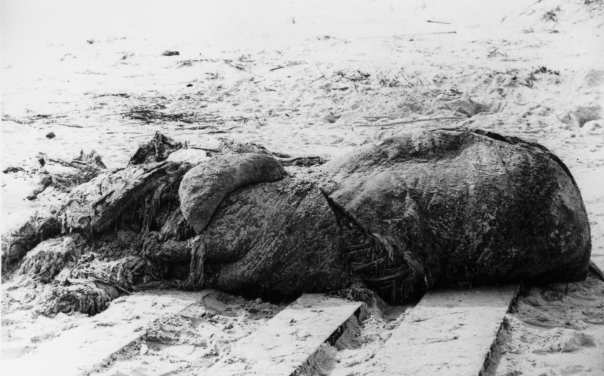
Before today, I had never heard of Globster. This is odd and somewhat troubling, as I consider myself an amateur expert in cryptozoology. Anyway, globster is the term given to any unidentified mass of organic material that washes up on the ocean shore, usually leading to wild and hilarious speculation.

Usually, it turns out, globsters are leftover adipose tissue from dead sperm whales, as was the case with the Chilean Blob of 2003, the Nantucket Blob of 1996, and Bermuda Blobs 2 and 3 in 1995 and 1997, but oddly not the original Bermuda Blob — that was a dead shark.

In rare instances, though, as in both the original Tasmanian Globster and Tasmanian Globster 2: Revenge Of Tasmanian Globster, the globster appears to have organs or flippers or tusk-like protuberances and could be more than just the remains of some massive dead sea creature we already know about; it could be the remains of some massive dead sea creature we don’t even really know about yet.

Like the Stronsay Beast. That do anything for you? No? Maybe a gigantic octopus then. Or Trunko.

They all could be out there, in the sea, just begging for us to study them and hopefully domesticate them in some way we haven’t figured out yet. And then they wash up dead on shore, and people are just like, oh hey, it’s just another globster, probably just some adipose tissue from another dead sperm whale.

But what if those are the keys to unlocking the mysteries of the deep, and we’re just dismissing them as more dead whale fat? Maybe if we could come up with a name less silly than “globster,” we’d take them a little more seriously.

From the Wikipedia: Action Park

Today’s From the Wikipedia comes upon request by multiple readers, but does not aim to make light of the numerous deaths — at least six, according to the Wikipedia — that occurred at the theme park in question.

It does very much aim to make light of the horrible, horrible planning that led to said deaths, and I sincerely apologize if anyone out there lost a loved one due to the carelessness and downright stupidity involved in the creation of these rides. Death due to any circumstance — theme park mishap, bear attack, leprosy, whatever — is tragic and not funny, and please do not take this post to imply otherwise.

From the Wikipedia: Action Park.

Action Park was a water park and motor-themed park that opened in Vernon Township, New Jersey in 1978 and stayed open, against all odds, for 18 years. I’ll quote the Wikipedia directly:

Many of Action Park’s attractions were unique. They gave patrons more control over their experience than they would have at most other amusement parks’ rides, but for the same reason were considerably riskier.

In other words, unlike most theme parks, Action Park made no attempt to idiot-proof its rides. Then, as if to tempt fate, they put it right in the middle of New Jersey.

(That’s not to say, of course, that everyone in New Jersey is an idiot. Plenty of the most brilliant readers of this very blog are from Jersey. It’s just that every place in the world has idiots there, and the suburban New York variety of idiot is a particularly brazen and callous idiot, like the cast of Jersey Shore or 30 percent of the drivers on the Turnpike — precisely the type of idiots that strike me as likely to injure themselves if trusted with their own safety on theme-park rides.)

Oh, and they served beer there. Brilliant.

The Action Park Wikipedia page is amazing. Absolutely, blisteringly amazing. It basically goes into detail about how every single ride contained serious design flaws that led to injuries. It’s far too long to even summarize here.

The best part is that I remember most of them. I used to go with my family about once a summer. On my block, we called it “Traction Park,” though other nicknames listed on the Wikipedia include “Class Action Park” and “Accident Park.”

We called it Traction Park and we went anyway, because no matter how dangerous it was, Action Park was still really, really fun.

The Wikipedia mentions that the Go-Karts were regulated by governor devices which limited their speed to 20 miles per hour, but that park employees knew how to disable the governors so they could race the Go-Karts at up to 50 miles per hour when the park was closed.

I didn’t know that backstory, but I’ll tell you this much: I sure remember that every once in a while, one Go-Kart in the race would be zipping around the track about twice as fast as the rest. No joke. Amazing. My dad got one once. He was terrified, but at the same time really proud to have so handily beaten my brother and me in the Go-Kart race.

Even the mini golf course at Action Park was dangerous. Why? You guessed it: Snakes.

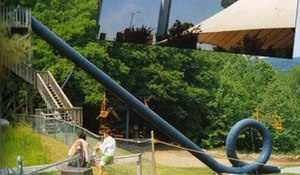
The biggest and best symbol of all that was awesome and ridiculous about Action Park was the looping water slide. A water slide with a loop-de-loop. How would that even work? You’re not harnessed into anything, like you are on a roller coaster. Doesn’t seem to make any sense, right? But it made perfect sense at Action Park.

The Wikipedia claims it was actually operated on occasion, but I never saw it open. And anytime you asked anyone about why it was closed, you always heard the same thing:

“Some fat guy got stuck in there and drowned.”

It turns out that was probably an urban myth, as were the stories that crash-test dummies sent down the tube to test it out came back dismembered. But who really thought a looping water slide was a good idea?

The Action Park people, that’s who.

Some of the Action Park rides are still open today at Mountain Creak Waterpark, but the Wikipedia mentions a “vastly increased emphasis on ride safety,” which I’ll take to mean they’re “incredibly lame now.”

From the Wikipedia: Victor Gruen

I spent about six hours wandering around the Palisades Mall yesterday, and based on empirical evidence, I’d say it’s a pretty safe bet you did too.

From the Wikipedia: Victor Gruen

Architect Victor Gruen was born Viktor David Grünbaum in Vienna, but changed his name when he emigrated to the United States in 1938. He didn’t do anything particularly interesting until the mid-1950s, when he designed the first surburban open-air mall outside of Detroit, then the first enclosed mall in the U.S. in Edina, Minnesota.

For this, Gruen’s name is given to “The Gruen Effect” or “The Gruen Transfer,” the experience a shopper has when he enters a mall, becomes disoriented, forgets what he came for, and ends up ambling around the mall looking at shiny things in store windows.

That’s intentional. Gruen himself would, later in life, speak out against intentionally manipulative architecture, but his name is now inextricably linked to it. Shopping-mall designers want you to get lost in their creations, kind of like how casino designers want you to have no idea what time of day it is. The end is the same: You keep spending money.

For a shopper — even one familiar with the mall in question — it takes an inordinate amount of will power to enter the mall focused on a single purchase, make that purchase and leave without being distracted by something at some other store. Often, a mall will have nooks and crannies that force you to look directly at other stores, rather than present an unobstructed view straight down any hall.

Note that in most malls, you can’t see an exit from any of the main shopping areas. It’s never just a long hall with stores on both sides and a big door at the end. That would make it too easy to escape.

The most downright Gruenizing mall I’ve ever been to is the hilarious Mall of America outside Minneapolis. It’s a complete maze, and it’s got like seven Orange Julii. And an amusement park. And an aquarium. I spent a full day there once in lieu of actually checking out Minneapolis.

The funniest instance of the Gruen transfer, of course, occurs in the movie Blues Brothers, when Jake and Elwood drive into the Dixie Square Mall while fleeing from cops, then, in the midst of a high-speed pursuit, become taken with all the shopping options.

“This place has got everything.”

Gets me every time.

I’m not saying the Gruen effect is a bad thing, of course. It just is what it is. I’m from Long Island, so I’m contractually obligated to like shopping malls, even if it’s more of a grotesque fascination. It’s just funny to me to hear people say things like, “Oh, that mall sucks so much, I always get lost there,” when, in fact, that means the mall has done its job.