Player spotlight: Darin Gorski
Reply

I spoke with Val Pascucci before yesterday’s double-header. Obviously.
Ted Berg: So when did you find out you were coming up?
Val Pascucci: After our last game in Scranton, we finished the game there and Tim Teufel called me into his office to basically thank me for having a great season and everything I did over there. Then he said, “And it’s not over yet, they’re calling you up to the Mets. Keep it going over there.”
TB: What’s going through your head when you hear that?
VP: Well people were kind of whispering about it throughout the week. After Sept. 1 when they called [Josh] Satin up, people were saying there’d be more moves after the season ended. So I was looking forward to that, hoping to be one of them or at least be in the talk. When I finally found out, it was just great. I think it was a seven year absence since Montreal. I was just excited to get everything together and get up here.
TB: What do you remember from your last time in the Majors?
VP: The last time, I got to play against the Mets in the last game ever as a Montreal Expo. We finished in Shea, so that was something I always remember. I had a good day that last game against Tom Glavine. I think I went 3-for-4 or something, so that was a good day for me. But just being there – that was my first time up, and I got to go up and down a couple of times that year.
TB: And then after that season you went to Japan?
VP: I went to spend ’05 and ’06 over there, with Bobby Valentine’s team. We actually went to the World Series in ’05.
TB: How’d you come to that decision?
VP: Well, the season ended and I was actually still on the roster, but I got a couple of random phone calls from international agents saying Japanese teams were interested in me going over there. And then once I found out I told my agent about it, and he looked into it to see who it was and one of the teams was Bobby Valentine’s team. I went and met with him in New York. He told me all about it and I said, ‘Why not? Let’s do it.”
TB Was it about the money, or just the opportunity?
VP: It was just to get a chance to play every day. Bobby had seen my numbers and said, ‘I can’t believe you haven’t had more of a shot in the big leagues with all the numbers you put up for Montreal. I want to give you a chance to play every day, and if you come to Japan you’ll have that chance -– you’ll be playing right field for me every day.” I was excited about it, and the Expos were switching over to the Nationals and they had a new GM coming in -– [Jim] Bowden. My agent asked him what the plans were for me and he didn’t really have an answer, so it seemed like a good choice to have a chance to play every day, and it happened to be in Japan.
TB: You mention the numbers — and we’ve talked about this before — but do you ever look at them at scratch your head a little bit about why you haven’t had more shots?
VP: Like I said before, all I can do is go out and put up the numbers and hope somebody takes notice. I had another good year of doing all that, and I got a nice reward from the Mets for it. So I guess the perseverance pays off in this case.
TB: You joined the team in Florida, I know — What’s it like being back in a big-league clubhouse?
VP: It was nice. I walked in and it was like I knew everybody already –- it’s not like walking in somewhere where you don’t know anybody. I played with a lot of these guys in the Minor Leagues, and then, being in big-league camp got to play a few days. It was nice. I got in and it was a warm welcome; people were excited to see me. They knew some of the numbers I had put up already, so they were happy for me to be here.
TB: I assume some of these guys picked your brain a bit about pitchers in Triple-A. Is there a sort of role reversal now that a few of them have been up a while and you’re just joining the team?
VP: A little bit, yeah. There are a lot of guys who have faced guys who have been here that I haven’t seen in a while. They have the videos here and everything, and I’ll see ‘em and be like, ‘Oh yeah, I remember facing this guy three years ago.’ But he’s here now and if I haven’t seen him in a while, I’ll talk to someone. [Nick] Evans and I were looking at the starting pitcher yesterday — I faced him a couple years ago. Stuff like that — guys who have been around, I ask them what they’ve seen from different people.
TB: Has Terry Collins or anyone said anything to you about what to expect in terms of playing time?
VP: Not really. There are a lot of guys here, guys who have been here and pinch-hit and have that role. I’m ready to go whenever they need me. If I get in the starting lineup that’s great, if they call on me to pinch hit, I’ll be ready to go.
With two out and none on in the eighth inning of the second game of a double-header between the Mets and Braves on Thursday night, Jason Bay squeaked a single past the shortstop. Willie Harris left the on-deck circle and walked toward the Mets’ dugout. As Harris stepped down the stairs toward the bench, up came Val Pascucci.
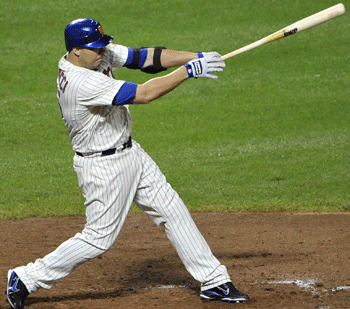 When the stadium P.A. announced Pascucci into the game, the thousand-some fans left in the ballpark cheered — some politely, some heartily, some with the type of slap-happy fervor brought on by 17 innings of underwhelming baseball spread out over six and a half hours.
Pascucci’s last at bat came at Shea Stadium, which no longer exists, for the Montreal Expos, who no longer exist. He went 3-for-4 in that game, but after the season signed with the Chiba Lotte Marines when manager Bobby Valentine promised him regular playing time and the new Nationals management could not.
He played two seasons in Japan, then returned to the U.S. and played five years of Triple-A ball in five different home cities and for five different organizations.
“This guy’s a legend in my office,” said a voice in the press box when Pascucci stepped to the plate. “A mythical legend.”
“A mythical legend?” someone asked. “What the hell does that mean?”
“Well… he hits a ton of home runs in the Minors every year,” said the first voice as Pascucci took strike one from Eric O’Flaherty.
A cowbell clanged out through stretches of empty seats in Citi Field’s upper deck. “Everybody hit!” someone yelled from the field level.
O’Flaherty fired a fastball and Pascucci swung over it, a massive uppercut. With an 0-2 count, the pitcher threw a slider below the strike zone, and Pascucci laid off.
After a pickoff attempt, O’Flaherty hung a slider over the middle of the plate. Pascucci lined it into left field, his first Major League hit in six years and 342 days. Pinch-runner Jason Pridie jogged out to first base, and Pascucci returned to the dugout.
I loved bologna sandwiches when I was a kid. They were my go-to elementary school lunch: Bologna and cheese on white bread, dry. I don’t know when or why I grew out of it, but by the time I worked in the deli I found myself somewhere between suspicious and judgmental every time an adult came in and ordered a bologna sandwich.
Why do kids and adults have such starkly different tastes in food? Is there science on this? It seems like kids generally prefer simple, unsubtle food. I know taste buds supposedly change, but are kids’ taste buds not fully developed or something?
Wait, focus: I got a Barbecued Beef Bologna sandwich from Blue Smoke in Citi Field’s center-field concourse. It looked like this:
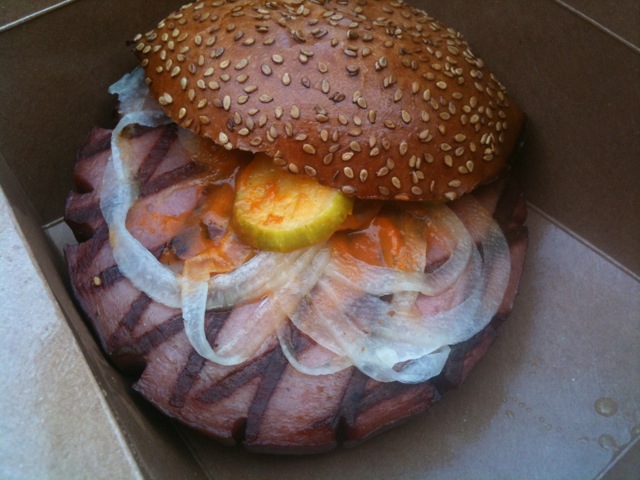
That’s a sesame-seed brioche bun with pickles, onions, barbecue sauce and a huge, huge hunk of bologna. You can’t tell from the picture but the meat has got to be almost an inch thick — unlike any bologna I’ve had before.
The sandwich tasted a lot better than I expected it would given my apprehension about the bologna. Barbecue sauce and pickles, you might know, make a great combination of sweetness and tanginess. I’m not normally a big fan of the onion but these were sliced so thin that they hardly affected the texture but still provided a nice bit of flavor.
That bologna, though. It wasn’t that it was awful — the flavor was hot-doggy and good and matched well with the rest of it. It’s just that the texture of a giant bologna steak… it’s weird. It’s almost too tender, like meat-nougat or something. I hoped the barbecuing might mean some crispiness to the outside but that wasn’t the case.
If bologna is your thing, by all means, check this sandwich out. It’s about as good as I can imagine a bologna sandwich being. But for my money, if I’m going to Blue Smoke I’d much rather have the pulled pork or fried chicken sandwiches.

Via Jelisa Castrodale.
Daniel Herrera throws a pitch not often seen in the professional ranks these days: The screwball. Before Thursday’s double-header, I asked him and his catchers about it. I included my questions below where necessary:
 Herrera: I learned to throw it in college. When I was a freshman I had a pretty bad changeup, and I dropped my arm slot to get more movement on my fastball. I started fooling around with grips and different ways to throw it, so pretty much I was just kind of pronating my changeup more and more until the spin was on the side. And eventually the spin started getting on top, moving like a curveball.
It was just messing around with a lot of things, a lot of trial error with what would hurt my arm and what wouldn’t. It definitely puts a lot of torque on my arm, but thankfully my elbow has held out.
I started throwing it in games my sophomore year in college. Since then it’s been my bread and butter pitch. I don’t think I’d have much of a chance if I didn’t have it.
I use it more heavily to righties. For lefties, it kind of comes back to them. I still throw it to lefties quite a bit, but I favor it to right-handed hitters.
Me: I read that you throw it with the index finger off the ball.
Herrera: (Grabs a ball and demonstrates the grip. It looks like a circle change, but with the index finger bent behind the knuckle of the thumb and a big space between the middle and ring fingers. The middle finger runs along one seam, with the ring and pinky fingers gripping the opposite side of the ball.) Yeah, I use the horseshoe to really pull down the ball. These two fingers (the ring and pinky) are basically for comfort, and the thumb just holds it in the hand. But the index finger is definitely off the ball.
When I release it, it’ll be right around here (turns his hand over so the circle made by his thumb and pinky faces straight down). Same arm slot, just a different release.
I know that hitters can see it more than my other pitches because it goes up out of the hand. It’s the only pitch that goes up before it comes down. Everything else is straight and then starts moving, and the breaking ball kind of goes around like a Frisbee. The screwball, when I do throw it, goes up.
Me: Do you know of anyone else that throws the screwball?
Herrera: I’ve talked to an old pitching coach I had with the Reds, Tom Browning. He used to throw it back when he pitched, but I don’t know anyone else who throws it now.
Mike Nickeas: His first day was in Washington. He came in, and I hadn’t had a chance to talk to him about his stuff. I heard he had a screwball. It was pretty neat. I was pleasantly surprised — he’s really effective. He throws the big one that acts like a curveball from a righty, and he has one that he throws lower that kind of dies before it gets to the plate.
It moves a lot, and the speed change is really dramatic. A lot of guys get out on the front side, and it’s a great pitch for groundballs -– easy outs.
I’ve never seen one before. It’s something that was new to me, and I was kind of nervous in anticipation, waiting to see what it was going to do. And it was pretty good, I was impressed.
Me: Is it a tough pitch to catch?
Nickeas: The knuckleball’s tougher just because it’s unpredictable. Once I get a feel for Herrera, I know which was it’s going to go. The knuckleball’s still the worst thing you have to deal with as a catcher.
Josh Thole: It’s a good pitch. It’s different. It looks like a changeup more than anything, but it’s different when you know what’s coming. I don’t know what it would look like when I’m hitting.
It’s the first time I’ve ever seen one. I’ve seen it on TV and all that, but it’s different. It’s an effective pitch for him. It moves pretty much like a right-handed curveball, I guess is the best way to put it.
Ronny Paulino: I think the knuckleball is more difficult. It’s weird rotation, no question. It’s weird; I faced him but it looked totally different. It looks different when you face him and when you catch it. It’s hard to explain.
He’s not this good, of course. If Evans had enough at-bats to qualify, his park- and league-adjusted 146 OPS+ would be good for 11th best in the National League — an upper-echelon run producer. But of course if Evans had enough at-bats to qualify, he probably wouldn’t maintain this level of excellence. Exciting as it is, this is a tiny sample.
Still, what can we take from Evans’ awesome late-season surge? For one, if he keeps up anything close to this pace for the rest of the season it’s hard to imagine he’ll be able to move so free and easy through waivers moving forward. Plus, if he keeps this up for the rest of the season, it’s hard to imagine the Mets would want to demote him anyway.
For another, if he maintains something close to this level of production, the Mets have to add him to their growing list of good-looking young hitters whose bats merit regular plate appearances but who lack an obvious position to play. If Ike Davis is healthy and back as the team’s everyday first baseman in 2012, the Mets will have Daniel Murphy, Lucas Duda and possibly Evans vying for jobs at uncomfortable or unfamiliar spots.
This is a discussion for the offseason, really, when we have more time to think about it, a better sense of what players the Mets will pursue, and more evidence to show how Duda and Evans will hit in the Majors.
I know I keep coming back to this, but it’s hard to think about the Mets’ crop of decent young bats and not look at the not-decent and not-young bat they trot out to left field almost every day.
Jason Bay is likely to play better defense than all those guys, but if he keeps hitting the way he has been this year it’s easy to envision a scenario in which one or several of the homegrown guys can more than make up the difference on offense.
With Toby and Patrick, and special guest Maury Brown from BizofBaseball.com. Come for the actual substantive stuff with Brown, stay for the Army of Pelfreys conversation at the end.
On iTunes here.
Breakdown:
Open (Triskaidekaphobia)
2:30: Email about closers
6:30: Danny Ray Herrera
15:00: David Wright’s Defense, and David Wright
29:30: Maury Brown on ramifications of Einhorn news
1:08:00: “Nick Evans is Totally Sweet”
1:15:00: Minor League Playoffs (and Johan Santana)
1:25:00: Patrick’s wonderful hypothetical … Never Ending Marlins or Eternal Pelfrey?
 Tedquarters