
Wright: Right?

From Rob at Amazin’ Avenue:
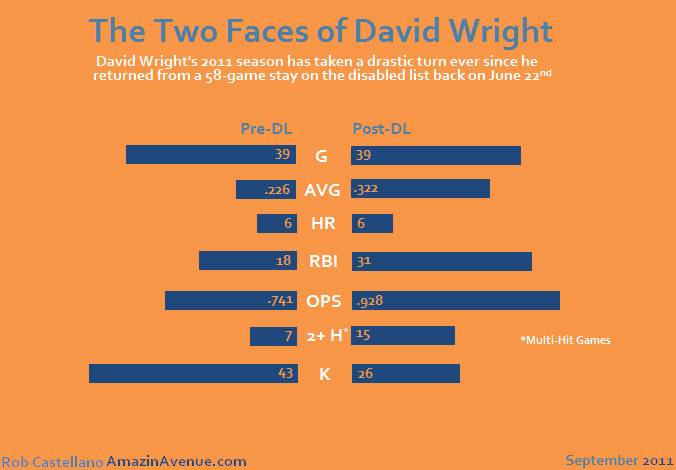
So it turns out baseball players perform better when they’re not playing with a broken back. Hmm.

There may be something else happening here, too. Even before Wright played hurt, he was striking out a ton. He whiffed 17 times in 70 plate appearances in 2011 before April 19, when he collided with Carlos Lee. That’s a 27.1 percent clip, above even the 24-percent standard he set for himself in 2010. All told, he struck out once every four plate appearances until he went on the Disabled List on May 15.

Since his return, Wright has struck out in 15.6 percent of his plate appearances, a pace much more in keeping with the 16.4-percent rate he kept from 2004-2008.

Of course, it’s hard to draw meaningful conclusions from such small samples. But even looking at the full season, Wright’s K-rate has dropped from last year while his walk rate has improved. Wright’s 135 wRC+ leads all Major League third basemen with at least 300 plate appearances, and that is, obviously, including his rough first stretch of 2011.

Even if those struggles had nothing to do with Wright’s injury and the split Rob depicts above is pure randomness — which seems unlikely — Wright is still a really, really good player. If he made some meaningful adjustment in his time off and the difference in his two halves indicates a return to form, then Wright is again a superstar. He does appear to be standing closer to the plate, though it’s hard to imagine the explanation could be that simple.

It’s also worth noting that third basemen in 2011 have hit a whole lot worse relative to the league than they usually do. Players at the hot corner, normally an offensive position, have out-produced only shortstops this season (by OPS). Seattle Mariners third basemen have a .505 OPS in 2011.

In love and WAR

Hippeaux at It’s About the Money investigates the problems with the super-stat WAR. A good read. I generally avoid using the metric, if not necessarily for the reasons Hippeaux lists then because I find it massively un-fun to rely on a single imperfect stat to compare baseball players. It’s good for quick-and-dirty evaluations, but I’d always rather see the components of a player’s WAR than his WAR itself.

Enter Val Pascucci

A lot of your friends and family ask, “What else do you have to do?” And I always tell them the only thing I can do is go out there and hit the ball and hope somebody takes notice.

Valentino Pascucci.

Yesterday the Mets announced that they selected the contract of 32-year-old first baseman Val Pascucci from Triple-A Buffalo. Pascucci will join the team in Florida later today.

Back in 2008, when Pascucci was mashing for the Mets’ Triple-A affiliate in New Orleans, I participated in an enthusiastic but ultimately fruitless Internet campaign to get the hulking slugger on the big-league team. That club, in the thick of a pennant race, filled the fringes of its roster with guys like Marlon Anderson, Robinson Cancel and Abraham Nunez and unironically gave 25 pinch-hitting opportunities to Argenis Reyes. Pascucci posted a .963 OPS in Triple-A but never got the call; at one point, manager Jerry Manuel admitted he had never heard of him.

The Mets, as you probably know, fell one game short of the playoffs that year. In the weepy final game of the season, they used Anderson, Cancel and Damion Easley to pinch hit.

In the three seasons since, Pascucci has continued crushing Triple-A pitching. In seven years at baseball’s second-highest level, Pascucci has 159 home runs and a .902 OPS. It is the stuff of Pat Misch’s worst nightmare.

Yet Pascucci can boast only 62 Major League at-bats, all of which came for the Montreal Expos in 2004. Meanwhile, five American League teams have received OPSes of .730 or less from their designated hitters in 2011. Seven did in 2010.

Few professions are as closely and objectively tracked as Major League Baseball, so it seems the sport should be a meritocracy. Guys who fail and continue to fail at the Major League level should get weeded out; guys who torch Triple-A pitching every single year should get more than 62 chances to show what they can do in big leagues.

Only it doesn’t always work that way. Players get labeled — “Major Leaguer” or “Quadruple-A slugger” or “closer” or “organizational guy” — and the labels stick. Guys wind up in systems that never have the right need at the right time.

Maybe if five more balls off his bat found holes in that 2004 stint, Pascucci would have had a long and productive career as a right-handed bench bat, an Olmedo Saenz type. Maybe if he played in the Padres’ system last year instead of the Mets’. Maybe if he played in the Mets’ system in 2009 instead of the Padres’. Maybe if he posted the exact same numbers but hit left-handed.

None of that happened though, so Val Pascucci stayed in the Minors, crushing homers, taking walks, striking out, doing right by the city of Buffalo.

And it seems either ruthlessly ironic or perfectly fitting that the Mets call up Pascucci now that they don’t really need him, when they have bench-bat types in spades, guys that are younger and faster and a bit more versatile on defense. Pascucci’s second turn in the Majors comes as a reward, a month’s worth of big-league salary and a handful of at-bats for years of dutiful Minor League mashing.

But he joins the Major League Mets regardless, and maybe with that handful of at-bats… who knows? Perhaps Pascucci shows enough in a short sample to convince some other club he’s worth more than a spot on a coach bus and a couple of asses in Triple-A seats. Doesn’t seem likely, but then with baseball being baseball, sometimes things play out in unpredictable and awesome ways.

Does Einhorn exit mean Reyes is gone?

Adam Rubin investigates for ESPN New York.

Sandy Alderson says:

It’s very difficult, unless you’re one of a couple of teams, to have three, four guys making $15 million-plus. I don’t care who you are — again, with the exception maybe of a couple of teams. So I would expect we’ll be looking actively in the free-agent market, but we’ve got to get it to a position where we can be active every year and not be hamstrung by existing contracts. Part of that is making good decisions in the first place. I mean, if you invest $15 million, you hope you’re going to get $15 million worth of performance. We haven’t always gotten that.

It’s an obvious cop-out to say, “we’ll have to wait and see,” but, well, we’ll have to wait and see, right? We’ll have to wait and see if the Mets pursue Reyes, how much Reyes winds up getting and from whom, and where the team’s 2012 payroll winds up.

Alderson mentioned “the $100-$110 million range,” but in a pretty abstract way. It’s reasonable to extrapolate from the comment that the payroll will drop to that range, but it’s not like he explicitly said the team has a hard cap at $110 million.

The bright side, I suppose, is that the Mets have a bunch of Major League contributors that aren’t even eligible for arbitration yet. In Ike Davis, Daniel Murphy, Josh Thole, Justin Turner, Ruben Tejada, Lucas Duda, Nick Evans, Jason Pridie, Jon Niese, Dillon Gee and Pedro Beato, the Mets should be able to adequately fill at least four positions, most of the bench and two starting rotation slots with guys making barely more than the league minimum.

But naturally we don’t know yet if that will provide them enough flexibility to bring back Reyes.

Make this happen

Position-player candidates to be called up: first baseman Valentino Pascucci and outfielder Mike Baxter. The 32-year-old Pascucci, named Triple-A Buffalo’s MVP, last appeared in the majors in 2004 with the Montreal Expos.

Adam Rubin, ESPNNewYork.com.

Do the Mets stand to gain much by calling up Val Pascucci? Not really. He’s 32, defensively limited, and probably not a big part of the team’s future.

Should they? Hell yes they should. Make this happen.