Which would be great, because it would mean Barry Bonds could get in as soon as next year…
Hall of Fame wait could be lowered to three years
Reply

Which would be great, because it would mean Barry Bonds could get in as soon as next year…
This is a pointless hypothetical, but I’m just wondering:
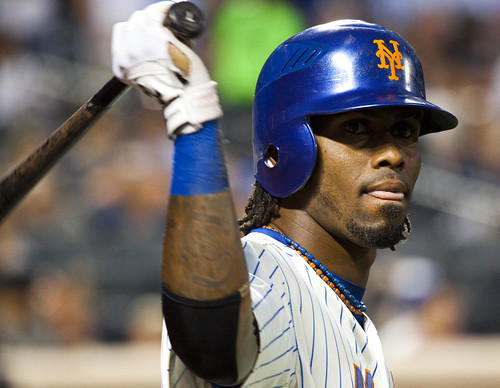 If Jose Reyes were doing this for, I don’t know, the Brewers, and there was talk that the Mets wanted to pursue him as a free agent this offseason, how do you think you’d feel about it?
Because I’ll say this: If that were the case, knowing what I know about myself, how I often approach baseball and how I fixate on stuff, I fear I might be filling up this site with long, boring screeds about why the Mets shouldn’t be pursuing Reyes.
I’d point to the history of injuries, mishandled or not, and say how bad an idea it would be to get involved in a long-term deal with a player that has already demonstrated a shaky-at-best ability to stay on the field. And I’d argue that signing a guy to a huge contract coming off a batting average-fueled career year represented a potential buy-high mistake.
Of course, I’ve watched Reyes play this season, so I’m biased toward the man and can’t actually think that. Plus, even if Reyes comes back to Earth a bit — as he almost has to — he’s still an elite 28-year-old shortstop, not the type of free agent that hits the market very often.
Ultimately, I suppose, it comes down to how much money and how many years it will take to lock him up. Obviously.
Fun fact: I got kicked out of the National Honor Society in high school. Among other transgressions, I used to show up to the “mandatory,” rarely used free tutoring availability we provided younger students, tape a sign somewhere that said, “wake if you need tutoring,” then put my head down on the desk. It was a wise-assy thing to do; I can hardly sleep in my own bed, no less on some hard desk in a high-school math office. I just wanted to make some stupid point about my having to give up my one free period for a service no one ever took advantage of. Meanwhile I could have just not shown up at all, or not applied to the National Honor Society in the first place. Confusing time, high school.
Anyway, in the last few hours, the news cycle on Carlos Beltran trade rumors has turned over three times. He has been speculatively traded, then not traded, to the Braves, Giants, Phillies, Rangers and Red Sox. The Mets are getting back a top prospect, or not a top prospect, or a collection of mid-level prospects. The Mets could sweeten the deal with another player, or they will refuse to trade anyone but Beltran because this is by no means a fire sale.
The trade deadline is supposed to be good for traffic around these parts, but it sure hasn’t been here, so presumably you’ve caught on by now that I don’t get too worked up over all the rumors and speculation this time of year. Consider this the blogging equivalent of me putting my head down on the desk in the math office. I don’t care to continue keeping up with the Carlos Beltran trade rumors. We’ll see what the Mets get back in a trade for Beltran if and when the Mets trade Beltran.
Of course, again I’m full of it. I can’t sleep on desks and I can’t pull myself away from this nonsense every July. Just allow me to maintain some sense of ironic detachment, is all.
At Baseball Prospectus, Colin Wyers explains why the site is abandoning its ERA estimator SIERA and details some of the failures of that stat and xFIP compared to FIP and plain-old ERA. It’s a dense read, but worth the effort. It’s a good reminder that all the best efforts to assess baseball teams and players are always works in progress. It’s fun — and valuable, in my opinion — to stay up on the latest thinking, but if you want to cite any one stat as gospel, you should remember that there’s a pretty good chance it’ll go out of vogue within a couple of years.
It is a perennial late-game conversation starter at Giants home games: “How do the gulls know to swarm to the ballpark during the ninth inning?”…
This season, the Western gulls, which nest on Alcatraz and other nearby shorelines, have been swooping into stands even earlier, gobbling up dropped fries, soiling fans and prompting officials to consider using falcons to chase them away.
Do it. Do it.
Of course, the article goes on to detail how the falcons would be professionally controlled, curtailing my fantasy of a scenario wherein the Giants were then forced to bring in some larger bird of prey to control the out-of-control falcon population, and so on, turning every night at AT&T Park into an airborne avian royal rumble.
Also, it’s worth noting that I really hate seagulls. Like way more so than most urban and suburban scavenger pests. Is that worth noting?
Matt passes along this heartwarming story about a generous young baseball fan in Arizona. Pretty awesome.
Before yesterday’s game, Terry Collins asserted that he did not feel David Wright needed to be eased back into the lineup, but that Carlos Beltran would still be hitting third in tonight’s game.
That seems to put Wright batting cleanup against right-hander Chris Volstad.
I don’t want to go too crazy over this because a lot of work has been done to show that batting orders don’t mean all that much. But I wonder if a case could be made for Wright hitting second, stacking the Mets’ best hitters at the top of their lineup.
Of course, before I go on I should note that a lot of this depends on who’s playing first and second base. Daniel Murphy should play every day. We’ll see how Collins handles it, but with Lucas Duda still around and hitting well of late, it seems like Murphy should play second against right-handers with Duda at first. Justin Turner can play second against lefties with Murphy sliding to first, effectively platooning Turner and Duda*.
Does that sound right? It would mean regularly moving Murph around the right side of the infield — which sounds a bit scary, but he’s already been shuttled around the diamond most of the season and has generally handled it well. I suppose Turner could enter late in games for defense, or pick up some starts with groundball-heavy guys like Jon Niese and R.A. Dickey on the mound.
Anyway, I guess the way I’m thinking is this:
Against righties: Against lefties:
Reyes — 6 Reyes — 6
Wright — 5 Wright — 5
Beltran — 9 Beltran — 9
Murphy — 4 Murphy — 3
Pagan — 8 Pagan — 8
Duda — 3 “Jason Bay” — 7
“Bay” — 7 Paulino — 2
Thole — 2 Turner — 4
Wait, hold on. This is a ridiculous exercise. First of all, Wright and Murphy could easily be swapped and then no one would freak out about a non-traditional No. 2 hitter batting behind Reyes. Since Beltran, Reyes and Pagan all hit switch, it wouldn’t even ruin the very Jerry Manuel lefty-righty thing I’ve got going on in the lineup against righties.
But more importantly, am I operating in the real world or fantasyland here? The Mets aren’t going to bat David Wright second, right? So if I’m taking it that far, why am I still operating with Bay in the lineup against pitchers of both hands? Why’s the pitcher batting ninth?
Seriously, just ignore me. None of this matters. We’ll find out the lineup in like an hour.
*- Unless Jason Bay’s hamstring or general ineffectiveness opens up more time for Duda in left field.
The Mets’ starting rotation has not been particularly good in 2011. The best pitchers on the staff have thrown like league-average innings eaters, and the worst have thrown like Mike Pelfrey. They have combined for a 3.89 ERA, which, though slightly better than the NL average of 3.92 for starters, is underwhelming when you consider that they pitch half their games in Citi Field.
 Still, if the Mets starters have not been stellar, they have been remarkably (knocking wood) stable in 2011. Since Dillon Gee replaced Chris Young in the rotation in early May, none has missed a start. And — though this is likely partly due to the change in managers as well as the change in personnel — Mets starters seem to have cut out the disastrously short appearances we became accustomed to in the last couple of seasons.
In 98 games so far, the Mets have had nine starts shorter than five innings. Of those, only two starts have been less than four innings: D.J. Carrasco’s 3 2/3-inning spot start in April, and R.A. Dickey’s 2 2/3-inning effort in Chicago in May when he tore his plantar fascia.
Last year, Oliver Perez alone had three starts of less than four innings. So did John Maine. By my count, the 2010 Mets totaled 28 starts of less than five innings and 14 starts of less than four.
Of course, it’s only July. There’s plenty of time for pitchers to break down, trades to cost the team some of its more reliable arms, and September callups to muddy up the picture.
And it’s worth noting that last year’s staff was better than this year’s, stability or not. Thanks to the presence of Johan Santana, a great season from Dickey and an up year from Pelfrey, that rotation finished with a 3.80 ERA. And this year’s starters have only average .1 inning more per start than the 2010 set.
Just seemed worth noting is all.
The Mets appear to need better starters for the front end of their rotation. But I wonder if a case could be made that, given the general flakiness of pitchers, a team with a good offensive core might be well served tooling up with more great hitters and building a deep rotation of pitchers good enough to keep the club in games while the offense scores runs. Innings-eaters are the new market inefficiency, or something like that.
Might hit a snag come playoff time, of course, but then there’s always a lot of randomness at play in October.
My understanding is that the Yankees are not as high on [Ubaldo Jimenez] as people have been led to believe.
– Mike Francesa, WFAN, yesterday.
This statement, in response to a caller wondering why the Yankees would pursue Jimenez when they have Ivan Nova, seems like it might mean something. But if you actually think about the words it contains, you realize it’s like six steps removed from anything of substance.
Mike Francesa is kind of awesome.
 Tedquarters