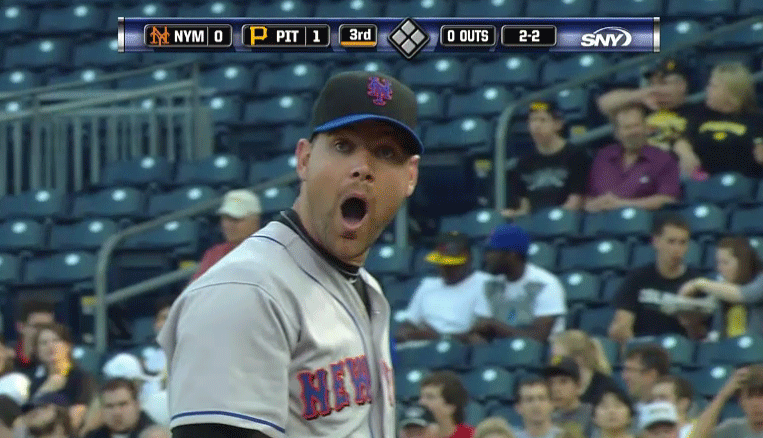
Mike Pelfrey zombie face

As far as I’m concerned, Mike Pelfrey’s performance was the highlight of last night’s Mets-Pirates game.

Not the pitching part — though Big Pelf looked great, retiring 20 of the last 21 batters he faced, striking out six and walking none and keeping the Pirates in the park.

Nay, the best part of the game came in the third inning, when Pelfrey got something in his eye and SNY’s camera caught him making all sorts of hilarious zombie faces while trying to get it out.

I tried to photoshop this to make him look like a Walking Dead zombie, but it turns out the makeup department on that show gets all sorts of credit for a reason.

The upside to being a Major Leaguer is that you get millions of dollars to play baseball for a living. The downside is that if you get something in your eye, some jackass blogger posts your reaction on the Internet for everyone to see. I happen to make a very similar face every morning when I put my contacts in. My wife taunts me for it. Luckily there are no HD cameras in my bathroom. Or SD cameras, for that matter.

Hat tip to Michael Baron for the screengrab.


Carlos Beltran doing stuff

Whenever he receives a new box of bats, Carlos Beltran takes each bat out, holds it to his ear and raps it, gently but convincingly, with the base of his hand, his head cocked, one eye shut, concentrating like a virtuoso tuning his violin….

“The higher the pitch, the better,” he said, referring to the tone. “Better means stronger and harder, more compressed.”

David Waldstein, N.Y. Times.

Mets just want the game scored correctly, is all

The Mets contacted Major League Baseball’s central offices in Manhattan after Saturday’s game, requesting a review of Andrew McCutchen’s third-inning “hit” in a 3-2 loss to the Pirates, a league source told the Daily News.

The team wants the ruling changed to an error, which would deduct two earned runs from R.A. Dickey’s line. The process will not likely be resolved until mid-week.

Andy Martino, N.Y. Daily News.

Wait: Why?

I thought it should have been an error, sure, but it was hardly the most egregious official-scoring decision I’ve seen. And it’s not like changing the ruling is going to change the outcome of the game. Someone must really care about R.A. Dickey’s ERA.


You follow drugs, you get drug addicts and drug dealers. But you start to follow the money, and you get league-average innings-eaters

Livan Hernandez is all caught up in some The Wire-type stuff. Yikes. (I say “The Wire-type stuff” because I’m in the process of re-watching The Wire, so right now everything about any large-scale drug operation and investigation is going to remind me of The Wire.) Sounds like he was mostly fronting money for a huge Puerto Rican drug-trafficking operation. Also, if you bet that this story would involve meetings at Chuck E. Cheese’s that did not include Livan Hernandez, you stand to make a lot of money right about now.

The Wright move?

Since Reyes is having an MVP-like year, I started thinking about the future makeup of the team. Nowadays, scoring is down and pitching is once again king. I believe that the Mets should keep Reyes and make him the centerpiece of the franchise. Build the Mets like the way the old Cardinals of the 1980s – pitching, defense and speed. Trade David Wright to get either pitching or position players who fits the mold. Build the team to take advantage of Citi Field’s dimensions. You probably need just one very good slugger to complement the offense. What do you think about this idea?

Willie, via email.

Well here’s the first part: I’m still not convinced the Mets need to choose between David Wright and Jose Reyes. So if you’re suggesting the Mets trade David Wright to clear salary to re-sign Reyes, I’m not sure it’s necessary. If you’re saying trade David Wright for pitching and/or players who fit a certain mold, to that I’d say this:
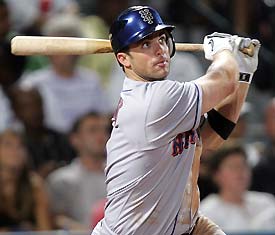
There are many ways to construct winning baseball teams. Certainly offense is down around baseball, but I’m not sure that means teams should go about trading good offensive players — in fact, it might mean exactly the opposite. If runs are at a premium, so are the players who produce them, no?

Right now, our perception of David Wright is tainted by his rough start to the year. Though logically we know how good Wright can be, our most recent memories of Wright show an injured, struggling player, so it’s easy to start hammering out trade proposals dispatching the third baseman.

But with Wright hurt and coming off the two worst seasons of his career, his value has likely never been lower. Plus, the team option on Wright’s contract for 2013 belongs solely to the Mets, meaning any potential trade partner would only have Wright locked up through 2012.

That makes Wright way more valuable to the Mets than to any other team. In other words, it seems unlikely that any competing club will offer the Mets enough for one year of Wright for it to be worth them giving up two years of Wright.

As for building a club to the park: I’m on the (very deep, asymmetric) fence. What’s the best way to tailor a team to Citi Field? Certainly you want good defenders in the spacious outfield.

Beyond that, what do you do? Do you stock up on pitching, or do you amount that opponents aren’t going to score many runs against you and focus on finding players that will produce in a tough run-scoring environment? Do you look for fly-ball pitchers? If so, what about all those road games they’ll have to pitch? Do you entirely eschew the home run, find line-drive hitters with speed and hope for rallies, or do you seek dead-pull sluggers since it appears the park is a bit more favorable to them? How many of these assessments do you base on eyeball estimations, and how many on data? And which data?

There’s a lot to it, and if I had to bet, I’d imagine when you work it all out it’s going to turn out that you want to put the best nine players you can find on the field. And I find it difficult to envision many scenarios in which Wright is not among the best nine players the Mets can find. I get that some of the crannies of Citi Field’s fence don’t suit his opposite-field power and that many believe the park has gotten into his head, but Wright — even the lesser Wright we watched in 2009 and 2010 — is still really, really good at baseball.

And from 2005-2008, Wright was a full-blown superstar. The troubles he has endured the past few seasons have been for the most part more nebulous than the ones Jose Reyes faced in 2009 and 2010. But in Reyes we now see a pitch-perfect example of how quickly and how emphatically a talented player in his late 20s can turn things around, given full health and the right situation.

Wright can do the same. It’s going to take more than a big park and a couple of rough years to convince me otherwise.

Goodbye, Dale Thayer’s mustache

After Saturday night’s game, the Mets cut reliever Dale Thayer and with him, his amazing mustache.

Thayer’s mustache appeared in four games for the Mets. The mustache defied both description and the telephoto lenses of any AP cameramen covering those games.

Thayer will head to Buffalo, but where the mustache goes from here is anyone’s guess. Perhaps it catches on above another Major League lip or takes time off to travel.

Or maybe Dale Thayer’s mustache retires into the sunset, remembered only in Flushing folklore and a couple of screengrabs.

Maintaining appearances

The Mets are at least going to give the appearance that they are trying to reach the playoffs this season, especially with the team playing scrappy baseball under Terry Collins, and probably wouldn’t deal K-Rod until close to the July 31 trading deadline.

John Harper, N.Y. Daily News.

First, I guess the Mets are kind of playing “scrappy” baseball, huh? Generally, when used to describe a specific player, “scrappy” is synonymous with “bad,” but I suppose it’s a reasonable way to characterize a club that scores a bunch of runs without often hitting home runs. Plus they’ve been playing good defense and getting solid pitching performances (the bullpen notably excepted) from a bunch of guys without overwhelming stuff. So yeah, all signs point to scrappy.

Dammit. Don’t get me wrong: Wins are the most important thing, but I miss home runs and Johan Santana.

Second, the time for assessing the Mets’ ability to contend hasn’t come yet, but I imagine if they’re really in it, they won’t just be maintaining the appearance that they’re trying to make the playoffs but actually trying to make the playoffs. And I know they’ve got financial limitations, motivation to trade a bunch of their players and some reasons to believe the starting pitching won’t hold up as well as it has so far.

But right now, even sitting in fourth place in their division, there’s still plenty of time for the Mets to assert themselves as a legit contender — as odd as that may seem to anyone who read even a single published report about the club in April. They’re winning games without Santana, David Wright and Ike Davis, and they’re hoping to get all three back before the trading deadline.

If all that crumbles, then Sandy Alderson and his crew can get about forgoing appearances and focus on improving the club’s future.