
Is it time to close the locker rooms?

Truth be known, the same notion skitters across the minds of sportswriters and athletes, too, who wonder if this ritualized behavior is worth the trouble. Before and after games at virtually every stadium and arena, reporters dutifully trek to the locker rooms for a quote or two, a postmortem, an injury update or a sliver of insight. Later comes the dash back to the computers for the deadline assault….

Let’s be clear: This is not a Woe Is Us story. Access is hardly a reporter’s entitlement, unless the assignment is the White House or City Hall. Even then, the willingness to wait out a story is a compulsory part of the job. Imagine, too, the view of an athlete, not yet showered and still absorbing a blown save or a missed shot, confronted by a swarm of notepads and microphones and pressed to answer the brain-numbing question: How do you feel?

“What do they expect you to say to that?” asks LaTroy Hawkins, a veteran relief pitcher. “And could they let you get your pants on?”

Craig Wolff, Wall Street Journal.

Wolff’s whole piece is worth reading so I urge you to click through. Essentially, it asks whether the time-honored tradition of allowing reporters into locker rooms before and after sporting events is one worth continuing.

With new facilities with deeper clubhouses springing up around sports, players can more often avoid interacting with reporters if they choose. Wolff notes one such experience at Yankee Stadium, and the same is generally true before any Mets home game. Players appear at their lockers to dress, then head to the field to do baseball stuff or recede into some other, presumably way more awesome part of the clubhouse.

Who could blame them, really? Often times, the pre-game scene in the Mets locker room features 40-odd members of the media standing around just sort of waiting for something to happen and one or two players sitting quietly at their lockers, occupied by cell phones or iPads. It’s… well, a bit weird. And I say this as one of those 40-odd members of the media.

Plus access often colors coverage. It’s no secret — especially to media-savvy Mets fans — that the players who provide good quotes and ample time to reporters often seem to receive preferential treatment in certain media outlets. I am not certain this is as nefarious as it appears; reporters become fond of the players that are friendly and well-spoken, and thus less inclined to criticize them when they struggle. See Jeff Francoeur for details.

Still — and I can only speak for myself, here — I have no doubt that access to players and the inside of locker rooms has provided me perspective that has advanced my understanding of baseball and its personalities, if not necessarily my writing.

Via Craig Calcaterra.
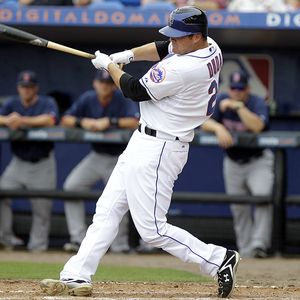
Talking about the Duda, here…

Mets officials are considering promoting Lucas Duda from Triple-A Buffalo….

The thinking is that Justin Turner, unaccustomed to this much consistent playing time at the major league level, is showing signs of wearing down at third base. Turner is 0-for-7 in this series, and hitting .220 in his past 10 games. So Daniel Murphy can see some action at the hot corner, opening first base for Duda.

Adam Rubin, ESPNNewYork.com.

I’ve made my stance on this matter pretty clear here and here, but with Duda destroying Triple-A pitching and the Mets demonstrating a wholesale lack of non-Beltran power in the lineup, calling up the 25-year-old corner bat makes a lot of sense. As Rubin notes, the Mets can still find plenty of chances for Daniel Murphy and Justin Turner at second and third, plus Duda can spell Jason Bay in left field some while everyone figures out what the hell is up with Bay.

The Mets designated Nick Evans for assignment after last night’s game to make room for Duda. Like many Mets fans, I’ve got something of a soft spot for Evans, but I suppose as long as Terry Collins is locked in to platoon matchups for pinch-hitting spots, he wants to keep the lefty-hitting Willie Harris on the Mets’ bench.

Of course, I could point out that Harris has a .545 OPS against righties this year. But while Evans torched the ball across two levels last year, he did not hit in Buffalo or in his 17 plate-appearance stint in the bigs in 2011.

Anyway, now Duda gets more chances to show what he can do at the Major League level after posting a 1.003 OPS over parts of the past two seasons in Triple-A. This is good.

Like I’ve said, Duda is the age at which he should be expected to start contributing to a big-league club, and since the Mets have their starting first baseman on the disabled list, their left fielder in an awful funk and their right fielder likely headed for the trading block, now’s as good a time as any to try to assess what they’ll get from Duda moving forward.

Outscoring your opponents is the new Moneyball

This must be the new definition of Moneyball.

The Mets don’t score many runs, and their bullpen has nearly placed the manager in a straightjacket. But the starting rotation seems almost like money in the bank.

Mike Puma, N.Y. Post.

I guess it depends on your definition of “many,” but the Mets really haven’t had much trouble scoring runs this year. They’re scoring more than the average National League team in 2011, and, adjusting for the park, their offense is top five in the circuit.


Tejadyssey

Good post from Patrick Flood on why Ruben Tejada is so fun to watch, with some excellent points about some of Tejada’s play and good quotes from Tejada and Jose Reyes. I noticed last year that during his at-bats, Tejada subtly peeked back to see where catchers were setting up. Seemed like kind of a cagey move for a 20-year-old, and I’m pretty certain it’s why he wound up being hit by eight pitches.

Jason Bay, oof

Jason Bay is hitless in his last 23 at-bats. He does not have a hit in the month of June. He has a .585 OPS, second lowest of any position player on the Mets’ roster — ahead of only Nick Evans, who has 12 at-bats. And nearly every day Bay plays left field, purportedly an offensive position.

Before yesterday’s game, Terry Collins said he planned to be patient with Bay and did not intend to change or limit the outfielder’s role.

The managerial vote of confidence is a good thing, but I hope that behind closed doors Collins, Dave Hudgens and whoever else need be consulted are considering solutions beyond just leaving Bay in the lineup and hoping he comes around. It’s not like Bay was hitting before the current ofer stretch, and it kills the club to carry a massive hole in the middle of the lineup every night.

Problem is, there’s no obvious answer. A vision test? A few days off to rest his body and clear his mind? One of those phantom Ollie Perez injuries and a rehab stint? A Steve Trachsel voluntary jaunt to the Minors?

I’m no hitting coach and I’m not in Bay’s head. But man, at some point something’s got to give. Lucas Duda keeps destroying the ball in Triple-A. Getting Bay straightened out should be the club’s top priority, but if the Mets are serious about winning baseball games, it’s soon going to become impossible for them to maintain that Bay is their best everyday option to play left field and bat in the middle of their lineup.

I hate to sound reactive and impatient, especially over a guy with so much evidence to show he really can crush Major League pitching — hard as that is to believe with how he’s going right now. But it sure seems like whatever the Mets and Bay are doing to fix the problem isn’t working.

The Kid

Carter is sick now, news that has devastated the Mets’ family and fan base. And the Mets face a disquieting choice now. Even an operation as tone-deaf as this ought to know that it should finally step up and do the right thing, have a day sometime in the next few months, put Carter’s 8 up on the wall next to 37, 14, 41 and 42.

Would it look like they would be reacting to the horrific news of Carter’s brain cancer? Maybe. And you know what? That’s tough. The Mets could’ve done the right thing on their own years ago. Now they need to give their fans an opportunity to thank and salute Carter, whether he is physically up for the task or not. And because the Mets couldn’t identify the right thing to do if it was a neon sign, then shaming them into doing the right thing will have to do.

Mike Vaccaro, N.Y. Post.

I’ve left this one alone because Carter’s health issues sort of hit close to home for me, though I suppose cancer hits pretty close to home for most people. And I’m not interested in getting into a whole thing about whether Carter’s contributions to the Mets in his five-season tenure with the club merit retiring his number, because retired numbers are a pretty subjective thing on the whole.

But here’s what I’m wondering: Has anyone asked Carter if he wants his number retired?

Carter has inoperable glioblastoma, an aggressive form of brain cancer. He is currently enduring radiation and chemotherapy treatments, which do brutal things to the body to try to slow the spread of the disease.

I don’t know Carter and I certainly can’t speak for the man. And one thing I’ve learned from this job is that baseball players — especially those of Carter’s caliber — are programmed a bit differently than I am.

But… I don’t know. Man. I guess I don’t understand why so many people seem to assume a guy staring at brain cancer wants some relatively meaningless (and inevitably grim) ceremony in his honor when he’s going through what he’s going through.

Is this something people want for Gary Carter or is this something people want for themselves? Is it all about honoring a Mets legend and “making it right”? Or does some part of this great campaign to retire No. 8 have something to do with our own sadness — not just for Carter and his situation but for ourselves and the crushing fragility of everything — and some human need to provide life with a neat climax to help us better process something that’s damn near impossible to process?

Or maybe that’s just me. Maybe I’m extrapolating too much. I loved Gary Carter when I was a kid, and if the Mets want to retire his number and he’s up for it too, then great.

Any recent news on Carter’s health has come via updates from his daughter to his family’s private website. Carter released one statement on the matter, after his diagnosis. It said this:

My wife, Sandy, and our children and family thank you for your thoughts and prayers. We ask that you please respect our privacy as we learn more about my medical condition.