ALERT:
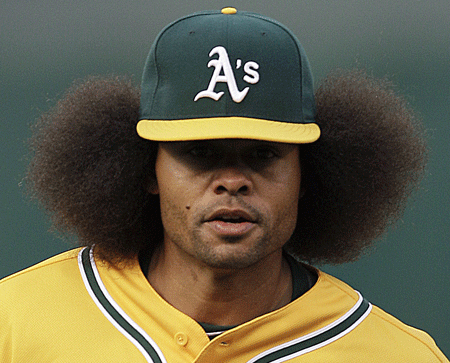
Oh my. Hat tip to Big League Stew for the heads up.

Let’s all agree never to speak of that Rockies series ever again. Moving on:
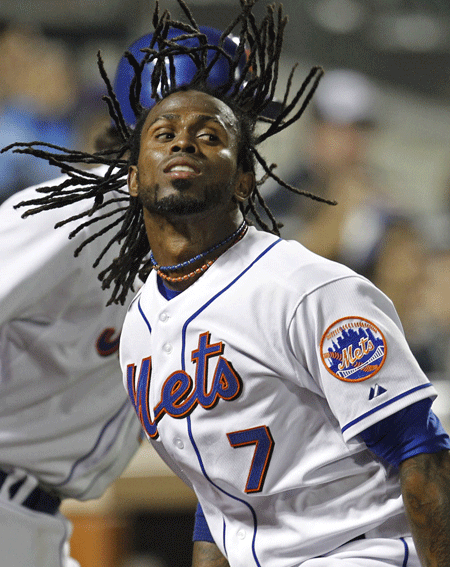 With Jose Reyes off to a hot start, there’s understandably a lot of talk about his future with the Mets. I’ve touched on this before, I know, but I want to go through it again.
People seem certain that Reyes will be gone within the next year, either traded around the deadline or allowed to walk via free agency. And indeed, it’s not hard to envision a scenario in which Reyes plays for another team by 2012. But many of the most vehement voices insist that Reyes is undoubtedly a goner because a) Sandy Alderson highly values on-base percentage and by leadoff hitter standards, Reyes does not have a very high OBP and b) The Mets’ owners have financial problems and Reyes will be very expensive to re-sign.
Let’s look at the first part first, because there’s actually a lot to unpack there.
There’s a often a weird, judgmental tone assumed when asserting that Alderson values OBP. That’s powerfully dumb. The ability to get on base is the most important offensive skill, and Alderson is absolutely right to value it in his players. Outs are a baseball team’s most precious commodity, and it behooves a team to find players who don’t give them away. Besides, hitters willing to take pitches and work deep in counts are more likely to see pitches they can drive. Plenty of people think otherwise, but it’s not really up for debate: OBP should be highly valued because OBP is highly valuable.
But the argument assumes that Reyes never gets on base, and that’s not really true. Many cite his underwhelming .335 career on-base percentage, but that number includes his first few seasons when he probably shouldn’t have even been in the Majors. Since 2006, Reyes has a .348 OBP, still not wonderful but well above the roughly .332 clip averaged by National League shortstops in that time.
Reyes is not Rickey Henderson, but no one is. Rickey Henderson was a unique player and the greatest leadoff hitter of all time. He also primarily played left field, an offensive position. Reyes plays shortstop, the most premium defense position.
That can’t be overstated. Saying that Alderson will not retain Reyes because Reyes doesn’t have an overwhelmingly high OBP not only massively oversimplifies the situation, but undercuts both Alderson and Reyes.
Presumably Alderson evaluates players on more than just OBP, and Reyes provides value beyond his ability to get on base — even in the eyes of a guy like Alderson who (rightfully) doesn’t put too much stock in the stolen base. Reyes plays good defense at the hardest position and provides more power than most shortstops. Those are valuable abilities. You have to figure Alderson knows, as you and I do, that you can’t just plug Daric Barton in at shortstop and reserve a spot in the playoffs because he gets on base a lot.
It’s worth noting before I move on that in 2010 Reyes endured his worst season in that stat since 2005. He missed most of Spring Training, recall, with thyroid issues and struggled with an oblique injury that led to — absurdly — the Mets deciding he should exclusively hit right-handed. Reyes has chalked up his drop in OBP to being overeager after missing so much time.
In a tiny sample of at-bats this year, Reyes can boast a batting-average fueled .349 OBP, and only two walks. Though it’s way too early to read much into this, he has seen 3.86 pitches per plate appearance in 2011, above his 3.68 career norm and a higher rate than he has in any single season. (If that seems like a very slight difference, it is, but consider that the full range of the stat for Major Leaguers is generally about 3.1-4.5.)
As for part b) above, the one that concludes the Mets will not be able to keep Reyes because the Mets have no money. Obviously I don’t have access to the Mets’ or the Wilpons’ financial books, but assuming that because the owners are in financial straits the team has no operating budget whatsoever seems like another vast oversimplification. Even when Citi Field is as empty as it has been, the Mets bring in a lot of money through a variety of sources, this network included. Just like any business, the club spends money on overhead and salaries, and must invest something to make sure the revenue keeps coming in.
Yes, it’s likely that the regardless of if the Wilpons find a partner, the Mets’ budget will tighten up a bit after the short-sighted extravagance of the Omar Minaya Era. But it’s silly to expect they’ll suddenly start spending like the Pirates. Jose Reyes will make $11 million this year, meaning on a per-year basis his next contract is unlikely to be much more than the difference of one Luis Castillo.
That doesn’t mean the Mets will re-sign him, of course. It’s up to Alderson to determine what Reyes is worth to the Mets and for how long, and it’s up to Reyes and his agents to weigh whether they should take the deal to stay with the Mets or try to cash in on the open market in the offseason. And the chance definitely exists that Alderson will conclude that the Mets can get the most possible value for Reyes by dealing him before the trade deadline.
But even if it does happen, don’t believe it’s solely because of Reyes’ on-base percentage and the team’s finances. These are nuanced decisions.
Back when I played in a band, we invested in a small fog machine for our shows. I played bass and rarely had to futz with effects pedals, so I got charged with fog responsibilities. I would set the thing on top of my amp, put the controller on the floor and operate it with my foot at the times I felt appropriate.
 The fog machine was in the trunk of my car one weekend when I went down to DC for my buddy’s house party. The guy was about to leave the country for a couple years so he had in his mind this one last huge raging party he’d throw before he took off. Only once it got started, it wasn’t raging all that hard.
I knew what to do: I brought the fog machine in and just fogged the hell out of the place. You couldn’t see three feet in front of you, the fog was so dense. Walking around, occasionally someone would come within your tiny field of vision and you’d chat about how hilarious it was that there were a bunch of other people in the house and you couldn’t see any of them. The stakes in the darts game became much higher. At some point I stumbled past a couple making out in the privacy of the cloud.
Massive fire hazard, the whole thing. I probably would have had a huge lawsuit on my hands if anyone got hurt.
No one did, and — if I do say so myself — the party pretty much ruled. People needed to coordinate to find drinks and everything, and I like to think the fog sort of brought them together, forced people to communicate that otherwise wouldn’t. Good times, and I’m hardly a party guy.
I’ve been reminded of that party a few times in the last day. A dense fog settled on Citi Field last night, so thick that it was difficult to see the ball from the press box on long flies to center field. My mind feels foggy today, a byproduct of the short sleep and the medication I take Wednesday nights. And early-season baseball creates a sort of haze too.
The Mets lost the first game of their doubleheader today, their fourth loss in a row and seventh in eight games. R.A. Dickey was OK but not great. Bobby Parnell got hit hard again. The Rockies seemed to have no trouble with Citi Field’s dimensions. The Mets’ offense mounted a too-little too-late rally, leaving David Wright looking a little like Mighty Casey again, disappointing the crowd with a long fly ball with the bases loaded and two out in the ninth.
I started writing this with some point in mind, but it has since slipped away from me. I guess it’s a long-winded way to say it’s early — the same thing I keep writing over and over again. It’s masochistic fun to load up on self-loathing, to band together with fellow Mets fans on Twitter and shout about how the team sucks again and about how it sucks to be a Mets fan, even though the party’s all fogged up and we have no idea where we’re going.
Something like that, I think. It’s a bad metaphor because that party was sweet and this is not that.
But point is what it always is. Twelve games are only one more than eleven. The Mets keep falling by one-run margins and blowing leads, the type of losses that feel like they should even out over the course of the season. Eventually there’ll come a time when we do know something meaningful about the team, when we can declare its suckitude and even determine precisely why it sucks, should it suck. But that’s still far off. For now we only enjoy the ups and lament the downs, conscious of our limited vision and the way it impacts our emotions.
By we I mean me I guess. Whatever. Maybe you know for sure that the Mets are great or terrible and you don’t have anything else to see. I don’t know.
Man, that was a kick-ass party. The end.
I hate the fans. It is bad enough that they bother us during the season, but they will not leave us alone in December when we go out to eat. We stayed here during the off season last year, but we will be going to California this year. There must be something particularly bad about Phillies fans because all the players leave in the off season.
– Sarah Madson, wife of Phillies reliever Ryan Madson.
Hope you like being intentionally vomited on, Mrs. Madson. Via Mike.
It’s easy to say, “woe is me, here we go again.” But we can’t… We’ve got to press forward.
– Terry Collins, postgame Wednesday night.
The Mets lost again tonight. You know this. Jon Niese started out strong, looking like he’d give the team the bullpen-saving starting pitching performance it desperately needed. He cruised through the first three, mixing his big hooking curveball with his cutter, striking guys out. And the Mets were scoring runs, too.
 Everything appeared pretty awesome until the top of the fifth. With one out, Niese walked Seth Smith, then allowed a single to Jonathan Herrera. He got Carlos Gonzalez to ground out, bringing up Troy Tulowitzki with two down and runners on second and third and Jose Lopez waiting on deck.
Troy Tulowitzki is awesome. He is coming off back to back excellent seasons. He is leading the National League in home runs in this early part of 2011. He doubled earlier in the game, and singled before that.
Jose Lopez is not awesome. He had a 71 OPS+ last year. He can knock a ball out of the park every now and then, but he very rarely gets on base. He grounded out and popped out earlier in the game. He finished the night 0-for-5 with a strikeout.
I’m no fan of the intentional walk and hindsight is 20/20 so I say this with some reluctance, but the Mets could have put the awesome Tulowitzki on first and taken their chances with the not-awesome Jose Lopez. They didn’t. The second pitch Niese threw to the Rockies’ All-Star shortstop was promptly deposited over the right-field fence in the Jody Gerut Memorial Corner, a three-run blast.
The Rockies never relinquished the lead.
Niese, for his part, said he wanted to face Tulowitzki and that — baseball players love this phrase — “you have to tip your hat” to him for taking a pitch off the plate and driving it 340 feet to the opposite field. Collins said he didn’t want to put another runner on base and put his team at bigger risk of a big inning.
Whatever. The Mets fall to 4-7 and further test our patience. The half-full set can point out that they hit pretty well in the game, that the bullpen actually held it together for once, and that with a couple of breaks they easily could have won this one.
But then most baseball games seem to come down to a couple of breaks, and the Mets rarely get them. Collins addressed the players afterward, reminding them that they’re only a couple of bad pitches and bad swings away from being 9-2, telling them to keep pushing and that “it’s time to win games.” This will probably be a big story tomorrow — FURIOUS COLLINS CHEWS OUT LIFELESS METS, or something — but it sounded from the press conference like a vaguely frustrated manager trying to get his team in good spirits after a rough loss.
Collins, upon prompting, admitted he felt the dugout get a bit deflated after Tulowitzki’s homer. Of course, the Mets still managed a run in the 7th for the comeback effort, and the bullpen certainly seemed to have no trouble with motivation. So who knows, really?
The good news, I suppose, is we don’t have much time to sit and stew and let our imaginations run wild after this one; the Mets and Rockies play two tomorrow starting at noon.
You don’t want to hear it and I don’t want to write it, but it’s still early. It was 10 games this morning. It’s 11 games now. You’ve heard it before: Tiny fractions of a long season, 4-7 goes by unnoticed in August, the Mets probably aren’t really this bad.
There’s at least one new sandwich available at Citi Field this year: a fried-chicken sandwich from popular and delicious barbecue purveyor Blue Smoke.
Blue Smoke the restaurant is among my favorite in the city, a regular request for my birthday dinner. The Citi Field installment is responsible for a Hall of Fame pulled-pork sandwich. Fried chicken is amazing. Obviously I had to take the new sandwich out for a spin.
It looks like this:

It’s a fried-chicken breast with lettuce, tomato and some sort of ranch dressing. It cost about $9.
The chicken is great, a very sandwich-friendly chicken breast. This might only be because mine was the first served at the Promenade-level Blue Smoke this evening, but it was crispy on the outside, juicy on the inside and piping hot throughout. The breading has a nice flavor, too — not overwhelmingly salty as some fried chicken can be.
The ranch sauce was tasty. Ranchy. It’s thin by dressing standards, but that’s a good thing: the sandwich isn’t too goopy or anything. The tomato added a little sweetness and some more juiciness without taking away too much from the chicken. The lettuce I could have done without.
What holds this sandwich back from greatness, though, is the brioche bun. And look: the bun works perfectly on the pulled-pork sandwich served at the same establishment, and it’s probably unreasonable to expect a stadium concession to stock multiple styles of bread.
But where the hearty, thick brioche is useful for soaking up barbecue sauce and pork juice from the pulled pork, here it serves no such purpose. The balance of the sandwich is slightly off; the ratio of bread to meat is too high. The result is a few dry, bready bites in an otherwise very good sandwich.
On the whole, I’d say this sandwich is a worthwhile addition to the Citi Field menu but it belongs on the second tier of Citi Field sandwiches, below the Shake Shack burger, the Blue Smoke pulled pork and Mama’s Special.
Speaking of: People don’t give proper credit to Mama’s of Corona. It might seem less interesting to Mets fans now since it’s one of the few holdover specialty food items from Shea, but that doesn’t make it any less delicious. Actually, that should earn it more respect as the OG delicious food option at Mets games. I will do my part to rectify this situation next time I come here.
Our man Josh tested the Walk-A-Taco at Target Field. He was underwhelmed.
I’m off to Citi Field, hoping the Mets and Rockies will get the game in tonight.
There’ll be more here later, but in the interim, enjoy a Talking Heads video that looks like it was extremely fun to film:
“The operative and most commonly known part of Kent’s Composition goes ‘da da da da da da… CHARGE!'”
Yep, that’s right, Bobby Kent says he invented the “Charge” thing people do at stadiums. In fact, he copyrighted “Stadium Doo Dads” in 1981, and received $10,000 to $20,000 a year from the San Diego Chargers for its use, according to the suit.
Now he wants to really cash in, and is suing for proceeds from every sports team or stadium that has used the ditty.
– Gus Garcia-Roberts, Miami New Times.
This one comes via Josh B.: A man named Bobby Kent is suing ASCAP for selling the rights to the familiar “Charge!” riff, one of our most universal stadium rituals, without his permission.
Kent claims to have written the song for the San Diego Chargers in 1978. Can that possibly be true? It sounds like a classic fanfare of some sort, something that would date back to at least the 1920s. I always figured it was a horse-racing thing, though it is not perfectly bugle friendly.
I distinctly remember my brother teaching me to yell “charge” when prompted before I even went to a baseball game, so the cheer was institutionalized by the mid-1980s. Did it really spread that rapidly?
 Tedquarters