Which New York sports nemesis would make the best comedy bad guy?

To me, Shooter McGavin from Happy Gilmore was the perfect comedy bad guy. Talented, lame, pompous, enviable and manipulative, Christopher MacDonald’s character made an ideal nemesis for Adam Sandler’s goofy, immature, capricious hockey-goon-turned-golfer.

MacDonald also played a classic comedy bad-guy part in Dirty Work, for what it’s worth, but he’s hardly the only actor who does it well. The EPA guy in Ghostbusters, Ted Knight’s judge in Caddyshack, Biff Tannen in Back to the Future, the local police chief in Super Troopers, basically the entire jock fraternity in Revenge of the Nerds, Craig Kilborn’s character in Old School, I could go on. It’s a cliched archetype: usually good-looking, always entitled and generally snively.

I’ve been thinking about comedy bad guys a lot lately because of how Bill Belichick and Tom Brady seem such perfect foils for the brazen, obnoxious, fat, freaky Rex Ryan. Brady, handsome star quarterback that clearly takes himself too seriously, could easily be cast as the bad guy in every single 80s teen movie.

But I have previously compared A-Rod to Shooter McGavin, specifically after the way he dismissed Dallas Braden in basically every sense after their mound incident and Braden’s perfect game.

So I’m wondering now which New York sports nemesis would make for the best comedy bad guy. I’ve included A-Rod on the list because even though he plays for a New York team, he seems to count as a nemesis for both Mets fans and a large portion of Yankees fans alike. Same thing for Sean Avery.

[poll id=”15″]

Hell yeah bro

I got my money on my team, bro.

Angel Pagan.

Hey, maybe not the world’s safest bet, but good for Pagan for expressing confidence in the Mets.

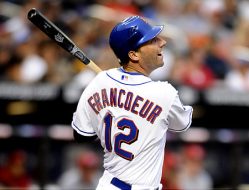
Truth is — though it will be difficult to unseat Philadelphia — the Mets appear apt to be a lot better than most people think. Remember the post from the other day about how the Mets committed 1633 plate appearances to dudes with sub-.300 on-base percentages? All the main culprits — Jeff Francoeur, Rod Barajas and Alex Cora — are gone.

Assuming some combination of Daniel Murphy, Brad Emaus and Justin Turner emerges from Spring Training with the second-base job and Josh Thole and Ronny Paulino make for a suitable catching platoon, the 2011 Mets may actually field a lineup without any major holes in it. That’s a big, big change from the last couple years, and I think fans might be surprised by how much a team can benefit from not giving away outs.

And better yet, for once the Mets appear to have viable in-house Major League ready depth at most spots on the field.

The problem, obviously, is the pitching. How big of a problem depends on if R.A. Dickey, Jon Niese and Mike Pelfrey can build on successful 2010s and if Sandy Alderson can concoct a legit back end of a rotation out of reclamation projects and rookies.

The Phillies will be good. The Braves, too, will be good. But it’s silly to count out the Mets before the season even starts, especially now that they appear to be in good hands.

Mets pursuing Dave Bush?

Rumor has it the Mets are pursuing Dave Bush.

Meh.

The upside to Bush is that he’s durable. I’ve long held that the ability to stay healthy and accrue innings is an underrated talent in pitchers, and it’s one Bush can boast. He has averaged 174 innings a season since 2006.

Problem is, none of them have been all that exceptional. In that same time, Bush has posted an 89 ERA+ and the velocity on his fastball has been steadily declining.

If signed, Bush will likely give the Mets around 174 innings, taking some heat off the bullpen and preventing the team from having to find someone willing to pitch those 174 innings. But Dillon Gee and Pat Misch are probably willing to pitch 174 innings, and they can probably combine for 174 innings just as effective as the ones Bush would provide.

Of course, it doesn’t entirely work like that. The Mets lack starting pitching depth in the high Minors, and bringing in a durable starter practically guarantees depth. Bush is a known quantity that offers a lower ceiling but a higher floor than reclamation projects like Chris Young and Jeff Francis, and for that matter Chris Capuano.

At Metsblog, Michael Baron suggests that pitchers like Bush that yield a lot of contact could benefit from pitching in Citi Field. It is frequently said (perhaps even here) that flyball-heavy pitchers (again, like Bush) could enjoy more success in Citi FIeld than they do elsewhere, and I wonder about this.

There’s still not a ton of evidence that Citi massively suppresses home runs. But even assuming it does — and it certainly looks like it does, even if I know better than to trust my eyes — does that mean the Mets should pursue fly-ball pitchers? The argument is, I suppose, that flyball pitchers might have more relative value to the Mets than to other teams, so the Mets could pick them up at a discount.

I just wonder if it really works out that way. For what it’s worth, the Mets’ most fly-ball prone starter in 2010, Johan Santana, far outperformed his peripherals and defense-independent pitching stats, at least partly because he allowed fewer home runs than you’d expect for a guy yielding so many fly balls. But none of the slew of fly-ball heavy relievers in the Mets’ bullpen did the same.

This guy is awesome at Wiffleball

Via the Score. Though this guy puts me to shame, I used to be a pretty dominant Wiffleball pitcher myself, though I haven’t played in years. I grew up playing against my brother, who I’m almost certain studied physics at MIT just so he could figure out ways to make Wiffleballs do cool things.

In my freshman year of college I played intramural Wiffleball and we played with a rule that if you hit the chair behind home plate and the batter didn’t swing it was an automatic strikeout. I once struck out the side on three pitches. Highlight of my athletic career. Also, most people on my floor didn’t appreciate that our Wiffleball team held practices in the study lounge.

Wasted at-bats

While working on a freelance job this weekend I wound up ruminating about just how many plate appearances the Mets committed to out machines in 2010. So I looked it up.

For no other reason than my own edification, I added up how many plate appearances each team in the NL East gave to position players with sub-.300 on-base percentages. I realize that .300, in this case, is a somewhat arbitrary benchmark for out-machineyness, and that there are park factors in play and everything else. But it’s a pretty stunning outcome regardless.

The Phillies gave 473 PAs to position players with sub-.300 OBPs.

The Braves gave 625 PAs to position players with sub-.300 OBPs.

The Marlins gave 479 PAs to position players with sub-.300 OBPs (though it’s worth noting that Wes Helms compiled 287 with an even .300 mark).

The Nationals — the lowly Nationals! — gave 1285 PAs to position players with sub-.300 OBPs.

And the Mets gave 1633 PAs to position players with sub-.300 OBPs.

More on Wright’s volatility

Bill Petti at Beyond the Boxscore continues his examination of David Wright’s volatility in recent seasons. This time, he compares Wright to a couple of his contemporaries.

This is interesting stuff, and there’s more to come on the subject — both from Petti and from friend of TedQuarters Seth “Ted” Samuels. I had a chance to read Seth’s research and it’s great, but I don’t want to give away his conclusions before he publishes it somewhere.