Enjoying the Kool-Aid

It was difficult to leave today’s Terry Collins press conference not feeling confident about the direction of the Mets. So I didn’t.

These days, with some Mets fans so upset over the past few seasons, whenever you agree with a decision the team makes or something someone from the front office says, someone will pop up and accuse you of “drinking the Kool-Aid.”

But here’s the thing: What if you like the way the Kool-Aid tastes?

Today, Sandy Alderson several times stressed Terry Collins’ experience in player development and familiarity with the young players in the Mets’ system as factors in his hiring. Alderson even used the term “sustainability,” a favorite of term of mine to describe the benefits of building a winner from within.

Collins, for his part, called the Mets’ current crop of young players “the finest group of young men” he has met in baseball. He emphasized that he wants players to continue getting better even at the Major League level and to establish better lines of communication with all 25 players on his roster, the front office and the Minor League managers.

When pressed about the rough end to his tenure in Anaheim, he said, “It was a huge learning experience…. I did a bad job managing the clubhouse. I will guarantee you it will not happen here.”

Collins even mentioned speaking to Carlos Beltran about how badly Beltran wants to win, and said he had no problem with Jose Reyes’ celebrations as long as they didn’t get him drilled.

And look: Words are only words, and Collins spewed a ton of them, so maybe I was just hearing what I wanted to hear. But what I picked up, and kept picking up, were the right words, over and over again. Sure, maybe Collins and Alderson are just saying they want to create a sustainable winner and compete in 2011 and beyond, providing the press good copy to buy them time while they conspire to keep the Mets’ mired in the basement of the National League East.

But I doubt it. It is yet to be determined if they’ll have any success, but it certainly sounds like they have a better idea of what success demands than their predecessors. There was nothing like, “I’m in the starting pitcher market,” or “hey, f@#$ everything, let’s make our best prospect a mop-up guy.”

Maybe I’m being too optimistic. Maybe I’m drinking the Kool-Aid, though whatever this is seems a whole lot more nutritious. It’s like green tea sweetened with just a touch of lemonade, my favorite beverage (order it by name — the Ted Berg) and the same stuff I’ve been enjoying and serving for years now.

And though it’s too soon to really know, it sure seems like the drink is more likely spiked with winning baseball than cyanide.

Return of the Mook?

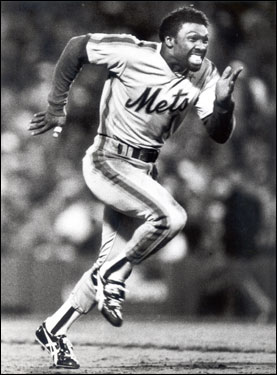
The rest of the staff remains in flux, although a source said Mookie Wilson might return at first base. Bench coach Dave Jauss might be asked to fill the minor league field coordinator position that Collins vacated, and Ken Oberkfell will either remain as manager of Triple-A Buffalo or become bench coach. Hitting coach Howard Johnson is unlikely to remain in that role, but will be employed by the organization in some capacity.

Andy Martino, N.Y. Daily News.

Cool. Mookie has been employed by the club in some role or another for years now — team ambassador, organizational baserunning coordinator, Cyclones manager, first-base coach. Obviously I think the Mets should have a first-base coach that they think will do a good job of it, that understands and preaches the organizational first-base coach philosophy and that they’re certain will consistently yell, “Back!” on pickoff moves and remind runners how many outs there are. But if they think Mookie can handle that, then, you know, awesome.

The only reason I mention him here, really, is to brag: One time Mookie Wilson called me. I was working on a freelance piece about the 1988 Mets, so I contacted the team to see if they could put me in touch with some former players. They obliged, and told me Mookie would be calling me soon.

If you’ve heard Mookie Wilson speak, you know he has a pretty distinct voice, so I had no doubt whom I was speaking with when I heard him say, “Hello, is this Ted?”

But even so, I played dumb. “Ahh, yes. Who is this?”

“This is Mookie Wilson.”

It was awesome. I know I’m pathetic.

Being Derek Jeter

I know I shouldn’t post this video here because it only perpetuates this type of stuff, and that there’s not much left to be said about the weirdness of paparazzi culture. But if you ever want to feel sympathy for a rich, famous, handsome Hall of Famer and his rich, famous beautiful actress girlfriend, watch this.

It’s not that the videographer is particularly aggressive or anything like that. He pretty much just stands there filming, then asks Jeter about whatever movie he just saw. Plus I realize that part of the bargain of being a celebrity — and dating celebrities — is sacrificing a good deal of your privacy.

So maybe I shouldn’t feel bad for them at all. But there’s something about Jeter’s brief, disgusted glance at the camera from the car that makes him seem way more human than he ever does during Yankee games (even when he’s diving in vain for groundballs).

On relevance

Alderson doesn’t have to be told that all of this has caused the Mets to have become irrelevant. To change that, the manager is going to be a most important part of the process. The Mets’ hierarchy all decided that Collins, twice fired, with no postseason games on his managerial resume, is the right man to make them relevant again. There is nothing to suggest he isn’t just another retread manager and not the kind of difference-maker the organization so desperately needs.

Bill Madden, N.Y. Daily News.

What does Madden mean by “relevant” here?

I feel like the term is thrown about by sportswriters and talk-radio hosts pretty frequently, and I’m never sure exactly what it means. I mean, I know what the word “relevant” means, I just don’t know when it pertains to sports teams. Is it just a stand-in for “worth writing about”?

Does Sandy Alderson really know that the Mets are irrelevant, and should he be charged with restoring their relevance? Seems like he should work on making them better, to hell with everything else.

Does “relevant” just mean good, though? Because if Madden’s saying, “Sandy Alderson knows the Mets have not been that good the last few years and he should try to make them good,” then I agree wholeheartedly. I don’t think the manager really is a most important part of that process, but I’m willing to agree to disagree on that point.

I’m pretty sure when the Jets hired Rex Ryan, people said he made them relevant again. Is that because he filled up columns with his bravado and made sportswriters all over the Metro area forget the snoozefest press conferences of the Eric Mangini Era? Or is that because he helped make the Jets good?

I should mention that none of these questions is rhetorical. I really want to know what everyone means when they say a team is relevant or irrelevant, how it’s different from good or bad, and why it matters.

Because if we’re to define relevant as “having significant and demonstrable bearing on the matter at hand,” as Merriam-Webster does, and the matter at hand is New York sports or the consciousness of the New York sports fan, then the Mets and Jets are perpetually relevant as far as I’m concerned. Since I root for those teams and follow them closely regardless of whether they win or lose, they always have significant and demonstrable bearing on me — at least in as much as any sports team can.

I am Jack’s apathy

Word leaked out yesterday that the Mets will hire Terry Collins to be their next manager, and now a good subsection of the fanbase is furious.

If I had to guess, I’d say all the angry fans fall somewhere on a Venn diagram with three intersecting circles.

In the first circle are the straight-up haters. These are the particularly bizarre fans that will lash out at just about any decision the team makes, no matter how large or small. They are the frustrating — and frustrated — fatalists, certain that the Mets are irreparably broken and no new front-office or roster overhaul will ever make any difference. I suspect some of them may be masochists and take odd pleasure in watching their team struggle.

The second circle is for the irascible Backman lobby. These fans, wooed by the media, by nostalgia or by Wally Backman himself, are certain that Backman — and no one but Backman — should be the Mets’ manager for now and forever, warts and inexperience be damned.

The third and perhaps largest circle belongs to a more reasonable set: The fans who doubt Collins’ ability to helm a Major League team based on his past failures with the Astros and Angels, most notably the miserable turn in 1999 when Mo Vaughn and his teammates in Anaheim petitioned upper management to have Collins relieved of duty.

Sometimes I get fired up over what I think are bad decisions, or the perpetuation of what I believe are fallacies or just dumb ideas. In this particular case, though — even after reading the reactions of the Mets fans who seem so incredibly mad — I find it difficult to muster up any emotion at all. Perhaps some entertained bewilderment about how people could get so angry over what will likely be an innocuous but informed decision made by reasonable men to fill an overrated position.

It’s not that I don’t harbor any doubts about Collins, either. It’s just that the almost unbelievable gusto with which some fans are decrying the decision, for whatever reason, leaves me feeling numb.

But if I could gather those angry fans and somehow prevent them from rioting long enough to talk to them, I’d probably ask this: Do you believe that people can change?

And that’s not a rhetorical question. I’m actually curious. Tons of people seem willing to argue otherwise based on old maxims — “A leopard can’t change his stripes” — as if just because something has been stated a billion times it must be true.

The fatalists, by definition, likely believe people cannot change, so they think Jeff Wilpon will never improve in his role as Mets’ COO, Sandy Alderson will still look for juiced-up players capable of smashing 50+ homers and Terry Collins will inevitably alienate the clubhouse with his alpha-male attitude. I don’t think I’ll be able to convince those people otherwise, so if by some chance you’ve found you’re way here and you’re one of them, please click away. I appreciate the traffic, but there’s nothing for you here. Try to enjoy your weird life.

The Backmanites and the reasonable doubters, though, must at least be open to the idea. After all, one of the main tenets of the Backman Lobby stated that Backman not only has changed from the man whose legal and financial troubles lost him a managerial position in Arizona, but would be willing to change again to fall in line with Alderson’s presumed organizational philosophy.

And if your doubts are only the reasonable ones, and you consider yourself to be a reasonable person, I follow up: Do you try to change? Do you work out to get in better shape, or read to learn more about the world, or consider your mistakes to avoid repeating them?

I sure do. Maybe I’m just self-conscious, and maybe my efforts to better myself are in vain and pathetic. But to me it seems downright arrogant, stubborn and small-minded to think, “well, this is how I am and the way I came out of the womb. If people don’t like it, so be it.”

Maybe Terry Collins thinks that way. I don’t know. I had one ten-minute conversation with the man and he really didn’t seem like it, but one ten-minute conversation is probably not the best way to judge a man’s character. Maybe he’ll take command of the Mets and repeat all the mistakes of his past. Maybe he learned nothing from his stints in Houston and Anaheim and his DUI arrest in 2002.

I’m not arguing, of course, that someone’s history should be entirely ignored when considering him for a job. That’d be crazy, like penciling in Jeff Francoeur for right field in 2011 and thinking, “hey, maybe he’s different now; maybe he learned to lay off bad pitches.” You, me, Terry Collins, Jeff Francoeur, we face uphill battles when we try to change our most deeply ingrained ways.

But I think, with an open mind and dedication, we can. And I would hope that if Sandy Alderson, Paul DePodesta, J.P. Ricciardi and John Ricco sat down with Collins for multiple hour-long interviews, they asked him if he learned from his prior stints and left satisfied that he did.

John Steinbeck:

‘Thou mayest!’ Why, that makes a man great, that gives him stature with the gods, for in his weakness and his filth and his murder of his brother he has still the great choice. He can choose his course and fight it through and win. … It is easy out of laziness, out of weakness, to throw oneself into the lap of deity, saying, ‘I couldn’t help it; the way was set.’ But think of the glory of the choice!


Report: Mets hire Collins

So there’s that. Color me ambivalent. Hopefully Collins demonstrates the player-development skills that earned him regards for his role as Minor League Field Coordinator, and not whatever characteristics made the Angels run him out the door in 1999. And here’s the friendly reminder that the manager probably doesn’t matter as much as we think.

Derek Jeter vaguely delusional

Neither Jeter nor his agent, Casey Close, has disclosed what numbers they are seeking, but it is believed Jeter wants a five- to six-year deal somewhere in the range of $20 million a year. If you do the math, that’s a difference of at least $50 million from the Yanks’ offer.

Most baseball analysts agree that, on the open market, the 36-year-old Jeter would attract no more than a two-year deal for a total of $15 million to $20 million.

Anthony McCarron and Bill Madden, N.Y. Daily News.

OK, it’s important — as always — to take the contract details with several grains of salt, since neither Jeter nor his agent is on record with his contract demands. And I know that essentially every single human in the N.Y. sports media has provided his or her opinion on the negotiations, so there’s probably nothing new here.

But it strikes me that Jeter stands to lose a lot more than the Yankees if the two part ways. For one thing, there’s the straight-up cash part of it: No other Major League team would offer Jeter even the three-year, $50 million offer that’s rumored to be the Yankees’ starting bid.

Second, if Jeter cares at all about loyalty and legacy and all that jazz — and presumably he does, since those are like the most Derek Jeter-y things about Jeter at this point — then it behooves him to stay in the Bronx. He must know as well as anyone how offputting it would be to his fans to see him playing in another team’s uniform.

The Yankees stand to take a pretty sizy marketing hit if they let Jeter walk, but it seems unlikely that their fans will stop showing up en masse and watching games on YES as long as the team continues winning. And, straight up, it’s unclear that signing Derek Jeter to a big, expensive contract extension is the best way to keep winning.

If the Yankees’ payroll is finite — which has never been entirely clear — and a $20 mil-a-year pledge to Jeter could feasibly keep them out of the bidding for some future free agent stud (also unlikely), then they’d be better off putting some of their considerable resources toward finding a younger, less expensive shortstop. Jeter is still a good player in spite of his shaky defense and diminishing production. But J.J. Hardy, Rafael Furcal and Jose Reyes — all years younger than Jeter and all currently slated for free agency next offseason — posted similar or better WARs in 2010. Jeter is hardly irreplaceable.

Barring unforeseen circumstances, Jeter will still be rich, handsome, bound for the Hall of Fame and dating Minka Kelly regardless of where he signs this offseason, so it’s hard to say he’ll lose all that much by leaving the Yankees. But he’ll stand to lose money — both contractually and likely due to fewer endorsements — and he’ll forever forgo some of that mystical “True Lifelong Yankee” legacy he has developed in the Bronx.

So it strikes me that the Yanks could easily call his bluff. Leave the three-year, $50 million on the table and tell him to come back to them if he finds anything better. He won’t.