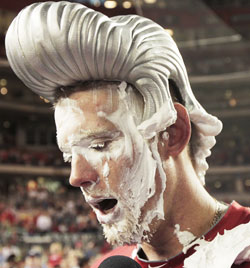
Kenny Powers f@#$ing on

The Knoxville News is reporting that the second season of HBO’s Eastbound & Down, in which Danny McBride will play the uncomfortable-making Kenny Powers, this time in Mexico, has a premiere date: September 26. Set your DVRs in preparation for maximum cringing.

Willa Paskin, Vulture.

The Knoxville News story has since been pulled down, but I’ll take even the hint of a premiere date for the second season as a good thing.

For a while I kind of hoped they would just leave Eastbound and Down at one short season like a miniseries or something because it was so perfect and wrapped up so neatly (well, messily, but neatly in context of the show).

I’ve since come around on a second season. The show was hilarious, after all, and Kenny Powers the type of transcendantly awesome character that can carry at least six more episodes. And Mexico promises comedy. I still hope more people will start bucking the trend and creating serial TV shows with endings scripted from their outset, defying the market, but that’s an entirely different conversation.

Anyway, this was just about my favorite moment in television history. It’s pretty funny as a standalone clip, but in context it was surreal:

Luke Gregerson gone nuts

Luke Gregerson has now struck out all six Mets he’s faced in his two innings of relief in this series.

Our video editor Jason directed my attention to Gregerson’s ridiculous season today, and it’s probably something worth noting.

The 26-year-old right-hander has now struck out 39 batters in 32 1/3 innings while walking only two. That’s a 19.5:1 0 K:BB ratio, if you’re not good at math. Oh, and one of those two walks was intentional.

He has allowed six runs this season, good for a 1.39 ERA. And, most amazingly, he has only allowed 12 hits this entire season. Dude has a 0.433 WHIP. No other pitcher with double-digit innings this season has allowed less than half a baserunner per inning.

Gregerson throws more sliders than any other pitcher in baseball according to Fangraphs.com, which means he’s probably an injury risk.

But considering the Padres got Gregerson as a player-to-be-named later from the Cardinals in exchange for Khalil Greene, it’s safe to say that was a decent pickup. Greene hit .200 with a .272 on-base percentage in 193 plate appearances with the Cardinals in 2009, a season in which he struggled with social anxiety disorder.

What’s funny — or maybe not funny at all, just telling — are the parallels between Gregerson and Padres closer Heath Bell. Both posted excellent peripherals in the Minor Leagues, though both were always a little old for their level. Neither got much of an opportunity with the team that drafted him, and both came to the Padres as low-cost trade acquisitions. Hmph. Maybe that Kevin Towers guy knew a thing or two about building a bullpen.

Dodgers breaking new ground in dysfunction

On the heels of talk that the Dodgers intentionally drafted a player who won’t sign with them comes a report that they paid for a Russian faith healer to treat their players via television, thousands of miles away. Check out Memories of Kevin Malone for more details and hilarious commentary, and remember that, no matter how frustrated you get with your team, it could always be worse. Unless you’re a Dodgers fan, apparently.

Hat tip to Chris Wilcox for the link.

OK, so that was amazing

Nothing I’m going to say here will add anything to the millions of words already spilled over Stephen Strasburg’s debut. It’s just that whole posterity thing again, my desire to make note of events that feel important so I can have them in the archive down the road.

I wrote last week that I was rooting for Strasburg to be a pretty good pitcher but not an exceptional one. I still think that would be funny — especially now — but I changed my mind when he struck out Jason Jaramillo looking on a backdoor curveball to start the third. Holy lord, he’s got some ludicrous stuff. I hope he stays awesome.

I love dominance and spectacle and pitchers who manipulate opposing batters. Strasburg provided all of that in his Major League debut. 14 strikeouts and 0 walks. Fourteen, zero.

And when Strasburg was up against his predetermined pitch count after the first out in the seventh, with Jim Riggleman sitting on the bench clearly wondering how he was expected to pull a pitcher who was effortlessly imposing his will upon the pitiful Pirates, Strasburg was all, “don’t worry, Skip, I got this.” Six straight strikes and the inning was over. Crazy. Crazy crazy crazy.

Bob Costas kept trying to keep things in perspective, then in the next breath would mention Bob Feller, Tom Seaver, Walter Johnson. It’s not fair, of course, to expect a Hall of Fame career out of any 21-year-old. But who’s to say what the hype machine would have churned out if Feller, Seaver or the Big Train made their debuts in 2010? And who knows if it matters? Competitors like those probably couldn’t care less about any expectations besides their own; to get to that level, they’ve got to be awful, awful driven.

Maybe Strasburg’s a Hall of Famer. Heck, maybe he’s the greatest pitcher of all time. Sure, Dwight Gooden had 58 Major League wins with a 2.28 ERA and a 155 ERA+ by the time he was Strasburg’s age, and Kerry Wood struck out 233 batters in his first 166 2/3 innings, and back in 1967 Gary Nolan whiffed five times as many guys as he walked across his first 10 starts when he was only 19 years old.

Who cares about that? Everyone knows pitchers flame out. It happens. But every so often a Roger Clemens comes around, or a Seaver or a Greg Maddux. That happens too. At some point in our lifetimes, we will see more historically great pitchers. And though the odds are long for everyone, it’s hard to bet against the guy who struck out 14 batters without walking any in his Major League debut.

Baseball as it oughta be

More instant replay has become the standard knee-jerk reaction to the increasing spate of blown calls by umpires in recent years – Thursday, even Don Denkinger of 1985 World Series infamy and the most egregious blown call in history before Jim Joyce’s faux pas on Galarraga Wednesday night – called for replay. On this one I’m in agreement with what Selig has maintained: To expand the use of instant replay beyond the determining of fair or foul home runs or fan interference would be to invite potential chaos and create situations that would make a mockery of the game.

Baseball has become dehumanized enough by sabermetricians and their mind-numbing statistical analyses and it doesn’t need to be made more complicated by having the potential for instant replay on every play. I would hope Selig, after consultation with all his advisers, elects to keep instant replay limited to just the home run calls….

I have long maintained that baseball has done an abysmal job of umpire development and that the solution to the alarming frequency of blown calls that has embarrassed the game is to spend what it takes to get better umpires – and at the same time for MLB to use the powers it has in the collective bargaining agreement to get rid of the umpires such as Bucknor, Bob Davidson and the others who consistently grade the lowest.

Bill Madden, N.Y. Daily News.

Exhale. OK. I realized earlier this year that I had become the type of Internet user I hate; those irritating folks who seem to spring up just to tell others when they’re wrong, without actually adding anything to the conversation. So I tried to take it easy on the local newspaper columnists for a while, a vow I am now struggling to maintain.
It’s not the dig at sabermetrics that bothers me. That sentiment is cliched now, and it only forwards a faulted argument perpetuated by nitwits who never seem to consider that statistics have been used to evaluate baseball players as long as anyone has been keeping score.  If I believed more in conspiracy theories and less in Hanlon’s Razor, I’d suggest that editors command writers to haphazardly insert asides like that one into their articles so people like me will forward them to Repoz at the Baseball Think Factory, inspiring all sorts of smart, funny comments from smart, funny people that ultimately direct Web traffic back to the source.

And I won’t even take issue with the contradictory logic in Madden’s premise, which states that there’s no place for video replay in baseball but Bud Selig should invoke his authority to overrule Jim Joyce’s out call and award Armando Galarraga a perfect game based on evidence gained from video replay. Nor will I bother harping on the irony inherent in using a quote about the importance of preserving the pace of the game from Joe Girardi, a man notorious for manipulating it.

My beef with Madden’s column is the underlying assumption that umpires have gotten worse in recent years. He mentions the “increasing spate of blown calls” that have, of course, “embarrassed the game.”

Think about that.

In this era of high salaries and intense competition for every single job on the Major League field, am I to believe that the league’s standards of umpiring have somehow slipped, allowing a barrage of underqualified officials to furtively ascend through the ranks and earn well-paying jobs they don’t deserve?

Or could it be that there are the same number of bad calls — if not fewer — and we are just now noticing an “increasing spate” of them because we have an increasing spate of technologies by which to judge them? Joyce’s call was a bad one, for sure. But we only know how bad it was because we have TV cameras in more places than ever before, broadcasting in higher definition, producing sharper replays.

In fact, I would guess that if we had a reliable way to evaluate umpires historically — some dehumanizing metric, for sure — it would show umpires have gotten significantly and steadily better over the course of the last century.  The difference is we now have technology that allows us to instantly judge Jim Joyce, yet Madden and so many others feel the same technology should never be extended to Joyce himself. Everyone watching the game can know the right call, but the people responsible for actually making it should not.

Why not? Because that’s the way it’s always been!

George F. Will:

“Human beings seem to take morose pleasure from believing that once there was a Golden Age, some lost Eden or Camelot or superior ancient civilization, peopled by heroes and demigods, an age of greatness long lost and irrecoverable. Piffle. Things are better than ever, at least in baseball, which is what matters most.”

This, as they say. Players used to swing 50-ounce bats and play the field without gloves. Before modern surgeries, pitchers’ arms would die and hitters would lose their vision. I could go on forever.

Baseball plows forward always, and every era brings its own docket of adjustments and tweaks to the game to better the competition. Since I started writing this post, someone tipped me off to a similar sentiment presented in much more eloquent fashion by Joe Posnanski. He uses the word I was getting to: Progress.

The game is and should be perpetually in flux. There are good developments and bad ones, but the eventual outcome is always a more balanced, fair and entertaining product. To stick a stake somewhere in the timeline and say “this is when baseball is grandest, this is when the rules should stop evolving, let’s freeze everything right here,” is to make the sport a false preservation of something that never really existed, like Colonial Williamsburg.

To truly safeguard baseball-as-it-oughta-be, Selig must investigate a reasonable way to incorporate instant replay on disputed calls. Innovation has been part of the game just as long as the human element.

I’m not saying I have the solution or that it will be easy to come by. Baseball games are long enough as they are, and unlike in the NFL, most of them are played on weeknights when people have other things they need to do, like sleep. No one’s going to have the patience to sit through six delays a day if MLB maintains the silly tradition of sending the entire umpiring crew into the stadium’s bowels to review each disputed call. But I’ve seen the MLB.com video brain-pod, or whatever it is. It sure doesn’t seem like it would be that hard to station an umpire or two in there to judge calls whenever the umps on the field request them.

Someone will come up with something. And then in 30 years, when someone comes up with something better — robot umpires or something — maybe I’ll be a salty old sportswriter bleating on about maintaining the purity of the game. That’s how it goes, I guess.

(Huge hat tip to Jay Jaffe for an assist on the George Will quote.)

Clemens trial makes up for lack of credible testimony by breaking new ground in meathead fashion

First Brian McNamee’s supplement-ad tie, now Jose Canseco’s Fleur-de-lis blazer and tight jeans. It’s worth nothing that Canseco has been proven honest about nearly everything he’s said in the whole steroids saga so far, but it still can’t be good for a defense when your key witness shows up in a sequined jacket:

If you’re not following this story, you probably should, even if you’re as sick of hearing about the whole steroids thing as I am. Turns out a whole lot of the controversy in the trial involves a pool party at Canseco’s house at which McNamee claims he saw Clemens speaking with Canseco about using steroids. Canseco and Clemens both say Clemens wasn’t even at that particular pool party, and say that pictures of Clemens in Canseco’s pool were from a different pool party, some other time.

Obviously the big revelation here: Jose Canseco has lots of pool parties. That’s the type of thing I imagined baseball players doing when I was eight years old and wanted nothing more than to spend all my time swimming and splashing around with my friends. So I just assumed then that baseball players hang out with their teammates and go to each other’s pools all the time, because hey, what else would you do if you were rich and famous?

I’m kind of shocked to find out I was right. I wonder, though, if the pool party in question was a formal affair or just the type of party that develops organically on a hot day in Florida when Jose Canseco wants to have a few friends over for a swim. Did he send out an E-vite first?

Come to Jose’s Swimming and Steroids Party! There’ll be volleyball, rage-fueled chicken fights, pizza, and of course, mebolazine.


Strasburg outcomes I’m rooting for

Here’s Stephen Strasburg striking out Mike Jacobs in the first of his five scoreless innings against the Buffalo Bisons today:

Man, if he could blow those fastballs by a guy good enough to hit cleanup for a Major League team on Opening Day, then — oh yeah. Mike Jacobs.

Seriously, though: Thanks to his outrageous arsenal and at least in part to the glut of information available on the Internet and the media one-upsmanship it fosters, Strasburg’s about as hyped a pitching prospect as we’ve ever seen. So naturally I’ve spent a whole lot of time thinking about the different ways Strasburg’s career could play out and the ones I would find most entertaining.

I enjoy greatness, and there’s definitely something satisfying about a much-lauded prospect coming up and being exactly the Hall of Famer everyone expected him to become. Ken Griffey Jr., who just retired yesterday, was one of those prospects. Chipper Jones and A-Rod, too.

So though it would be torturous to watch Strasburg dominate the Mets several times a season for the next decade, it would be thrilling. Great is great, and so if he’s great, you know, great.

Some of my friends have suggested it will be funny if he turns out to be a massive disappointment for one reason or another, but massively disappointing pitching prospects are cliched at this point. The road to Cooperstown is littered with Brien Taylors and Mark Priors and Rick Ankiels, and though each of their stories is uniquely tragic, the tragedies are entirely predictable. Pitching is a strenuous activity, mentally and physically, and it’s hardly surprising when young pitchers fail to put together lengthy and successful careers.

After careful consideration, I’ve determined that the most entertaining possible outcome for Strasburg will be if he turns out just pretty good. Not a Hall of Famer or even a true ace, just a good, solid Major League pitcher like Brad Radke or Javy Vazquez or someone.

In this pathetic, snarky fantasy, he’ll be good enough to once or twice put together an excellent stretch of starts that makes everyone freak out and assume he’s finally arrived, and he’ll probably even make an All-Star team or two when everything falls his way for a half season. But then he’ll go back to just being pretty good — as good as anyone could reasonably hope for from any pitching prospect, but nowhere near the ridiculous expectations levied upon him.

Ironically, though, since Strasburg throws a 99-mph heater and that devastating curveball, pretty-goodness is probably among the least likely outcomes for the prospect. And maybe that’s another reason to root for it.