Scouting the Twins with the excellent Aaron Gleeman:
Baseball Show
Reply

Scouting the Twins with the excellent Aaron Gleeman:
Commissioner Bud Selig was named the first recipient of Taylor’s Award, presented by the Taylor Hooton Foundation to an individual who has made a major impact on efforts to educate and protect American youth from the dangers of using performance-enhancing drugs. …
“I’m extremely proud to present the first Taylor’s Award to Commissioner Bud Selig,” said Don Hooton, Taylor’s father, who serves as president of the Hooton Foundation, said at a media conference after the joint session.
“I was being sarcastic,” Hooton later added.
(Ed. Note: Just to clarify, Hooton didn’t actually say that last part. That part’s the joke/Norm MacDonald reference.)
Somebody maybe ought to check the Mets if they did that. Their [bleeping] home record is out of this world and they’re losing on the road. Sometimes that’s a good indicator of getting signs and [crap]. I see somebody setting there at (14-7) at home and (4-8) on the road, I’d get concerned about that. That kind of crosses my mind.
I’m not accusing them, but you look at that and – damn. We’re about the same home and road. I’m just saying their record is much better at home and they hit better.
– Phillies manager Charlie Manuel, as told to CSNPhilly.com.
OK, a lot of stuff here: First of all, who put “[bleeping]” in to replace the expletive there? I mean, I carefully dance around including curses on this blog as best I can, and I realize it probably looks stupid sometimes. But “[bleeping]”? Why not “[freaking]” or just straight up “[expletive]”?
 Second, while it’s true that the Mets have a better home record than road record, a) that’s often true for lots of teams, b) it’s almost entirely fueled by the Mets’ 9-1 homestand against the then-struggling Cubs, Braves and Dodgers, and c) it’s just way, way too early in the season to suggest the Mets are playing to any sort of massive home-field advantage, especially since they’ve played so few games on the road.
Also, a pretty great way to accuse someone of something is to just flat-out deny that you’re doing so. Now, make no mistake: I’m not accusing Charlie Manuel of subterfuge or of haphazardly lashing out at the Mets because he’s defensive about his team getting caught stealing signs. That’s just something that crosses my mind.
For all I know, the Mets are breaking the rules to steal signs, and the Phillies were too. My stance on the matter is the same it has always been: It’s not cheating if you don’t get caught.
Ask Leo Durocher. Baseball players are hard-wired to compete, and stealing signs is a way to gain a competitive advantage. This is why the game has written rules: It’s not the players’ or coaches’ responsibility to police themselves. That falls on opposing teams and, in cases like the Phillies’, the league.
If the story’s true, the Phillies thought they could get away with the binoculars-in-the-bullpen scheme. They didn’t, so the league made them stop. The system worked. There are plenty of things to fault the Phillies for without assuming some sort of moral high ground against sign-stealing.
To quote Manuel: “I’m sure if teams could steal signs they would, and if we can we will, too, if we can get them legally…. If you’re dumb enough to let us get them, it’s your fault. It’s been going on in the game a long time. If you’re dumb enough to let us get them, that’s your problem.”
Saw your post on the minor league baseball life and wanted to refer a book to you, which you may or may not have already heard of / read. It’s called The Bullpen Gospels by Dirk Hayhurst. Hayhurst has written a blog for Baseball America for the past five years or so and it was always been very entertaining and informative. He finally synthesized those into a book which turns out to be a very interesting read. The book provides some keen insight into the life and mind of a minor league player trying to make it both mentally and physically to the Show. Interesting read if you have some time.
– Jeremy, via email.
I finished The Bullpen Gospels a couple weeks ago and I’ve been looking for an excuse to write it up, so I’m glad Jeremy provided one. It’s a terrific book.
 Hayhurst’s prose is entertaining from the start. It quickly becomes clear he can tell a story and has a lot of witty insight about baseball.
A few chapters deep, though, I was still skeptical of the lavish praised heaped upon the work by a bunch of analysts I really respect. I figured jaded baseball writers were just enthralled by the idea of a contemporary ballplayer actually saying all the funny and interesting things he’s thinking, and thus waxed hyperbolic.
But as the book continues and Hayhurst reveals more about his home life — if you could call it that — readers begin to understand why someone might call The Bullpen Gospels “one of the best baseball books ever written,” as Keith Olbermann did. Hayhurst details the psychological journey that accompanied his trek through the Minors, but manages to stay funny and avoid provoking any pity parties.
In the end, readers come away with a colorful picture of Minor League life and valuable insight into the mindset that keeps players like Hayhurst — non-prospects, Quadruple-A heroes, organizational soldiers, etc. — relentlessly pushing forward.
Would I put The Bullpen Gospels among the best baseball books ever written? I don’t know; I honestly haven’t read enough baseball books in my adult life to tell you with any confidence. But I can state for certain that it’s a really, really good book, and a book likely to make some dude you might never have even heard of into one of your favorite baseball players and favorite baseball writers.
More of me talking to Ralph Kiner. You might have seen this earlier in the week on SNY.tv or MetsBlog. My apologies; the hotel Internet connection in New Orleans has been down and it’s an old brick building so it’s bad for wireless. Plus I’ve been busy consuming tons of food and funk music.
In this part, he tells me about facing Satchel Paige when he was 17, plus about coming up with the Pirates.
Talking to Ralph Kiner about facing Satchel Paige goes on the short list of coolest things I’ll ever get to do.
Thanks to the whims of our road-trip schedule combined with the storm that ravaged the South earlier this week, I have seen the last three Birmingham Barons games. In all three games, the Barons took the lead early, squandered it when their starting pitcher started to tire in middle innings, and fell behind for good in their opponent’s final at-bat. Check it out.
Smart money says I won’t see any other Birmingham Barons games this season, so thanks to the caprices of small samples, I will conclude that the Barons’ bullpen is a big bunch of choking chokers who ruin everything for their offense and starters in every single game.
Not the type of stuff that will make Barons alumni like Razor Shines, Robin Ventura or Michael Jordan proud.
Outside of Historic Grayson Stadium on Friday night, a group of Lexington Legends stood near their team bus talking on cell phones. I didn’t linger as I walked by them toward my rental car, but I overheard one sentence’s worth of conversation: “I love you.”
 The opportunity to play baseball professionally is a pretty amazing one, and something I’m sure few of those guys would willingly trade for the cramped college dorm rooms enjoyed by many of their contemporaries. But the Minor League life is a difficult one.
That night or sometime shortly thereafter, the Legends’ players and coaches would endure the 9 1/2-hour trip back to Lexington in that bus. They will spend this season riding the bus to Delmarva and Lakewood and Charleston and all the far reaches of the South Atlantic League. And if any of them are lucky enough to advance to the next level at any point, they’ll have to adjust to a new home city and a new bus and a whole slew of new destinations.
It’s all part of the game, of course, and it has been a long time. Still, I wonder if there’s a way the system could be improved. If the Minor Leagues are aimed at maximizing the potential of prospective Major League baseball players, is that best accomplished by forcing 19-to-22-year-old kids into nomadic lifestyles?
Here’s a half-baked thought: As far as I understand, there are teams in the Sally League that draw as well as some International League teams. And there’s some overlap in the areas covered by the Class A South Atlantic League, Class A Advanced Carolina League, Double-A Eastern League and Triple-A International League.
Not many Major League teams own a lot of their own Minor League affiliates. But, in theory, could a big-market club purchase Minor League franchises in four strategically located markets and switch around each team’s level every season?
In other words: Could a team start a crop of prospects in the Sally League, then keep them together and in the same city the next season, but have them play in the Carolina League? They could move to the Eastern League the next year and the International League the next, but stay in the same home city the entire time. That way, prospects get a full slate of Minor League experience, but can maintain some degree of normalcy.
For what it’s worth, it would benefit the various Minor League fanbases, too. Fans in each city would have a chance to get to know their particular group of players before the best ones moved onto the Majors.
There are logistical problems, of course: For one, I’m not certain there are enough appropriate markets to make it work, nor do I know if Minor League Baseball would permit clubs to so rapidly jump levels. Plus I’m near-certain there’s some minimum stadium capacity required for the different levels, even if the higher levels aren’t necessarily drawing more fans.
And it doesn’t all make sense from a development standpoint: A team that endeavored that plan would lose a lot of the flexibility afforded by the current system, since it would likely try its best to keep players in the same place for as long as possible. Certainly there would still be players who moved too quickly to be held back and players who demonstrated they had no business jumping a level, so some guys would still have to move every year. But likely the players at the margins would be socially promoted with the rest of their guys in their “class” every offseason.
Plus the system breaks down for Quadruple-A types, since presumably a city will only host the Triple-A team once before the whole system shuffles again. So any player entering his second season in Triple-A would finally be forced to move, and he’d have to move again every season until he cracked the Show.
Are all the logistical problems and hangups worth it to give developing players a rooted home base for the several years they spend in a system? I have no idea. Hell, maybe the going thinking is that they’re better off not getting too comfortable in any one city, since comfort probably leads to girlfriends and social lives and all sorts of non-baseball distractions.
I don’t know. I’m just thinking out loud, and thinking that as awesome as playing Minor League baseball certainly is, it probably doesn’t always feel that way. And maybe a system that makes life a little easier for the athletes would pay off for teams down the road.
I don’t make a lot of sweeping declarative statements, here or anywhere.
 But here’s one: The front of all Major and Minor League road uniforms should feature the team’s city name, and decidedly not the team’s nickname.
For some reason I cannot determine, this bothered me in particular on Sunday when the Mets, in Philadelphia, showed up at Citizen’s Bank Park with “Mets” on their shirts.
This is culled from baseball history, or something: The Mets represent New York. They have traveled to Philadelphia to measure their talents against the team that plays in that city, and so should be obligated to the Philadelphia fans to make clear, via uniform top, where they’ve come from.
Maybe this isn’t the best example, because I don’t believe anyone owes Philadelphia fans anything. But other fans, maybe.
Even as our allegiances to baseball teams become less necessarily dictated by geography, the league should dictate that teams prominently display their own. I could care less if a team has three regular home jerseys and two alternates and seven varieties of road uniforms as long as all the road jerseys say the city name.
And I recognize there’s no actual good reason. I’m just sayin’s all.
In the bottom of the 8th inning in tonight’s tilt between the Savannah Sand Gnats and Lexington Legends, Lexington catcher Jonathan Fixler bobbled a pitch and Savannah right fielder Cesar Puello broke to steal third base.
Fixler made a perfect throw to third that had Puello beat by 20 feet. Puello stood to be only the second runner caught stealing in the game after something like a million had already stolen bases successfully.
But Puello turned back from whence he came, so Lexington third baseman Jonathan Meyer threw toward second. Only Meyer’s throw glanced off Puello’s back and into center field. Puello again switched directions, this time reaching third safely. Meyer was charged with the Legends’ fourth error of the game.
Puello would later score on the Legends’ fifth error of the game.
The official scorer, sitting next to me in the press box, spent a good ten minutes on the phone trying to explain what happened. It’s all reflected now in the box score.
Oh, and Wilmer Flores crushed a home run in his first at-bat, on the second pitch he saw. More on that to certainly follow.
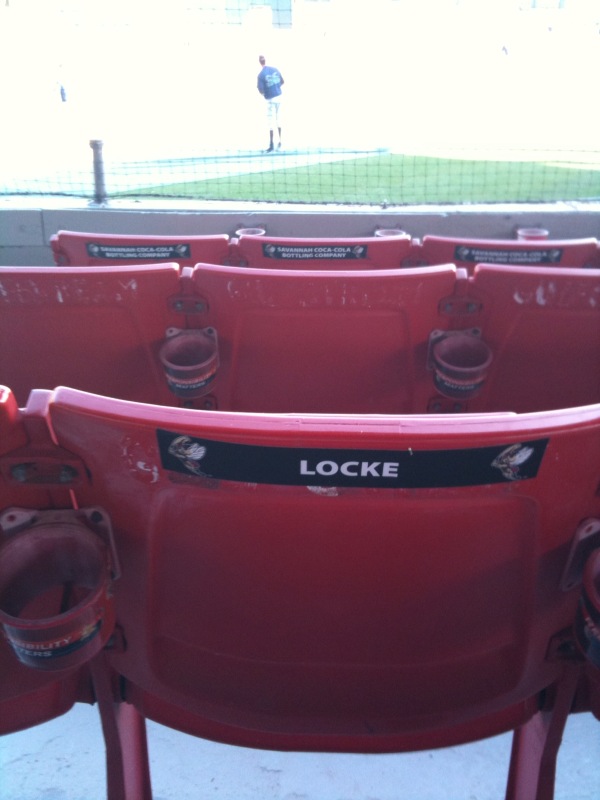
Holy crap, Savannah is beautiful. I’ve been here twice before, but maybe I was too young to fully appreciate it, or maybe the weather wasn’t quite this nice. Whatever the case, I had to drive a radius of the city to get to my hotel. It seemed like every house was architecturally interesting — from a wide varieties of styles and eras, too — and they’re all under a canopy of big old oak trees draped with Spanish moss. Gorgeous. I regret not taking photos, but I was driving.
I’m here at the ballpark — Historic Grayson Stadium, just 84 years young — perched in the “trailer in the sky” of a press box, as Toby Hyde describes it. The catwalk to get up here was just a tiny bit terrifying:

I spoke to the Sand Gnats’ manager, Pedro Lopez, and the Mets’ Minor League Field Coordinator Terry Collins. Segments of those conversations should be posted in a video for SNY.tv sometime after I get back and our video editors chop ’em up, but we talked a lot about expectations for this level, the need to balance results and development, and, of course, Wilmer Flores.
Lopez raved about Flores’ makeup, and said his two-strike approach is outstanding for a player his age. He said Flores needs reps, more than anything, defensively.
Collins stressed that there’s no rush to move Flores along, but expects he’ll advance at some point this summer. He said he’d like to see Flores be a little more patient at the plate.
Soon will be time to watch some South Atlantic League baseball. It’s a brilliant night for a ballgame, so I don’t expect I’ll stay in the press box long. Plus I want to chat up a few fans. Survey the scene and all. Also, that $3.50 Frito Pie has my name all over it.
Don’t tell me where I can’t sit!
 Tedquarters