We’re All-Stars now in the dope show

I hate to deploy the Slippery Slope Argument … but where does this end?

In less than a decade, they’ve now added eight more All-Stars per season?

You really have to wonder if there’s any real limit. Will there be 35 players on each roster next year? Will the players try to get 40 players per roster when negotiating the next Collective Bargaining Agreement?

Rob Neyer, SweetSpot.

Neyer, decrying the near-constant growth of All-Star rosters in recent years, makes a series of good points about how the expansion stems from negotiations between the players and owners.

But he misses, or at least neglects to mention the obvious one: Duh. The less exclusive the game becomes, the less anyone will care who is or isn’t an All-Star. If we continue down the slippery slope and the league is soon suiting 40 guys per side for All-Star uniforms, then at some point we’ll be seeing unexciting or downright pedestrian matchups late in Midsummer Classics. And that defeats the whole purpose.

Because to me, the only thing that’s exciting about the All-Star Game is the opportunity to see the greatest pitchers in the game square off with the greatest hitters in the game. It’s been cheapened a bit by interleague play, I think, and I could honestly care less that “THIS TIME IT COUNTS.” I watch the All-Star Game to see stuff like Pedro Martinez striking out three members of the 400-home run club (plus Barry Larkin and Larry Walker) in two innings.

And while I understand and support the owners’ desire to protect pitchers for the games that actually matter, there’s no real point in constantly adding bodies to the margins of the rosters. It’s the all-star game. I want all stars, dammit. GET OFF MY LAWN!

I’m out y’all

The Mets have now won nine of their last 10 games. That makes it tough to leave the New York area, realizing I likely won’t see most of the upcoming series with the Phillies — even with the Internet and my iPhone and all that — and knowing that things almost certainly won’t seem this awesome by the time I return.

But it’s nice to take off on such a series of good notes, and I can’t say I’m not psyched for this road trip. Come tomorrow afternoon I’ll be in Savannah, filming some stuff for SNY.tv, chatting up Toby Hyde, and watching Wilmer Flores hit baseballs.

From there, it’s a winding trek through the American south. If all goes according to plan, I’ll take in two Single-A games, three Double-A games, a Triple-A game, and three Major League games.

And I’ll do my best to keep the content flowing here as best as I can throughout.

It will be different, of course — probably more a haphazard baseball travelogue and series of photos of ridiculous Southern food than a standard Mets/Taco Bell/nonsense blog — but it seems disingenuous at best to continue trying to cover the intricacies of the Amazins when you all know I’m not paying them all that much attention.

Plus, once I leave Savannah, it’s my vacation and all. A busman’s holiday, for sure, but those are a lot more appealing when the bus is baseball games.

So in other words: The posts here may be spotty and the content will definitely be atypical for the next week and a half. I hope you keep clicking anyway, because maybe I’ll see some hilarious stuff on the side of the road that you don’t want to miss. Or maybe I’ll post some video of myself setting off the fireworks I inevitably purchase. And fireworks are awesome.

Kind of like James Brown:

I’m an idiot

Sometimes, doing interviews, I get a little Chris Farley Show on guys and just want to be remind the people I’m talking to about the awesome things they’ve done in the past.

I basically just did that with Don Mattingly. I brought up the Simpsons episode, but I had absolutely nothing to actually ask about it, other than, essentially, “remember that time you were on the Simpsons?”

So look out for that tomorrow.

Talking baseball with a real-live Hall of Famer

I try not to express too much excitement over some of the cool things I get to experience in this job because I never want to sound like I’m bragging or anything. And the truth is, this job has great moments and stressful moments, like lots of jobs. Plus I have a sneaking suspicion that no one really cares.

But this — talking baseball with a real-live Hall of Famer — this was awesome. Ralph hung around chatting for about a half hour after we finished shooting. Unbelievable. Really nice guy, crazy good memory.

In the next part (SPOILER ALERT), we talk about how he hit a home run off Satchel Paige when he was 17.

When he was 17, Ralph Kiner hit a home run off Satchel Paige! And somehow I get to talk to talk to Kiner about it. I don’t mean that to sound like bragging, just wonder and disbelief.

OMG OMG OMG OMG!!!!@*#&&^@!#^

Also tonight, as with every home game this season, fans will be treated to the Taco Bell Saucy Sprint, the Tex-Mex take-off of Milwaukee’s sausage races.

In the Saucy Sprint, which is part of a sponsorship deal with Taco Bell, three oversized sauce packets – mild, hot and fire – race around the field, finishing in front of the third base dugout.

Ford Gunter, Houston Business Journal.

OMG you guys! Taco Bell is so f@#$ing awesome. Have I mentioned that?

I love it when Taco Bell and baseball intersect. My two favorite things. This doesn’t quite match the “Steal a base, steal a taco” promotion that once made Jacoby Ellsbury a hero, or the Rockies’ Feed the Fever deal, whereby anytime the Rockies score seven or more runs you can get four tacos for a dollar with the purchase of a large drink at Denver-area Taco Bells from 4-6 p.m. the following day, but a taco-sauce race sounds pretty awesome, too.

More importantly, I’m going to a game in Houston next week. That means I will see the Taco Bell Saucy Sprint in person.

I will root for Hot. I know a lot of you probably expected I would advocate Fire, and while I do appreciate Fire sauce sometimes, I find that Hot actually adds a better combination of taco-sauce flavor and heat. Generally, if I have three tacos, I put Hot sauce on the first two and Fire on the third. If you eat the Fire sauce sooner, I find, you don’t fully appreciate the flavor of whatever tacos you eat next.

Plus I feel like probably everyone roots for Fire, except the weaklings, who are naturally drawn to Mild. So I’ll root for Hot because it’s a nice solid middle-ground, and, you know, take that, Texas.

Also, I can’t believe I didn’t think about a possible Taco Bell tie-in when I presented suggestions for a Mets on-field race back in February.

Huge, huge hat tip to Mike from NY Metscast for the heads up.

Patrick Flood on Ryan Howard’s contract

The Phillies have been making strange decisions since Amaro took over as GM, some of which worked out – Raul Ibanez – and the Phillies are still the best team in the NL East, but they’re old, and this contract and the weird departure of Cliff Lee do not bode well for the team’s decision making process – it’s become suspiciously Metsian.

Which is good news for the Mets, because the more inept franchises there are in the division, the better their chances become for stumbling back into the playoffs.

In one way, the Ryan Howard deal isn’t good news for the Mets, because Ryan Howard is really good at baseball, and is going to be playing for the Phillies for a while. But, in another way, it is good news for the Mets, because Ryan Howard isn’t THAT good at baseball, and the Phillies decision making appears to be shaky.

Patrick Flood, Exile on 126th St.

This, as they say. And I wouldn’t call the Ibanez deal a win just yet. While he played well last season, he slumped down the stretch, there are still two years left on his contract, and he’s going to be 38 in June.

Moreover, between Howard, Roy Halladay and Chase Utley — tremendous players, no doubt — the Phillies have $55 million in payroll already locked up for the 2012 and 2013 seasons. Utley’s one of the best players in baseball and could still be a bargain at $15 million at age 33 in 2012.

Halladay’s certainly among the best pitchers in the game now, but will be 35 for most of 2012.

Presumably Amaro knows more about the Phillies’ finances than I do, and maybe he doesn’t expect the team to be hamstrung by $55 million in salary committed to three players on the backside of their primes. That’s a lot of money, though.

Whiff counts and pitch counts

I was a guest of my buddies Scott and Ted on last night’s Rockiescast to forward my longstanding and mostly baseless theory that the Marlins are baseball’s most hilarious bro squad.

You can listen, but the funny part about the Marlins mostly focuses on their efforts against Dodgers’ knuckleballer Charlie Haeger a couple weeks ago. Though the Fish ultimately won the game, Haeger struck out 12 Marlins in six innings. And while Haeger is obviously his own unique snowflake and all, you rarely see knuckeballers whiff batters at that rate.

In fact, Tim Wakefield has fanned 12 batters — his career high — in precisely one of his 424 starts, and it took him eight innings to do it. He’s only cracked double digits five times. Charlie Hough whiffed a career-high 13 in a complete-game win over the Royals in 1987, but he only thrice managed to strike out 10 or more batters in 440 starts.

So it seems at least mildly notable that the knuckleballing Haeger managed to whiff so many in only his fifth career start, especially considering his 6.3 career K/9 rate in the Minors. And it makes me laugh to consider that fact in light of my supbrosition about the Marlins.

“BRO! WHAT THE F@#$ WAS THAT?”

“I dunno, bro… we better swing harder.”

Anyway, before we even got to that point we meandered onto a tangent about pitch counts, specifically in regards to Ubaldo Jimenez throwing 121 yesterday coming off his 128-pitch no-hitter on Saturday. I questioned Jim Tracy’s logic bringing Jimenez back out for the eighth inning after he was already up well over 100 pitches, then went off on my standard Nolan Ryan spiel (though I got some of the details of his ridiculous 1974 start wrong).

I expressed my skepticism that 100 pitches should be the magic number for every pitcher, since it almost seems too perfect, and since, presumably, all arms are different.

Then today I stumbled onto this massively interesting graph from Sabernomics charting the median and range of pitch counts for starting pitchers since 1988, when STATS first started tracking pitch counts. Turns out 100 has pretty much been the median MLB pitch count for the past 22 years, it’s just that the range has gotten significantly narrower.

And according to The Book Blog, Dodgers starters were averaging right around 100 pitches per start back in the late 50s and early 60s.

Clearly there are a ton of elements to the whole pitch-count conversation I haven’t touched on, but my point is this:

Maybe the next time I run on about how no team will ever find the next Nolan Ryan if everyone keeps limiting pitchers, I will consider just how special Ryan was, in his time or any. Obviously.

And while I can lament that we may never see another pitcher throw a 13-inning, 19-strikeout, 10-walk outing, I should recognize that pitchers are limited for the sake of prolonging their careers.

So maybe we won’t ever find out if Ubaldo Jimenez has the capacity to do what Ryan used to do, but we should remember that we’re sacrificing that knowledge for a better chance of seeing Jimenez pitch every fifth day for the next 10 seasons. That seems like a tradeoff worth making.

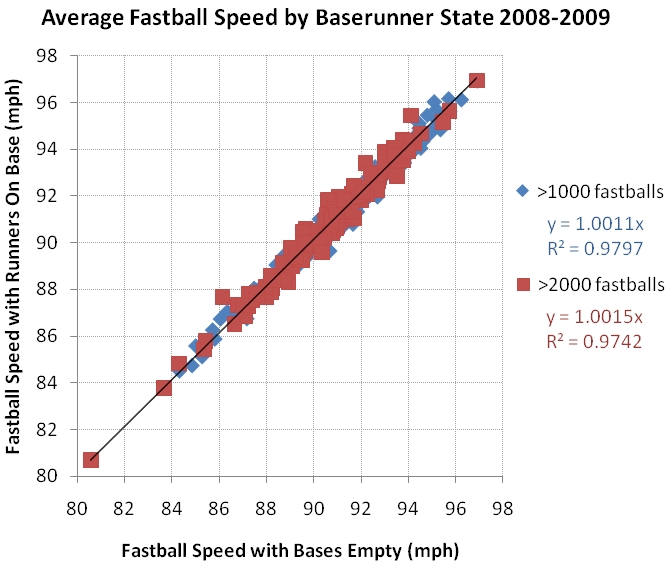
Seeing Jamie Moyer’s average fastball velocity plotted on a chart nearly as funny as seeing Jamie Moyer’s average fastball

Mike Fast at The Hardball Times reacts to a comment from Rob Neyer about pitchers losing velocity when throwing from the stretch and concludes that it’s not really true.

Fast’s analysis is worth a read, but the most entertaining thing in the post is the graph plotting average fastball velocities of Major League pitchers.

That red dot all the way on the bottom left? That’s Jamie Moyer.

Moyer, according to Fangraphs, has not averaged more than 82 miles per hour with his fastball since 2002 (when he was only 39).

Obviously I knew Moyer doesn’t throw hard, but it’s pretty amazing to see it plotted out like that, and to see just how not-hard he throws in comparison to the rest of the league.

And it makes me wonder whether Moyer is some massive outlier who manages to get Major League hitters out with guile and an 81-mph fastball in a way no other pitcher knows how, or if there’s a huge selection bias at play here, and pitchers with 81-mph fastballs simply don’t stick around professional baseball long enough to make the Major Leagues (and learn whatever they need to learn to get guys out without heat) even if they can be effective.

A little from column A, a little from column B, I’d bet.

Seriously

Rays’ manager Joe Maddon likes to wear a hoodie over his jersey — or more likely, over a t-shirt in lieu of a jersey. Major League Baseball has put the kibosh on that, however, telling him that the hoodie is not approved for on-field wear. Maddon said he’ll stop wearing the hoodie….

I think managers should be able to wear anything they want to. Maybe we’d get some style out of these guys.

Craig Calcaterra, Hardball Talk.

When I read the top, newsy part of this story, I figured I’d link to it as an excuse to make the point that managers should be able to wear anything they want. Then I read to the bottom and found that Calcaterra said just that.

But I mean, duh. I guess I can sort of abide having the base coaches wear uniforms, since they’re on-field personnel and all. But baseball pants really aren’t very flattering, and I imagine Razor Shines could come up with something still a little more dashing — but still appropriate for on-field use — if left to his own devices.

And managers? The tradition dates back to player-managers, but at this point there’s really no good reason for the manager to be in uniform. Let’s see some seersucker suits.