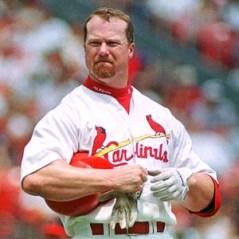
Just Tsuyoshi being Tsuyoshi

Ladies and gentlemen, we have a Tsuyoshi Shinjo sighting.

One of the many disturbing things about Paris Hilton is that it's absolutely impossible to distinguish her from a mannequin.

The former Mets outfielder and longtime Nippon Ham Fighters star threw out the first pitch at Game 2 of the Japan Series yesterday. From the Japan Times:

The roar only got louder when former Nippon Ham star Shinjo made his appearance.

With his unnaturally white teeth gleaming, hair teased and dark sunglasses perched on his face, the heavily tanned former outfield maestro looked more like a movie star than a baseball player.

Yes!

Say what you will about Shinjo’s lifetime .668 Major League OPS, the dude did it with flair. That, and huge orange wristbands.

There are far more meaningful aspects to the story linked above, most notably the return of uber-phenom Yu Darvish from shoulder fatigue. After a 42-day layoff, Darvish threw 87 pitches over six innings, allowing two runs while striking out seven and walking none.

Despite never having seen them play, I’ve long been a fan of the Nippon Ham Fighters. Until recently, I thought “Nippon” meant the place they were from (which was itself perplexing, since Nippon is Japanese name for Japan) and “Ham Fighters” was their nickname, as though they were either fighters made of ham or fighters who battled ham.

Obviously that was a bit conflicting, as I wanted to root for a group of pork-based fighters but couldn’t even consider supporting any team that was waging war on ham. But it turns out they are the Fighters that are sponsored by Nippon Ham, a Japanese company that predictably sells ham.

So I guess they are fighting on behalf of ham, and so I’m cool with that. Plus they have Darvish, who appears to be incredibly good at pitching.

I know this much: The best decision I’ve made today was searching YouTube for Tsuyoshi Shinjo. It’s a veritable goldmine of awesomeness.

Cat-and-mouse game

I play in a weekly pickup baseball game in Brooklyn on Saturdays.

The level is perfect. Everyone knows the rules and at least knows what he’s supposed to be doing, but no one is good enough that you feel bad when you make an embarrassing error. It’s low key.

And it’s about as Brooklyn-ish an affair as you’ll ever see. On any given Saturday, the field is littered with hipsters, lawyers, artists, bartenders, musicians, carpenters, architects, med students, whatever. It’s a big melange of just about every demographic of Brooklyn resident, with a few out-of-towners (myself now included) mixed in.

Everyone gets along, of course, because everyone there really likes baseball.

And when you play with the same general group of guys every week, you start creating mental scouting reports on all the pitchers and you get a decent sense of your own strengths and weaknesses. So there’s never a lack of bench conversation; you can just size up everyone’s game.

I’m a decent hitter. I don’t have a ton of power, but I’m reasonably patient and I rarely strike out. I can’t hit curveballs all that well, but I can usually lay off them or foul them away until I see a fastball.

I’m also pretty certain I’m the single worst defender ever to put on a baseball glove.

Anyway, that’s a long introduction to this: I was on the ball yesterday. I ripped a double down the line in my first at bat, then singled to center, then hit a couple of well-struck flyballs, one of which scored a runner from third.

I got up in the top of the 9th with the bases loaded and my team down 11-8. I had only faced the pitcher once or twice before — he’s not a guy who pitches that frequently — but I had a decent book on him. He throws a reasonably hard, but not overpowering fastball with a decent curveball that he has trouble controlling.

He started me off with a fastball off the plate that I took a huge cut at and missed. He threw another fastball off the plate that I laid off, then came inside with a fastball that I fisted (with apologies to Chip Carey) foul.

Anyway, I know for certain that I should not try to guess or think too much at the plate. It just never goes well. But despite that, I couldn’t help but think, “OK, it’s 1-2 and he’s just thrown me three straight fastballs, no way he throws another.”

But sure enough, he did. It was a perfectly hittable straight pitch right over the heart of the plate, and I froze. Such a terrible approach. So very unclutch.

The next batter grounded out to third and we lost.

Anyway, I often wonder how much the so-called chess match between pitcher and batter affects at-bats in real baseball. Obviously Major League hitters are much better than me at baseball in every imaginable way, but the pitchers are much better than that pitcher too.

I’ve heard hitters discuss it both ways. I’ve heard some guys admit to guessing one way or the other, but plenty of guys say they try to avoid thinking about the cat-and-mouse game entirely and just try to read the pitch when it comes. That can’t be entirely true, of course, because everyone knows he’s getting a fastball from Ollie Perez on a 3-1 pitch with the bases loaded. Can hitters really ever clear their mind of what could be coming next?

It sure seems like pitchers work to outthink their opponents, but can they really, or is it just a matter of their confidence and their ability to throw all their pitches for strikes? I feel like every time I’ve heard Pedro Martinez discuss pitching, especially the intricacies of at-bats, it’s clear he’s doing a tremendous amount of strategizing on the mound. But Pedro, even without throwing 97 miles per hour, has some pretty nasty stuff and pretty awesome control.
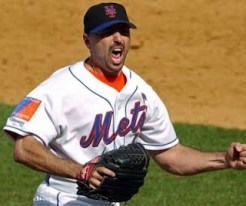
I’m certain that one time I saw John Franco strike out Barry Bonds with four straight changeups, only one off the plate, the last a swinging strike. That’s got to be a mental victory, right? Franco was a very good pitcher with a great changeup, for sure, but Bonds had to be thinking that no one would have the balls to just keep throwing him changeups over the plate.

But then Franco, it turns out, kind of owned Bonds. Including the postseason, in a very small sample of 41 plate appearances, Franco held Bonds — he of the lifetime .298/.444/.607 line — to .216/.268/.270. So maybe Bonds just couldn’t pick up the ball out of Franco’s hand, or maybe Franco was really in Bonds’ head.

Or maybe Franco was a good left-handed pitcher who was ever-so-slightly lucky against one of the greatest hitters in the history of the game.

I’m guessing these are questions we can never really answer because only the players themselves know exactly what’s going through their heads during an at-bat, players have little reason to reveal everything they were thinking during an at-bat, and quite likely every player’s approach is different.

But it’s fun to think about, especially as a way to rationalize striking out with the bases loaded and the game on the line. Ugh.

We can all laugh now, huh?

While you still can, check out Neil Best’s Watchdog blog at Newsday.com. It’s good.

Today, for example, he transcribes a radio conversation between Scott Kazmir and Jim Duquette, the man who traded Kazmir for Victor Zambrano.

Apparently they ran into each other in an elevator in Baltimore and had an awkward conversation, which they recap awkwardly in this conversation:

Duquette: “I was trying to keep it loose and light, you know?  You never know that first moment after the trade, you’re not quite sure how the reaction’s going to be.”

Kazmir: “Kind of a halfway smile like, ‘Is he mad at me?  Are we cool?  Everything’s cool?’  No, we were fine.  After we went past one level I think the tension was gone.”

Duquette: “Yeah, there was the point of no return.  Neither one of us could get out. (laughs)”

Kazmir: (laughs)

I’m so happy Scott Kazmir and Jim Duquette can look back and laugh about this now. So funny.

You know who’s not laughing? Mets fans. Mets fans and, I presume, Victor Zambrano.

Anyway, as Best points out, Ken Davidoff provided a nice rundown of the real thinking behind the Newsday.com paywall. It’s pretty much precisely what NaOH posted here.

An army of Mark McGwires

So Mark McGwire’s going to coach the Cardinals’ hitters next year, and good for them. The dude could hit.

Good for him, too. For some reason, McGwire feels like the most tragic of the outed performance-enhancers, maybe because he managed — or at least tried — to maintain his dignity throughout everything.

Anyway, I bring it up because it allows me to rehash what I’ve always considered an interesting topic of baseball discussion, and one I’ve written about before. In 1998, after watching McGwire hit two home runs in a double-header at Shea, my friend Eric and I were chilling on his back porch discussing McGwire’s awesomeness.

We agreed that he was the best hitter imaginable, but I argued that his talents were mitigated at least a bit by the fact that he couldn’t even capably defend first base, at least not to the eye.

From there, we speculated on how a team would fare if you could somehow clone Mark McGwire and field an entire team of Mark McGwires. Would nine Mark McGwires score enough runs on offense to compensate for their awful defense and pitching?

It’s an interesting question, but one that can’t be answered. It does, in retrospect, seem oddly foreboding of the more recent sabermetric trend toward trying to better evaluate defense.

As the conversation progressed, I pointed out that if you could clone Mark McGwire, why stop at nine? Why not fill the stadium with Mark McGwires, or create a whole damn army of Mark McGwires, stomping into battle, bats on shoulders, chanting “McGwire!”?

That’d be badass, you must admit. The dude was pretty intimidating in his heyday.

The wonder Down Under

This is cool: Major League Baseball is partnering with the Australia Baseball Federation to create a new winter league for Major Leaguers staying fresh in the offseason and native Australians looking to make their mark. The article doesn’t make it clear, but I assume it will work like winter ball in Venezuela or the Dominican Republic, where Major League teams often dispatch young players to hone their games in the offseason.

We tend to look at the years since the 1994 player strike as “The Steroid Era” or some such nonsense, but we overlooked that 1994 was also the year Chan Ho Park made his Major League debut, ushering in a new era of Asian players in the Majors. The following year brought Nomomania, and since then Japanese, Korean and Taiwanese players have become common sights on Major League rosters.


Since that year — an arbitrary endpoint, no doubt — we have also seen a growing trickle from Aruba, Australia, Colombia, Curacao, Netherlands Antilles and Nicaragua, along with the consistent influx of players from Canada, the Dominican Republic, Mexico, Puerto Rico and Venezuela. To date, there has still only been one player hailing from a ship on the Atlantic Ocean.

I suppose that, with leagues now rolling in Italy and the Netherlands, the Majors will boast more European players soon. Teams have also done outreach work in China and India, two countries with massive populations crazy for sport. Multiple organizations are working to spread the game in Africa.

Simply put, baseball is becoming more global. I imagine this is all tied up with the Internet, another thing that has gone more global since 1994, since there’s just so much more information available to everyone now. Now we not only know about Yu Darvish, but we can follow his career in stats and video.

It’s cool, and I’m certain it’s a very, very good thing for the sport. In high school, I often got in arguments with soccer players over which game was better. They’d fall back on the argument that people all over the world played soccer, and I’d insist that was just because people all over the world hadn’t seen baseball yet. Now, people are seeing baseball, and they see that it is good.

Immortality

It turns out Babe Ruth is buried about a mile from my house.

The rain washed away my plans to play baseball in Brooklyn today, so I had nothing better to do than go check out the Bambino’s grave. It looks like this:

-1

At wakes and funerals, people often nod to the coffin and say things like, “It’s hard to believe he’s in there,” or, if it’s an open-casket affair, “He looks so good.”

But he’s not in there. And that’s not him that looks good. Those are merely the flesh and bones that he once inhabited. The person you knew was something that lived and breathed and thought and loved and miraculously somehow operated without batteries. That thing in the casket does none of those things. He is gone. Maybe to somewhere else, maybe to nowhere at all, but certainly not here. Kaput. Adios. So it goes.

I recognize that some people feel otherwise, and I certainly respect their right to pray over the caskets and visit the graves of their lost loved ones. But to me, cemeteries are only repositories for human bodies that are no longer of use to their owners, and vast reminders of our own mortality.

Ruth’s grave, though, feels different. Ruth’s grave is a reminder of the human potential for immortality.

It is large but unspectacular, featuring an engraving of Jesus guiding a small child flanked on the right by the names of Ruth and his wife, Claire, and on the left by an epitaph from Francis Cardinal Spellman. Around its base today were letters from fans, baseballs, Yankees hats, prayer cards and some news clippings about the current Yankees club. Against the stone leaned a bat, a 34-inch toothpick compared to the 54-ounce job Ruth swung. And someone left an unopened bottle of Sam Adams Summer Ale, because if the Babe were around today he’d certainly thirst for a beer with hints of lemon zest.

Standing there in the rain, I felt moved, maybe as much as I ever have been by a gravesite. Not toward sadness or anything like that. Toward something more akin to amazement. I kept thinking: “Holy crap, Ruth is down there. Babe Ruth. The Babe Ruth.”

On one hand, it’s oddly equalizing. Here lies Babe Ruth: 714 home runs, a 1.164 career OPS and a six-foot box. Same as the rest of us, really.

On the other, it’s wholly mesmerizing. To someone of my generation, it’s difficult to believe Babe Ruth actually existed. He died just a few weeks after my parents were born. Even my grandparents only would have caught the downside of his prime, and they passed away before I ever thought to ask them about him. Babe Ruth stands more like a mythical figure, a person whose existence we have some evidence of but whose awesomeness we can never fully comprehend.

And some parts of him are in there. They’re down in the ground, a few feet deep, not a mile from my house.

Is there really some of Ruth’s DNA somewhere not too far below where I just stood? Should that be exhumed? Could we clone Babe Ruth?

And what would happen if that happened? Could Ruth dominate current Major League pitching the way he dominated Major League pitching of the 1920s, back before the league had Black guys and Latin guys and Asian guys, and before weight training and before video scouting and before, ahh, nutritional supplements? Or would he just be some guy, some power hitting outfielder with a little bit of patience, like a Ryan Klesko or something?

Would Ruth, if he were around today, be chastised for playing the game the wrong way? Would he even play the game at all? Perhaps baseball was more the product of Ruth’s nurture than his nature. Maybe something about that Baltimore orphanage made it destined to produce the greatest hitter of all time.

Who knows?

What we know is that in 1915, Gavvy Cravath set the modern-era record with 24 home runs, and by 1920, Ruth had more than doubled it. And yeah, I know that 1920 marked the beginning of the so-called live-ball era when fresh equipment created a hitter’s paradise, but no one else hit more than 19 home runs that year. Ruth had 54.

Think of how crazy that must have looked. 54. Fifty-four home runs when the record — set by Ruth the year before — was 29. That’s like some player (a converted pitcher, no less), hitting 80 home runs next season, and then 150 the year after that. Mind-blowing.

And Ruth wasn’t just the game’s first great power hitter. We’re approaching a century since Ruth’s 1914 debut, and he remains the game’s greatest power hitter. Sure, some guys have hit more home runs in their career and some guys have hit more home runs in a season, but no one has even come close to Ruth’s .690 career slugging average.

Simply put: Babe Ruth was the Babe Ruth of being Babe Ruth.

And now what remains of him is busy not being Babe Ruth within walking distance of my house. So that’s cool. I imagine I’ll be back.

On the rumor mill

I’m hitting the Friday-afternoon wall, and I’m concerned the “From the Wikipedia” post I prepped earlier might be a bit too dark for public consumption, so I’ll check out for the evening with this:

The offseason rumor mill is already churning, and nothing inspires reader e-mails as frequently as vague reports on the Internet and talk-radio that certain teams are interested in certain players.
Here’s my general rule of thumb for rumors: If it doesn’t sound feasible, it’s probably not true. If it does sound feasible, it’s probably not true.

Pay attention to the language used in so many of these reports. Know that there’s a huge difference between “could” and “will” and between “considering” and “planning.”

For example: I personally guarantee that Omar Minaya will consider trading David Wright this offseason. One day, he will just be thinking about stuff — who knows what — and he’ll think, “should I trade David Wright this offseason?”

Soon after, he’ll probably think, “nah.” Then he’ll get on with his day. But he will have considered it. Will he have seriously considered it? No. But it was considered nonetheless.

There should be many moves this offseason, as there are in every offseason, and I know as well as anyone that it’s fun to speculate on what they should or what they will be.

But the offseason hasn’t even started yet, and no GM — and certainly no writer — has his finger firmly on what the market will be for free agents or trade chips. We can speculate on both, of course, based on examples from the past. But we definitely can’t know.

So often, deals that are rumored to be in the works for weeks or months never pan out, and the ones that actually happen have never been rumored anywhere. Sometimes it’s the other way around, of course, but not often enough for me to be convinced about any scoop I read anywhere.

In other words: Enjoy the rumors, but enjoy them skeptically.

Chuck D is so cool.

More on Newsday

Apparently Repoz at Baseball Think Factory found his way here and linked up my recent Newsday post. It has sparked an interesting discussion over there and I urge you to check it out.

First off, as commenter NaOH pointed out both there and here, I probably missed a big aspect of the reasoning behind the decision. He writes:

Cablevision owns Newsday. Cablevision, for now, also owns the Knicks and Rangers, but they will be spinning off that portion of the business. Cablevision’s core assets are tied to television and cable: Rainbow Media Holdings, digital cable service, providing Internet service, and VOIP. This move is about using Newsday as another value-added component to Cablevision’s range of core offerings. Why? Because Verizon FIOS is steadily chipping away at their customer base.

That seems pretty likely, when I think about it. Still, I wonder a) how much value access to Newsday adds to a television or cable subscription and b) how long Newsday could possibly last if its parent company is making moves that will stave off online readership.

I have a “From the Wikipedia” post I’m hoping to do later today and I don’t want to harp on this since it’s not really about sports, but I find the whole subject massively interesting. I suppose I should, since I work in online journalism.

A man I firmly believe should be in the Baseball Hall of Fame, Sean Forman — the creator of baseball-reference.com — provided a pretty interesting business model for newspapers in the BBTF thread. He’s one of very few people that I’m willing to admit are likely way, way smarter than me, so it’s probably worth reading what he has to say.

Anyway, whatever the reason, the main point of said Newsday post stands: I won’t be able to read Davidoff or Best or Lennon anymore, and that’s a shame.