System requirements

Or: How I spent my Saturday morning.

Last week I tweeted about the success of the Rockies’ farm system in developing actual Rockies. Anyway, I wanted to see if any other team had drafted and developed players as well as Colorado, so, using the 25-man Division Series rosters from MLB.com, I compiled the lists of players who have spent their entire professional careers with their postseason teams.

This includes international free agents, which I realize in the case of guys like Hideki Matsui and Daisuke Matsuzaka is not really about development. Plus, guys like Derek Jeter and Jorge Posada likely only stayed with the Yanks because of the Yanks’ unique ability to pay them. But whatever, it’s just an exercise.

Obviously it’s not a perfect way to assess a team’s farm system, as in many cases, prospects are dealt for players who will help immediately. These are just lists. Don’t read too much into them.

Please excuse the terrible formatting, I’m not great with spreadsheets or WordPress and I have someplace to be in an hour. Anyway, here we go:
Continue reading

More of the same

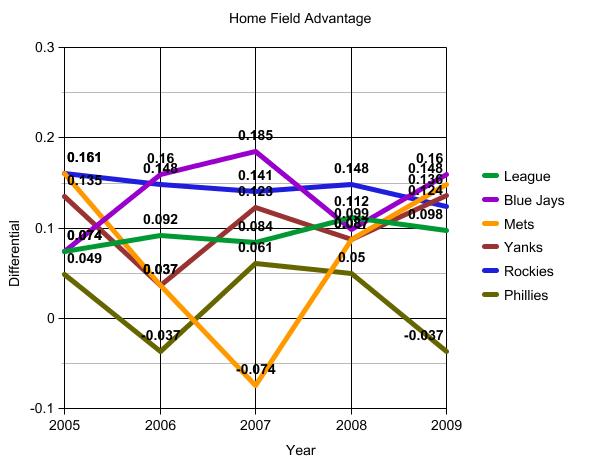
Here’s the third in this series. I picked the Blue Jays for Astroturf purposes, the Mets and Yanks because they’re the Mets and Yanks, and the Rockies and Phillies because of their noted hitter’s parks.

Looks like it’s just more noise.

Interestingly, the Rockies stayed above the league every single year. I wonder if the effects of altitude on the body, more than on the ball, could have something to do with that.

Hilariously, the Phillies were steadily below the league. That makes perfect sense, because everyone knows Phillies fans are miserable and don’t deserve to see a winning team.

The 2007 Mets were terrible at home, but the Mets otherwise fluctuated right around the mean. Same deal for the Yanks.

Graph!

There’s got to be a better way to quantify this, and a way to determine if it really exists. If anyone has any suggestions, I’m all ears. Just don’t make it too difficult on Jon T. Intern; he’s in college and should be having more fun.

More graphic fun

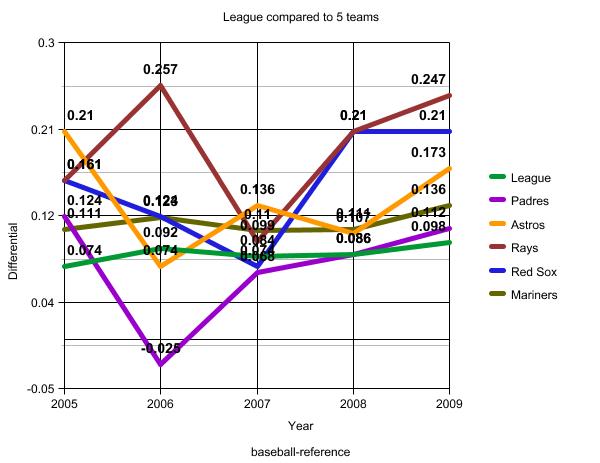
Here’s the second graph from Jon T. Intern, plotting the Padres, Astros, Rays, Red Sox and Mariners. Why those teams? Mostly more randomness.

I picked the Padres and Mariners because of their reputations for having pitcher’s parks, the Astros because they have a stupid, ridiculous hill in center field, the Rays because they play on turf, and the Red Sox because of its peculiar dimensions.

Looks like more noise to me. The Padres are the first team here to have played to a negative home-field advantage, back in 2006:

Home field advantage, random teams

Root, root, root for the home team

Harold Reynolds, on the MLB Network earlier this week, suggested that the Twins have the best home-field advantage in all of sports.

Just in terms of baseball, that seems to make a lot of sense. After all, the Metrodome features two unusual characteristics — artificial turf and a white roof — that could give fits two an unfamiliar team. (Granted, all Major Leaguers have played on turf at some point, but not with the frequency of the Twins, Blue Jays and Rays.)

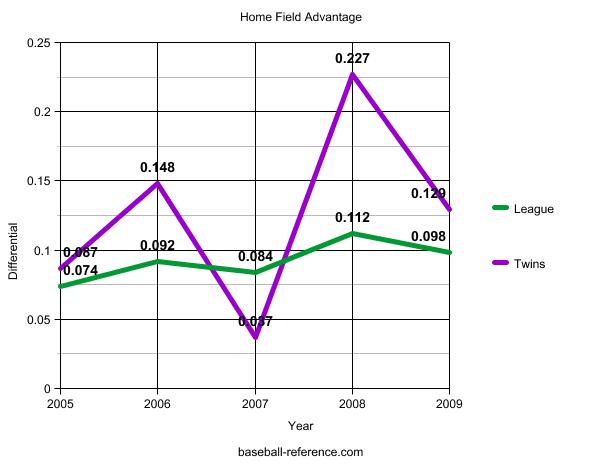
Anyway, the comment intrigued me, and I had an intern available to me with nothing else to do, and I love graphs. So, thanks to Jon T. Intern, here’s the differential between home winning percentage and road winning percentage for the Twins and the entire league over the last five seasons:

Twins vs. league average, home field advantage

So, by this relatively unscientific and totally imprecise method, the Twins have played to a better-than-average home-field advantage in four of the last five seasons. Is that significant?

Maybe, but I’m skeptical. It looks, to my untrained eye, like the whims of randomness and sample size.

Jon is working on another graph charting a bunch of other teams, ones that — off the top of my head — I thought might demonstrate a home-field advantage. Plus the Mets and Yankees, just because.

Dan O’Dowd: Cool

I’m rooting for the Rockies in the National League, and not just because I desperately want them to take down the Phillies. I just like the way they’re run.

I rarely hear Dan O’Dowd’s name thrown around in discussions of the better GMs in baseball, probably because his Rockies spent the beginning of his tenure mostly buried near the basement of the NL West.

But what O’Dowd has done with the franchise in the last few years is pretty remarkable. The Rockies — as I’ve recently tweeted — drafted and developed all 10 of their 2009 top 10 plate appearance leaders, all but Todd Helton drafted under O’Dowd. And in Troy Tulowitzki, Chris Ianetta, Seth Smith, Ian Stewart, Dexter Fowler and Carlos Gonzalez, they’ve got a nice core of players entering their primes. Plus Ubaldo Jimenez is beginning to look like something of a stud.

Moreover, as the Rockies’ GM, O’Dowd faces certain challenges few others do. Even in the post-humidor era, Coors Field is a peculiar park. Nearly all of the Rockies’ hitters feature pretty extreme home-road splits, and the team posted an .849 OPS at home against a .719 OPS on the road in 2009.

O’Dowd has managed to compile a pitching staff, however, that minimizes the disparity. Rockies pitchers yielded a .752 OPS at home, compared to a .713 tally on the road this season.

That’s done with ground balls. The starting rotation features three pitchers — Aaron Cook, Jason Marquis and Jimenez — with ground-ball rates above 50% and a fourth — Jason Hammel — at 46.2%, good for 16th among Major League qualifiers.

I have no idea if O’Dowd reads Fangraphs or just relies on scouting to determine the best ground-ball guys, but either way, it’s clever. Clearly that is the antidote to altitude.

In 2009, the Rockies combined those guys with good defenders (Stewart, Tulowitzki and Clint Barmes) in their infield, and wound up with a staff in which all five starters finished with ERA+s over 100. That’s a pretty solid way to end up playing postseason baseball.