Last week I looked at all the age-27 and younger position players who have suited up for the Mets this year to try to assess what we’ve learned about them in 2012 and how it bodes for their futures with the club. Here’s the sequel to that post: The pitchers.
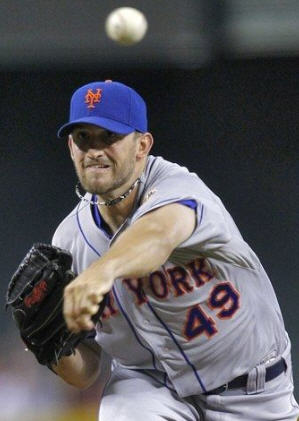 Jonathon Niese: With a contract extension inked early in the season, Niese obviously has a part in the Mets’ future. The young lefty — still only 25 and with over 500 Major League innings on his resume — has pitched like a credible middle-of-the-rotation starter so far this year. Niese faded after July in 2010 and 2011, so the next couple of months could go a long way toward determining whether that’s a pattern or a coincidence. With a solid ground-ball rate and strong rate stats, Niese has pitched to his peripherals with a 3.72 ERA in the first four-plus months of 2012, benefiting from a career-low batting average on balls in play but suffering a bit from a career-high home run per fly ball rate. Both should normalize a bit, but as long as Niese stays healthy and keeps pitching the way he has there should be no doubt of his status in the Mets’ rotation moving forward.
Dillon Gee: Gee had kind of a weird year. The second-year starter struck out way more batters, walked way fewer and yielded more groundballs than he did in his rookie campaign, but the results didn’t quite follow. If he’s done for 2012 after surgery to correct a blood clot in his shoulder, he finishes with an unspectacular 4.10 ERA but a 3.69 FIP and a 3.53 xFIP. Gee’s high strikeout rate was more in line with his Triple-A numbers from 2010, so perhaps, if he returns healthy in 2013, the improvement is sustainable. It allowed him to average nearly an inning more per start in 2012 than he did in 2011 and makes Gee look like a valuable member of a big-league staff. Whether he’s in the Mets’ rotation come Opening Day 2013 should depend entirely on his recovery.
Bobby Parnell: My friend Ripps, a true SABR if there ever was one, sent me this text message a couple nights ago: “It feels like Bobby Parnell should be better than he is but it seems like he is much worse than he is.” I couldn’t put it better myself. Parnell’s blazing fastball and now-nasty-looking curveball have made him by far the Mets’ best reliever this year: He has the best strikeout to walk rate and best ERA of anyone who has been in the bullpen for the bulk of year — faint praise, for sure. Parnell’s few high-profile meltdowns and his unfortunate association with the rest of the Mets’ relief corps have clouded what should be a partly sunny outlook: This will be his third straight season as a capable Major League reliever, and he gets a lot of ground balls, strikes out more than a batter an inning, and doesn’t walk too many. He’s 27 so it seems unlikely he’ll get much better, but he’s under team control through 2016 and good enough that he should be an important part of a Major League bullpen as long as he’s healthy. But it does seem like he’s worse than that, for whatever reason.
Jeremy Hefner: No one outside the Hefner household appears to get too excited about Jeremy Hefner starts, and Hefner himself admitted he wasn’t as good as Johan Santana earlier this week — true, but a surprisingly humble statement from a Major Leaguer. Hefner’s only 26, though, and his 5.04 ERA in 50 innings with the Major League club masks solid peripherals and a strong part-season at Triple-A Buffalo. He throws strikes, which is more than many can say. His lack of strikeout stuff means he’ll likely have to rely on weak contact and a good defense behind him, which could get him in trouble on occasion. But he seems well-suited to the role given to Miguel Batista at this season’s outset: A long reliever and spot starter for the big-league Mets. Hefner’s got options remaining so he could ride the Buffalo shuttle if there’s a roster crunch next season, but he’s good enough to keep around.
Matt Harvey: Even after Sunday’s shaky start, it looks like Harvey will have to pitch his way out of the Mets’ 2013 rotation. Though Harvey hasn’t pitched very deep in games so far at the big-league level, he has shown the stuff to overpower Major League hitters and struck out 23 of them in his first 16 1/3 innings at the level. He’s still a bit wild — walking 3.9 batters per nine both at Triple-A Buffalo and so far in the Majors — but Harvey’s health and performance this season bode well for his future. He looks fit to at least join Niese and Gee as solid young starters in the Mets’ rotation next year with a reasonable shot to be better than both.
Elvin Ramirez: Elvin Ramirez has thrown 12 1/3 Major League innings this year, and though I watch nearly every pitch of every game I can hardly remember any of them. They’ve been pretty forgettable, as Ramirez, who has been wild throughout his Minor League career, has walked more than he’s whiffed in the bigs. That’s not good, and though Ramirez mounted a 1.99 ERA in 40 2/3 innings at Double-A and Triple-A this year, the walks prevent him from looking like a dependable Major League reliever. He’s only 24, so Ramirez still has time, but counting on him to be a part of the 2013 bullpen seems foolish until it’s clear he’s made some improvement or adjustment.
Josh Edgin: Edgin was also pretty wild in the Minors, but he appeared to improve across the season and into his first 12 Major League innings. Sort of by default, Edgin has emerged as one of the Mets’ best late-inning options in the very early part of his big-league career. He’s lefty and he throws hard, which means he likely has a long big-league future. Unless the Mets go crazy for bullpen arms in free agency — and perhaps even if they do — Edgin should be penciled in for the team’s 2013 bullpen. If he performs anything like he has in his first month in his next two, write over that pencil in ink.
Chris Schwinden: If you’re only aware of Schwinden’s three woeful Major League outings in 2012, you don’t know a quarter of the story. After being DFA’d by the Mets in late May, he was claimed by the Blue Jays. He made one start for their Triple-A team, then was waived again and claimed by the Indians. He made three starts for their Triple-A Columbus squad, then was DFA’d in late June. He got picked up by the Yankees, made one start for their Triple-A team before being DFA’d again and picked up by the Mets, the only organization he had known before his whirlwind tour of the highest Minor League level. Schwinden has actually been great in Buffalo this season, boasting a strikeout to walk ratio over three and a 2.19 ERA in 78 innings. His 2012 transaction ledger suggests he can have value to a Major League team as a spot starter or fill-in member of the rotation, but also that teams see him as expendable when rosters get crowded. I’m rooting for him, for what it’s worth.
Pedro Beato: Beato’s seven sporadic outings with the big club in 2012 did not go well, but he’ll be back. He has a 1.97 ERA in Triple-A this year with a 0.906 WHIP, and he’s still got the arm that everyone raved about when the Mets grabbed him in the Rule 5 draft before 2011. Bullpen arms are fickle. Beato could pitch well for a few years in the future and someday earn a “closer” label somewhere and hang around the Majors for years. Or he could prove a Manny Acosta type, good enough to dominate Triple-A and pitch well in spurts at the big-league level. Either way, if he’s around and healthy come February he should compete for a role in the Mets’ 2013 bullpen.
Robert Carson: Carson’s got youth, handedness, arm strength and roster status on his side, but he looked pretty hittable in Double-A and in his insignificantly brief Major League stints this year. His first go-round in Triple-A has gone well over a very short sample, but oddly Carson has had more success against righties than lefties. Lefty relievers often seem to emerge in their mid-to-late 20s, so it’s way too soon to rule out a successful big-league career for Carson. But it’s also way too soon to expect one.
In sum, and despite this season’s bullpen atrocities, the future of Mets pitching looks better than it did last year at this time. If Gee returns to form, the Mets should enter 2013 with at least a solid pitching staff. R.A. Dickey looks like a lock for the front of it, with Niese and Harvey somewhere behind him, and Johan Santana and Gee inked in if they’re healthy. Plus, in Parnell, Hefner, Edgin and Beato they’ve got youngish arms with varying degrees of promise that should vie for bullpen roles. And, in Zack Wheeler, Jenrry Mejia and Jeurys Familia, the Mets have three talented 22-year-old pitchers in Triple-A.
But don’t think about trades. The cliches are true: There’s no such thing as too much pitching and there’s no such thing as a pitching prospect. The best way to build a great staff is to compile as many good pitchers as possible and hope some of them stay healthy. The Mets now appear to have a deep crop of good or potentially good pitchers. Let’s hope some of them stay healthy.



 Tedquarters