
Category Archives: Baseball
Mostly Mets Podcast presented by Caesars A.C.
Reply
A new holiday classic. With Toby and Patrick:
On iTunes here.
BREAKING: Surveyed baseball players disrespect best Christmas song
Mark Newman at MLB.com asks some baseball players and executives to name their favorite holiday songs. Alarmingly, none of them chose Run-DMC’s “Christmas in Hollis,” which rules:
Via Repoz.
Bill Murray continues to rule
Old friend Terry passes along a link to the following video of Bill Murray’s South Atlantic League Hall of Fame induction speech, and more importantly, a whole site full of people’s first-hand accounts of Bill Murray encounters. It is incredible.
Bill Murray is the best:
So this guy’s on board
Growing up as a catcher, I used [Mike Piazza] as my role model and tried to play like him, catch like him and hit like him. I’m really honored to be a part of the New York Mets, where he played as well.
Nice.
Hooray! Hooray! Hooray! The Mets got a right-hand hitting outfielder
The Mets traded Minor Leaguer Jefry Marte to the Oakland A’s for Collin Cowgill, who is a human outfielder that bats right-handed and thus a massive upgrade to their roster.
 It’s actually a good deal for a number of reasons: Though Cowgill’s 75 career OPS+ won’t turn many heads, he’s posted a strong .298/.379/405 line against lefties in a tiny sample in the Majors and a .281/.330/.536 line against them over the past two seasons at Triple-A. He plays all three outfield positions and supposedly had a good arm, he always hit pretty well in the Minors — though he was a bit old for every level — he stole bases in the Minors at a Beltranian rate, and he’ll be under team control for the next five years if it comes to that. Unless the Mets sign multiple righty-hitting outfielders, Cowgill’s likely to make the big club out of Spring Training.
Also, he’s short. Listed at 5’9″, Cowgill inspires all sorts of short-guy love in everything I can find about him from Google. Here’s a fantasy article from 2011:
That latter stigma is the one that has been attached to the fiery Cowgill, 25, for so long. Standing just 5-foot-9, Cowgill has been a victim of his stature, and perhaps his own intensity. He has gotten labeled gritty — perhaps even an overachiever — but he could be the next Eric Byrnes with speed and pop.
“He really has no pride; he really has no ego, other than the drive to be successful,” said Triple-A manager Brett Butler, who knows a thing or two about being a dirt-baller. “There are certain guys who could have played in any era. He’s one of them. You can pay him $5 or you could play him $50 million and he’s going to be the same guy. He’s going to give you his heart and soul every single day.”…
Cowgill, perhaps because the scouts don’t tend to be fans of grit and any outfielder under 6-feet, is flying well under the radar in fantasy. Just this week, he was finally owned in at least one percent of CBSSports.com’s leagues. The story about a potential call-up has ticked him up to 3 percent.
Wait, since when are scouts not fans of grit?
Cowgill’s going to have to be really good for that type of talk not to become infuriating. But hey, at least he does all the little things. Plays the game the right way. Gives his heart and soul every day.
Also, his name is only one letter off from “Cowgirl.”
On David Wright’s defense
I noticed some incoming traffic from a comments thread on Amazin’ Avenue and investigated because I’m pathetically vain. One of the readers there linked to this post in the midst of a lengthy discussion about David Wright’s contract extension, focusing largely on Wright’s defense and the way his improved UZR in 2012 impacted his WAR.
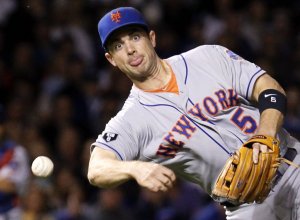 Like many of the conversations at that site, it’s an interesting discussion and worth checking out. In lieu of chiming in there, I’ll add some notes on Wright’s defense here.
I am a longtime defender of Wright’s defense and UZR skeptic. I appreciate that the stat is the best we have to quantify defense and I do use it to inform my understanding of baseball. But it’s so fickle and so frequently misused that it often frustrates me. And though I think sometimes knowledge of a player’s UZR can color our perceptions when watching the games, I do think there’s still a lot of value in empirical assessments, and I find it extraordinarily difficult to believe that Wright was a worse defensive third baseman from 2009-2011 as Miguel Cabrera was in 2012.
The stat, as you may know, requires huge sample sizes to be considered predictive, so much so that I suspect in many cases by the time it can be adequately used to measure a player, the player has already changed. In any case, I’d argue that Wright’s huge uptick in UZR in 2012 should not be viewed as an outlier in an otherwise alarming trend but another data point in Wright’s career totals, which show him to be an average to slightly below average defender at third base.
Though I do think I noticed defensive improvements from Wright at third base in 2012 — those frequently credited to better footwork from Tim Teufel’s coaching — I realize that my eyes were probably biased by my knowledge of his improved UZR. And I struggle to accept that he was the best defensive third baseman in the Majors last season after playing as pretty much the very worst for the prior three. I recognize that the data only reflects what happened, so I’m guessing that Wright was actually somewhere near the middle the middle of the pack throughout and suffered from the heavy hand of randomness.
Also — and I’m not sure if this is something that has been quantified or studied and dismissed — but I imagine some of Wright’s improvement can be attributed to the presence of Ike Davis at first base. It’s no secret that Wright has been plagued by throwing troubles at times in the past, but in 2012 he made only six throwing errors, his fewest in any full season. (And I’m pretty certain, for what it’s worth, at least one of those was thrown to second base and one to a non-Davis first baseman.) From anecdotal evidence alone, it’s not hard to figure why an infielder’s throws would improve with a big, steady target at first base.
My guess is that Wright, with Davis or some other solid defender at first, plays like the average or slightly below average defensive third baseman he has been, in aggregate, over the course of his career. If you want to use the fangraphs version of his WAR to assess his value to the Mets but prefer to dock him the “wins” he earned with his defense in 2012, it’s probably worth crediting him back some of those he lost from 2009-2011. Bottom line, David Wright’s a really awesome baseball player no matter which way you want to draw it up.
New details, new poll
Per Jon Heyman, the “non-elite prospects” in the deal were Mike Nickeas on the Mets’ side and 18-year-old Venezuelan outfielder Wuilmer Becerra on the Jays’ side. Toby points out that Becerra signed to a $1.3 million bonus in 2011, but Becerra played only 11 games in rookie ball this year before, per Jays Journal, a pitch to the face broke his jaw and ended his season.
So it shakes out like this:
Blue Jays get: R.A. Dickey, Josh Thole, Mike Nickeas
Mets get: Travis d’Arnaud, John Buck, Noah Syndergaard, Wuilmer Becerra.
Now what do you say?
Wait, so if the Mets were going to trade Dickey, why did they sign David Wright?
The question in the headline seems to be coming up frequently, so I figured I’d take a crack at it.
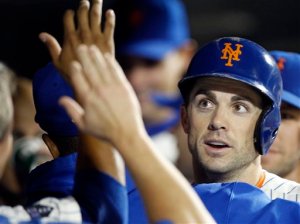 I understand the logic that says if the Mets were planning on rebuilding, they should have opted for a full rebuild by trading Wright for a package of prospects like the one they got for Dickey. But there are some big distinctions between Wright’s situation and Dickey’s situation that don’t make either decision seem like the wrong move. To boot:
– Wright has established a level of production that suggests he’s a safe bet to continue being excellent moving forward. Remember this post? That’s kind of the point. It’s impossible to expect any prospect — or any package of prospects — to outproduce Wright as soon as 2014 or 2015, or maybe ever. If Dickey maintains his 2012 pace through the next few seasons, that’s also the case for him. But Dickey’s future is far tougher to project than Wright’s, in large part because…
– Dickey is eight years older than Wright. I know everybody ages, and sometimes time catches up with a player quickly. But guys as good as Wright don’t often suddenly suck at 31. Will he still be the player he was in 2012 in 2014? Doubtful, but certainly not impossible. Chipper Jones had his two best seasons at 35 and 36. George Brett was still an elite hitter at 37. There’s always a risk Wright suffers some sort of career-altering injury and the deal become a huge albatross, but that’s true for any player with a big deal. Obviously Dickey wasn’t seeking the same money or years that Wright was, but the Mets need Wright more than they need Dickey because…
– The Mets don’t have any other good hitters. Wright was by far the Mets’ best hitter in 2012, with Daniel Murphy the team’s only other regular that provided above-average offense for his position. Behind Dickey, the Mets have Zack Wheeler, Jenrry Mejia and Jeurys Familia, plus guys like Collin McHugh and Jeremy Hefner that seem apt to at least fill in the back of a rotation. The Mets’ best offensive prospects are limited to a bunch of guys in low A or rookie ball and Wilmer Flores, who has a half a season of experience at Double-A. They could have traded Wright to clear the spot for Flores, but that’s putting a ton of eggs in a basket that hasn’t reached Triple-A and might never be able to defend third base as a Major Leaguer. The Mets’ next contender will need to score runs, and it’s hard to figure a better way to ensure that happens than keeping Wright around.
 Tedquarters