From our man Rob in Kansas:
https://twitter.com/Cassidy_Rob/status/280739670164393984
https://twitter.com/Cassidy_Rob/status/280739882412937216
https://twitter.com/Cassidy_Rob/status/280740072859525120

Remember when I noted that every photo Jordany Valdespin has tweeted has been a photo of Jordany Valdespin? It turns out he’s way more prolific but no more diverse on Instagram. He has instagrammed 88 photos, and 75 of them have been of himself — most of them alone, posing. It’s like Jordany Valdespin is curating his own archive of embarrassing photos of Jordany Valdespin:


Huge thanks to @DylanAbruscato for the heads up.
The Mets said goodbye to another, less-heralded member of the 2012 Opening Day starting rotation yesterday when Mike Pelfrey signed a one year, $4 million contract with the Twins. Incentives included in the deal mean Pelfrey could earn up to $5.5 million, which puts into perspective how much of a steal R.A. Dickey is at $5 million. Also, the Dickey trade could have opened up a rotation spot for Pelfrey to start 2013 if the Mets wanted to bring him back, but presumably they wouldn’t have paid him what the Twins did and for all we know he wanted to get the hell out.
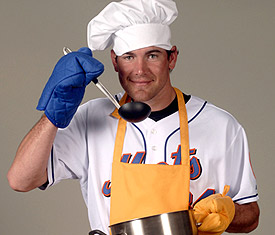 Anyway, with Pelfrey’s departure, it seems appropriate to for once stop lamenting all the things he is not and celebrate the cool things about Mike Pelfrey. I mentioned a bunch of these a couple weeks ago, but I figured I’d hash them out a bit better. Here are some:
– He introduced me to the term “the yips.” Before Pelfrey balked three times in one game in 2009, I don’t think I had ever heard anyone refer to “the yips.” But it’s a great phrase, and perfect to describe what happened that day.
– He’s pretty funny.
– He’s braver than he gets credit for. Pelfrey spoke openly about consulting a sports psychologist because he wanted to combat the stigma against psychology in sports. The same psychologist treated Greg Maddux and Roy Halladay, both of whom are frequently praised for their bulldog mentalities. But Pelfrey’s reward for admitting it was constant undermining of his mental health whenever anything went wrong.
– He was remarkably consistent, year over year. I’ve joked that you could set your watch to Pelfrey’s xFIP. His ERA bounced around, but his peripherals stayed the same. Across Pelfrey’s four full big-league seasons from 2008 to 2011, he struck out exactly five batters per nine innings and walked exactly three. His lowest strikeout rate was 4.9 and his highest was 5.2. His lowest walk rate was 2.9 and his highest was 3.2. Pelf gonna Pelf, as we say.
– He warmed up to Nirvana’s Unplugged cover of “Lake of Fire.” Doesn’t seem like a traditional choice for walk-up music, but it’s a good groove and Pelfrey wore it well. A guy from Kansas could easily go country with it, so credit Pelf for bringing grunge to the park.
– One time he spent a few minutes talking to me about sandwiches. He pronounces bologna like “bo-low-nya.” It’s great. He’s a really nice dude.
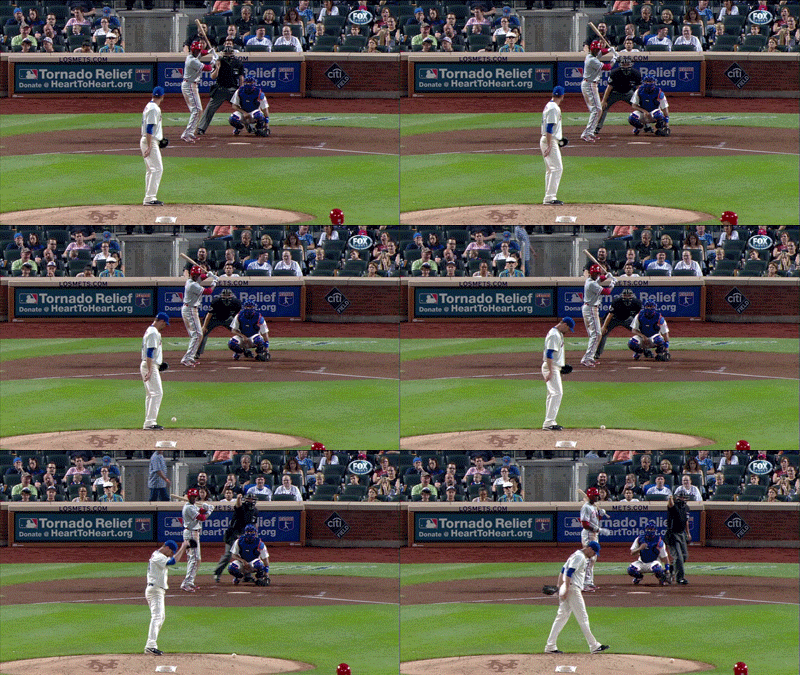
– This happened:
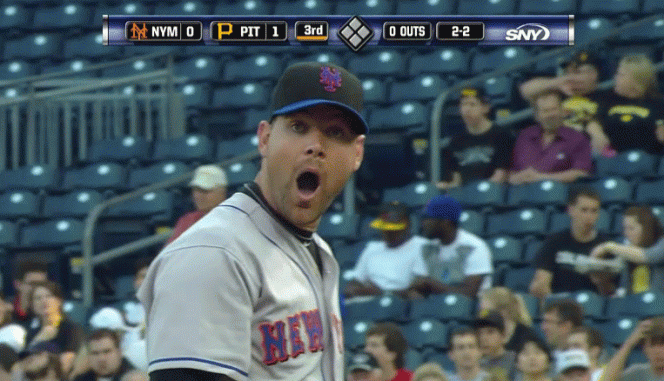
– This zombie face, too:
I can say (and have already said) without hesitation that I’ll be rooting for Mike Pelfrey as hard as I will any ex-Met not named Carlos Beltran.
Given the amount of vitriol being spewed about the Internet following the news that the Mets agreed to trade R.A. Dickey (and Josh Thole and a “non-elite prospect”) for Travis d’Arnaud and Noah Syndergaard (and John Buck and another non-elite prospect), I was surprised to see that over 70 percent of those polled on this site since yesterday feel good about the deal.
 From my perspective that makes things easy, as it means I don’t need to talk most of you into the rationale behind the deal. It’s pretty straightforward: The Mets trade a guy who’s very good now for a couple of guys who might be very good in the future. Thole, who can catch a knuckleball better than most, goes to Toronto as Dickey’s caddy. Buck comes to New York presumably to serve as an Opening Day stopgap to allow d’Arnaud to spend a month in the Minors for an extra year of team control.
This is all assuming Dickey signs an extension with Toronto and the deal gets done, of course. Unless Dickey really hates the idea of pitching indoors in half his games, I’d guess he inks something within the window. Sure, he stands to make a lot more money if he can pitch like he did in 2012 in 2013 and hit the open market after the season, but Dickey seems like a pretty smart guy who realizes how fickle baseball can be. And though I can’t say for sure as I never expect to make close as much money for anything as Dickey already has for pitching, I’d bet for a guy with four kids, the difference between the $13 million he’ll have made through 2013 and the extra $26 million or so he stands to earn in an extension is the difference between “OK, great, we have a lot of money now,” and “we’ll never have to worry about money again ever.” (UPDATE: While I was writing this, reports came out that Dickey and the Blue Jays reached an extension.)
Oh, plus there are still some details we don’t know, most notably the names of the non-elite prospects and whether the Blue Jays will give the Mets another prospect or salary relief to compensate for the $6 million owed to Buck in 2013. The non-elite prospect swap seems like an odd particular of the trade, and could mean a variety of things. It could be as simple as the Mets wanting more outfield depth deep in their system and the Blue Jays preferring pitching, or maybe there’s an unheralded guy in the Toronto farm system the Mets really like and vice versa. Or the players could be — and this I’m hoping for — near-ready non-prospect types aimed to address each big-league team’s specific needs. But I’ll hold off on speculating any more on the subject, since presumably we’ll find out soon.
Instead, let’s assess the guys we know are part of the deal to figure the ways it could pay off or blow up for the Mets.
Dickey: Trading for Dickey makes a lot of sense for the Blue Jays, a club decidedly in win-now mode with a rare window opening up in the American League East. And Dickey seems a safe bet to pitch well in 2013, if not quite as well as he did in 2012. If he can pitch like he did in 2010 and 2011 (ie, excellently) from 2013-2015, Toronto has a great pitcher on what we assume will be a reasonable deal. But by now you know all the risks: He’s 38, and his style of knuckleballing is unprecedented. Those risks, it should be noted, are part of what makes Dickey so awesome and fun to root for: He’s 38 and his style of knuckleballing is unprecedented! Also, everything else.
Thole: I’m a pretty staunch Thole apologist and willing to bet he bounces back in 2013. He’s not about to emerge as a superstar, but a lefty-hitting catcher that can get on base is a rare and valuable thing. And Thole’s now under the Blue Jays’ control for the next four seasons. Look for him to start the year working primarily when Dickey’s on the mound, then steal at-bats against righties from J.P. Arencibia as the season moves along. Many Mets fans seemed to give up on Thole after his awful 2012, but I don’t think he’s an insignificant part of the deal.
Next, the guys coming to the Mets.
d’Arnaud: By most accounts, d’Arnaud is the best catching prospect in baseball. The concerns — all coming out now from many who clamored for him weeks ago — are that he has struggled to stay healthy and that his offensive numbers in Triple-A were bolstered by the hitting environment in Las Vegas. On the other hand, he has a rare lowercase d at the beginning of his name (his older brother Chase uses and upside-down “P” on his jersey) and he has had shirts made in honor of tacos. So he’s alright by me.
Syndergaard: Y’all know I’m not a prospect guy, but Syndergaard’s the type I like — a guy whose results match his hype. As a 19-year-old in Single-A Lansing in 2012, he struck out tons of guys, walked very few of them, and allowed only three home runs in 103 2/3 innings. I’ve read that Syndergaard’s ceiling is a No. 2 starter, but to me, if a 19-year-0ld is throwing in the upper 90s (as he reportedly does) and showing good control, his ceiling is the moon. It’s hard to find a lot of recent teenage pitchers who dominated the Midwest League the way Syndergaard did, and every pitching prospect is his own unique snowflake susceptible to all sorts of injuries. But Shelby Miller and Tyler Scaggs both reached the Majors in 2012 after tearing through the Midwest League as teenagers in 2010. Expect Syndergaard to start the season in High A at St. Lucie, and if all goes well, finish it in Double-A. If he stays healthy, he could be in the Majors as soon as late 2014.
Buck: John Buck is a legit Major League catcher, and the Mets have precious few of those. He’s not a great Major League catcher by any stretch, but he rates out pretty well on defense and can hit a home run every now and then. His batting average dropped below the Mendoza Line in 2012, but on paper it looks a bit like a fluky BABIP thing. He’s here to hold down the fort until d’Arnaud is ready, but I wouldn’t be surprised if his offense moves back toward his career mean and he hits about as well as the coveted Arencibia in 2013.
As for the rest of this…
Off-field stuff and whether it factored into the deal: Honestly, who cares? If we agree the trade is a good one for the Mets, there’s no real point delving into the he-said, they-said, he-reported drama. Because I work at SNY, anything I write about it will be assumed by someone to be coming straight from the Wilpons even if that’s 100-percent never the case. So it’s just not really worth my time.
How many seasons are the Mets “punting”?: At the New York Times, Tyler Kepner wrote this:
By trading Dickey to the Toronto Blue Jays, pending the negotiation of a contract extension, the Mets essentially told their fans that they do not expect to contend for the next three years. The Mets have already staggered through four consecutive losing seasons, three shy of the franchise record. Now the wait to be relevant drags on.
That’s absurd. Three years? We’re mostly Mets fans here — does anyone feel like this trade sent the message that the Mets don’t expect to contend until 2016? Anyone?
If d’Arnaud’s healthy and hitting in Vegas, he should be in the Majors by May. He’ll be 25, nearing his peak, by Opening Day of 2014. If by then he can emerge as a top-10 regular catcher — what the Mets are banking on in making this trade — he could very well be worth more to the Mets that season than Dickey will be to the Blue Jays. Throw in the stark difference in their likely salaries — money that we hope the Mets will allocate elsewhere — and the organization’s depth at starting pitching relative to its stock of legitimate Major League hitters, plus the fact that Dickey is a 38 year old man, and the idea that the deal implies punting three seasons seems stark raving mad.
This deal, if it goes through, makes the Mets significantly less likely to contend in 2013. They have sacrificed Dickey’s near-term value for players they hope will provide more in the future, trading from what appears to be an organizational strength to address what is certainly an organizational weakness. It’s more smart than it is scandalous.
By most accounts, it seems the Mets will send R.A. Dickey, Josh Thole and a prospect to the Blue Jays for Travis d’Arnaud, Noah Syndergaard, John Buck and a prospect. Both prospects have been described as “non-elite.”
I’ll have way more tomorrow, obviously. But assuming the deal actually happens and those are actually the terms of the deal, what say you?
Via email, Bill asks:
What would you name the new seven-team, basketball-focused conference rising from the ashes of the Big East?
Honestly, it’s really hard to keep track of what’s happening with all this, and whether they’ll have the ability to dissolve the conference, to keep the name Big East, to keep their automatic tournament bids, and which teams they’ll be able to bring on from outside the conference. I believe it’ll be more than seven teams when the dust settles though, so you can’t go with “the Magnificent Seven” or anything like that.
If they’re all Catholic schools in the new league, maybe there could be a tie-in there, like “The Big Priest” or something. Alternately, I kind of like “The Medium Sized East.” CATCH THE FEVER!
https://twitter.com/seanadekunle/status/279602892007149569
I do. Dirk Hayhurst’s The Bullpen Gospels was great. It sort of took me a while to get into it, but Hayhurst is a very funny dude and paints a great picture of Minor League life.
Also, Joe Posnanski’s The Soul of Baseball is outstanding. I know someone will pep up and say something about Posnanski’s soft stance on Joe Paterno because the Internet, but that obviously has nothing to do with the content of the baseball book.
I mostly read fiction at home, and I’d definitely recommend Bernard Malamud’s The Natural over Chad Harbach’s recent bestseller The Art of Fielding.
https://twitter.com/jeffpaternostro/status/279601387313168385
I’ve actually sponsored a bunch of baseball-reference pages, but I always snooze and let the sponsorship expire. The pages I’ve sponsored in the past are: Tommy Hanson, Fernando Martinez, Val Pascucci, the 2009 Mets, Bris Robotham Lord — “The Human Eyeball” and Buzz McWeeny.
I changed the message for the 2009 Mets a few times, but for a while I went with “Carlos Beltran: Because baserunning blunders happen more frequently when you’re always on base.” I was pretty happy with that, given the early goings-on of that season.
The Tommy Hanson page obviously had to do with his much-rumored relationship to the band Hanson. I don’t remember what I wrote for Martinez or the Scooch. Obviously the pages for Lord and McWeeny had jokes about their names.
I thought about sponsoring Jeff Francoeur’s page, but it turns out Jeff Francoeur’s page costs $265! It’s almost as much as Frenchy’s on-base percentage. It might be cool to sponsor the pages for the other Ike Davis and David Wright as shoutouts to Mets fans who click the wrong link.
https://twitter.com/patrickboegel/status/279604215830163458
What? Dude, there should be a sandwich named for Mike Piazza at Citi Field regardless of if he makes the Hall of Fame. There should be a standard sandwich named for Mike Piazza available all over the place, like a Reuben or an Elvis. And it’s pretty obvious what it should be: Mike Piazza is an Italian hero. So all your finest Italian meats and cheeses piled high on a hero, with some oil and balsamic vinegar, red roasted peppers, and maybe sundried tomatoes if those are your thing.
https://twitter.com/TheHoeMan16/status/279600909074456576
I have no idea, but I can’t imagine adding Havens does much for a deal at this point beyond freeing up a 40-man roster space for the Mets. Even if you haven’t given up hope for his career, teams aren’t going to give up anything of value for a 26-year-old who has yet to play above Double-A and has never played 100 games in a season. So is Dickey and a non-Harvey, non-Wheeler pitching prospect enough to get a trade for Trumbo and Bourjos done? I kind of doubt it, but I suppose it depends on how much the Angels value the pitching prospect.
I’m way less excited about Trumbo than many Mets fans seem to be, for what it’s worth. He has a ton of power and he hits right handed, both of which would satisfy some of the Mets needs. But without having seen a ton of him in the outfield, I can’t say for certain he’d be a great fit in a corner at Citi Field. And his approach at the plate seems at least a bit foreboding.
Check this out: In 2012, Trumbo posted a .317 on-base percentage and a .491 slugging. Since 2000, only 11 other players have enjoyed seasons with an on-base percentage below .320 and a slugging above .490, and it’s not a very inspiring list of hitters: Jay Gibbons, Jason Lane, Garrett Jones, Jorge Cantu, Nelson Cruz, JJ Hardy, Mike Jacobs, Garrett Anderson, Alfonso Soriano, Tony Batista and Curtis Granderson.
Granderson, Jones and Trumbo all did it in 2012. Of the rest, only Soriano managed an OPS above .800 in the following season. And Batista, Jacobs, Hardy, Cantu, and Lane all collapsed to significantly below average hitters the year after doing it. The endpoints are pretty arbitrary and based on Trumbo’s season, but the point shouldn’t be that difficult to grasp: It’s hard to keep hitting for lots of power without lots of patience.
And since I suspect Trumbo would require more in a deal than Bourjos would, and that Bourjos might come with additional prospects where Trumbo likely would not, I’d take Bourjos over Trumbo. He’s younger, and because of his value on defense I imagine he has a higher floor than Trumbo. His numbers from 2011 don’t seem terribly out of line with how he performed in the Minors, given the expected improvements for a 24-year-old, and I’d take a chance that his 2012 numbers were at least partly the result of playing part time for the first time in his professional career and try to buy low on him instead of buying high on Trumbo.
But all that said, given the price that’s been paid for pitching on the open market, the Mets should probably hold their cards for at least a bit longer and see if someone goes crazy with prospects or young players.
https://twitter.com/Columboid/status/279614969438412800
Nope. He’s 22. I know a knock on Tejada when he was coming up was that due to his body type and physical skills, he didn’t stand to improve much. I… well, I don’t really believe that. Maybe he won’t get faster or more rangey in the field, but I’d bet he gets stronger and more selective at the plate over the next few years.
https://twitter.com/Ceetar/status/279602938173849600
It was Beltran.
https://twitter.com/Beards25/status/279602188014202880
If we’re talking about their baseball prime and not their Mets prime, the Mets get Willie Mays. So that’s sweet.
My starting nine looks like this:
SP: Pedro Martinez
Cases could be made for Tom Seaver, Johan Santana, and oft-forgotten Met Warren Spahn, but Pedro’s 1997-2003 prime was one of the best things we’ll ever see in our lifetimes. <3 Pedro so much.
C: Mike Piazza
Duh.
1B: Keith Hernandez
It was a tough call between Keith, John Olerud and Carlos Delgado — who was an awesome, awesome hitter with the Blue Jays. But Mex wins by a mustache.
2B: Edgardo Alfonzo
Fonzie’s prime didn’t last long, but it provided some of the best seasons in Mets’ history. I know some of you might say Jeff Kent, but f- Jeff Kent. And though Robbie Alomar was probably the best of all of them, I can’t in good conscience include Robbie Alomar even despite the parameters of this exercise.
3B: David Wright
No brainer. Honorable mentions to Hubie Brooks and Chico Walker for having cool names.
SS: Jose Reyes
Another lay-up.
OF: Carlos Beltran, Willie Mays, Darryl Strawberry
Beltran has to play left because of Willie Mays. Willie Mays is Willie Mays. Darryl Strawberry a) still owns the Mets’ home run record and b) one time bought me a sandwich.
Incidentally, by baseball-reference’s WAR, Bernard Gilkey’s 1996 is the best season ever by a Mets right-fielder. But that’s mostly because the defensive WAR kills Strawberry in 1988. I’ll take the Straw Man.
Everyone’s running wild with trade talk now that the Angels have signed Josh Hamilton and seem to have too many outfielders. They seemed to have too many outfielders last year, too, for what it’s worth, but the two names most frequently being mentioned in rumors are Peter Bourjos and Mark Trumbo.

Both players bat and throw right-handed. Trumbo is one year and three months older than Bourjos.
In 1175 plate appearances over 301 Major League games the past three seasons, Trumbo has hit .259/.302/.478 with 13 stolen bases in 22 attempts. By fangraphs’ version of WAR, he has been worth 4.6 wins over his career. By baseball-reference’s, he has been worth 4.7 wins over his career. He hit 32 home runs in 2012 and posted a .268/.317/.491 batting line.
In 940 plate appearances over 299 Major League games the past three seasons, Bourjos has hit .247/.301/.402 with 35 stolen bases in 48 attempts. By fangraphs’ version of WAR, he has been worth 8.3 wins over his career, in large part because of his defense in center field. By baseball-reference’s, he has been worth 7.3. He played a part-time role in 2012 and posted a .202/.291/315 line in 168 at-bats.
Trumbo and Bourjos would both be under an acquiring team’s control through arbitration for the next four seasons.
So who ya got?
Several Mets fans have suggested to me they’d like to see the team sign A.J. Pierzynski. Assuming that would require a multi-year deal or even a lucrative one-year deal, it’s just not a good idea.
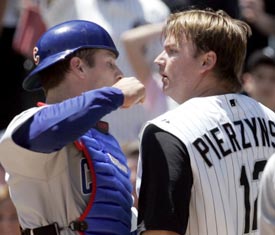 As you may know, Pierzynski hit 27 home runs last year. As you may also know, regression to the mean is a extraordinarily powerful force in baseball, and Pierzynski has never before been as good as he was at age 35 in 2012.
In fact, using park- and league-adjusted OPS+, Pierzynski’s 96 career mark in the stat is actually one point lower than Josh Thole’s rate from 2009-2011. Thole fell apart offensively after returning from a concussion in 2012, but if he can return to form, it’s at least even money he’ll be a better hitter than Pierzynski in 2013. And Thole is a full decade younger than Pierzynski.
Oh, and by the best efforts of those who evaluate catcher defense, Pierzynski was actually worse than Thole behind the plate in 2012. And 2011. And 2010.
Teams with financial limitations and almost no outfielders to speak of should not hand out big contracts to 36-year-old catchers coming off the best seasons of their careers.
If Pierzynski hit right-handed and came cheap, he might fit as a platoon partner for Thole. But since Pierzynski and Thole both hit left-handed, the Mets would be paying a premium to displace a 26-year-old who hit like a league average catcher from 2009 to 2011 in favor of a 36-year-old who hit like a league average catcher from 2009 to 2011. If Thole can bounce back and the team can find a suitable right-handed complement, it should be able to get at least the production Pierzynski would provide at the catcher position and dedicate the resources that would be required to sign him toward outfielders.
In short: Moderate. I’ll be brief here because I’ve got meetings all afternoon.
 Per the New York Post, the Mets have interest in Ross and view him as a potential everyday player, but see Hairston as more of a platoon outfielder.
Over the course of their careers, Ross has only marginally outhit Hairston against right-handers: Ross has a .727 OPS in the split to Hairston’s .704. But it’s probably telling that while the two have almost exactly the same number of appearances against left-handed pitchers, Ross has nearly twice as many as Hairston against righties. So it could be that Hairston’s numbers against righties are a bit inflated by a lack of exposure to the toughest right-handers.
Other than that, they’re pretty similar players. Ross is seven months younger than Hairston. They’re both adequate defenders in the outfield corners who can fill in at center in a pinch. They both hit for power, but Ross gets on base a bit more. And, again, Ross has had slightly more success against and a lot more exposure to right-handers.
Of course, signing either would give the Mets only one capable right-handed hitting outfielder at the Major League level. It’s unclear how much they’ll cost and how much the Mets have to spend, but bringing in both to join Kirk Nieuwenhuis, Mike Baxter and Lucas Duda could allow them to cobble together a decent outfield by carefully managing platoons and defensive alignments. It might get a little hairy on defense sometimes, but you start Duda when the ground-ball pitchers are on the mound and so on.
The end. Now, the meetings.
 Tedquarters