The relief pitchers in April: Frank Francisco, Ramon Ramirez, Jon Rauch, Bobby Parnell, Tim Byrdak, Manny Acosta, Miguel Batista.
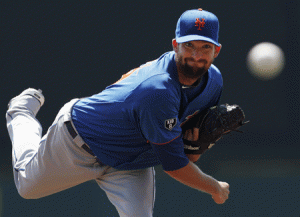 Overview: Before I started this I was looking over the bullpen previews from this year and 2010 and I came upon this bit:
And then there’s the Jenrry Mejia thing. I’ve said my thing on that thing. I refer you to this, this, this, this, and this. I’m kind of sick of shrouding the kid in negativity because he’s a homegrown prospect and I root for homegrown prospects, and now I’ll be rooting like hell for him to dominate in his bullpen role.
The funny thing is, so many people act — and I’m certainly guilty of this myself — as if it’s sort of written in stone that he will. There’s no arguing that he looked great in the Grapefruit League, but 17 innings of Spring Training ball and a rousing endorsement from Jerry Manuel do not necessarily portend Major League success. Big-league hitters — not to mention big-league scouts — are really, really good, recall, and I wonder if Mejia might start looking more like the guy who posted a 4.47 ERA in Double-A last year after the league has seen him a few times.
And then I wonder, of course, if that could ultimately be a ticket back to Binghamton for Mejia, and so a blessing in disguise. And that sucks. This has got to be one of the weirdest fanbase/management divides of all time. I don’t think I’ve ever heard of any team’s fans putting up a more or less unified front urging patience and restraint against a front-office that seems to want no part of it. That’s why you never want your GM making decisions from the hot seat, I guess.
Remember that?
I’ve been thinking about the Mets’ offseason bullpen acquisitions the last few days and trying to decide if I’m justifying them because I have it in my head that Sandy Alderson and the SABRos know what they’re doing. I’ve always held that teams shouldn’t spend offseason assets on relievers and that good bullpens could be cobbled together on the cheap, but the Mets’ front office went out and signed Jon Rauch and Frank Francisco and traded for Ramon Ramirez.
I’ve argued — publicly and privately — that there’s obviously some plan in mind, like maybe the Mets hope to spin a couple of the relievers for young players at the trade deadline (when relievers are often overvalued), or they determined that the easiest way to add wins inexpensively is via bullpen arms. And both of those things could be the case. But I could just as easily be rationalizing.
I’ll say these things: It doesn’t seem like there’s an obvious place the Mets could have allocated the resources they spent on Francisco, Rauch and Ramirez that would have likely added more wins without impeding the progress of a young, team-controlled player, and bringing in two free-agent relief arms and trading for another is a much, much, much, much, much, much, much, much, much better way to go about building your bullpen than making your 20-year-old top prospect your 8th-inning guy. Much.
So there’s that. Plus, it’s not like the Mets spent a lot on the guys they brought in or overpaid for nebulous Kevin Gregg closer labels. Francisco and Ramirez have always been good, and Rauch has more often been good than not good. Manny Acosta, quietly, has a career 119 ERA+ in five partial seasons of work. Byrdak will get lefties out, and Bautista — peripherals be damned — always winds up with pretty solid results and should be a good fit for the long man/spot starter role.
Parnell’s sort of a wild card. He drew raves in Spring Training with his enhanced repertoire and 12 1/3 scoreless innings, but that’s sort of textbook Spring Training trap stuff. Thing is, there’s always been plenty to like about Parnell. Most notably: He throws really hard, he yields a lot of groundballs, and over the last two years his strikeout to walk ratio is just shy of 3:1.
If and when Parnell ascends into a higher-leverage role, you’ll read all about his past failures in similar situations. Believe what you want, but I’d be skeptical. There’s plenty of pressure in the sixth inning of a Major League game, for one thing. For another — and I’ve made this case before — every time Parnell has been promoted, it has come on the heels of a long stretch of effectiveness by the righty. So generally, he has been pitching those high-leverage innings only after periods of heavy use.
On paper it’s a fine enough looking bullpen. Many of them are around this time of year. Once they start actually pitching, we see how the dice turn up.
The relief pitchers in September: C’mon now. Ahh, Francisco, Parnell and five other guys, some of whom are listed above.
Overview: The Braves’ bullpen was awesome last year. The Phillies and Marlins added big-name free-agent closers and the Nationals brought on Brad Lidge and returned the awesome Tyler Clippard. But obviously there’s a ton of randomness in play, enough that I can again safely guess the Mets’ crew will fall somewhere near the middle and hope this year is the one I’m right.

 Davis saw 11 pitches from starter Tommy Hanson. Hanson, who might be related to the band Hanson, threw the Mets’ first baseman one fastball, two sliders, and eight curveballs.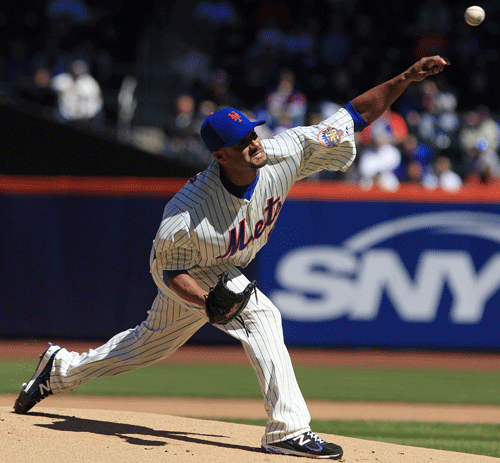

 The Mets’ offseason, more than any other in my twentysomething years of Mets-fan consciousness, was blanketed by an awful shroud of nonsense and negativity. There’s not much need to belabor any of it here: The Wilpons’ looming financial lawsuit and eventual settlement, the bankruptcy rumors, the big-name free-agent departures, the silly helicopter thing, the various illness and injury diagnoses and alleged misdiagnoses, everything. Not all of it — maybe not much of it — actually affects what happens between the foul lines starting in about 80 minutes and ending, in all likelihood, in the early evening on October 3rd in Miami.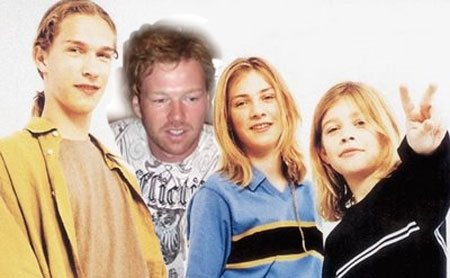
 Tedquarters