This is as much for me as it is for you, as I’m as guilty as anyone of getting caught up in the hype around big-name MLB prospects. But most MLB prospects suck, and it’s important we not lose sight of that.
I don’t know why that’s important. Actually, it’s not important all you want. Continue overhyping prospects all you want. But before you start swooning for some dude with a cool name and a strong reputation that you’ve never seen play, you should probably check out this post from Royals Review last offseason.
Players ranked in Baseball America’s Top 100 prospects “bust” — i.e. contribute little to nothing at the big-league level — nearly 70 percent of the time. 70 percent! And Baseball America is awesome at what it does. It’s just that trying to figure out which baseball players will be good and which will suck is an extraordinarily difficult task.
Mets fans — and I again include myself here — love to get all woe-is-me and recount the series of big-name Mets prospects who have failed at the Major League level: Alex Escobar, Alex Ochoa, Generation K. But check out that Royals Review post again: From 1990-2003, the Mets prospects succeeded at roughly the league average rate. Every team in the Majors has its Alex Escobar.
And this is obviously not to say teams should give up on grooming prospects or we should give up on tracking them. When a young player turns into a legitimate Major Leaguer, his team has a cost-controlled contributor for up to seven seasons. That’s enormously valuable.
But there are no sure things, and when leafing through prospects lists to determine good trade packages the Mets can get in return for R.A. Dickey, remember that the large majority of guys you’re reading about won’t ever provide their teams a quarter of what Dickey gave the Mets last year. And same goes for the guys on the Mets’ list.
I can’t purport to know the team’s strategy, but if I had to guess, they’re tarrying to see if any team ponies up some impressive package of young position players for Dickey.
If the best the Mets can get for Dickey is Mike Olt in a straight-up swap, they’re better off giving Dickey the extension he’s seeking and hoping they’ll get more surplus value from their knuckleballing ace in the next three seasons than they would from Olt in the next seven. If the Rangers panic and add additional promising young players to the deal, the Mets are probably better off trading Dickey than extending his contract.
If a Dickey trade could net the Mets two regular position players under team control for five or more seasons, it’d be worth it — especially given the Mets’ apparent lack of regular position players in the upper levels of their farm system. But obviously most players with five or more seasons of team control remaining come with quite a bit of uncertainty, way more so even than 38-year-olds trafficking in the much-reviled knuckleball.
In any case, there really shouldn’t be as much urgency here as the Internet seems to be demanding. It’s Dec. 11, after all. Assuming Dickey’s terms don’t change or the team does not irritate him into testing free agency after 2013, there’s no real harm in the club biding its time to measure the trade market. If Sandy Alderson determines extending Dickey’s contract is the Mets’ most appealing option, we’ll forget all about this sluggishness in the negotiations long before Dickey takes the mound on Opening Day. Again, our offseason boredom does not and should not impact the way the Mets approach improving the club.
Good read from John Manuel at Baseball America about Steve Meinke, a Thai-American hand model who made Thailand’s World Baseball Classic team despite not having played baseball since a two at-bat Division III career in the late 90s:
“I had to deal with the language barrier, chickens, oldness, no medical training, more oldness, blown hamstring, water and food poisoning, more injuries, the whole cultural aspect of society there, and of course their approach to baseball, which many times drove me crazy,” Meinke said. “And I loved every minute of it.”
For his trouble, Meinke got to make a WBC-paid trip to Taiwan as a member of the Thai national team, where Damon was his teammate. “Johnny was always awesome and considerate to his teammates,” Meinke said, “and always warmed up with the non-Americans and even had the players sign his jersey.”
Meinke never got into a game, though. He was warming up in one game that Thailand lost by mercy rule, and was set to pinch-hit in another game that also ended early by mercy rule.
Before the WBC qualifiers, I started and scrapped a post about all the new participating teams to jokingly determine if there were any I might be good enough to play for. Once I realized that basically every country in the games has its own domestic baseball league, I figured I was eliminated not only by heritage but by utter lack of practice and athleticism. My grandmother was born in Scotland, though, and I’m hoping Scotland goes independent in time to field its own club for the next WBC just so I don’t have to give up the dream.
I’m going to Thailand in January, for what it’s worth, but by my best Internet research there isn’t any baseball in the places I’ll be. Also, though there’s little I’d rather do than watch baseball anyplace, it doesn’t seem like the best use of my limited time in Thailand to spend it doing the exact same thing I do all summer long at home.
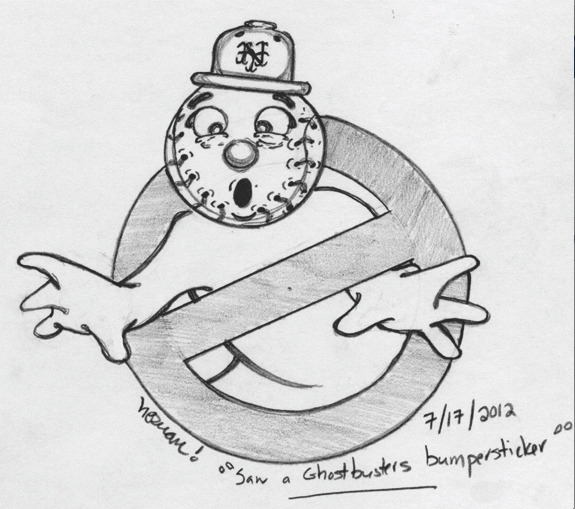
I don’t know how I’ve missed this until now, but thanks to Michael Donato for the heads up: This Tumblr posts a different image of Mr. Met every day to reflect the illustrator’s mood or something that happened to him. I’ve spent the last half hour working my way through the archives. It’s pretty awesome, though some of them may be disturbing for small children sensitive to Mr. Met’s brand identity or whatever.
I got Luis Tiant’s autograph at a paint store when I was nine years old. Some local paint store hired him to sit at a table for a day and autograph these leaflets advertising their special prices on paints. He looked miserable. I remember thinking, This is the best moment of my entire life and the worst moment of his. Luis Tiant was a pitcher for the Boston Red Sox, by the way.
I would pay a whole lot of money to hear Louis CK do color commentary for a baseball broadcast, FWIW.
This is apparently from a pre-game ceremony after Shinjo retired and not actual game action, though anyone who speaks Japanese is welcome to chime in with more details. Most importantly, Shinjo’s uniform number is just a picture of his face. Also, he’s wearing an amazing glove:
In case you missed it, this weekend featured more hot-stove action than the entire span of the Winter Meetings. And the two biggest weekend headlines at least vaguely pertain to the Mets.
First, the Dodgers signed Zack Greinke to a six-year, $147 million contract. Greinke’s a very nice pitcher, but outside of his outstanding 2009 campaign he has hardly pitched like an ace. He routinely posts great rate stats, but his 106 ERA+ over the last three seasons is barely above league average. At 29, he’s reasonably young by free agent standards, and now, thanks to the Dodgers’ absurd new spending habits, he’s extraordinarily rich by every standard.
Based on results alone, Greinke actually pitched a bit like Jon Niese in 2012. The pitchers finished with similar rates in ERA+, WHIP, ground-ball percentage, hits per nine, walks per nine and home runs per nine. Greinke struck out more batters and threw 22 more innings, both of which are important. And Greinke comes with a much stronger resume, since 2012 was by far Niese’s best season to date. But since Greinke will earn as much in 2014 alone as Niese will for the next four seasons, his payday makes the Mets’ contract for the young lefty look like even more of a steal.
Of course, the Dodgers now seem to be operating like the Yankees did in the latter half of the last decade, so it’s not necessarily reasonable to compare the money they’re willing to pay for players to the money other teams should be paying for players. With $115 million already on L.A.’s books for 2017 (!), Greinke’s massive salary looks only like a large drop in a inconceivably huge bucket.
Still, if it sets any sort of precedent for player value in the TV-contract era, it seems to bode well for the Mets in the short term. Assuming Greinke’s contract does not exist in a vacuum, it makes signing R.A. Dickey at even the most expensive rumored terms look like striking oil (presumably with a hard knuckleball that flummoxed a catcher and drilled itself into the ground somewhere). And it means Dickey at his current $5-million rate for 2013 may present even more value to a trade partner than we previously expected.
Speaking of: The second big baseball thing that happened this weekend was a trade between the Royals and Rays. The Rays sent pitchers James Shields and Wade Davis to Kansas City for prospects Wil Myers, Jake Odorizzi, Mike Montgomery and Patrick Leonard.
Myers you presumably know about by now: He’s baseball’s top hitting prospect and was the Royals’ best trade chip in their hunt to upgrade their starting rotation. Shields and Davis should do that, to varying degrees. Shields is a very good pitcher who has thrown at least 200 innings in every full season he has pitched in the Majors, and comes to the Royals on a one-year deal worth $9 million with a $12 million option for 2014. Davis excelled out of the Rays’ bullpen in 2012, but pitched more or less like Mike Pelfrey as a starter in 2010 and 2011. He’s only 27 and he’s signed for the next two seasons for $7.6 million total, with escalating options on his contract that run through 2017.
Shields and Davis look to become the Royals’ best and fourth-best starters, respectively, and push from Kansas City’s rotation some of the dreck they started in 2012. If we can attribute any reason to the front office that gave Jeff Francoeur a three-year contract, it looks like the Royals have identified 2013 and 2014 as a window to contend and sacrificed some part of their future to do so.
But on paper, the cost looks huge. In addition to Myers, the Royals sent the Rays two of their best-regarded and nearest to ready pitching prospects in Odorizzi and Montgomery. Odorizzi entered 2012 as Baseball America’s No. 68 prospect and pitched well in Double- and Triple-A. Montgomery, a lefty, entered 2012 as BA’s No. 23 prospect but struggled throughout the year. Both will be 23 on Opening Day, and both will join the Rays’ consistently obscene arsenal of highly regarded starting-pitching prospects, the strength that allowed them to deal Shields.
It’s hard to figure how the Royals value Shields vis a vis R.A. Dickey. Shields is younger and nearly as good with a longer history of big-league success and an extra year of team control, but will be more expensive in the near term. But, again, the huge cost in prospects the Royals were willing to part with for Shields seems to speak well of what the Mets’ could seek in return for Dickey, should they decide to trade the knuckleballer.
I assume he means what about Matt Diaz as an option for the Mets, not just what about Matt Diaz in general. Diaz, you probably remember, was one of the preeminent Major League lefty-mashers in the latter part of the last decade, one of the few players who manage to hang around the league as the right-handed side of an outfield platoon.
But Diaz is hardly the player now that he was in 2009, when he rocked an 1.103 OPS against southpaws. He’ll be 35 by Opening Day, he hasn’t hit lefties all that well since 2010, he’s now utterly useless against righties, and he’s not much in the field. I’d rather take my chances with Andrew Brown or an Andrew Brown type, or just play Mike Baxter everyday.
Via email, Chris writes:
Ted, how do you think the 2013 Mets will be? Will they contend for the second playoff spot or will it be a year to punt and wait for 2014.
I don’t think “punt” is the right word, because I don’t think teams should ever entirely give up on seasons before they even get started. If there are ways to improve the team around the margins with relatively inexpensive short-term deals and such, they’re worth doing because almost anything can happen in a baseball season and there’s no sense not entering the year with the best team you can put together.
But there are years when teams should go all in and jeopardize their future payroll or roster to compete in the present, and this is not that type of year for the Mets. The Nats look too strong, and there’s too much uncertainty up and down the lineup for them to target 2013 as a year for contending and act accordingly. Again: That doesn’t rule out contending, so it’s not punting the season. It just means you don’t sign older free agents to big contracts or trade away prospects for established players.
Wait, they don’t allow tailgating at baseball games? I definitely tailgated at several Mets games this year. Saw some pretty impressive spreads, too. You just need to pour your definitely-not-beer into a cup.
Totally depends on what it’d take to extend Dickey’s contract, and I’m not sure which reports I believe on that one. If Dickey’s actually available for as little as two years and $26 million on top of his $5 million 2013 option, then it’s Dickey. If it’s significantly more than that, it’s Niese. And though I’ve been discussing trades quite a bit in this space, I don’t think there’s anything wrong with keeping both of them if there’s no worthy package on the table. There are a bunch of ways to win baseball games, and having a deep starting rotation is certainly one of them.
I don’t think the Rangers hate Michael Young nearly as much as the Internet hates Michael Young, and the Internet hates Michael Young because he has been bad at pretty much every position according to defensive metrics, his offensive numbers are a bit inflated by the park in which he plays, and, like many high batting-average guys, he earns a ton of praise from those who limit themselves to the stats on the back of baseball cards. Plus, though his leadership is frequently trumpeted, he complained when the Rangers signed Adrian Beltre and moved Young off third base. But despite all that, I suspect the Rangers are looking to part ways with him mostly because they’ve got so many position players who merit playing time. And I’d bet Young enjoys something of a bounceback season on offense.
I think I am still biased by my faith in him and his administration, and I suspect if Omar Minaya made some of the same moves Alderson has I’d be killing him for them. But I do think Alderson’s still working towards the appropriate goal, creating a sustainable winner with young players developed from within. Whether or not he’s going about that the right way is yet to be determined. Next offseason, when all the payroll money frees up, should be a pretty good test for him.
I’ve read a bunch of people kill Alderson for the Mets’ 2011 and 2012 drafts, and I think that’s extraordinarily silly for a variety of reasons. Mostly because it’s way, way too early to judge the outcome of the 2011 and 2012 drafts.


 Tedquarters