
I want to revist this now

The Albert Pujols vs. Babe Ruth debate was silly enough that I figured I’d drop it and move forward, but then someone mentioned it today in an email and now I’m fired up. And I know the game has changed so much as to make the whole conversation essentially pointless, but whatever. It’s on my mind.
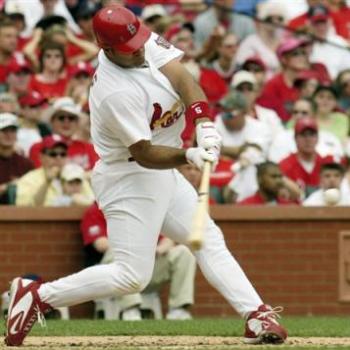
So I’ll state this again: Albert Pujols is a better hitter than Babe Ruth was.

Not relative to their eras. No Major Leaguer was ever better than Ruth when held up against the players against whom he played. That much is obvious. But I’m talking about right-now Albert Pujols vs. 1930 (or 1927, or 1920, or whenever) Babe Ruth.

And not “oh but what if Ruth had this advantage or that advantage that Pujols now has?” He didn’t. That’s part of the point. I’m talking time-travel scenario: Ruth hits his third home run of the 1928 World Series and as he crosses the plate is magically transported to April, 2011, then gets traded to the Cardinals since the Yanks already have Nick Swisher.

Ruth doesn’t match Pujols in 2011. No way.

Let’s consider some of the factors. The only reason I didn’t pursue these in more depth the last time around is that I thought I was making a pretty obvious point.

There were only 16 teams then and there are 30 now, so that might mean Ruth faced a higher concentration of talent. But consider that by the 1930 US Census, there were 122 million people in the country, compared to 308 million in 2010.

There are nearly three times more people in this country now, and nearly all of them grow up exposed to baseball in some form or another. In 1930 there were no Major League teams west of St. Louis, and lots of people in the U.S. still got polio and stuff. It was a very different time, and one in which the road to the Majors was more difficult to traverse.

Obviously a lot of people still played baseball, and yeah, back then baseball didn’t have to compete with as many other sports for a young athlete’s attention. Still, there was certainly nothing like the type of youth baseball structure we have now, with the fundamental instruction and competition that begin when kids are 5 or 6.

If a kid in the US has the ability and desire to become a Major League Baseball player in 2011, he will almost certainly get an opportunity to prove himself in organized ball with somewhat knowledgeable coaches, not by impressing the townsfolk playing against old men in the local farm-league game. Professional-caliber players can’t slip through the cracks these days.

And that doesn’t even consider the impact of the game’s global popularity on the Major League talent pool. 125 guys from the Dominican Republic alone played in the Majors in 2011. You know how many foreign-born players there were in 1930?

Six: Two from Cuba, two from Canada, one from Norway and one from Austria-Hungary. Six dudes born elsewhere, and no doubt at least a few of them grew up in the ol’ U.S. of A.

But that’s all just about the talent pool. What about the game itself?

In 1930, teams scored on average 5.55 runs per game. In 2011, it was 4.28. Pitchers walked guys at about exactly the same rate, but struck out about half as many as they do now. Teams got more hits but fewer home runs, and defenders made nearly twice as many errors.

You can explain all that in a variety of ways: Maybe guys struck out less because they were more focused on hitting for contact than power, and maybe official scorers of the 1930s were harder on infielders.

But the way it looks to me, and the explanation I’m certain is correct, is that the Major League game was just crappier across the board in 1930. I’m sorry if that offends your sense of nostalgia.

Pitchers struck out fewer batters because they couldn’t boast the same arsenals as their 2011 counterparts, and more balls in play meant more hits and more errors because the fielders weren’t very good either. Not by today’s standards, at least.

I could go on, but I’m getting bored and I imagine I’ve long since lost you. But the important thing is this: Major League Baseball keeps getting better. As the talent pool grows, so does the competition for spots on rosters. Advancements in medicine, nutrition, scouting and communications help players become faster, stronger and smarter.

That’s not to take anything away from Ruth. Ruth was unutterably awesome, and deserves any praise directed his way. I have, and probably will again, called him the greatest player ever, because I think that term implies “relative to his competition.” But it is only relative to his competition that he is the greatest player ever.

Top free agent outfield contracts

Patrick Flood continues his look back at the best and worst free-agent contracts by examining outfielders signed since 2004. Any guesses whose contract was the best?

Worth noting: Not only did Carlos Beltran earn his money with the Mets, as Flood points out. He also — in the final awesome flourish of his tenure — brought back Zack Wheeler, now considered one of the Mets’ top prospects.

To rebuild or not to rebuild?

The term “rebuilding” is thrown around a lot in some baseball discussions, if not often publicly by front-office types themselves. To some Mets fans, the team needs a rebuilding year to usher it back toward contention. To others, the idea of blowing up the club — trading all the best players for promising prospects and starting fresh — seems too rash.

What the Mets actually need likely falls somewhere between the two. And really the term “rebuilding,” in its professional sports connotation at least, is shorthand for an approach to a whole series of decisions facing a team. For a smaller market club, it may make sense to function like a Taco Bell franchise: operating with the structure it has until it’s no longer efficient to do so, then tearing down the building and suffering short-term losses while it erects something that works better.
But teams like the Mets, if running optimally and with the flexibility afforded by a big budget, should never really require such a drastic overhaul. A better approach — or metaphor, or whatever — for those clubs might be a state of perpetual renovation, the type required to maintain the value of a structure more stately than a suburban fast-food joint (however delicious).

Whatever. The point is, those Mets fans crying “rebuild” should consider that the team endured many of the aspects typically associated with a rebuilding in 2011.

Yes, they made pretenses toward contention before the season and for a time even teased us with a winning club. But the 2011 Mets entrusted a slew of big-league roles to young and unproven players, resisted the urge to trade prospects for help at the Major League level, and even traded a couple of proven veterans to benefit their future.

And considering all that, it went pretty well. We learned that Josh Thole, Daniel Murphy, Ruben Tejada, Justin Turner, Lucas Duda and Dillon Gee deserve spots on Major League rosters, if not necessarily everyday roles or the jobs they are penciled in for in 2012.

In the Minors, the Mets’ top pitching prospects progressed, which is good. Most of their top offensive prospects (outside of the ones who cracked the Majors) did not. And in a way that’s not all bad, either. The Mets will not likely bank on the success of Fernando Martinez now after another injury-plagued and underwhelming season in Buffalo. It’d no doubt be a lot better if he busted out in 2011, but a firmer sense of Martinez’s chances gives the team more information with which to move forward.

There’s obviously plenty of work to be done before the Mets can comfortably field a functioning 2012 baseball team, and further work still before the Mets can field a contending baseball team. And when I suggested earlier that a team with the Mets’ resources should never have to entirely rebuild, I said “if running optimally,” which the Mets certainly were not for the latter years of Omar Minaya’s tenure.

All I mean to say is that the process — whether you want to call it rebuilding or retooling or renovating — has long since begun. It’s never going to be as obvious or unsubtle as a wrecking ball to the side of a Taco Bell, nor is there any sort of detonator the team’s front office can or will push to blow the whole thing up. It’s fluid.

Really, to many fans it appears the question of whether or not to rebuild in 2012 is linked only to the way the club should approach the futures of its two biggest stars, Jose Reyes and David Wright.

But signing Reyes to a long-term free-agent contract this offseason should in no way imply that the Mets expect to contend in 2012 and will make every effort to do so; it should only say that the Mets expect to Reyes to stay healthy and productive for a long enough time to benefit their next contender, even if that’s a couple of seasons away.

And trading Wright right now, coming off a down year, makes no sense at all. Even if the club wanted to admit to a full “rebuilding” phase — likely sacrificing some of the ticket and ad sales that allow it to maintain a large payroll — it would be better served waiting to see if Wright rebounds in 2012 before shipping him elsewhere for prospects.

The Mets’ front office appears (and has behaved) as if it is interested in developing a sustainable winner by fostering depth from within and putting faith in promising young players. It doesn’t matter what you call the process, only that the process is already underway.

Lance Berkman is probably right

[Albert Pujols is] a better hitter than Babe Ruth and Reggie Jackson and there’s no doubt about it. I’m dead serious. Babe Ruth, as great as he was, played in an all-white league. Now we have the best talent pool we’ve ever had and he’s doing it in that environment.

Lance Berkman.

This is one of my favorite things to think about. Relative to their respective eras, Ruth was a far better hitter than Pujols. Ruth finished with a park- and league-adjusted 206 OPS+, by far the best of all time and 36 points above Pujols.

But like Berkman pointed out, Ruth faced a very limited talent pool. Also, he did so before nearly a century’s worth of advancements in training and instruction, and, you know, computers and stuff.

I’m reasonably certain that if Ruth somehow time-traveled from 1927 to 2011 and replaced Berkman in right field for the Cardinals, he’d prove a well inferior hitter to Pujols. Probably worse than Berkman too, especially if the time-travel mechanism is at all taxing or traumatic.

My question — and the best argument for human cloning, as far as I’m concerned — is: If Ruth were born today and raised with all the trappings of 21st century life, would he again become the best hitter in baseball? Would he again become the best hitter ever?

Get on it, science.

Which is the New York Timesiest?

May I present two excerpts from recent articles in the New York Times sports section:

On second-and-goal, they lost track of Charles Clay in the end zone. He seemingly had time to recite the poem “Ozymandias” — backward, in Ukrainian — before the play devolved into an incompletion on the other side of the field.

Ben Shpigel, Oct. 18, 2011.

Then, just as the Cardinals slugger Albert Pujols used his bat to conduct Game 3 in three stunning movements — a trio of towering home runs struck with the thunder of the symphony timpanist Douglas Howard — the visiting conductor Hannu Lintu used his baton to conduct the orchestra.

David Waldstein, Oct. 23, 2011.

I want to know:

[poll id=”40″]

Broadcasters neglect to mention steroids for first time ever

In the second inning of the first game of the World Series there would be no mention of McGwire’s 2010 statement about using steroids for nearly a decade. No mention of his 2005 testimony at a congressional hearing when he declined to answer questions about steroid use under oath.

No mention of how the guy who hired him, La Russa, had also managed McGwire and another guy partial to the needle, Jose Canseco, when he ran the Oakland A’s….

Still, if you know going in that the teams are ratings-challenged, the idea is to make sure that you don’t lose any viewers after they enter the tent. There are fans who are not interested in hearing the truth or being returned to the steroids era while watching the World Series.

Is it possible Buck and McCarver were advised to make any discussion of McGwire’s past a low priority? Same holds true with McGwire’s connection to La Russa and the fact that he once managed several steroid abusers but saw no evil.

Bob Raissman, N.Y. Daily News.

Yeah, that sounds right. Every time FOX shows Mark McGwire or Tony La Russa, Tim McCarver and Joe Buck should take time to mention their connection to baseball’s heinous Steroid Era. Actually, why stop there? Whenever Ron Washington appears on screen, the FOX broadcast team absolutely must note that he coached for the A’s throughout the Peak Steroid Years.

And hell, Dave Duncan has been the Cardinals’ pitching coach since 1995, a span in which several St. Louis players have been connected to performance-enhancing drug use. Rangers pitching coach Mike Maddux? He played for the Astros in 2000, when teammates (presumably) entertained themselves by bobbing for hypodermic needles in barrels of Dianabol.

Basically every time anyone who was involved in baseball in any way from roughly 1995-2003 appears on camera, McCarver and Buck are obligated to explain his connection to the rampant steroid abuse that heaped shame upon a once-pure industry. Guys from the 70s are exempt even if they sweated amphetamines through their powder-blue road unis, and no need to even mention if a guy from the 80s got a bloody nose every time he laid down a bunt.

These things are all relative, and speed and coke are puny sparklers compared to the dynamite made of steroids that nearly blew the game apart decades later. Actually, the simplest way to make sure everyone is properly shamed for their actions is to affix a big red S on the jersey of anyone who played or coached anywhere near anyone who ever took steroids.

Ugh. Sorry. I know it’s best to just let columns like this one go and that I shouldn’t even indulge it with a link or a reaction. It’s just that this one is about the most infuriating thing I’ve seen all year.

To attribute any capacity for reason to Joe Buck and Tim McCarver practically stomps on my soul. But could it be — oh my goodness, could it possibly be? — that the FOX team didn’t mention McGwire’s steroid abuse because they know no one really wants to hear about it anymore? Or because it has absolutely nothing to do with the World Series game they’re broadcasting?

No way. Obviously this is a Selig-conceived conspiracy enacted to whitewash the sport of its checkered past and ensure that any World Series viewer who spent the last decade comatose will never learn that professional athletes are not all gallant, principled heroes.

Raissman’s absolutely right that “there are fans who are not interested in… being returned to the steroids era while watching the World Series.” Because in retrospect, the whole thing is really, really sad.

You’re telling me what Jose Canseco is evil? Jose Canseco, this pathetic man now reduced to a constant stream of shameless publicity stunts, who pours his heart out to ex-girlfriends on Twitter?

It was never evil. It’s sad that players wanted so badly to succeed in baseball, and enjoy all the trappings of that success, that they were willing to jeopardize their long-term health. It’s sad that no one really did enough to stop them, neither their coaches nor their families nor the league nor — oh dear me — the media.

And it’s sad that baseball fans who loved the sport in the late-90s now face constant reminders that they were somehow complicit in that widespread wickedness. I was 17 in 1998, and it might have been the best baseball summer of my life.

It didn’t matter that I stunk like fish from working in the lobster farm by day, I had a car to get to ballgames and some money to buy tickets, and I had every night at my buddy’s house watching highlights of McGwire and Sosa smacking 450-foot moonshots.

And we knew!

Maybe my memory is unreliable, but I remember talking about how the players we loved watching were almost certainly on steroids. We never stopped to think about the children because we were the children — teenagers at very low risk of injecting themselves with anything who just thought home runs were awesome.

And they were awesome. And they all happened. Mark McGwire, not his steroids, hit 583 career home runs. All of them, as far as I know, still count toward his team’s records. Why, I wonder, were Larry Bigbie’s steroids so ineffective?

You can point out that it wasn’t fair to the players who didn’t take steroids, even if those guys are likely now enjoying the spoils of longer, healthier lives with larger testicles. But you’re right: It wasn’t fair. I got that. I know.

It happened, it was exposed, and every player associated has by now been thoroughly condemned. Shut up already. Or if you really want to be proactive about it, encourage the Daily News “I-Team” to expose the ways players are cheating in 2011. Undoubtedly it’s still happening somewhere.

Encouraging broadcasters to make their already irksome broadcast intolerable does nothing. Everyone knows Mark McGwire took steroids. Let’s move on.