
Our literary knuckleballer

R.A. Dickey is a man with distinguishing taste in cheese.
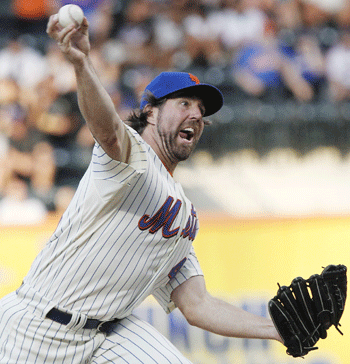
In March, after a video interview with Dickey about his signature array of knuckleballs, I asked him about The Dickster — his personalized sandwich, first Tweeted by Newsday Mets beat reporter and sandwich enthusiast David Lennon.

Dickey told me the Dickster contained turkey, bacon, lettuce, cheese and mayonnaise. As he stepped into the Digital Domain Park clubhouse, I realized I had slipped in my duties as a vigilant sandwich blogger.

“Hey, R.A.,” I called after him. “What type of cheese?”

“Havarti,” he said with a grin.

Not Swiss or cheddar or American or even Muenster or provolone. Havarti: A subtle, buttery Danish cheese, specific enough to suggest it was chosen after careful consideration.

Fangraphs’ pitch-value stat calculates the runs above or below average produced by every pitcher’s offerings. When averaged out for every 100 times the pitch is thrown, the stat shows some predictable returns: Cliff Lee has the game’s most effective slider*; Cole Hamels’ changeup prevents more runs than any other; Roy Halladay throws the most devastating curveball.

Fastball values per 100 pitches tend to be less extreme, somewhat predictably, since the fastball is typically not used to deceive hitters so much as to establish the timing that pitchers hope to betray with breaking balls and offspeed stuff. Still, most of the names near the top of the wFB/c (fastball value per 100 pitches) leaderboard for 2011 should be familiar to anyone who has been following the postseason: Lee, Ian Kennedy, Doug Fister and Justin Verlander sit at places 2-5 on the list.

But atop that mountain of all-stars and Cy Young favorites stands our literary knuckleball, Mr. Robert Alan Dickey. At an average of 84.4 miles per hour, Dickey’s fastball was among the very slowest in the Majors in 2011. But according to the stat, the pitch was 1.84 runs above the average fastball per every 100 times he used it.

Before the Mets’ final game of the season, I presented that information to Dickey.

“Does that surprise you?” he asked.

“It’s the way I use it,” he said. “I might throw six or seven fastballs a day, maybe 10. Usually when I’m throwing it, it’s in counts when they’re not swinging or I’m surprising them with the pitch.”

Despite the well-documented lack of an ulnar collateral ligament in his throwing elbow, Dickey once threw fastballs that reached the mid-90s. In his rookie season with the Rangers in 2003, Dickey still averaged 89.4 miles per hour with his fastball. The pitch’s velocity has withered with the effects of time and a shift in focus, but its effect is amplified by the contrast with his trademark knuckleball.

“It is such a drastic difference from a knuckleball,” he said. “If you see six knuckleballs in an at-bat–”

“The fastball looks like it’s coming in at 110?” I asked.

“I’ve had hitters on the opposition tell our first baseman that,” he said. “So I know it’s effective if I use it correctly.”

For Dickey, the transition from relying on velocity — as he could from his earliest playing days — to relying on deception was not easy.

“Leaving who you were behind and knowing you’re never going to be that person again is tough,” he said. “You have to put your ego on the back burner and embrace something new, and that’s a real challenge.”

This winter, Dickey will re-read Ernest Hemingway’s “The Snows of Kilimanjaro,” and endeavor to climb that mountain. Before he rejoins the Mets in Port St. Lucie in February, he’ll read a Shakespearean comedy — either Much Ado About Nothing or A Midsummer Night’s Dream, he expects — then a few more books from his lengthy reading list.

There are many reasons we like R.A. Dickey. First and foremost: He is a good pitcher on our favorite baseball team. He has led the Mets in ERA+ in both his seasons with the club so far.

He does that while primarily throwing the knuckleball, that last vestige of hope for a Major League career for all of us who could never throw 95 (ignoring, of course, that we could never throw 85 either). Dickey himself put it well, in an interview with Sam Page last offseason: “It’s almost a blue-collar pitch. You’re in the seats and you watch me or [Tim Wakefield] or whoever throw and you’re like, ‘There’s a chance that I could do that.'”

Then there’s all the rest, the stuff that elevates him to folk-hero status in certain sections of the fanbase: He reads books, he rides a bike to Spring Training, he wants to be a ballboy at the U.S. Open, he has a cool beard, he makes a funny face when he pitches, his mom reads Amazin’ Avenue, he loves Star Wars.

Dickey is, on the field and off, an interesting dude. And I suspect we identify with him at least a bit because we all fancy ourselves interesting as well. He is the guy whose fastball is his change-of-pace pitch, subtle Havarti in a league long on assertive cheddar.

*- Technically, Wandy Rodriguez’s slider was worth way, way more on average than any other pitcher’s, but he threw it so infrequently that it seems more likely the pitchFX data used to determine the stat registered a handful of Rodriguez’s curveballs as sliders.

Yu and the Mets

Over at Amazin’ Avenue, Eno Sarris puts together a comprehensive examination of Yu Darvish’s posting and free-agency situation, and asks readers if they’d rather the Mets go for Darvish, re-sign Jose Reyes, or save their money for another starter.

Like many baseball fans stateside, I’ve been mancrushing on Darvish for years now. And if it were a different offseason and the Mets appeared to have more financial flexibility, I’d be all for them taking a big chance on what could be a big arm. Though few high-profile Japanese pitchers have really worked out so far, it’s a very small sample. The Mets lack front-line starting pitching and aces aren’t easy to come by, especially in their peak years.

But right now it seems the Mets are probably best off avoiding such risks. Barring some major change, they’re going to be somewhat cash-strapped for the next couple of years with or without Darvish. So if they did sign him and he got hurt or didn’t prove extremely effective, that would suck hardcore.

The Yankees suck now

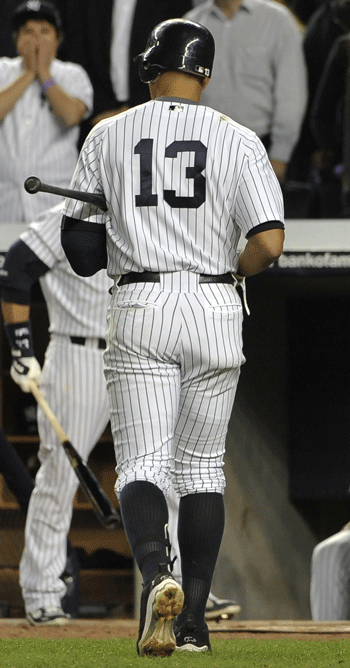
It makes more sense to call [Alex Rodriguez] the same kind of October bust he was for the Yankees before he had his one shining moment in 2009….

Benoit struck him out, swinging.

Two outs now. Still a big swing from Mark Teixeira – who has so often been as small as a jockey in his big games for the Yankees – would bust the game open. Only Teixeira seemed perfectly content to take a walk in that moment, take the walk that made it 3-2.

Mike Lupica, N.Y. Daily News.

A Mostly Mets podcast listener emailed in a good question last week about the Mets’ worrisome home-road split in 2011. He wondered why the Mets went 31-44 at Citi Field this season and 42-36 on the road.

The obvious, satisfying answer is that the park got into the Mets’ heads. All year long we heard about the psychological effects Citi Field’s distant home-run fences had on the Mets’ hitters, and then late in the season we even heard from Dan Warthen say that the dimensions let some of the team’s pitchers grow comfortable throwing bad pitches they felt they could get away with due to the spacious outfield.

And maybe that’s true, despite the randomness suggested by Patrick Flood’s research. Maybe some of that did happen, or maybe it happened even a few times — enough to convince the team’s coaches that it happened frequently, and then, you know, confirmation bias and all that.

Either way, it’s not likely to continue happening. In 2010, in fact, the Mets finished 47-34 at home and 32-49 on the road. Jerry Manuel suggested then that the team’s hitters pressed on the road, swinging too hard for the home runs they knew they wouldn’t compile in Citi Field. In 2009 they finished 41-40 at home and 29-52 on the road. They were much better at Shea Stadium than elsewhere in 2008, but much worse at home than on the road in 2007.

Perhaps calling any of that random statistical noise is too easy. Maybe there was something unique about the makeup of each of those teams and their coaching staffs that could explain the way they performed at home and on the road, even if rosters (and sometimes coaching staffs) tend to be fluid throughout a season.

Point is, none of it appeared to be continuous from year to year.

So here we have A-Rod, great in the playoffs in 2000 and 2004, bad in 2005 and 2006, pretty good in 2007, great in 2009, and bad again in 2010 and 2011. His aggregate postseason batting line looks a whole lot like his career regular season line, but hell, maybe he really did tighten up under the pressure in those down years. Anyone watching the games will say with certainty that he looked more comfortable in that 2009 postseason, though, of course, players generally look pretty comfortable when they’re beating the hell out of the ball.

And everyone in this great city knows that only New York players dictate clutchness, that guys from Detroit and everywhere else in flyover country are more or less robots performing to their expected levels with remarkable consistency. Who cares if Jose Valverde is now 51-for-51 in save situations this year? If A-Rod were clutch he could have overcome that. And if Mark Teixeira were clutch he would have knocked a pitch off the plate over the wall in the seventh.

Let’s forget for now that A-Rod and Teixeira have thrived in countless pressure situations throughout their baseball careers: in high school when big-league scouts came to watch, in the Minors with promotions looming, and in thousands of regular-season at-bats in the Majors. Let’s say for the sake of argument that postseason baseball represents some magical threshold at which the weight of pressure becomes overwhelming for even professional athletes accustomed to it, and that in those situations A-Rod and Teixeira are no different from all of us run-of-the-mill human beings, subject to the whims and burdens of our pathetically imperfect constitutions.

My question to Mike Lupica and the legions of Yankee fans convinced A-Rod is irreparably unclutch, then, is this: Have you ever failed in a big spot? Have you struggled with an important test or botched your lines in the school play or panicked on the parkway or frozen up in a job interview or embarrassed yourself on a date with someone beautiful?

I bet you have. We all have. It happens.

But do you expect it will always happen like that? Do you think that because you failed once or twice or even three times under pressure that you are doomed to do so every single time?

I don’t. Maybe you do. But I imagine anyone with such a defeatist attitude doesn’t often allow himself the opportunity to achieve great successes, and certainly nothing on par with a flourishing career in professional sports.

Existence precedes essence, and A-Rod is essentially one of the greatest athletes of his generation. That he struck out to end the game last night — while playing through injury, no less — should imply nothing other than that he struck out to end the game last night. He will undoubtedly find himself in many pressure situations to come. In some he will certainly fail, and in others he will just as certainly succeed.

You’re watching Bill Buckner saves the day on ‘Curb Your Enthusiasm’ 09/04/11 – TV Replay. See the Web’s top videos on AOL Video