I can’t think of a better way to spend 20 minutes this morning than reading Patrick Flood’s very specific set of predictions for this winter and the Mets’ 2012 campaign.
Things that will happen in the next year
Reply

I can’t think of a better way to spend 20 minutes this morning than reading Patrick Flood’s very specific set of predictions for this winter and the Mets’ 2012 campaign.
A little too harried today to craft anything cohesive, so here’s a Twitter Q&A.
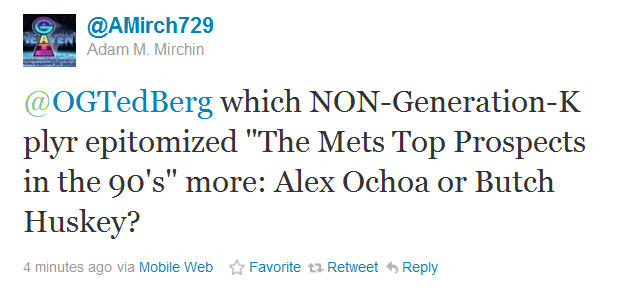 It’s Ochoa. Butch Huskey epitomizes many things, among them the general meaninglessness of Spring Training stats, what a 245-pound man can do to catchers when plowing into them at full speed, and baseball’s rich tradition of great names. But since Huskey enjoyed a couple of reasonably productive seasons as a Met, it’s hard to call him an utter failure as a prospect.
For whatever reason — perhaps because the Mets acquired him in the Bobby Bonilla trade — it seemed like Ochoa came up to a lot more hype than Huskey did. In fact, I remember that Ochoa was the first player I had ever heard referred to as a “five-tool guy,” which was about the most hilarious thing my 14-year-old mind could process.
Soon after the Mets called Ochoa up, I went to a game with my brother and a couple of his friends. We managed to sneak down to the field level in right field, where we proceeded to commend Ochoa for every single thing he did in the game, proclaiming everything as examples of his tools. He took a couple steps toward first base from right field on an infield groundout, and I yelled something about backing up first base from right field being the elusive sixth tool. Stuff like that, all game long.
Eventually Ochoa acknowledged us, and we went absolutely ape. But from there it was all downhill for Ochoa as a Met. Until right now, I had forgotten that he ever put up productive seasons with the Reds and Brewers after leaving Flushing. He did finish fifth in the NL in outfield assists in 2001, strong evidence of at least one tool.
 I don’t drink very often. I know so little about beers that if there’s nothing I recognize on a bar’s tap list I usually panic and wind up with something that tastes like fermented tar, which I sip politely until it’s about 3/4 done then leave it and walk to some other part of the bar hoping it doesn’t follow me.
When I do drink, it’s usually bourbon. And I know plenty of people will judge the hell out of me for saying this, but I rarely drink my bourbon straight. At bars I usually order it with seltzer, and at home I mix it with unsweetened green tea and a little lemonade (about three parts green tea, one part bourbon, one part lemonade). That’s the Ted Berg — order it by name, then explain it to the bartender. I’d like for this to catch on.
I also like a good frozen rum drink, where appropriate.
 Yikes, that’s a tough one. I’m trying to imagine life without my pinkie fingers, and it’s not great. I don’t use my left pinkie as often as I should while playing the guitar, but I still definitely need it for that. And obviously both pinkies are very necessary for typing with any rapidity. Plus — and not to be Debbie Downer here — I’ve got the MS, so my dexterity is at times already limited, and I don’t know how much more of that I want to give up.
I guess there’s an underlying question of vanity here: Would everyone know I had given up two pinkies for a pair of Mets championships? Like would that be something celebrated at the parade — here’s this guy who for some reason had to give up his fingers for this! — or would I just be some eight-fingered fan in the crowd?
Either way I think the answer is no. Maybe that means I’m not committed enough, but I’d say it’s just optimism. I’m confident enough that the Mets will eventually win a World Series or two that I’m not willing to part ways with my fingers to guarantee it.
Toes I’d do in a second. Especially if it came with the promise that headlines after the fact referred to the Mets’ victory as “digitally enhanced.” I don’t think we make enough digit/digital jokes in general.
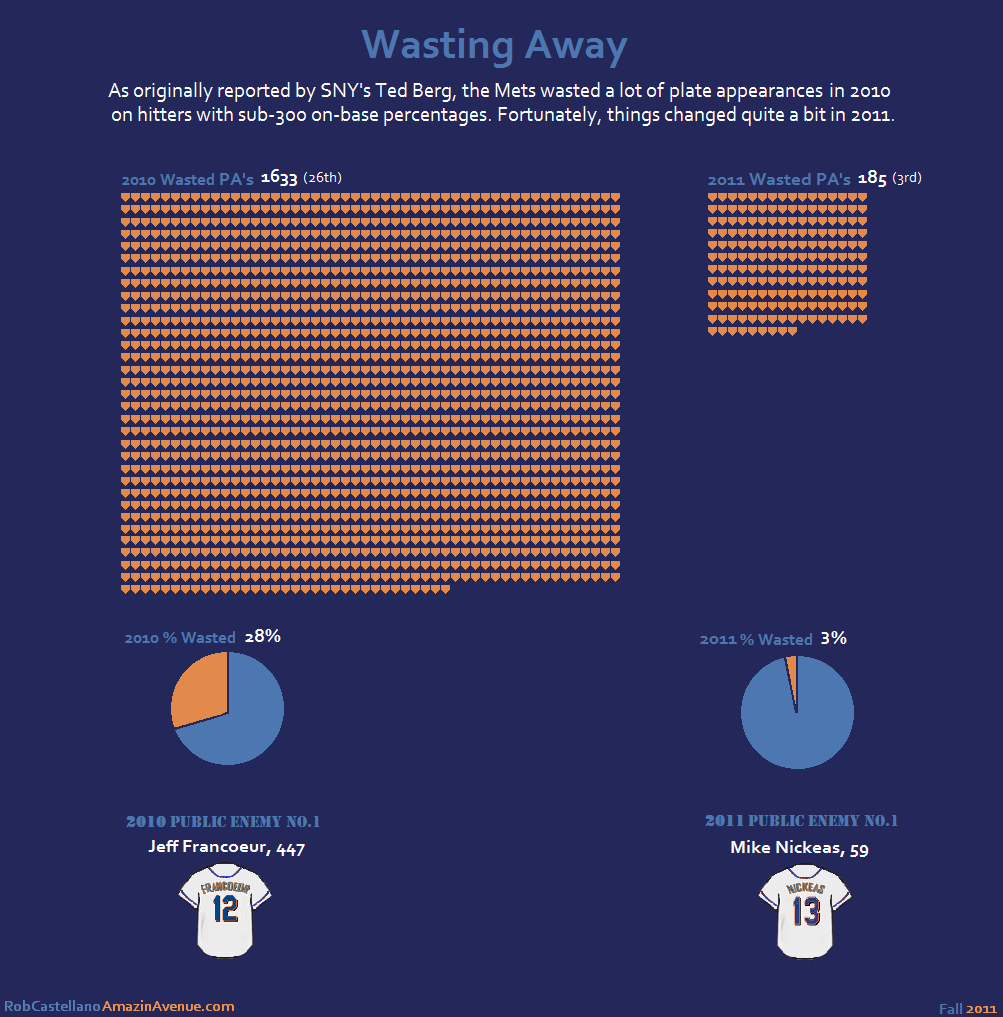
Rob from Amazin’ Avenue hooked us up with a graphic to depict my wasted at-bat watch:
At Amazin’ Avenue, Chris McShanes ha the Mets’ five longest home runs of 2011. This is the best of them:
That’s about the most vicious thing you can do to a baseball, and of course Beltran did it with typical grace. I laughed out loud when I first re-watched it this morning, and I’ve probably played it about 10 times since.
I saw this one live from the left-field corner in Citi Field, a great seat for admiring the distance. In his previous at-bat, Beltran had pulled one of Dan Haren’s pitches foul into the upper deck in right, so I had a hunch he’d get one.
I brought it up on the podcast this week, actually, when considering our awards for best game and best home run of the season. This was the Mets’ last home game before I went on vacation, and I was worried they’d trade Beltran while I was gone and I’d never see him in a Mets’ uniform again. So I went to watch Beltran, and he did this.
Remember Carlos Beltran?
Extra-Base Omir Santos, god of thunder, is on the Tigers’ playoff roster.
Somehow that did not come up in SNY.tv’s series preview with Al Beaton from BlessYouBoys.com.
When we came into Spring Training, one of our main issues was to have a good approach at the plate — to work counts, to get ourselves in situations where we’ve got runners on base via the walks. And I think we did that. I think Dave [Hudgens’] insistence on it — I think the players bought into it as we kept going in to the season. And I look now at the end of the year and we had a lot of guys get on base. I think the approach is going to spread. I think it’ll go through the organization now due to that. To me that’s one of the keys to why we played as well as we did. We got ourselves on base a lot.
– Terry Collins, pre-game Wednesday.
For whatever reason last offseason I started charting the Mets’ “wasted at-bats,” their number of plate appearances by players finished the year with on-base percentages below .300. It’s not by any means a great way to assess an offense — just charting the team’s on-base percentage would be more useful — but it has become a great way to exemplify the improvements at the fringes of the roster brought on by the new regime in Flushing.
Last year, the Mets gave 1633 plate appearances to players with sub-.300 OBPs, by far the most in their division.
 This year, the Mets gave 185 plate appearances to players with sub-.300 OBPs.
Outside of the muscly Cardinals, every other team in the National League had at least one single player with a sub-.300 OBP amass at least 185 plate appearances. Several teams have multiple regulars giving away at-bats all the time.
The Mets finished second to those Cardinals in on-base percentage for the season. Despite their home field and general lack of power, they finished sixth in the National League in runs per game, behind three playoff teams and the park-aided Reds and Rockies. By adjusted OPS+, the Mets tied with the Brewers as the NL’s second-best offense.
Of course, nabobs will be quick to point out that the Mets finished 77-85, and maybe their strong on-base skills mean nothing because they can’t grit out clutch hits or something. But the Mets lost 85 games principally because they allowed the fourth-most runs per game in their league. The offense was absolutely not the problem.
Speaking of: Imagine what the Mets offense could have done if it stayed healthy and optimized all season long? What would have happened if the offense looked more or less like this all year long:
Reyes (143 OPS+)
Murphy (125)
Beltran (150)
Davis (123 career OPS+)
Wright (114)
Duda (136)
Pagan (93)
Thole (94)
This is assuming Davis would not have continued his torrid pace and Murphy could have lasted longer at second base than he ever has without getting injured, and it’s purely hypothetical. Injuries are inevitable, but if that lineup could have averaged 450 at-bats apiece, it would have given the Mets about 3600 at-bats’ worth of a 122 OPS+. If the reserves provided about a 90 OPS+ in the remaining 2000 at-bats, the team would have finished with an OPS+ of 111.
Again: This is all shoddy math that I’m endeavoring for my own entertainment. But if the Mets scored 4.43 runs per game with a 102 OPS+, they would score about 4.82 runs per game with the 111 total. Assuming the team could prevent runs at the same rate, using the Pythagorean expectation formula, that would make for about a .525 winning percentage. So, still not good enough to make the playoffs. But hey: better.
You’re going to want to watch this. Tim Byrdak is a masterful videobomber. There’ll be a few more on Mets Weekly on Sunday.
Amid the joyous news that we will not have to stomach Larry Jones in the playoffs, we may have missed the important subtext that we will indeed get to watch Albert Pujols.
Pujols’ streak of batting .300 with 30 home runs and 100 RBI ended this year when he hit .299 and drove in 99 runs. Of course, the .300-30-100 thing is really just a statistical novelty, and falling an RBI single short of that mark doesn’t mean Pujols is much less awesome.
After a rough start to the season, Pujols finished with a 150 OPS+ — not quite up to his career standard of 170 but still good for eighth best in the league. From June 1 through the end of the regular season, Pujols posted a .997 OPS. He has a 1.009 OPS in the postseason because he’s Albert Pujols.
The Cardinals’ NLDS matchup with the Phillies provides the stage for a possible playoff rematch between Pujols and Brad Lidge. For some inexplicable reason I can’t find video of Pujols’ 2005 NLCS home run off Lidge, which should be like the main thing on the Internet.

 Tedquarters