The Dolphins… oof.
Previewing Giants-Dolphins with John Fennelly
Reply

The Dolphins… oof.
More of the rapid-fire style established with Belth a couple weeks ago.
Yet signal-callers are on pace to throw his way slightly more than last year, when they took just over four shots per game at him. The increase comes despite the fact that Revis has allowed an unheard-of 2.9 quarterback rating—by far the best in the NFL—when passers throw into his coverage zone, according to analysis site Pro Football Focus.
By comparison, his performance this year is dwarfing that of his 2009 season, when he was a runner-up for Defensive Player of the Year and led the league by allowing just a 32.3 quarterback rating. Through seven games, in which he’s recorded four interceptions and allowed just 11 catches for 193 yards, he’s on pace for a career-high interception total and a career low in completions given up, according to Stats LLC.
– Chris Herring, Wall Street Journal.
Via SNY Why Guys.
Teams coming off a bye have been horrible this season. Three wins and nines losses to this point. All the time off actually hurts the players, especially since training camps were so condensed. Right now, players don’t need more rest; they need to keep improving on their fundamentals. The lack of practice time makes it hard to get players in game shape with great pad level and explosion. Four days off makes it even harder to regenerate what was gained from the start of the season. I’d be worried if my team was now entering a bye week.
I’ve seen this factoid mentioned a number of times in relation to the Jets already, but something about it didn’t smell right. Mostly: 3-9. A 12-game sample in this case doesn’t seem like enough to indicate anything.
As it turns out, the 12 teams who have had bye weeks so far are a combined 28-43 for the season. And while that’s still a better rate than 3-9, it makes the 3-9 stat look a lot less glaring, no?
Of course, one could argue that if the bye week is actually hurting NFL teams this year, the games played after a bye week shouldn’t be counted against the 12 teams in question. Still, if you take those three wins and nine losses out of their records, they’re a combined 25-34.
Think of it in terms of baseball, where we’re better at identifying randomness: If a 25-34 team went on a 3-9 stretch, would that seem at all notable?
Perhaps some of the factors Lombardi lists are negatively impacting NFL teams on bye weeks. But they’re also undoubtedly benefiting from the rest and the extra time allowing players to return from injuries. I would not hold the Jets’ bye week in Week 8 against their chances in Week 9.
We’ve gone to plaid.
On the fourth play of the Jets’ opening drive against the Chargers on Sunday, after a 1-yard run on first down left Gang Green in a 2nd and 9 situation, someone — presumably offensive coordinator Brian Schottenheimer — called for a pass.
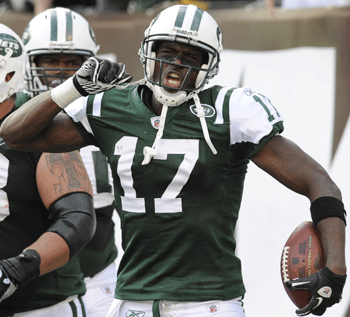 This is notable because, as Mike Salfino pointed out last week, the Jets have passed the ball every single time they’ve faced a 2nd and 9 in the first quarter this season.
The Chargers sent linebacker Takeo Spikes charging just outside the Jets’ left tackle, where he was met by Jets fullback John Conner. Conner put a good first hit on Spikes but failed to hold his block, and Spikes slid off in pursuit of Mark Sanchez.
Sanchez, under pressure, threw the ball slightly behind tight end Dustin Keller cutting across the right flat. Keller had a step on linebacker Donald Butler but had to slow to juggle the pass. He corralled it briefly, but by that time Butler and linebacker Shaun Phillips had converged on the ball. Butler stripped it from Keller during the tackle and returned it 37 yards for a Chargers touchdown.
Here’s why it’s so hard to point fingers in football games, to oversimplify the way we like and identify some single bugaboo as the problem on any team or drive or play.
None of Schottenheimer, Conner, Sanchez or Keller made a mistake so egregious to deserve all of the blame for the play. But if Schottenheimer had called something less predictable, if Conner had done a better job keeping Spikes at bay, if Sanchez had made a better throw or if Keller had held on to the ball, the outcome of the play would have certainly changed.
And all that said, it still took an excellent play by Butler (and a decent one by Spikes) to earn the touchdown.
Luckily, Sanchez made some better throws later in the game and Keller did a better job holding on to the ball. The play-calling appeared to improve, too, but then that’s the type of thing that generally operates on a positive-feedback loop: It’s always easier to call the next play when the last one worked.
The Jets won, which matters most. Plaxico Burress caught three touchdown passes. He deserves a fair share of the credit, but he likely wouldn’t be enjoying any if the Jets’ offensive line didn’t do a great job protecting Sanchez and opening holes for Shonn Greene, and if Greene, in turn, hadn’t done a fine job steamrolling defenders in the open field.
More to follow.
May I present two excerpts from recent articles in the New York Times sports section:
On second-and-goal, they lost track of Charles Clay in the end zone. He seemingly had time to recite the poem “Ozymandias” — backward, in Ukrainian — before the play devolved into an incompletion on the other side of the field.
Then, just as the Cardinals slugger Albert Pujols used his bat to conduct Game 3 in three stunning movements — a trio of towering home runs struck with the thunder of the symphony timpanist Douglas Howard — the visiting conductor Hannu Lintu used his baton to conduct the orchestra.
– David Waldstein, Oct. 23, 2011.
I want to know:
[poll id=”40″]
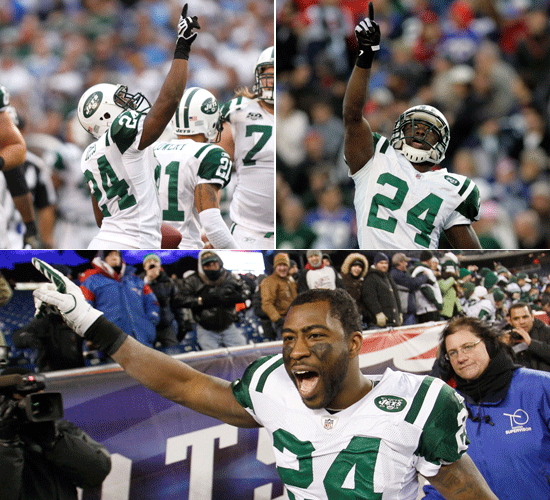
Our man Revis got in a bit of a tiff with Mike Francesa today. I’ll share the audio as soon as I can find it. For now, here’s this:
 Tedquarters