
Jets win hooray

On the fourth play of the Jets’ opening drive against the Chargers on Sunday, after a 1-yard run on first down left Gang Green in a 2nd and 9 situation, someone — presumably offensive coordinator Brian Schottenheimer — called for a pass.
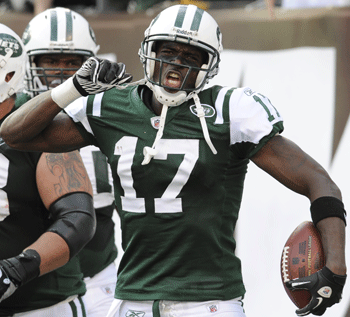
This is notable because, as Mike Salfino pointed out last week, the Jets have passed the ball every single time they’ve faced a 2nd and 9 in the first quarter this season.

The Chargers sent linebacker Takeo Spikes charging just outside the Jets’ left tackle, where he was met by Jets fullback John Conner. Conner put a good first hit on Spikes but failed to hold his block, and Spikes slid off in pursuit of Mark Sanchez.

Sanchez, under pressure, threw the ball slightly behind tight end Dustin Keller cutting across the right flat. Keller had a step on linebacker Donald Butler but had to slow to juggle the pass. He corralled it briefly, but by that time Butler and linebacker Shaun Phillips had converged on the ball. Butler stripped it from Keller during the tackle and returned it 37 yards for a Chargers touchdown.

Here’s why it’s so hard to point fingers in football games, to oversimplify the way we like and identify some single bugaboo as the problem on any team or drive or play.

None of Schottenheimer, Conner, Sanchez or Keller made a mistake so egregious to deserve all of the blame for the play. But if Schottenheimer had called something less predictable, if Conner had done a better job keeping Spikes at bay, if Sanchez had made a better throw or if Keller had held on to the ball, the outcome of the play would have certainly changed.

And all that said, it still took an excellent play by Butler (and a decent one by Spikes) to earn the touchdown.

Luckily, Sanchez made some better throws later in the game and Keller did a better job holding on to the ball. The play-calling appeared to improve, too, but then that’s the type of thing that generally operates on a positive-feedback loop: It’s always easier to call the next play when the last one worked.

The Jets won, which matters most. Plaxico Burress caught three touchdown passes. He deserves a fair share of the credit, but he likely wouldn’t be enjoying any if the Jets’ offensive line didn’t do a great job protecting Sanchez and opening holes for Shonn Greene, and if Greene, in turn, hadn’t done a fine job steamrolling defenders in the open field.

More to follow.
Which is the New York Timesiest?

May I present two excerpts from recent articles in the New York Times sports section:

On second-and-goal, they lost track of Charles Clay in the end zone. He seemingly had time to recite the poem “Ozymandias” — backward, in Ukrainian — before the play devolved into an incompletion on the other side of the field.

Ben Shpigel, Oct. 18, 2011.

Then, just as the Cardinals slugger Albert Pujols used his bat to conduct Game 3 in three stunning movements — a trio of towering home runs struck with the thunder of the symphony timpanist Douglas Howard — the visiting conductor Hannu Lintu used his baton to conduct the orchestra.

David Waldstein, Oct. 23, 2011.

I want to know:

[poll id=”40″]

More on predictability in football

For offenses to be most effective, they need to be unpredictable. In the 2nd and 10 situation, this means defenses would have to prepare for the nearly equal chance of a run or pass. Many analysts refer to ‘balance’ as the key to unpredictability. But balance itself doesn’t matter if the offense is predictable in achieving its balance. Running and passing on every other down would provide perfect balance but would be completely predictable. That’s why randomness is at least as important as balance to keeping the defense on its heels. Anything other than random play selection provides a pattern, however subtle, that an opponent can detect and exploit….

Coaches and coordinators are apparently not immune to the small sample fallacy. In addition to the inability to simulate true randomness, I think this helps explain the tendency to alternate. I also think this why the tendency is so easy to spot on the 2nd and 10 situation. It’s the situation that nearly always follows a failure. The impulse to try the alternative, even knowing that a single recent bad outcome is not necessarily representative of overall performance, is very strong.

Brian Burke, Advanced NFL Stats.

It turns out most teams are predictable on 2nd and 10, if not quite as predictable as the Jets have been in the first few games of this season. If you’re interested in play-calling tendencies at all, click-through and read the piece (and look at the graphs); it’s good.

Also, a fun fact: Brian Burke is the first cousin of my former roommate Ted Burke.

Hat tip to reader Brian (not Burke) for passing this along.

Jets doomed by their own predictability?

On first and 10 in the first quarter, the Jets are 51.72% run and 48.28% pass. However, in the first quarter, on second and 10 (presumably on incompletions), the Jets run 100% of the time. Last year in the first quarter on second and 10, they ran 82.35% of the. But on second and 9 in the first quarter (presumably after a failed run) the Jets PASS 100% of the time in 2011 and 75% of the time in 2010. So, fail a pass play, run. Fail a run play, pass. This doesn’t seem that hard to defend, does it.

Mike Salfino, SNY Why Guys.

Whoa.

It sure does seem like the playcalling is predictable while watching the games, but I also think the playcalling is usually the easiest thing to criticize when a team’s going poorly.
At the Giants’ game on Sunday, the dude next to me just kept yelling, “Pass the football!” incessantly, even on obvious running situations or when the Bills were giving the Giants a lot of room up front.

It was annoying, especially because if the Giants passed as often as this guy wanted them to they’d almost never be successful. Everyone loves sexy deep pass plays, but if you don’t keep defenses honest with runs they’re never going to work. People forget that, I think.

Regardless, the stat above is pretty eye-opening. Like Mike points out, it just can’t be too hard to defend against a team when you know with some certainty what’s coming.

Jets stuff

The Jets won last night. I planned to recap that with a longer post, but I had a meeting that occupied my whole morning and I covered most of what I wanted to say in the below video with Brian Bassett. So in lieu of that, here’s Darrelle Revis doing his thing:

And here’s me and Brian talking about it:

Remind me again why they’re testing for HGH

NFLPA officials said the World Anti-Doping Agency refused to share all the information they requested during a three-hour meeting in Montreal on Aug.24. The union wants data about the athletes who were used to originally set thresholds for positive tests so it can compare that information with a study of its members’ HGH levels.

The union believes football players may have higher HGH levels than other athletes. WADA has not shared the data because it says there is plenty of information about the test already available.

Goodell, meanwhile, is scheduled to meet Friday with Rep. Darrell Issa (R-Calif.), the chairman of the House Committee on Oversight and Government Reform, and Rep. Elijah Cummings (D-Md.), the panel’s minority leader, to discuss HGH testing. Baltimore Ravens union representative Domonique Foxworth and union official Ernie Conwell, a former NFL tight end, are expected to attend the meeting. Travis Tygart, the executive director of the United States Anti-Doping Agency, is also expected to participate in the meeting.

Michael O’Keeffe, N.Y. Daily News.

Remind me again why they’re testing for HGH. I know it’s cheating, but why is it cheating? Is it because it’s illegal to use HGH without a prescription? Because that’s true; it is. And we know from Ricky Williams that the NFL tests for marijuana. So maybe owners just want to know if the players in which they’re investing tons of money are engaged in illicit drug use, fearing the inevitable effects of that criminal lifestyle. Or something.

Are they testing for HGH because of the longterm health effects it might have on players? That seems like by far the best argument for testing, but if that were the case, man, you’d think the NFLPA would be all about it. NFL players have enough long-term health problems as it is, you’d think their union would want to work to protect them from inflicting more upon themselves.

What does Lloyd Christmas have to say about all this?

[Rex Ryan and Mike Tannenbaum] denied, with straight faces, that this trade had anything to do with Mason complaining with other receivers to Ryan about the offense, as reported in the Daily News, or Mason’s critical comments about the offense after the Baltimore loss.

“It’s not like we’re singling out anybody …,” Ryan said. “It wasn’t that he wasn’t buying in … I was the most excited guy in the building when Derrick signed here. For whatever reason, it wasn’t working.”

The Jets keep looking dumber and dumber on this, denying the existence or impact of events that surely influence their decision-making process. Ryan, as much as he hates to admit it, turns out to be like most other pro football coaches when the temperature flares. He has his limits. And the Jets are not so very different from the other members of the No Fun League after all, despite the happy talk and the be-yourself rhetoric.

Filip Bondy, N.Y. Daily News.

So if you’re following at home: The Daily News reports that three Jets receivers, including Derrick Mason, enact a mutiny against Brian Schottenheimer by complaining to Rex Ryan about the team’s offense. The Jets deny these reports, but bench Mason and trade him a few days later. The Daily News asserts Mason was traded because of his role in the mutiny. The Jets deny that too.

Who really cares? What does it matter how Ryan and Tannenbaum publicly justify the move as long as the move was made to better the Jets?

Mason is a 37-year-old receiver whose output has been in sharp decline since 2007. The Jets signed him to a two-year deal late in the weird offseason. For whatever reason, he never got in sync with Mark Sanchez and never contributed much to the offense, and Ryan and Tannenbaum felt he didn’t offer them much as a fourth receiver since he did not play on special teams. When the Jets found a taker for his contract, they made the trade.

The news item in the same paper cites a source saying that Mason struggled to grasp the playbook, but Bondy chastises Ryan and Tannenbaum for claiming they traded Mason because of his performance. Isn’t that just semantics? If you don’t grasp the playbook in the NFL, you don’t perform well.

One of Rex Ryan’s greatest strengths as a coach appears also to be his greatest weakness: He believes in his guys and wants everyone else to believe in his guys, too, and he must expect his players will in turn believe in him and strive to live up to his lofty expectations. (I suspect this works especially well on players with daddy issues.) It seems every time someone mentions a Jet to Ryan, the coach insists that guy is the very best at his role in the NFL. This player is the best backup tackle in the NFL. This one’s the best coordinator. This other dude is the best placekick holder this league has ever seen.

And that’s fine. It’s a good way for a coach to be. If Ryan were to come out and say, “yeah, we screwed up — Vlad Ducasse pretty much sucks,” maybe his candor pleases some in the media and fanbase (though it inevitably enrages others). But that would do Ryan no favors with the players in his locker room and the ones around the league he will someday woo.

Where Ryan struggles, it seems, is in recognizing when some Jet is not in fact the best player in the league in his role. Colin Baxter is not the best backup center in football. Eric Smith is not the best safety in the league. Brian Schottenheimer is not the best offensive coordinator. Derrick Mason certainly was not the game’s best slot receiver, nor would he have caught the 90-100 passes Ryan once predicted.

So it seems, then, that the Jets’ willingness to move Mason is a good sign, in that it shows that Ryan and Tannenbaum can tacitly admit a mistake and hold players accountable when they fail to meet the expectations. That they did so — and chose to compliment Kerley instead of scolding Mason — hardly seems dumb.