At ESPN.com, David Schoenfield lists ten reasons the Mets aren’t that bad. It’s a lot of the stuff fans have been saying for weeks, but it’s nice to see some national writers pick up on it.
Ten reasons the Mets aren’t that bad
Reply

At ESPN.com, David Schoenfield lists ten reasons the Mets aren’t that bad. It’s a lot of the stuff fans have been saying for weeks, but it’s nice to see some national writers pick up on it.
Mike Pelfrey got rocked last night. Really no two ways about it. He retired only six batters and allowed eight hits and seven runs — six earned — to an underwhelming Phillies offense. He didn’t help himself with his defense and, though he probably got at least a tiny bit unlucky with how many hits found holes, nearly everything hit off him was scorched. He looked terrible.
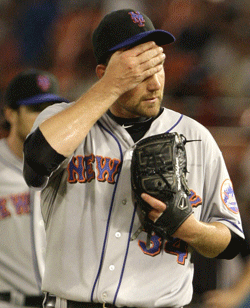 The Mets have only lost two games this season: Both of Pelfrey’s starts. Mets fans and media seem about ready to panic. I’m not interested in singling out any reporter or analyst, but the concerned masses seem to offer three potential explanations for Pelfrey’s struggles:
1) He is overwhelmed by the pressure to be the Mets’ “ace” in the absence of Johan Santana.
2) He is reeling from the offseason loss of his sports psychologist, Harvey Dorfman.
3) He is injured and keeping mum about it.
To the first: Remember that “ace” is just a label and that often the pitcher that emerges as a team’s “ace” or “No. 1” is someone entirely different than the one chosen to throw on the first day of the season. Indeed, of the three returning holdovers in the Mets’ rotation from 2010, I could pretty easily make the case that Pelfrey is least likely to pitch as “an ace.”
Pelfrey has three full seasons of being a solid but unspectacular Major League starter under his belt, implying that he’ll probably continue being just that. R.A. Dickey had the eighth-best ERA+ in the National League last season, which seems pretty ace-like to me. Jon Niese is the youngest of the three and has an arsenal more impressive than Pelfrey’s.
Of course, clearly Pelfrey is conscious of the team’s decision to pitch him on Opening Day, and far be it for me to say it hasn’t weighed on him. But starting games in the Major Leagues is a pretty high-pressure thing to begin with, and I’m not sure how the loss of Johan Santana necessarily puts more pressure on Pelfrey, other than in how it puts more pressure on all the Mets’ starters that are not Santana. I would guess that every starter in the Majors wants really badly to pitch like “an ace,” and that if a pitcher allows pressure to get to him, it’s not one specific identifiable item of pressure like the responsibilities of being an Opening Day starter. In other words: If Mike Pelfrey is struggling due to pressure, there are probably plenty of reasons besides just that he started the game on Friday.
Which seems to be a pretty good segue into No. 2 on the list. According to this report, Pelfrey first admitted to consulting with Dorfman to combat the stigma against psychology in sports. So we reward him for that bravery by assuming he is so fragile mentally that he melts down in the face of adversity.
Again: I’m not Pelfrey’s psychologist and I can’t tell you what’s going through his mind, but I can say I’m pretty sure that’s not how it works. A good psychologist — and presumably Dorfman was a good psychologist — gives people the tools to overcome mental and emotional challenges whenever they arise. Supposedly Pelfrey called Dorfman after rough starts, but certainly he didn’t call Dorfman after every rough inning or rough pitch.
People seem eager to diagnose Pelfrey as crazy because of his body language on the mound, which seems patently ridiculous. How often have you seen a pitcher getting rocked maintain great body language? It’s a combination, I’d guess, of a pitcher actually looking distressed and confirmation bias on our parts, but I’m pretty sure we’re always going to view a pitcher in the midst of a shelling as a mope on the mound.
As for the injury thing: It’s another possibility I can’t discount. Pelfrey pitched through shoulder pain all last season, and though he says he’s healthy now, really, who knows? If he didn’t say anything about the injury last year, it could be he’s not saying anything about the same injury — or a more taxing one — this year.
But I’ll offer another possible explanation: Randomness. Pelfrey looked pretty bad in his first two starts, but if you go back through his game logs, you can find plenty of other times where he has done the same — they were just relatively masked by a handful of good starts around them, mitigating the concerns. In fact, over a three-start stretch from July 5-19 last season, he yielded a 15.30 ERA, just about as bad as he’s sporting this season.
Pitchers like Pelfrey who pitch to weak contact and lack a swing-and-miss pitch appear prone to huge fluctuations in performance. It could easily be that Pelfrey just happened to have two bad starts in a row that happened to come at the beginning of the season.
This you already know: It’s very early. I’m willing to give Pelfrey a few more starts to get the kinks worked out before I call him a head case and suggest he’s the new Oliver Perez.
Bob on what Chris Young did and Mike Pelfrey needs to do:
In a guest post to MetsGrrl, Brad Jasper presents a bunch of ideas for new versions of Mr. Met commercials. I loved the ones from a couple years ago that he mentions — the t-shirt sniping one especially. I think those ads are produced by the Mets, not SNY, but I’ll ask my man in the promos department.
Excellent work from former intern and pizza expert Jimmy:

It’s true. It’s not Mets Opening Day 2010 bad or as terrible as the Phillies’ starting rotation is awesome, but it’s just nothing like the type of offense we’ve come to expect from the Mets’ division rivals.
Jimmy Rollins, coming off back-to-back seasons with a sub-90 OPS+, is the Phillies’ current third hitter. None of the three guys hitting in front of Ryan Howard got on base at even a 34% clip last year. Ben Francisco is the youngest regular in the lineup, and he’s 29. Last year their offense was just about average, and they had Jayson Werth and Chase Utley playing most days, not to mention Carlos Ruiz enjoying a BABIP-fueled career year.
The ridiculous arms are good enough that the Phillies will still win a bunch of games. But as long as Utley is out — and it’s sounding like that will be a while — they’re going to have massive holes all over their lineup. They’re still a good team, but they appear way more vulnerable now than they did the day they signed Cliff Lee.
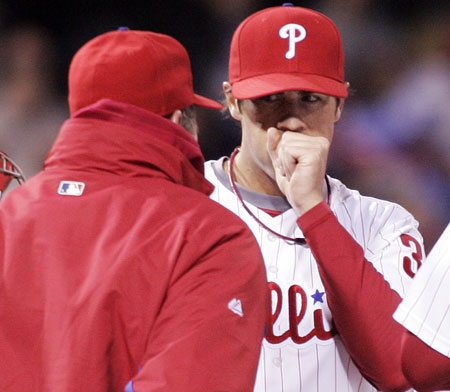
But you probably know this already if you watched last night’s game. Cole Hamels’ embarrassing moments, though there were plenty, went pathetically undocumented on the AP wire. Here’s Cold Hamels:
This one comes via Mets Police. It’s Mike Piazza golfing, in a foursome with Mario Lemieux, Michael Jordan and Toni Kukoc, who can’t even get mentioned in the title of the YouTube clip.
Also — and I’m really in no position to be saying anything — is it me or does Jordan have a pretty healthy gut going there? He’s probably still better at everything* than I’ll ever be at anything; I’m just sayin’s all.
*- People like to joke about how bad Jordan was at baseball. I guarantee those same people could not hit any home runs against Double-A pitching after a 13-year absence from the game.
Andrew, an urban planner/architect and Mets fan in Miami, chimed in on the Marlins’ new ballpark in the comments section for yesterday’s post. It’s interesting stuff for Mets fans and general baseball fans, so I’m reposting it here. He writes:
Interesting to hear your take on the stadium Ted. I’m a New Yorker (Mets fan of course) that’s been in Miami for about 11 years; a UM grad with fond memories of the old OB; and, an urban planner/architect.
As you correctly assumed, the inception of the stadium was fraught with complaints, major tax implications, and allegations (in our corrupt city, likely true) of back-door dealings. On they plodded and a few years later we are one season from away from baseball in Little Havana. I find myself wondering how the new stadium will (or won’t) impact baseball in South Florida.
Miami is notoriously a bandwagon sports town; this isn’t a stereotype, it’s a legit description of the situation. I worked my way through college at a couple of sports bars and witnessed the ebbs and flows of the “loyal” fans as each the Marlins and Heat won their championships. I am living life in a “post-Decision” Miami, where Heat shirts and license plates are more abundant than when they signed Shaq.
Miami is a major melting pot for Latin America, Cuba, and other baseball-centric cultures and it always seemed to me that there are a tremendous amount of fans waiting for the opportunity to take part in So Fla baseball. Until now the team simply hasn’t found a way to tap the roots of the people here. The Marlins as an organization have done a great job fielding a decent team year after year (with 2 championships in its short history) despite being generally unable to afford their players as they come into their prime. However, it has never translated into a solid fan base. I hope that the new stadium will provide increased opportunities for the cultivation of loyal fans.
The current stadium, aside from being a cavernous place which was designed for football, is sited in an awkward location. Neither in the heart of Miami or Fort Lauderdale, it sits somewhere in between, with no dense population area to support it. In addition to its poor location, Sun Life has no transit access, is positioned to be heavily impacted by rush hour(s) traffic for evening games, and is a logistical nightmare. Parking is a major PITA and circulation around and near the stadium is non-existent. The current stadium is simply inaccessible for many people.
The new stadium on the other hand will sit right in the heart of little Havana (where the OB used to live), be much more central to the greater Miami area, and can be accessed a variety of ways. It will be closer to where the possible fans live, not the retirees and transplants living in Boca and northward. Hopefully this will help establish a cadre of passionate fans that come to root on their team.
While I’m sure it will be a great venue for baseball (as many of the new stadiums are), sadly it is a lurching spasm of sheet metal that pays no homage to the historic roots of its community. Despite strong efforts by local architects (and a friend of mine who spent an entire studio in architecture school studying the area and creating a much more sensitive design), the Marlins brass felt the stadium’s design had to be emblematic of the cutting edge (the worst rationale in architectural history; see every new hospital built since 2000). While the retractable roof will be a welcome addition to baseball in So Fla, surely a more contextual design would have blended better with the community. Large structured parking will face the stadium’s neighbors; they failed to utilize a proliferating trend of surrounding garages with habitable spaces (shops on the ground floors, at the least). This would have helped to enhance the adjacent streets much more than blank parking garages. I fear that the neighborhood streets will ultimately be damaged frontages as opposed to being reinvigorated by the new development. In the end the stadium was about the Marlins organization and their players, not the community.
I wish the Marlins good fortune in their new stadium, but hopefully we Mets fans continue to represent and dominant the new stadium just like we have Sun Life over the years.
Matt writes for Philly.com:
That’s not right that he said that’s why they let me go. I read that and it hurts because I like Dan, he’s one of my good pitching coaches. He’s saying they didn’t want to sign me because I’d blow out this year. That hurts.
Aw, shucks. We — and by we I mean me — love Perpetual Pedro around here. Dude just goes about his weird incredibly specialized business. And now Dan Warthen has hurt his feelings.
Presumably his shoulder still hurts more or else he’d be pitching for the Yankees and not on the disabled list. The good news is he has $8 million over the next two years, and maybe a lesson that asking for the ball every single day isn’t necessarily the best way to secure the best contract.
 Tedquarters