Out of curiosity

I stood with a couple of guys from the Real Dirty Mets Blog yesterday and watched Jose Reyes awesomely get in to his awesome car and leave the complex, awesomely. We got to talking about how badly we want him back in a Mets uniform next year and years to come.

So I’m wondering what you think would be a fair price for an extension for Jose Reyes right now. Knowing that he can be awesome, but hasn’t been for a couple of seasons.

As I mentioned before, until 2008 Reyes and Carl Crawford were remarkably similar offensive players, and Reyes plays the more valuable defensive position. Crawford got a seven year, $142 million contract from the Red Sox in free agency. But Crawford got that deal coming off the best season of his career in 2010. Reyes is coming off two straight injury-plagued years, and a 2010 that saw his on-base percentage drop to its lowest mark since he was 22 in 2005.

We don’t have to make these decisions, which is good. And we don’t fully know the extent to which the Mets’ financial problems will hamstring them moving forward. But would you sign Reyes to, I don’t know, a five-year, $90 million extension today? Would Reyes accept that, or would the allure of getting Crawford money on the open market be too great? What would the Mets need to spend to lock him up, and should they?

Nick Evans on hitting right-handers

I asked Nick Evans if he knew that he fared better against righties than he did against lefties in Triple-A last season. He didn’t.

He said he thinks platoon splits are too often overblown because big differences in batting average could come down to a few hits (Nick Evans: understander of sample size caveats). As a hitter, he never concerns himself with the handedness of the pitcher he’s facing. “I just try to hit whoever’s pitching,” he said.

Evans did not make any specific adjustments to face righties last year and said they pitched him like they always do — hard inside, soft outside. He said the only time anyone ever even suggested to him that he struggled to hit righties was when he got to the Majors in 2008 and found himself part of a platoon.

He said comfort against pitchers of either hand increases with regular exposure, and he thought the reason he struggled against righties in the Majors is only that he saw them so infrequently. “It’s not a mental block or anything,” he said. “It’s just seeing the ball from two different angles.”

Mike Nickeas on catching Jason Isringhausen

I had a quick chat with Mike Nickeas this morning about Jason Isringhausen’s bullpen session yesterday. Nickeas, as mentioned, seemed a lot more excited about Isringhausen’s curveballs than the more stoic Isringhausen did.

“Well, he’s been doing this a long time,” Nickeas said. “It’s fun for me to catch guys of that talent level.”

Nickeas said Isringhausen threw about 40 pitches, and threw 11 of his 13 curveballs for strikes. I asked him if they looked hittable. “Not for me,” he laughed.

Nickeas said that it’s not easy to judge velocity from behind the plate and that catchers are often surprised by radar-gun readings. But he said Isringhausen’s fastball seemed to have more life on it than it did when Nickeas caught him last week.

Carlos Beltran grimaces

Carlos Beltran, age 33, grimaces. He is taking live batting practice on Saturday morning on Field 7 in the Mets’ Spring Training complex, a day before he is scheduled to make his Grapefruit League debut. He has just fouled one of Scott Moviel’s first offerings off the inside of his lower right leg.
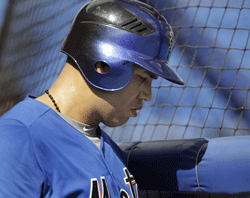
“I always wear a shin guard,” he says, stepping slowly out of the batter’s box.

As a trainer scrambles to find a guard, Beltran walks outside of the protective cage and rolls his pant leg up to examine the damage. The bottom of the hard plastic brace on his knee becomes visible. He leans against the cage, head down.

Someone arrives to toss Beltran a shin guard, and as the outfielder adjusts it and straps it on, Moviel, 22, throws some warm-up pitches.

Moviel is massive, a sequoia tree. Listed at 6-11 and 235 pounds, he was drafted in the second round out of high school in 2007. He was considered among the team’s better prospects until losing half a season to knee surgery in 2009 and struggling with his command in 2010.

“Carlos, he has 15 pitches left,” says a coach from the shade of a pitching screen set up just behind the mound. Beltran nods and steps back in.

Beltran, too, was drafted in the second round out of high school, back in 1995. He is a veteran of 12 Major League seasons, a five-time All-Star, and the best centerfielder in Mets history. He missed large parts of the last two seasons with knee injuries and recently decided to move to a less taxing position in right field.

In the batting-practice session, he mostly tracks Moviel’s pitches, swinging sparingly. When he connects, he hits a couple line drives, a couple foul balls, and a couple grounders to the right side of the infield.

Moviel reaches his limit and jogs off to another field for conditioning. The screen is moved in front of the mound and a coach throws soft tosses to Beltran from 55 feet away.

Now Beltran smacks pitch after pitch. A strong wind blows in from left field, but Beltran’s bat defies the elements. Beyond the right-field fence — shaped to Citi Field’s spacious dimensions — fans with mitts hoot as they chase and catch Beltran’s bombs. It is all there: the short stride, the swift stroke, the easy power that helped Beltran hit 280 Major League home runs.

On another field about 50 yards away, Matt Harvey, 21, pitches against the Italian national baseball team. Harvey was drafted in the first round in 2010 out of college and given a $2.52 million bonus upon signing his first contract. He needs only 12 pitches to retire the side, striking out two. He throws just one inning. His arm must be protected; he will pitch his first professional games in 2011.

In the dugout, Valentino Pascucci, 32, awaits his chance. He was drafted out of college in the 15th round in 1999. He has spent ten seasons in the Minor Leagues and two in Japan. He has 138 Triple-A home runs to his credit, and 62 Major League at-bats. He will play first base for the latter innings of the exhibition against Italy, replacing Eric Campbell, 23. In two at-bats, Pascucci will strike out swinging and pop out to right field on a check swing.

Earlier in the morning, Jason Isringhausen, 38, threw a bullpen session to catcher Mike Nickeas, 28.

Isringhausen was drafted out of high school in the 44th round in 1991. He made his Major League debut with the Mets in 1995 before converting to a bullpen role with the A’s in 1999 and enjoying a nine-year run as a successful closer. He is a veteran of 915 1/3 Major League innings, two all-star games, four arm surgeries and two hip surgeries.

With each pitch, Isringhausen grunted, staccato bursts from the diaphragm. “Hunph! Hunph! Hunph!”

Nickeas, enthusiastic, oohed and ahhed at every one of Isringhausen’s trademark curveballs. All there-it-is and attaboy.

Nickeas was drafted in the fifth round in 2004. He has played seven seasons in the Minor Leagues and five games in the Majors. He will, in all likelihood, make his first Opening Day roster in 2011 because Ronny Paulino, 29, is suspended for performance-enhancing drug use.

On Thursday afternoon, Oliver Perez, 29, walked down a short hall toward the clubhouse exit wearing jeans, a golf shirt, and his salt-and-pepper hair cropped short.

Perez was signed as an amateur free agent out of Mexico in 1999. He has pitched nine seasons in the Majors; one of them excellent, one of them good, two of them effective, and five of them bad. As recently as 2008, his fastball averaged over 91 miles per hour. Now he can hardly crack 85.

He had just finished a day of activity that culminated in two moderately successful innings against the Cardinals. From the clubhouse kitchen, a woman’s voice called out.

“How do you feel, Ollie?”

“Good, good,” he said. “But I’m tired now.”

(Insert clever headline loaded with Italian stereotypes here)

I caught a good seven innings of the Minor League Mets’ matchup with the Italian National Team. It’s Spring Training for them too, apparently.

There’s not a ton of worthwhile conclusions to draw since the Italian team didn’t seem to pose much of a challenge for the Mets. I lost track of the score; the Italians notched one run off Ryan Fraser thanks to a pair of singles and a wild pitch. The Mets prospects scored many runs on many hits. In one rally — though I am not certain — it appeared some form of mercy rule was invoked.

The Italian pitchers, for the most part, lacked the velocity the Mets’ prospects are likely accustomed to seeing even in the low levels of the Minors. Several worked with fastballs around 80 mph. There were a couple of sidearmers in the bunch, and one guy with a strange, crouched, halting delivery that seemed to try some of the Mets’ timing.

Cory Vaughn went 3-for-3 in the game with a triple, a double and an infield single. Matt den Dekker had a bunch of hits; I lost count of them.

Outside of a bit of wildness from Fraser, all the Mets’ young pitchers looked good. The Italian squad appeared to have trouble catching up with pitches in the 90s, so hard throwers like Jeurys Familia and Robert Carson looked particularly dominant.

The Mets’ pitchers only threw one inning each, and I missed Matt Harvey’s inning (the first). Apparently he struck out two batters and got a groundball out. Adam Wogan, the Mets’ director of Minor League operations, said the goal for all the pitchers was just to throw strikes, and all of them did.

So that’s cool.

Today stuff

I’m still here in Port St. Lucie and rolling through the weekend, but if this site is a little slow this morning it’s because a) a certain awesome unappreciated outfielder is taking live batting practice at 10:15 and b) I want to check out the Italian team against Matt Harvey and the Mets’ prospects, which starts at 10:30. I will be back with stuff from either or both later.

Mike Piazza is totally awesome and cool

Mike Piazza is in Port St. Lucie to coach the Italian National Team against a team of Mets prospects. He spoke to reporters about 20 minutes ago. It looked like this:

You’ll read a lot elsewhere, I’m certain, about how Piazza said he’s in the Wilpons’ corner, they treated him great and he believes they’ll be fine once all the dust clears. And you’ll see how he said he has considered being part of an ownership group as a way to stay in the game without committing to anything full time. Piazza says he thinks he could bring “certain intangibles” to a team.

For example: Being totally awesome and cool.

At this point, I’m rarely starstruck by baseball players. But Piazza, forget it. Mike Piazza! I wanted to ask him something, just for the sake of saying something to Mike Piazza, but I couldn’t. My voice probably would have cracked. Look at his aviator sunglasses!

Piazza mostly spoke about the Italian National Team, and I’m lucky in that I might have been the only guy in the scrum really interested in hearing about that. He said it’s important to keep the team cohesive since they’re playing in a World Cup in September, and lauded the Italians’ success winning the European championship and placing third in a recent international friendly in Taiwan.

“I’m not going to say baseball in Europe is the way soccer is now,” he said. “But the popularity of the game is increasing.”

Piazza cited a couple of Italian players in the Minor Leagues and said he hoped that Major League success for a European player could help bolster the sport’s popularity. And he said that while there were pitchers on the Italian team who threw in the low-90s, he was surprised to see starting pitchers in the European Championship lighting up the radar guns with 82 mph fastballs.