Look: If I knew before I left for work that we were going to get Peter Gammons on the line today, I probably would’ve shaved. But then I was out pretty late last night at the Prince concert, so no guarantees.

Look: If I knew before I left for work that we were going to get Peter Gammons on the line today, I probably would’ve shaved. But then I was out pretty late last night at the Prince concert, so no guarantees.
On Friday afternoon in the batting cages at the Mets’ Minor League facility in Port St. Lucie, Fla., Tim Teufel pitches to a righty-hitting college-aged kid in blue mesh shorts and a t-shirt.
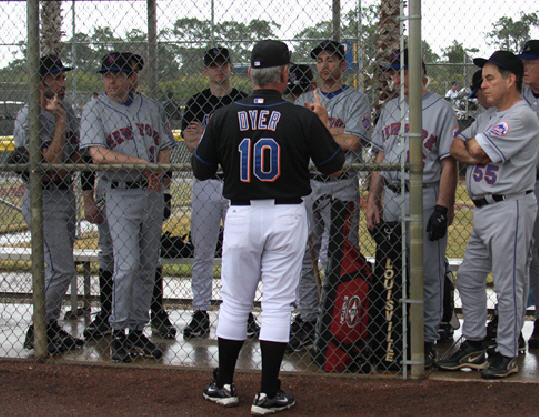 A clutch of guys in Mets jerseys looks on, but none among them can peg down the identity of the kid. They know his name is Mike and that he’s not among their ranks at Fantasy Camp. They think the kid knows Teufel. One says he’s Teufel’s son. Another suggests he’s Teufel’s son-in-law. A third says he’s Teufel’s son’s friend. No one is certain.
But they see that he is awesome. He lashes line drive after line drive, every ball darting off his bat toward left-center field, slicing into the cage’s net and pulling it taut against its supports, then ricocheting back near where Teufel is throwing.
His contact produces a Major League sound. It is something different than the clichéd “crack of the bat.” That familiar sound, at stadiums, is filtered by distance and crowd rumble, limiting the spectrum of noise that hits the eardrum.
Here, up close, you can hear the sizzle and whoosh as the kid’s hands and bat and the ball all speed into the zone at the same time, then an oaky baritone report when they all come together. Thwock, thwock, thwock. It is magnificent.
“You know what’s wrong with this kid’s swing?” one camper asks another.
“What?”
“Nothin’.”
Only Lenny Harris sees something amiss. The familiar pinch-hitter extraordinaire, fresh off his own BP session in the next cage over, stops Teufel and jumps in the cage. The kid, he says, is cheating forward with his lower half before he swings, costing him balance — presumably passable in batting practice but the type of thing good pitchers will eventually exploit.
“You see it, Teuf?” Harris asks. Teufel nods and steps over to the batter’s box. He explains the importance of keeping flexible through the hips, swiveling his own as he does so. A few of the Fantasy Camp group chuckle; they have enjoyed a brief, exaggerated version of the Teufel Shuffle.
Harris pulls over a tee to teach the kid — and Teufel — a drill to help hitters stay back in the box. The kid hits more line drives toward left-center, shots that look and sound a lot like the earlier ones. Harris, a Minor League hitting coach these days, can see the adjustment, and he seems satisfied.
In the next cage over, one of the camp-goers takes his cuts off Pete Schourek. Long and lean and probably in his early 30s — one of the youngest in attendance — his swing appears steady, if lacking power. But he is missing the ball, swinging over it. The few he connects with veer straight down into the artificial turf.
Jim McAndrew walks into the area from one of the back fields. He watches the hitter struggling, then speaks up.
“Put your bat on your shoulder,” he says.
The guy looks confused, and a bit tentative. Little League coaches everywhere earn their pay reminding hitters to take the bat off their shoulder. Now, a member of the 1969 Mets — a pitcher, no less — is telling him otherwise. He pulls his hands in uncomfortably close to his body, elbows bent so tight his forearms almost graze his biceps, then swings and misses again.
“No, no. Just place the bat on your shoulder. Relax,” McAndrew says. The guy heeds his advice. Line drive.
The people at Mets Fantasy Camp are dentists and lawyers and doctors and teachers in real life. They range in age from about 30 to 70. Most of them are men, but there are a few women peppered throughout. Most come alone, but there are some kids and wives and parents milling about. They have in common only a love of baseball and a learned understanding that Major League Baseball players are really, really, really good at it.
The former players, too, seem to delight in the sport as much as the campers do, and the place becomes like a weeklong mid-Winter celebration of its grandeur. It’s January, and you’ve missed baseball. Here, you watch baseball, you play baseball, you talk baseball, you revere it.
“After October, you just kind of sit around,” says Al Jackson, a veteran of some 50 years in various positions in professional baseball. “This gets you ready for Spring Training. It breaks up the monotony.”
I broke news today, sort of. I heard that the Mets were signing Scott Hairston, so I tweeted it. I trusted that the people from whom I heard the news believed it wholeheartedly, but since I know the way these things often play out and am familiar with the game “Telephone,” I hedged the hell out of the Tweet with a full disclaimer before the news.
 Adam Rubin, who is actually in the business of breaking Mets news and does a better job of it than pretty much anyone, confirmed the report later.
And so I contributed my piece to the nonsense that is offseason baseball coverage. I’m happy to say I’m now 1-for-1 in transaction-related scoops.
For what it’s worth, I also broke the news that Billy Wagner needed elbow surgery, way back when (only to have Mike Francesa read my report word for word on air without crediting me or SNY), and I was the first person to publish the news — on MetsBlog, at about 3 a.m. ET — that Willie Randolph had been canned.
That’s about it. I don’t intend to ever be in the business of breaking news with any real frequency, but when someone here hands me some or wakes me up with a phone call because I’m the most accessible person with a public forum, I’m happy to publish it. I recognize that’s probably a good way to increase my online profile or whatever, but at the same time I’m content to sit here writing about sandwiches.
I will say, though, that there’s one minor scoop for which I am directly responsible and have never been credited. I was the anonymous source that fed Matt Cerrone the details of the Johan Santana contract.
It went like this: I got word that Santana, his agents and the Mets’ front office were negotiating his contract in the SNY offices because of their accessible Midtown location. I work in said offices, and figured out which conference room they were in (it wasn’t hard — it’s the fancy one).
The workday was winding down as the negotiations were starting, and I had nothing particularly important to do that evening, so I went upstairs and parked myself at the receptionist’s desk outside the conference room. I considered doing the old sitcom cup-on-the-door thing. I IMmed Cerrone when they got dinner delivered.
I sat there for a while, browsing the Internet and waiting for something to happen. I was just about to give up when a dude — a young guy, must have been someone who worked for the agent or something — emerged from the conference room on his cell phone.
“It’s done, dude,” he said. Then he paused.
He continued: “Six. Yeah, six and 137-point-five.”
Layup. That was my one endeavor into investigative journalism. I figure it’s not always that easy.
Of course, I had been working here for all of three weeks at the time, so I spent the next week crapping my pants worried that someone would find out and I’d somehow get in trouble. But then I realized I was actually kind of doing my job, and then no one ever asked me about it anyway.
As for Hairston, he seems like a nice pickup to compete for a fourth or fifth outfield spot. Eno Sarris has way, way more.
Two things you should read about closers: 1) Eno Sarris’ plan for how the Mets could use K-Rod effectively without having his $17.5 million option for 2012 vest.
2) Cliff Corcoran’s analysis of just how good Mariano Rivera has been compared to every other relief pitcher ever.
I’ve long held that the one-inning closer role should be retired with Rivera. The telling stat is this one: In the 20 years before Tony La Russa popularized the one-inning closer, teams entering the ninth inning with a lead won the same percentage of games as they did in the 20 years after. There has got to be a better way to construct a bullpen than wildly overpaying one guy to throw 60-some innings.
I got my money on my team, bro.
– Angel Pagan.
Hey, maybe not the world’s safest bet, but good for Pagan for expressing confidence in the Mets.
 Truth is — though it will be difficult to unseat Philadelphia — the Mets appear apt to be a lot better than most people think. Remember the post from the other day about how the Mets committed 1633 plate appearances to dudes with sub-.300 on-base percentages? All the main culprits — Jeff Francoeur, Rod Barajas and Alex Cora — are gone.
Assuming some combination of Daniel Murphy, Brad Emaus and Justin Turner emerges from Spring Training with the second-base job and Josh Thole and Ronny Paulino make for a suitable catching platoon, the 2011 Mets may actually field a lineup without any major holes in it. That’s a big, big change from the last couple years, and I think fans might be surprised by how much a team can benefit from not giving away outs.
And better yet, for once the Mets appear to have viable in-house Major League ready depth at most spots on the field.
The problem, obviously, is the pitching. How big of a problem depends on if R.A. Dickey, Jon Niese and Mike Pelfrey can build on successful 2010s and if Sandy Alderson can concoct a legit back end of a rotation out of reclamation projects and rookies.
The Phillies will be good. The Braves, too, will be good. But it’s silly to count out the Mets before the season even starts, especially now that they appear to be in good hands.
More excellent work from Bill Petti at Beyond the Boxscore. Hoping our man Seth publishes his findings soon, as I think they offer the final piece to this puzzle.
Rumor has it the Mets are pursuing Dave Bush.
 Meh.
Meh.
The upside to Bush is that he’s durable. I’ve long held that the ability to stay healthy and accrue innings is an underrated talent in pitchers, and it’s one Bush can boast. He has averaged 174 innings a season since 2006.
Problem is, none of them have been all that exceptional. In that same time, Bush has posted an 89 ERA+ and the velocity on his fastball has been steadily declining.
If signed, Bush will likely give the Mets around 174 innings, taking some heat off the bullpen and preventing the team from having to find someone willing to pitch those 174 innings. But Dillon Gee and Pat Misch are probably willing to pitch 174 innings, and they can probably combine for 174 innings just as effective as the ones Bush would provide.
Of course, it doesn’t entirely work like that. The Mets lack starting pitching depth in the high Minors, and bringing in a durable starter practically guarantees depth. Bush is a known quantity that offers a lower ceiling but a higher floor than reclamation projects like Chris Young and Jeff Francis, and for that matter Chris Capuano.
At Metsblog, Michael Baron suggests that pitchers like Bush that yield a lot of contact could benefit from pitching in Citi Field. It is frequently said (perhaps even here) that flyball-heavy pitchers (again, like Bush) could enjoy more success in Citi FIeld than they do elsewhere, and I wonder about this.
There’s still not a ton of evidence that Citi massively suppresses home runs. But even assuming it does — and it certainly looks like it does, even if I know better than to trust my eyes — does that mean the Mets should pursue fly-ball pitchers? The argument is, I suppose, that flyball pitchers might have more relative value to the Mets than to other teams, so the Mets could pick them up at a discount.
I just wonder if it really works out that way. For what it’s worth, the Mets’ most fly-ball prone starter in 2010, Johan Santana, far outperformed his peripherals and defense-independent pitching stats, at least partly because he allowed fewer home runs than you’d expect for a guy yielding so many fly balls. But none of the slew of fly-ball heavy relievers in the Mets’ bullpen did the same.
While working on a freelance job this weekend I wound up ruminating about just how many plate appearances the Mets committed to out machines in 2010. So I looked it up.
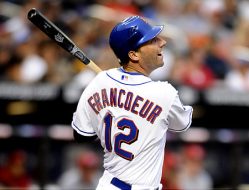 For no other reason than my own edification, I added up how many plate appearances each team in the NL East gave to position players with sub-.300 on-base percentages. I realize that .300, in this case, is a somewhat arbitrary benchmark for out-machineyness, and that there are park factors in play and everything else. But it’s a pretty stunning outcome regardless.
The Phillies gave 473 PAs to position players with sub-.300 OBPs.
The Braves gave 625 PAs to position players with sub-.300 OBPs.
The Marlins gave 479 PAs to position players with sub-.300 OBPs (though it’s worth noting that Wes Helms compiled 287 with an even .300 mark).
The Nationals — the lowly Nationals! — gave 1285 PAs to position players with sub-.300 OBPs.
And the Mets gave 1633 PAs to position players with sub-.300 OBPs.
Bill Petti at Beyond the Boxscore continues his examination of David Wright’s volatility in recent seasons. This time, he compares Wright to a couple of his contemporaries.
This is interesting stuff, and there’s more to come on the subject — both from Petti and from friend of TedQuarters Seth “Ted” Samuels. I had a chance to read Seth’s research and it’s great, but I don’t want to give away his conclusions before he publishes it somewhere.
To summarize, we’re looking for starting pitching, we’re looking for left-handed relief and fourth and fifth outfielder possibilities — I’d say in that order of priority.
Well, good. I’d probably say a fourth outfielder should be a higher priority than a left-handed reliever, but I’m willing to grant that Alderson might know more about the potential effectiveness of in-house candidates like Mike O’Connor and Eric Niesen than I do.
Though the Mets’ GM doesn’t say anything groundbreaking, all of Adam Rubin’s interview with Alderson is worth reading, if only because it’s refreshing to hear a GM speak logically and without nonsense. The big takeaways: Luis Castillo will probably only be around if he wins the starting second-base job in Spring Training, the Mets will very much look at Daniel Murphy at second base, and Chin-Lung Hu will probably be on the roster as a utility infielder.
 Tedquarters