
About this thing

I had a long conversation toward the end of the season with Wright about essentially the same subject. Actually, it was more me talking and Wright saying he was interested and to keep talking. The subject was this: I wish I could transport Wright out of the Mets clubhouse to a more professional team such as the Yankees or Red Sox so he could see how different that atmosphere was in those places.

What I told Wright was that I looked at him and a few others in the Mets’ clubhouse as an oasis around too much unprofessionalism. And I suggested that he had been at the party so long –- a lifetime Met –- that he was losing the ability to distinguish between acceptable and unacceptable. I pointed out various elements both in front of us about how cavalierly players were preparing for that day’s game; the lack of structure, discipline, seriousness.

Joel Sherman, N.Y. Post.

OK, I should start by saying that for all I know, Wright does have a problem with the way the Mets’ clubhouse has been run the past couple of seasons. From what little Wright demonstrates of his personality to the public, we know that he is an extremely hard worker and very, very dedicated player.

But him coming out and saying on the record that his teammates need to take their preparation more seriously would be very different from him just maybe nodding as Sherman told him that his teammates need to take their preparation more seriously. And I find it difficult to put too much stock in second-hand quotes from Wright via Larry Bowa, for that matter.

I’ve been through this about a billion times before and I’m not all that eager to revisit it, but problems in the clubhouse — at least the type reporters see — are almost entirely based on confirmation bias (and I don’t think players are immune to that).

The first example I can think of is the one I mentioned here: When the 2007 Rockies played video games in the Dodgers’ clubhouse before a game during their miracle run, they were praised for their loose, fun-loving unity. When Oliver Perez did the same thing the next year, he should have been watching video or something. The 2010 Mets themselves were celebrated for their attitude when they were winning; it was “toward the end of the season” when Sherman voiced to Wright his concerns about their unprofessionalism.

I think I can add a little context here, too. Since the Mets moved to Citi Field, it has become way harder for reporters to get a sense of what players do before games. In the locker room before most Mets’ home games, you’ll usually see at most four or five Mets sitting by their lockers listening to music or texting, and somewhere between 20 and 40 members of the media standing in the middle of the room, just kind of waiting to see if something interesting happens.

The other players will pass through — they’ll quickly throw on their uniforms on their way to the batting cage, or out to the field for warmups and batting practice. But they tend to spend most of the time before games — at least the time that the locker room is open to the media — in back rooms of the clubhouse where reporters can’t go, doing something that is presumably way more awesome than standing around listening to Joel Sherman tell you that your team lacks discipline.

The beat reporters who travel with the team might get a better sense of it because the players don’t have nearly as much space in visiting clubhouses, but I’m not sure anyone besides the players and coaches themselves is qualified to weigh in on the full breadth of preparation that Major Leaguers — even the Mets — endeavor to get ready for games.

And though it’s impossible to argue that the Mets were structured, disciplined and serious in 2010 — they were not a winning team, after all — it doesn’t seem fair to put those words in Wright’s mouth simply because he was too polite to walk away from them.

Early offseason deal roundup

It’s still very early in the offseason, but there was a trio of deals yesterday — one bigger than the others. All appear to have at least some implications for the Mets’ offseason, so I figured I’d run through them quickly here.

The deal: Marlins trade Dan Uggla to the Braves for Omar Infante and Mike Dunn.

Why they did it: The Braves traded from strength to instantly upgrade their offense with Uggla, who’s good for 30 home runs a year and an OBP around .360. The Marlins save money — Uggla earned $7.8 million last year and is entering his last arbitration year coming off the best offensive season, while Infante stands to make only $2.5 million. They also add a promising, if wild, young reliever in Dunn.

Local flavor: It means a) the Braves appear set to be pretty damn good next year and b) the Mets will not get Dan Uggla to play second base in 2011. The first point is more troubling than the second; while Uggla would make the Mets a much better team in 2011, to keep him around beyond next year they’d need to give him a pretty hefty extension. Uggla already isn’t much of a fielder, and he’s only likely to get worse as he ages.

The deal: Marlins and catcher John Buck agree to a three-year, $18 million deal.

Why they did it: Ahh… Well, Buck had a nice season last year, though it certainly doesn’t seem sustainable. Buck walked only 16 times in 437 plate appearances — the lowest walk rate of his career — and enjoyed a batting average and batting average on balls in play that were about 40 points higher than his career norms. And the Marlins needed a catcher.

Local flavor: The Mets will need a catcher as well. Josh Thole played well enough in his first 90 Major League games to earn the chance to start out of the gate in 2011, but a contingency plan and backup is necessary. Seems to me they’d be best-served finding a guy healthy enough to hold up as a starter if Thole falters, rather than a career backup like fan favorites Ramon Castro or Henry Blanco (incidentally, Rod Barajas might not be a bad choice). It’s way too early in the offseason to say if Buck’s seemingly too-big contract reflects some weird shift in the catching market, though.

The deal: Cardinals sign Jake Westbrook to a two-year, $16.5 million contract.

Why they did it: A two-year deal for a 33-year-old pitcher who spent most of 2008 and all of 2009 on the disabled list might raise some eyebrows, but Westbrook stayed healthy in 2010 and pitched well for the Cardinals down the stretch, and it’s probably fair to just defer to Dave Duncan on assessing veteran innings-eaters at this point.

Local flavor: With Johan Santana out for who-knows-how-long, the Mets definitely need starting pitching this offseason. Cliff Lee is out of their price range, and both Ted Lilly and Westbrook were locked up by their teams. There are a few decent innings-eating options remaining but it doesn’t appear as though they’ll come cheap this offseason. And there have been conflicting reports on the Mets’ payroll flexibility. If they really only have $5 million to play with — which I tend to doubt, honestly — they’ll likely be priced out of all the reliable starters on the market, and forced to take risks on guys coming off injury or bad seasons.

Pedro Feliciano stuff

Feliciano would likely end up earning around $4 million in arbitration, assuming the Mets offer it to him. He’s rumored to be seeking at least a two-year deal. He’s letting more runners on base, he’s pitched a ton of innings over the last few seasons, he’s walking more and striking out less, and he showed he’s not very effective against right-handed batters last season, at least to the extent that he should be used as anything more than a situational lefty. So, is it wise to sign a 35-year-old situational lefty, with a lot of mileage on his arm, to a two-year, $8 million deal? I don’t know that it is.

Feliciano is a Type B free agent. In other words, if the Mets offer him arbitration and he signs with a new team as a free agent, they will be rewarded a draft pick between the first and second rounds.

Matthew Cerrone, MetsBlog.com.

I’ve written about this before, but offering Feliciano arbitration seems like a no-brainer to me. Worse comes to worse, he accepts, then wins in arbitration and you end up slightly overpaying a pretty damn good and unbelievably durable situational lefty — something you’re probably going to need anyway.

Best-case scenario, he declines and signs elsewhere and you get a free sandwich-round draft pick.

Mmm… sandwich round.

Murphman-Turner Overdrive?

I wrote a bit about the Mets’ second-base situation yesterday, and the more I think about it, the more I am intrigued by the possibility of a Daniel Murphy-Justin Turner platoon.

Offensively, the pair would likely represent a pretty massive upgrade over the woeful .226/.307/.285 production the Mets got from their second basemen in 2010 (although, really, who wouldn’t?). Bill James projects a .281/.339/.455 line for Murphy in 2011, which seems reasonable given his .275/.331/.437 career mark, and which would place him among the better-hitting second basemen in the Majors.

While I can’t find any 2011 projections for Turner, Dan Szymborski translated his impressive performance in Triple-A in 2010 to a .288/.340/.434 Major League mark — though since Turner’s 2010 was his best season so far offensively, that line is probably a bit optimistic for 2011.

Still, Turner mashed lefties in a small sample in Triple-A last year, and Murphy hits better against right-handers, as left-handed hitters often do. Combined, they appear apt to offensively outperform any available free-agent middle infielder.

The question, of course, is their defense. Murphy is playing second base every day in the Dominican Winter League, though I haven’t heard any reports about how that’s actually going for him. For all Murph’s calamities in left field, he appeared to the eye and to the stats (in an inadequate sample size) to be a pretty good and even particularly rangy defender at first base.

How that translates to the more difficult position remains to be seen (or perhaps has been seen, but by people other than me who haven’t reported it).

There’s no real good way to know from a desk in Manhattan whether Murphy (or Turner, for that matter) can capably field second base at the Major League level, or if their deficiencies there would cost the Mets more runs than their bats would produce. The decision has to come down to a scouting assessment.

The three pitchers set for the Mets’ 2010 rotation — Mike Pelfrey, Jon Niese and R.A. Dickey — all accrue a decent-to-heavy number of ground balls, so the defense behind them is pretty important.

But if the Mets feel Murphy and Turner are up to the challenge, the pair could provide a nice, inexpensive solution with offensive upside, instantly improving the team at the keystone and buying time to determine which — if any — of their prospects at the position deserves the job for the long haul. And since Murphy can play a little first base, third base, and left field if necessary, and Turner has played shortstop and third in the Minors, they don’t handicap the team’s flexibility when they’re on the bench.

Even more Wally Backman stuff

Talking with Patrick Flood, with help from Wally Backman, about Backman’s much-hyped managerial candidacy.

Patrick adds:

I misspoke. Wally Backman’s Brooklyn Cyclones team was “only” second in the New York-Penn league in bunts this season. They were six bunts behind the club that bunted most, but 21 bunts ahead of the club that bunted third most. It was his 2004 Lancaster JayHawks that bunted 27 more times than any other team, and his 2003 Birmingham Barons that bunted 19 more times than anyone else. It’s actually the caught stealing that is more alarming, as his teams are routinely first in caught stealing and somewhere in the middle in steals.

Once again, Mets probably need a second baseman

So I’ve slacked really hard on my position-by-position review of the Mets farm system. Well, that and the team went out and hired a new General Manager and reshaped the entire front office, which is kind of a big deal. I’m using these to start lining up my thinking for my overall rankings. I want to finish the infield with shortstops and third baseman this week and finish the series the week after.

So, today we move on to second base. Second base was a black hole for the Mets in 2010. By Fangraphs’ WAR, the team’s -0.4 WAR was the second-worst in all of baseball, ahead of only the Cleveland Indians. The Mets’ keystoners combined on a .269 wOBA, making their offensive contribution dead last in all of baseball. Since the Mets derived so little value from secondbase in 2010, it should be the easiest place to improve in 2011.

Toby Hyde, MetsMinorLeagueBlog.com.

Toby’s right, you know. Second base should be the easiest place for the Mets to improve in 2011.

Problem is, I’m not sure there’s an obvious answer. Everyone loves Orlando Hudson, and if he’s available for as reasonable a cost as the one-year, $5 million deal he got from the Twins last year, he seems like a good choice for a quick upgrade. According to Fangraphs, Hudson has not been worth less than $5 million — or less than $7 million, really — since 2003.
For a while I was certain the Mets would be best-served by signing a utility guy who could open up the season starting at second, back up shortstop, and transition into a backup role if and when one of the Mets’ younger second-base options proved worthy of everyday play. I mentioned Edgar Renteria as a possibility in this space, and I know others have brought up Juan Uribe and David Eckstein.

None of those guys represents as certain of an upgrade as Hudson does, though they should all come a bit cheaper. Hudson has never played shortstop in the Majors or Minors, though, so his acquisition would mean the Mets likely need an additional infielder to back up Jose Reyes. Ruben Tejada could theoretically field both middle infield positions in the Majors, but it seems silly to commit a 21-year-old to a backup role when he could be polishing his game in Triple-A.

Justin Turner has a career .806 OPS in over 200 games at Triple-A. He played some shortstop and some second base for the Bisons in 2010, though I don’t know much about his defensive acumen.

If the Mets opt not to look outside the organization for middle-infield help, Turner probably represents their best option. Daniel Murphy is now playing second regularly in the Dominican Winter League, though, again, I have no idea how he’s performing at the position. If Murphy can capably field the spot, perhaps he could fill the lefty-hitting half a platoon with Turner.

But again, I’m not sure there’s an obvious choice. With Murphy, Turner, Tejada and Reese Havens in their system, it seems like the Mets would be best served not handing out any multi-year deals to veteran options. At the same time, none of those prospects (except perhaps Turner) appears ready to man the position in the short term.

These thoughts are haphazardly compiled because I’ve had a long day of meetings and studio responsibilities, and I’ve got to leave early to boot. And I feel like I’ve been trying to come up with a good, creative way for the Mets to fill their second-base spot every offseason since I started writing for SNY.tv in 2006. At this point I might be out of ideas, so if you’ve got any, feel free to share ’em.

And of course, they’ve still got Luis Castillo under contract for another year.

What?

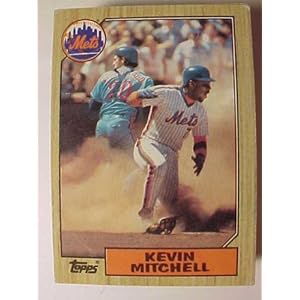
So Topps is hosting a vote to name the 60 greatest baseball cards of all-time, but the company “pre-selected the 100 greatest cards [it has] ever produced.”

I have no idea by what standards they determined those 100, or how they define “great,” but any list of top baseball cards that does not include the following gem does not deserve to be voted on.

Also, I remember thinking that when Kevin Mitchell led the league in homers in 1989 it was something of a meteoric breakout season. But looking back at his stats now, I see that Mitchell was an excellent hitter from the time he came up and for pretty much the length of his Major League tenure. Career 142 OPS+. Not shabby.

Just because

I did my best to keep this column — one of my all-time favorites — living (though not exactly easy to find) on an active page on SNY.tv for a very, very long time. But word came down from on high that it was time to remove that page from our navigation, so I figured I’d link the “On Keith’s mustache” epic here in memoriam.

I wrote this before I actually worked at SNY proper. It remains, to date, the only time I have ever been given a specific writing assignment by anyone here (they were putting together a package for the mustache-tribute night). And it marked, I believe, the first time I spoke to Kevin Burkhardt, who happily provided good quotes but probably still thinks I’m a weirdo for it.