Not Just a Mets Blog does a nice job defending Angel Pagan from the “fourth outfielder” label put on him by, in this case, Baseball Prospectus’ Christina Kahrl.
Angel Pagan — Baseball’s Rodney Dangerfield?
2

Not Just a Mets Blog does a nice job defending Angel Pagan from the “fourth outfielder” label put on him by, in this case, Baseball Prospectus’ Christina Kahrl.
Jim writes for AZSnakepit.com. Byrnes today and Sandy Alderson tomorrow, just like the Mets are doing it.
Optimistic Mets fans everywhere, this one included, spent all day Sunday considering the symbolic value of Ryan Howard’s caught-looking strikeout that ended the Phillies’ 2010 World Series hopes. “Just like Beltran,” we said, hoping Howard and the hated Phils would suffer the same fate Beltran and the Mets did after the 2006 NLCS.
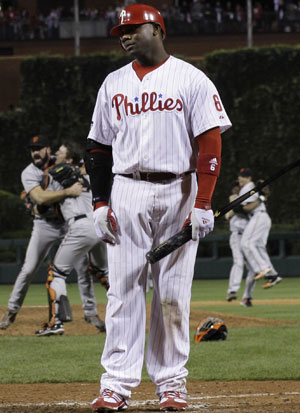 The Situations were far from identical, of course. The Phillies won the World Series in 2008 and got back there in 2009. Howard earned the love of the Philadelphia fanbase with three home runs in that series, and — though these things can turn quickly — probably will not soon suffer the same nonsensical and misdirected hostility from the fans and media that Beltran endured.
Many Mets fans tend to overrate the Phillies’ intangibles (underrating at the same time their very-tangibles). The Phillies have been the bad guys in the N.L. East for four seasons now, so we look at them like they’re 25 T-1000s, ignoring their humanity and trumpeting their apparent inability to be destroyed, citing their arrogance and their will and their remarkable capacity to overcome injuries.
But no team is invincible in a five- or seven-game series, and though Brian Wilson hardly cast the Phillies into a vat of molten steel, that 3-2 slider on the low-outside corner reminded everyone that the Phillies might not be so mighty after all, and inspired columns like this one and this one examining wounds in their mechanism that might not heal themselves instantly.
(OK, enough of that metaphor. </terminator2>, if you will.)
Truth is, the Phillies will still have Roy Halladay, Roy Oswalt and Cole Hamels at the front of their rotation next year, and a trio that good makes them unlikely to collapse completely. And if we — me — here at TedQuarters are unwilling to accept that Beltran and the Mets became magically unclutch and weak-willed upon the Wainwright curveball, we must recognize that the same will be true for the Phillies.
But since we’re in a celebratory mood, we can look down the road with rose-colored glasses on and find more important similarities between those Mets and these Phillies.
Those Mets locked up a ton of payroll in some longterm deals that rendered them financially inflexible. These Phillies already have $143 million spent for 2011 and and $89 million committed to seven players in 2012. Both clubs thinned their organizational ranks with a series of trades aimed to help at the Major League level. Injuries, you already know, took their toll on those Mets teams. Jimmy Rollins and Chase Utley, both on the long side of 30, both missed time with injury this year.
So though it’s probably silly to expect the Phillies to fall apart as dramatically as the Mets did in 2009, it is certainly reasonable to expect that they won’t be able to dominate the division much longer.
The Braves, I am concerned, could be a problem.
Excellent interview with Alderson from DuckSnorts in 2008. Obviously it’s a lot easier to say the right things than to actually put them in practice while running a baseball team, but kudos to Alderson for saying just about all the right things.
We are bringing back Josh Byrnes and Sandy Alderson for a second round of interviews with Fred, Saul and me. Josh is scheduled for Monday and Sandy for Tuesday as we continue our search for the next General Manager of the Mets.
John Ricco and I spoke personally with Allard Baird, Rick Hahn, Logan White and Dana Brown earlier today to thank them for their interest and taking the time to interview with us.
– Jeff Wilpon, Mets press release.
First of all: Cool. Byrnes’ record in Arizona isn’t perfect, but he seems like a better choice than, well, Allard Baird. This article from 2008 provides some background.
Second: Is it weird that we keep hearing every detail of the Mets’ GM search directly from the Mets? Do other teams do stuff like this?
From strictly the blogging perspective, it’s a hell of a lot better this way than sorting out endless anonymously sourced rumors and speculation, I suppose.
Matt Cerrone brought up the Ike Davis-for-Prince Fielder debate that I touched on nearly a month ago, and now debate over whether the Mets should make that deal (should it even become available to them) is spreading through the blogosphere.
 Here’s your answer: No.
That’s not because Davis is currently a better player than Fielder or because I believe Davis will certainly be a better player than Fielder soon. Fielder is one of the league’s best hitters, and the Mets should be thrilled if Davis ever puts up an offensive season as good as the one Fielder posted in a down year in 2010.
Davis can boast superior defense and a body that appears better suited to long-term success, which mitigates the difference between the two players at least a little. But Fielder now has four years’ worth of evidence to show he is a great offensive player and is still only 26, so he’s a reasonably safe bet to continue being one of the league’s better power hitters into the latter part of this decade. Davis, coming off one season of just below league-average production for a first baseman, offers no such assurance.
It comes down to money.
Fielder is entering his final year of arbitration, meaning any team that acquires him will likely work to sign him to a contract extension at market rate, like the Mets did when they got Johan Santana.
I have no idea what it will cost to extend Fielder’s contract, but it won’t be cheap. Ryan Howard will earn $25 million a season from 2012-16. Mark Teixeira will get $22.5 until 2016. Miguel Cabrera — $19 mil and change through 2015.
Even if Fielder doesn’t command quite as much as his fellow young, slugging first basemen, he’ll inevitably require a hefty chunk of the acquiring team’s payroll for the multiple years.
Davis, meanwhile, won’t even be eligible for arbitration until after the 2012 season. If he continues improving, the Mets could look to buy out his arbitration years — a deal that would still likely be favorable to the team and well, well below what it would require to extend Fielder. Keeping Davis instead of trading for and extending Fielder would probably save the Mets at least $10 million a season in payroll into the second half of the decade, money that could be allocated toward free-agent signings that could more than make up the difference between the two players.
Throw in that Davis is, as mentioned, a much better defensive player and quite likely to improve, since he came to Flushing in 2010 with only 42 plate appearances above Double-A ball, and trading him for Fielder doesn’t even seem like a topic worth debating.
The final sticking point is that there remains some reasonable chance that Fielder and Adrian Gonzalez hit the open market next winter. Since the Mets’ chances of contention in 2011 appear long anyway, it seems crazy to dispatch one of their most valuable cogs in a trade now when they may be able to find an upgrade for only money next offseason, dangling Davis as trade bait then or forcing his once-discussed move to right field.
A former lawyer and marine, he quietly might have been the most important baseball executive of the last twenty-five years. Front offices using sabermetrics? He introduced Billy Beane to Bill James’ work. Building a championship team simply by out-spending everyone else? Alderson might be indirectly responsible for the Yankees. Ever see umpires huddling up to discuss a call? Alderson encouraged them to do that when he worked for the commissioner’s office. Questec, the system MLB uses to grade an umpire’s strike zone, was also brought in by Alderson. His current job is cleaning up corruption in the Dominican Republic’s amateur player system, because Sandy Alderson is a man who Gets Things Done. In the future, there will be hoverboards; there will also be several interesting books written about Alderson’s influence over the game of baseball. He is an agent of change.
– Patrick Flood, PatrickFloodBlog.com.
Flood makes a pretty convincing case for Alderson, who appears to be the fan favorite, the media favorite, and, at this point, the odds-on favorite to get the job.
Don’t count out a late push from Jimmy McMillan, though.
Now randomly on the Daily News Live! set for an episode.
Pretty poor job by the New York papers last night. Jeff Francoeur not only had a hit, but his trademark cannon-arm fired a costly error in the Yanks’ second-inning rally.
And yet we’re only treated to one Frenchy sider, courtesy of the Daily News. That puts the tally at eight, and it’s starting to look good for anyone who had the under on 20.
Shocked to read not a single recap of Francoeur’s stay in New York, with his old apartment and favorite restaurants and everything. Maybe those are forthcoming, or maybe — heaven forbid — the papers are actually going to focus on all the exciting real baseball stuff.
And if you’re the type of person who cares about these things — and I bet you are — Francoeur now has a grand total of 10 ALCS at-bats and two hits to only eight articles. This man needs a bigger stage.
In an early Frenchy Tracker update, I mentioned that no reporter I knew of had yet caught up with Darren O’Day to discuss his “brief, weird stint in Flushing.” Adam Rubin finally did and totally destroyed it. Really great read, detailing O’Day’s friendship with the late Nick Adenhart, how he wound up in Texas, and, of course, a little bit about the Mets’ roster mismanagement.
 Tedquarters