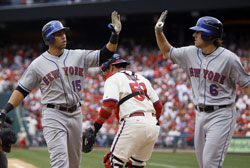
Boiling down a Beltran deal

So, take Beltran’s xBABIP for this year, and add back in those six hits he lost to luck – call them all singles – and you have a .280/.367/.459 line, or a .352 wOBA. Combined with scratch defense in the corner outfield, and that’s something like a 3 WAR player over a full year. Not exactly a cheap player, given that wins are about $4-5 million per, but not grossly overpaid either. Does it seem worth paying another team most of that salary to get off the team? Probably not….

Lastly, Beltran does have better upside. He might just be better than a scratch right fielder with an offseason of preparation and recuperation. If we use his UZR instead of UZR/150 (-3), then we actually get a +7 defensive right fielder, and closer to a four-win player. Beltran has surpassed that number in every full, healthy year but two in his career. Can Duda, Murphy and Evans get you four wins? Probably (definitely?) not.

Eno Sarris, Amazin’ Avenue.

Sarris takes time away from slandering Ruben Tejada to pen a nice piece examining the positives and negatives of trading Beltran, something I’ve been doing a bit here lately and something it sure sounds like the Mets will be doing this offseason.

Look: All of this speculation hinges on the terms of the deal. Sarris assumes — as I have, as many have — that the Mets will have to eat a huge portion of Beltran’s contract just to be rid of him, and that they won’t get much back in terms of talent. But sometimes everyone figures one thing and then something else entirely happens, and so maybe there’s some total sucker out there willing to take on all of Beltran’s contract and give the Mets something valuable in return, in which case, you know, I’ll miss you Carlos Beltran but, well, peace out.

I doubt that’s the case, though, so for the sake of the below exercise let’s go on assuming what we have been assuming. So do the various potential positives of dealing him outweigh the potential positives of keeping him?

Dealing him means likely somewhere between $3-5 million of salary relief. That’s a positive for a cash-strapped team, inarguably. It also brings a variety of nebulous positives probably don’t matter in the win column: a “new image” for the club, the establishment of different clubhouse leaders, whatever.

In Lucas Duda, Nick Evans and Daniel Murphy, the team has corner-outfield types who appear at least close to Major League ready, so it’s not that the team would immediately have to go about appropriating the money saved by dealing Beltran to replacing Beltran. More likely, it could be spent on pitching or middle infield help, more glaring needs.

But, as Sarris suggests, no combination of those three is likely to match the contributions of a healthy Beltran, which leads me to the major positive of not dealing Beltran: You get to have Carlos Beltran on your team.

The issue, of course, is that it’s far from guaranteed that Beltran will be able to stay on the field or produce anything like the way he did from 2006 to 2008, when he was one of the very best players in baseball.

But essentially, in some convoluted way — and again, assuming the Mets have to eat a lot of money just to move Beltran — it works out to taking a $3-5 million gamble that Beltran can remain mostly healthy and productive for the 2011 season. Given the potential upside, that seems like a worthwhile risk.

Baseball Show with Bob Ojeda

This would’ve been done sooner but Bob was looking up the swinging-strike rate against Jon Niese. These former Major Leaguers need to get their heads out of the spreadsheets. Lots of good pitching stuff here:

Ruben Tejada can’t get into the bar yet, but he can treat you to the laser show

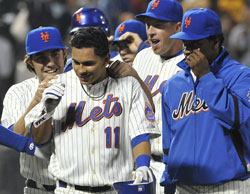
Ruben Tejada went 3-for-4 last night with a pair of doubles, including a walk-off job against Brewers closer John Axford. It looked like this:

Since I wrote the epic post titled, “I don’t think Ruben Tejada is as bad at hitting as everyone else does,” the diminutive infielder has rewarded my faith by posting a .333/.394/.500 line across the tiny 30 at-bat sample, raising his OPS for the season to a still-bad .577.

There was a discussion on the post-game show last night over whether the Mets should enter Spring Training penciling in Tejada as their starting second baseman. Bob Ojeda said they shouldn’t even give Tejada the slightest inkling that he’d be considered for the job, and that, though maybe he could compete for a spot in Spring Training, he certainly hasn’t earned anything.

Ojeda’s right, of course. Tejada still needs to improve before he should play regularly at the Major League level for a team with any aspirations at contention, especially at second base (as compared to shortstop, where a .577 OPS is ever-so-slightly more palatable).

If the decision-makers for the 2011 Mets decide the team is unlikely to contend, and that Tejada is a real part of the team’s future and his development doesn’t stand to be hindered by his playing at the Major League level, then, sure, let him compete for a job.

It seems to me that the best and safest route, though, would be to sign a Major League stopgap like the ever-frustrating Felipe Lopez to a one-year deal and let Tejada, Daniel Murphy, Justin Turner, Reese Havens, Josh Satin and whoever else I’m missing battle to eventually unseat him.

After the departure of Alex Cora and with the team reportedly finally ready to cut bait on Luis Castillo, the Mets will need middle infielders anyway, so they might as well sign someone with some sort of reasonable track record while the younger players work to prove their merits in Spring Training and then Triple-A. In other words, let one of those guys force his way into the lineup instead of forcing one of those guys into the lineup.

Kiner’s Korner Revisited: Richie Ashburn

Fun stuff about the 1962 Mets. Stay tuned ’til the end when he calls batting average overrated, like a good sabermetrician. Easter Egg: Shirtless photo of Jay Hook.

For what it’s worth, I just ventured to the 1962 Mets’ baseball-reference page to gawk at just how bad they were. Holy hell. They managed a team OPS+ of 82 and ERA+ of 82, meaning they hit like 2009 Omir Santos and pitched worse than the late Jose Lima.

Somehow, the 2010 Pirates actually have a team OPS+ of 82 and ERA+ of 81.

Ike Davis stuff

The founder of the group, Dan Brooks, said the organization began with six people and has grown to about 1,000. The mission is to educate people about the Holocaust by telling the stories of their families, to provide a forum where the grandchildren of survivors can connect, and to fight intolerance and ethnic violence wherever it exists. They have had speakers from Darfur and Rwanda address the group in the past. The meeting with Davis, Brooks said, was exhilarating.

“The fact that he would take the time to meet with us and share his story was great,” Brooks said. “It really means a lot that he’s willing to do this.”

One member, Leora Klein, said she was the grandchild of four Holocaust survivors and mentioned to the group how important it was that Davis was willing to identify himself with this cause because he was “young, successful and hot.”

David Waldstein, N.Y. Times.

Excellent feature from Waldstein in the Times about Davis taking time out to share the story of his great aunt, a Holocaust survivor, with a group dedicated to Holocaust awareness.

Davis also told the group how his paternal grandfather, as a member of the U.S. Armed Forces in World War II, helped liberate a concentration camp, and how it warmed him up to the idea of Davis’ father bringing home a Jewish girlfriend.

For what it’s worth, my own grandfather helped liberate a concentration camp, too, and I’m pretty sure was one of the contingent of American troops ordered to march the citizens of Dachau through that camp to show them the atrocious things their government had done. I think. I get his stories jumbled up in my head with a lot of the books I’ve read, since there’s plenty of overlap, and since he really only shared war stories when we had to beg them out of him for school projects. He always preferred to talk about baseball, which I totally respect.

Speaking of: Davis’ strong finish has pulled his OPS+ up to 116, just shy of the Major League average 120 for first basemen, and an impressive mark for a 23-year-old with only 55 games above A-ball before the season started. Factor in Davis’ Gold Glove-caliber defense, the likelihood that he’ll improve at the plate as he develops, and the fact that he’s still a couple years away from even hitting arbitration and he looks like a keeper for the Mets.

Someone asked me earlier this season if I’d trade Davis in an offseason package for the Brewers’ Prince Fielder, an excellent young hitter a year away from free agency. At the time Davis was slumping badly, but even then I was uncertain — reminding the person that a trade for Fielder would be, in truth, a trade for the right to sign Fielder at market rate.

Now, it seems like a no-brainer: No. Sure, there’s a lot more evidence to prove that Fielder can hit like a Major League first baseman than there is for Davis, and it seems unlikely Davis will ever be the same type of offensive force as Fielder, but when you consider Davis’ superior defense and especially the difference in contracts, Davis looks like a more valuable commodity.

Plus Leora Klein thinks he’s hot.

Hot pursuit

So for whatever reason I’ve found myself listening to the Mets on the radio a bunch the last few days, and Howie Rose and Wayne Hagin seem to maintain that Jerry Manuel is intentionally limiting and manipulating Ruben Tejada’s at-bats to make sure the 20-year-old infielder finishes the season with a batting average above .200.

I have no idea if it’s true, but they’ve said it a few times, and I’ve really got no reason to doubt them.

Didn’t the same thing happen with Ted Williams once? I think so. Except that was aimed at finishing over .400 instead of .200, and it was only on the last day of the season, and Williams refused to sit and wound up hitting .406. So this is just like that, except like a billion times sadder.

Also, honestly: Who decided that whatever mental advantage Tejada gains heading into the offseason with a .200+ batting average will outweigh the benefits he might gain from a few dozen extra Major League at-bats?

I mean, I can’t imagine it matters much one way or another since Tejada’s playing a lot now. But seriously, who makes that call? Is it lame-duck Manuel or lame-duck Omar Minaya? John Ricco? The marketing department?

To me — and this is totally uninformed — it seems like if the Mets were looking to shake the whole “rudderless-ship” perception, they’d at least have someone on board making baseball decisions that had some investment in the team’s future. But then I was basically saying the same thing last year.

After an 0-for-1 day yesterday, Ruben Tejada sits at .199 for the season. The chase continues!

I’m off to Connecticut to talk to some college kids about the Internet. Vendys writeup coming later.

Expect Carlos Beltran to return or expect him to be traded

Some fun, if meaningless, stuff coming out of the waning days of the Mets’ season: Chase Utley slid in hard and late on Ruben Tejada on Friday, trying to break up a double play, and several Mets took exception — most notably Carlos Beltran. Then the Mets, powered in part by Beltran, went on to take the next two from the Phillies, scoring a rare road series win and preventing the Phillies from celebrating their inevitable playoff berth in their own clubhouse.

The Mets downplayed the importance of that accomplishment, as they damn well should have, saying they were just happy to be playing good baseball and they should have been playing like this all year. And good. Something always feels messed-up when you hear about a team “relishing the opportunity to play spoiler.” Oh, you do? Why don’t you relish the opportunity to play better baseball for the first 140 games of the season?

Anyway, the whole thing sets up the lamest bit of post hoc ergo propter hoc talk-radio nonsense since “Lastings Milledge woke up the Marlins.” Someone somewhere will suggest — probably already has suggested — that Utley’s slide shook Beltran to life and made him decide, “oh, I guess I’ll start being awesome at baseball again,” even though, as we know, Beltran had been hitting like Beltran for weeks.

The whole affair brings Beltran back into the fore for the first time since the Walter Reed flap. Both the Post and Daily News put Beltran in the focus of their game stories for Sunday, with the Post asserting that he’ll likely be back in 2011 and the News suggesting he’s as good as gone.

It’s going to be one of those offseasons, I suppose. Which is pretty much every offseason. Until we get there, though, we might as well relish this opportunity to watch Carlos Beltran do stuff, knowing that it might be our last to watch him do it in a Mets uniform.