Friday Q&A, pt. 1: Mets stuff

Wait, no stops at all? Because even if I limit my coffee and water intake I can only do at most like five or six hours between bathroom breaks. Plus if I’m driving all the way to Port St. Lucie I’m probably going to want to look up good places to eat along the way, and I’m generally willing to drive a little bit out of the way to eat better food than what’s available on the side of I-95.

In any case, it’s Kevin Mitchell. That’s a long drive, and you’re going to want someone who can keep things interesting. Mitchell seems like the right mix of crazy and well-traveled to have great stories to pass the time. I’d say Carl Everett for similar reasons, but I’ve known people who don’t believe dinosaurs existed (really) and I get incredibly frustrated when they’re around and topic comes up — and I just assume it would at some point on a 20-something-hour road trip. So I suppose I’d have to confirm that Mitch believes in dinosaurs before we set out. Bonus points because I suspect Kevin Mitchell appreciates good Southern barbecue as much as I do.

I’d also consider Tsuyoshi Shinjo, despite whatever language barrier may exist. I assume we could find ways to communicate, and his presence alone would be endlessly entertaining. And I’d totally be willing to be Shinjo’s wingman if we stopped at a nightclub or something.

https://twitter.com/Section518/status/246607341443751939

Bossman Junior. It’s one of my favorite things about B.J. Upton.

Via email, Evan writes:

Watching [Carlos] Beltran do stuff like this as well as just maintaining his general all around awesomeness makes me wish the Mets had given some more thought to resigning him after last year, especially considering the way their outfield situation has played out. I realize hindsight is 20-20 and all, but his contract looks like a steal and his talent is well beyond what seems available in free agent outfielders this offseason. Selfish Beltran not providing Sandy with time travel capabilities to inform his free agent signing decisions. Seriously though, did they ever consider resigning him last year?

I have no idea, but I don’t think so. Remember that the Mets had a very limited offseason budget and a whole lot of money already tied up in one veteran corner outfielder — Jason Bay — with most of us pretty excited about Lucas Duda’s bat in the other corner. I, too, wish the Mets had Beltran this year, if only because I very much enjoy watching Carlos Beltran play baseball. But he wouldn’t have made the difference between these Mets and a winning team.

This much I hope: 1) Beltran, who has struggled recently and been unironically accused of failing the struggling Cardinals in the clutch — classic Beltran-blaming — goes berserk and cements St. Louis’ postseason bid over the next few weeks, then does typical Carlos Beltran stuff in the playoffs. I know as a Mets fan I’m not supposed to root for the Cardinals, but for me it’s Beltran uber alles.

2) Beltran enjoys another strong season with the Cardinals in 2013. When his contract expires after the season, the Mets — still in need of outfielders and power hitters but finally free of Bay’s salary — bring Beltran back on a two-year deal. He performs admirably in 2014, then enjoys a swansong season in 2015. He leads the Mets to the World Series, then hits a walk-off grand slam in Game 7, flips everybody off and retires. Five years later, he enters the Hall of Fame in a Mets jersey.

Two from Chris because he asks good questions.

OK, I’ll bite: Torres yes, Thole yes, Acosta no, Pelfrey maybe, Johnson no.

Torres hasn’t been great for the Mets, but he’s got value in that he’s a switch hitter, he’s performed well from the right-handed side of the plate, and he’s excellent on defense. I don’t think they should plan on him starting in the outfield next year, but they’re so short on outfielders that they could probably use him as a reserve or platoon guy. A lot of this depends on the budget, though: If they’re absolutely strapped for cash, the money it will cost to keep Torres may be better spent elsewhere.

Thole’s too young and, as a lefty-hitting catcher who can get on base, potentially too valuable to just let walk for nothing. I know he’s had an awful season and a lot of Mets fans seem near done with him. Whatever. Look at the catchers in the Mets’ system and the free-agent market for catchers. There just aren’t many obvious better options who might be parts of the team’s next contender. He’s not likely to earn much in arbitration anyway. The concussion stuff is scary so they would be well-served to hedge their bets a bit with a decent righty-hitting backup or two (Kelly Shoppach would be good), but Thole should be back. Always go with the biggest sample: There’s still more evidence that Thole can hit like a Major League catcher than that he can’t.

Acosta has quietly been very good in his most recent stint with the big club, but, really, what’s the market going to be like for Manny Acosta this offseason? It’s hard to imagine him getting a guaranteed deal coming off a 7-plus ERA season, and if he does, you know… peace out. If he doesn’t, bring him back on a Minor League deal and stash him in Triple-A until late July when he randomly gets good every year.

Pelfrey’s a tough call. Since the Mets actually have starting-pitching depth to some extent, it seems like he’s got more value elsewhere. But it also seems like it’d be tough to trade him while he’s still recovering from Tommy John surgery, though certainly that has happened before. Most reports suggest the Mets will not tender Pelfrey a contract but could try to bring him back on a less expensive deal, but I wonder if that’s even possible.

Last year, the Mets had to guarantee Chris Capuano $1.5 million and load up his contract with incentives and he hadn’t pitched a full season since 2006. The A’s gave Ben Sheets $10 million before 2010 after he missed all of 2009. With Pelfrey’s history of good health, the relative reliability of Tommy John surgery, pitching being pitching, and Pelfrey’s affiliation with Scott Boras, it seems possible he’d get as much on the open market as he would in arbitration, and eminently likely that if he’s non-tendered he’ll get a better deal elsewhere than he will with the Mets. I have no idea if I’m reading this one right so I’m interested to see how it plays out. And, again, it all depends on how much money the Mets have to play with. But I’m leaning toward thinking they should tender him a contract, assuming they’ll either have a need in the rotation when he’s ready or be able to trade him for something if they don’t. Also — and this will sicken some Mets fans, I know — I still kind of like the idea of Big Pelf in the bullpen.

Given the uncertainty surrounding Thole, it’d be good if they entered 2013 with better hitting Triple-A catchers than Rob Johnson. Easier said than done, I know, but please: Give it a shot.

Late October.

Mostly Mets Podcast presented by Caesars A.C.

We didn’t plan on talking about these awful Mets for two hours. I think that’s my fault. With Toby and Patrick:

[sny-libsyn url=”http://html5-player.libsyn.com/embed/episode/id/2065565/height/360/width/640/autoplay/no/autonext/no/direction/forward/thumbnail/yes”%5D

On iTunes here. Review us if you please; we’re lonely. Also, hit up the voicemail at (347) 915-METS.

Mets Fan Experience in Atlantic City after game on Sept. 23

Status

Ted Berg's avatar

After you catch the Mets at Citi Field on Sunday September 23, catch the bus to Caesars Atlantic City for an exclusive Mets Fan Experience all for $97.

Board a luxury Greyhound Lucky Streak right from Citi Field, 30 minutes after the game ends. Once in Atlantic City you’ll enjoy…

  • Overnight accommodations at Caesars Atlantic City.
  • $10 Slot play per person.
  • $10 Food and Beverage Credit per person.
  • Special Mets Fan Happy Hour at Toga Bar.

To reserve your spot by Sunday, September 16, click here.

[sny-line]

The trouble with the curve

https://twitter.com/AdamRubinESPN/status/223210758023036929

OK, a few notes first. A) Yes, this is sort of trolling, and I promised to stop that. But the way the Mets have been playing (John f@#$ing Lannan? Really?) must make trolls of much stronger men than me.

B) That quote — referring to Matt Harvey — comes from a scout texting Adam Rubin, not Rubin himself. Rubin’s merely reporting what the scout said, and just a few days later he presented more thorough and balanced scouting takes on Harvey in a forum not limited to 140 characters. I intend to troll the scout in question only.

C) The quote above came after one of Harvey’s starts in late June. And though Harvey didn’t pitch appreciably better in terms of results in his handful of Triple-A appearances after that one, perhaps he spent the month refining his secondary stuff and preparing to strike out buttloads of big-leaguers in his first turn around the Majors.

But still.

Here’s a fun thing: In Matt Harvey’s first nine Major League starts, he has 63 strikeouts. If you go through all of Pelfrey’s 149 big-league starts, isolate the nine outings in which he struck out the most batters and add up the total, you only get to 61 strikeouts. Pelfrey never at any point showed anything like the capacity to fool Major League hitters that Harvey has already demonstrated. Harvey’s tiny-sample career K/9 rate is more than twice Mike Pelfrey’s.

That’s not to hate on Pelfrey. Big Pelf, for all he’s reviled in some circles, provided the Mets nearly 900 roughly league-average innings in their starting rotation and should not really be faulted for failing to develop the swing-and-miss stuff necessary to become the front-line starter we hoped he’d be.

But that was like the main thing about Mike Pelfrey! He didn’t strike anybody out. And the main thing about Matt Harvey, so far at least, is that he strikes everybody out. That’s a massive distinction, because with the strikeouts comes the legitimate hope that Harvey can develop into a dominant starter. Matt Harvey is like Mike Pelfrey in that he is a big, hard-throwing white dude* drafted in the first round by the Mets out of college. But that’s really it.

I’m not just trying to be a jerk here. I aim to emphasize the problem with relying too heavily on anyone’s eyes to evaluate baseball players. This person, who is thought so good at watching baseball players and judging their talents that he is actually paid to do so, said in June that Matt Harvey was “Pelfrey without the split or breaking ball.” Think about that.

Again: Maybe a lot changed between late June and Harvey’s debut in late July. Maybe one very bad start colored a good scout’s perception on Harvey enough that he compared a guy a month away from a double-digit strikeout start in the Majors to Pelfrey, who never did that once. Or maybe this is one bad scout. After all… Pelfrey’s breaking ball and splitter?

In any case, it’s kind of damning. Indisputably, scouts have a ton of value in the development and evaluation of young baseball players and can very much benefit reporting on the subject. But scouts are human beings and human beings all pretty much suck at stuff. We are biased in so many ways: by our deeply ingrained cultural perspectives, by our first impressions, by our preconceived notions, by our moods, by the weather, by the quality of our breakfasts, everything. And this guy making the Pelfrey/Harvey comp should theoretically be one of the very best in the world at keeping all those biases at bay. Think of what that implies for the untrained scouting fodder you sometimes read here and elsewhere.

This is why I get frustrated when I see a lot of baseball analysis seemingly swinging back toward the subjective stuff from the hard data that came into vogue after Moneyball: All the issues inherent in relying on traditional scouting still exist. We better understand the flaws in relying too heavily on certain stats or in relying only on certain stats, but there was plenty of evidence even back in July to suggest that Harvey and Pelfrey didn’t have much in common.

Harvey’s big-league success, of course, has come across only 52 1/3 innings, a more or less insignificant sample. Maybe he’ll spend the next six years pitching exactly like Mike Pelfrey, proving this scout correct and making the previous 750 words look either silly or like a massive jinx.

All I’m saying, I guess, is that I’d recommend against taking anyone’s word for anything. Not some anonymous scout’s and certainly not mine. People are generally full of it, and Matt Harvey is sweet.

*- I don’t know anything about this particular scout, but I mention Harvey and Pelfrey’s shared whiteness because I read a ton about baseball and it’s very rare that you see an interracial scouting comparison. I suspect that if Matt Harvey were an Asian dude** — even if he still grew up in Connecticut and pitched at U.N.C. — he’d never be compared to Pelfrey.

**- I really only mention that as an especially awkward segue into a discussion of rookie pitchers and Asian dudes. Harvey’s first nine big-league starts look pretty similar to Yu Darvish’s first nine big-league starts: Tons of strikeouts, a few too many walks, not a lot of hits, good ERA. Darvish now has an extra 100+ Major League innings under his belt, plus five years’ worth of being the best pitcher in NPB history. But Darvish is two and a half years older and owed about $50 million through 2017. The Mets, I believe, should control Harvey through arbitration through 2018 if he stays in the bigs continuously. He could make more than Darvish over that time, but only if he’s good. Would you trade Harvey straight up for Darvish? Not rhetorical.

So here’s something

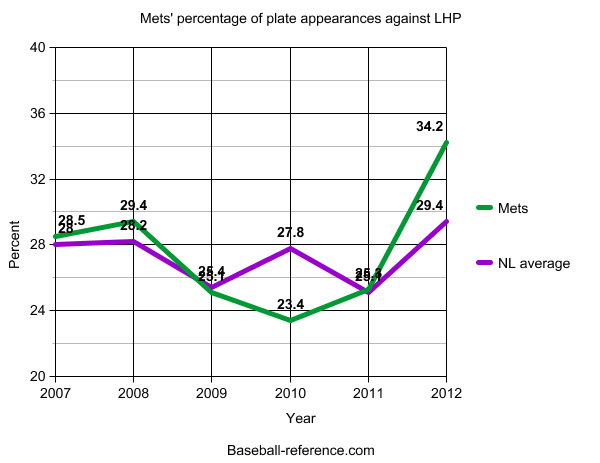
Stumbled onto this while working on something else today. I’m pretty sure this came up earlier this season but I didn’t realize it had borne out over time: The Mets seem to have faced an atypically high percentage of lefty pitchers this season, likely in part due to the atypically high percentage of lefty hitters in their lineup. Check this out:

The Mets’ only other marked deviation from league average here came in 2010 when, if you’ll recall, they spent portions of the season pretty heavily right-handed, during Peak Rod Barajas.

I suppose this shouldn’t be all that surprising, given what you’ve seen from the Mets this year. It also probably helps to explain why so many of the Mets having good years by their standards — David Wright, Ruben Tejada, Scott Hairston and Ronny Cedeno — hit right-handed and so many of the Mets having bad years by their standards — Ike Davis, Josh Thole and Lucas Duda — hit left-handed. That’s hardly a rule, of course, as Mike Baxter’s hitting better than anyone could have expected, and Jason Bay.

Anyway, the point I was setting out to make was that Baxter and Hairston could combine for a pretty damn good outfielder in the Mets’ 2013 plans. I don’t know if Hairston has priced himself out of the Mets’ plans with his mashing this season and Baxter’s big-league success has come in a reasonably small sample. But Hairston’s got a career .280/.330/.505 line against lefties and Baxter’s at .271/.363/.431 against righties. Plug that pair into an outfield corner and manage it effectively and you should be able to hope for better than league-average production from the spot, plus solid defense. Also, both can play center field in a pinch and both have proven useful in pinch-hitting situations, for whatever that’s worth.

The Mets will need to make the outfield their top offseason priority since they’ve got no one in their system now who appears apt to man an everyday spot next year. But since it seems unlikely they’ll be able to find three outfield regulars in free agency and via trade, a Hairston/Baxter platoon could more than adequately shore up one of the spots. Not exactly breaking news, I realize.

Maybe the city of Buffalo needed to do better by the Mets

The most important point as far as I’m concerned is that Bisons attendance has been falling fairly steadily, since 1991. That’s over two decades of straight slipping. Some years, the declines are larger than others, but the declines are real and consistent.

You know what else has been declining in the last twenty one years? The Buffalo population, which is less than half of its 1950s peak. To be fair, the population of the other major Western New York cities like Syracuse and Rochester has been falling as well. Buffalo is a relatively poor city with a median household income of $30,043 as of the last census, well below the New York State median of $55,603. Perhaps more damning, 30% of Buffalo lived below the poverty level.

Toby Hyde, MetsMinorLeagueBlog.com.

With the Mets’ Triple-A affiliation with Las Vegas looking — for better and worse — all but inevitable, Toby investigates and debunks claims that the Major League team is largely responsible for the Bisons’ declining attendance figures. It’s worth a read.

I don’t know enough about player-development contracts or the specific situation in Buffalo to say anything for certain, but this latest turn seems more like misfortune than mismanagement from the Mets’ end. Obviously the Blue Jays make a hell of a lot of sense for the Bisons and vice versa, and it looks like the Mets will wind up the last man standing when the music stops in Triple-A musical chairs — forcing them to skulk down into the chair that no one really wants to sit in because it’s such an awful chair for pitching from.
About that: The Mets have, for the first time in a long time, a bunch of young pitchers at the high levels of their system. If Dillon Gee and Johan Santana are healthy come April — far from a guarantee, mind you — then the group of Zack Wheeler, Collin McHugh, Jeurys Familia and Jenrry Mejia should all be targeting the Triple-A rotation out of Spring Training (barring a Major League bullpen assignment).

They should be targeting that, but if the Mets’ Triple-A home is in Las Vegas, they might not wind up there. Check this out: That environment is so unfavorable to pitchers that it seems teams often fill it up with Quad-A types and leave the prospects at Double-A. The Blue Jays’ two youngest starters this year, 22-year-old Henderson Alvarez and 21-year-old Drew Hutchison, both skipped over Triple-A en route to the pros. And since the Blue Jays started their affiliation with Las Vegas in 2009, they haven’t let many of their pitching prospects spend much time there — pretty much just Brett Cecil. Kyle Drabek spent half a year there, but his is hardly a success story.

Before the Blue Jays, the Dodgers’ Triple-A team was in Vegas. To find many success stories from Las Vegas’ pitching ranks, you have to go back to 2006, when Chad Billingsley, Joel Hanrahan and Hong-Chih Kuo all spent time in the 51s’ rotation. Clayton Kershaw skipped Triple-A when he jumped to the pros in 2008. Edwin Jackson also skipped a stop in Vegas before his big-league debut in 2003, but he started the 2004 season there, got torched, got torched there again in 2005 and then got traded before he 2006 season.

Of course, that’s hardly to say that time in Las Vegas precludes a pitcher from Major League success — the example of Billingsley suggests otherwise, plus pitching prospects succeed so infrequently that it’s impossible to expect anyone from the Triple-A ranks at any city to make an impact in the big leagues. It does appear, though, that the Blue Jays were careful about which pitchers they used in Las Vegas and when. That could just be the organization’s philosophy or a reflection of the timing of Alvarez’s and Hutchison’s Major League arrival, but there’s no doubt that Vegas’ combination of thin air and hard surface make for a brutal pitching environment that the Mets, should the affiliation happen as expected, will need to monitor.

It’s obviously not ideal. Unless, of course, you’re planning a road trip to see the Mets’ Triple-A team in 2013 and you love shiny things and home runs. Then you’re all set, buddy.

Buy the ticket, take the ride…and if it occasionally gets a little heavier than what you had in mind, well…maybe chalk it off to forced conscious expansion: Tune in, freak out, get beaten.

To enjoy hatred unqualified

Let’s start with the unalienable facts. First, a programming note of sorts: There’ll be no Friday Q&A today and this week’s Sandwich of the Week may be delayed, as I’m heading out of town for the weekend for a rather grown-up obligation down south. I expect I’ll ultimately enjoy myself, eat some delicious barbecue, see some old friends and traverse new swatches of the country. But it is a somewhat grim responsibility regardless, and something unexpected that will pull me away from the sickening lovefest surrounding Chipper Jones’ final visit to New York as an opposing player that was long circled on my calendar.

Second: Here on my desk I have a two-page agreement granting ownership and “absolute rights” to “all drafts and versions” and the “blueprints, patterns, instructions, codes and other information necessary to create” a freelance piece I wrote that is not available online about the relationship Mets fans have with Chipper Jones. I haven’t signed it yet because themes covered in that piece – as detailed in the following post – come from the core of my sports-fan soul, and I fear inking away the rights to those blueprints and patterns could in some way damn this career in its nascent stages.

But the check cleared nonetheless, and that sweet freelance cash helps put the sandwiches on the table. Plus said contract flatters me by referring to me throughout as “the artist,” and everyone involved on the editorial side was extraordinarily agreeable throughout the process. So I will have to tread carefully in the following post. The missing scenes in Larry Wayne Jones’ history with Mets fans, omitted here for legal and professional reasons, are the same that are likely burned into the memories of every Mets fan about my age — all those who suffered so frequently and so savagely at the hands of the Braves’ turn-of-the-Millennium dynasty and its prevailing superstar.

Third: Chipper Jones was one of the greatest baseball players of his or any generation. He was an eight-time All-Star and an MVP-award winner, and his 81.5 bbWAR ranks 31st all time. Though injuries slowed him late in his career, he never finished a single season as a below-average hitter by park- and league-adjusted OPS+. He will wind up with a lifetime on-base percentage above .400 and a first-ballot Hall of Famer.

He was straight-up awesome at his job, and I hate him for it. In fact, if pressed, I could probably count on only one hand the people I have never met that I dislike more than Larry Jones who have not committed actual atrocities.

About that: I have twice tried in earnest to meet and speak to Chipper Jones to temper that hatred. This profession, for better or worse, humanizes both the heroes and the villains of your youthful fandom. It’s something you rationally should always know, but something that smacks you in the mouth regardless when you see, on your first day with a credential, a chagrinned but still very friendly Jimmy Rollins taking responsibility for a crucial error, and something that is reiterated every time you see Bryan McCann enjoying a peanut-butter sandwich or Carlos Beltran grimacing in pain or Dan Uggla giggling at a blooper on the clubhouse TV.

The first time I tried to meet Chipper, I stood in a cadre of reporters around his locker in the visitors’ clubhouse at Shea Stadium after a game in 2007. He pulled on a mock turtleneck, turned to the group and somewhat contentiously stated that he wouldn’t be answering any questions that day. I didn’t know it, but he was upset about a headline in the New York Post that had taken something he said out of context to make it seem like he suggested Alex Rodriguez took steroids, so my attempt to ameliorate or modify my distaste for the man would have to wait.

The next time I tried to meet ol’ Larry Jones, I was working on the aforementioned freelance piece earlier this season. I arrived at Citi Field hours before game time and waited at the clubhouse entrance while all his teammates streamed in and did baseball-guy stuff. When he finally arrived, I approached him, alone, and requested some of his time. He asked for a minute, walked over and whispered something to some of his teammates, then skulked off somewhere, never to return. He blew me off. Whatever.

Lest you think this is that particularly obnoxious and oblivious type of media screed that admonishes a player for eschewing the media, I should note that I’ve heard from multiple veteran members of this city’s press corps that Chipper Jones is one of the very best guys – if not the very best guy — in baseball, to the media and to everyone else. My understanding is that he’s typically candid, friendly, funny and approachable — a great teammate, a great family man and a great patriot. And rationally, based on the information I have, it’s easy to believe that behind the beady eyes and loathsome smirk there’s a damned good dude, and that he blew me off that morning to rescue puppies from kill shelters and distribute them to disabled veterans.

But being a sports fan is rarely rational, and to justify the type of emotional toll fandom can elicit requires complex mental leaps beyond the scope of this already too-long post on an afternoon I’m trying to sneak out of town. Chipper Jones was a great player for the Mets’ biggest rival while I was growing up, and he seemed, way more than most, to revel in the hatred his stellar play earned him from opposing fans. That all makes sense to me, even makes me feel like something of a rube for buying so readily into his inarguably vain trolling.

What I don’t get is why one man — and, again, by most accounts a good man and by every account a great ballplayer I should be thrilled to watch play baseball – should somehow still have the capacity to turn my stomach, even now after I’ve learned to understand and make peace with far, far heavier things.

So it seems funny to me, and perhaps perfectly fitting, that adult and professional responsibilities will prevent me from experiencing and reasoning through a catharsis in his final series with the Mets, because none of the ill feelings I harbor toward Larry Wayne Jones are adult or professional. They live someplace deep and demented in my soul – maybe some long-embedded socially coded vestige of tribalism or something – and when I think about it, I have no real inclination to watch the Israelites send the never-felled Goliath off into retirement with a commemoratory cowboy hat or surfboard.

Which is all a long-winded way of saying: Maybe some things are better left not got. Maybe, in my increasingly reasonable, adult, professional and psychologically balanced life, I shouldn’t need to have everything sorted out so neatly, and maybe I’m OK allowing this one remnant of youthful fanaticism to slip through unchecked this one time. Maybe it’ll prove useful somehow, or maybe I’ll just want to remember how it feels to enjoy unqualified hatred.

In other words, good riddance to bad rubbish. F— ‘em.