Fernando Tatis is actually pretty decent

Now I’m straight trolling.

I’ve noticed a lot of Mets fans throwing around Fernando Tatis’ name when listing the players that have stunk up the Mets’ bench in the past couple of years, and that’s not really fair. I covered this during the offseason: Tatis has been a valuable reserve player for the Mets for the past two seasons. He’s certainly not an ideal starting first baseman — a role he’s been thrust into due to injuries and ineffectiveness at various points in the past two seasons — but he’s a player worth having on a reasonable contract.

The Mets signed Tatis to an $850,000 contract this offseason — less than half of what Alex Cora got, and without any vesting option. He has struggled so far this season, posting a .706 OPS across a small sample of 54 plate appearances, but look a little closer: His batting average on balls in play — .250 — is well below his career .309 mark and he’s hitting at least as many line drives as he ever has.

Tatis’ struggles are likely a sample-size blip, and though it’ll likely take him a while to get enough hits for his stats to normalize a bit, his rough start doesn’t make him any less apt to produce moving forward. Certainly he’s aging, and at some point it will stop seeming wise to hang onto an old utility player, but as long as he is demonstrating decent plate discipline with some power and the capacity to play almost anywhere on the diamond, he’s a guy worth having.

He doesn’t belong lumped in with the rest. Even to this point in the 2010 season, Tatis can boast a 0.3 WAR, placing him solidly ahead of Cora, Gary Matthews and Frank Catalanotto, all of whom have marks below the replacement-level.

Chemical explosion

There was always a cold feeling in the Mets clubhouse last year. Players checked in for work, but there was no sense that this was a team that was in it together.

That has changed.

These 2010 Mets certainly have their flaws, and their margin of error is slim, but that makes team chemistry even that much more important. When last night’s game against the Padres was rained out at Citi Field, David Wright walked past Mike Pelfrey’s locker. As he passed Big Pelf, he gave him a friendly little slap in the face with his batting glove, laughed and jogged away.

Kevin Kernan, N.Y. Post.

Are the Mets winning because they’re getting along, or are the Mets getting along because they’re winning? Was there a cold feeling in the clubhouse last year because Ike Davis wasn’t around, or was it because basically every player got hurt and the team was out of the race by late July? It’s an impossible chicken-egg debate and not one I really care to expound upon further than I did here or here.

But I wonder why the team-oriented leadership of Jeff Francoeur didn’t propel the Mets to greatness in the second half of last season, why Rod Barajas couldn’t do much to help the Blue Jays last year, and why the 2006 Mets seemed to have no trouble winning with ol’ me-first Carlos Delgado slugging home runs?

No one could argue that it’s bad for a team to get along. It’s not. Everyone appreciates a cheerful work environment, baseball players included. But I bet the clubhouse doesn’t seem nearly as chummy when the Mets lose four in a row. Kernan says it himself in his conclusion: “Talent is always the difference-maker.”

That. Francoeur, Barajas and Davis do seem like pretty awesome guys, always charismatic and affable when pressed by reporters. And that’s good. In the grand scheme of things — whatever the hell that means — being a great person is probably more important than being a great baseball player. But the latter will probably win more games.

Exciting times

Pelfrey and Davis, Davis and Pelfrey. Whatever may become of the Mets’ season as summer turns to fall, there is the hope that at least — at least! — this year will be the year when Mike Pelfrey and Ike Davis become bona fide stars. Strasburg struck out 14 for the Nationals on Tuesday, fulfilling the expectations that come with being the No. 1 overall pick in the 2009 MLB First-Year Player Draft. The Mets took Pelfrey at No. 9 in 2005, and it wasn’t until this year that he has shown the sustained success they had envisioned.

Tuesday’s start against San Diego was typical of 2010 for Pelfrey: Nine innings, one run, five hits, no walks, six strikeouts. He ended up taking a no-decision — the Mets wouldn’t win until Davis’ walk-off blast in the 11th (more on that later). Yet Pelfrey’s performance still resonated. He’s allowed a total of three earned runs in his last four starts, dropping his ERA to 2.23, good for ninth in the insanity that is the pitching landscape of this season.

Sam Borden, SNY.tv.

Last night, the Mets started an entirely homegrown infield, all 27 or under, with Pelfrey on the mound. Jose Reyes and Davis hit home runs. David Wright had a pair of hits. Pelfrey was awesome.

Fans always seem to appreciate young, homegrown players, and they’re right to: Young, homegrown players are both exciting and cost-effective.

These are exciting times for Mets fans. Whether by design or by accident, the Mets appear to be moving away from their familiar model of relying on over-the-hill acquisitions and toward a more organic winner.

That may or may not come this year, but those clamoring for the team to to trade a slew of prospects for the right to rent Cliff Lee or overpay Roy Oswalt should consider the Mets’ promising future. This is something I got at this offseason: For the first time in years, the Mets have numbers in the farm system. Not just one or two top-flight prospects and a pile of muck, but a whole group of young players in the high levels who appear likely to contribute to the Major League team.

Not all of them will pan out, but there’s no good way of knowing which ones will and which ones won’t, and no reason to trade away any of them in the name of this single season. The Mets should, as always, strive to compete every single year. And teams need to develop good young players to do that.

Sure, Oswalt and Lee are great pitchers and if either could be had for a steal, you know, cool. But neither guarantees the Mets a playoff berth, and so the team should be leery of jeopardizing its longterm health for a short-term fix.

Oh, and someone please make Jenrry Mejia a starter already. Good lord.

Mets give me good excuse to post Sonny Rollins song

In the 10th round of the MLB draft today, the Mets picked a right-handed pitcher named Akeel Morris out of Charlotte Amalie High School in St. Thomas in the U.S. Virgin Islands.

I don’t know anything about Morris beyond what’s on his BeRecruited.com profile: He’s 6’1″, 170 pounds, threw 44 innings with a 2.65 ERA this season (or in travel ball, or somewhere) and he’s committed to Connors State University.

If Morris signs and eventually reaches the Majors as a pitcher, he will become only the second player from the U.S. Virgin Islands to do so. Al McBean — who went to the same high school as Morris — pitched in 409 games with the Pirates, Dodgers and Padres in the 60s and 70s.

There have been 10 position players in the Majors from the U.S. Virgin Islands, but only three since the turn of the millenium: Midre Cummings, Callix Crabbe and monstrous Quadruple-A masher Calvin Pickering. And all three went to high school in the continental United States.

So here’s rooting for Akeel Morris to help make baseball just a little bit more global. And if it benefits the Mets along the way, you know, good.

Mets draft some guy

Somehow I never realized how much of a crapshoot the actual game of craps is until this weekend, when I stood near a table in Atlantic City and learned the rules of craps. It’s really just betting on dice rolls. Total crapshoot. It’s not just a clever name.
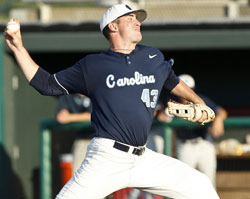
So it’s not really fair to call the MLB draft a crapshoot, because it’s not like the Mets could choose just anyone with that seventh overall pick and expect equal odds of a reasonable return. Matt Harvey has a much better chance of turning into a legitimate Major Leaguer than I do because I don’t throw a fastball in the high 90s. So it’s a good thing the Mets didn’t draft me.

But since baseball players are drafted from all sorts of different levels and leagues, there’s no easy way to compare skill levels and obviously no perfect way to project how good a player will become. So yeah, once scouts have poured over thousands of amateur players and identified the ones worth drafting in the first couple of rounds, it does a bit random as to which ones pan out.

Teams and general managers who draft players that become good Major Leaguers are generally credited as good drafters, and there are very likely some scouts with a better sense of projectable Major League talent than others. But such a slim percentage of drafted players become Major Leaguers and even fewer become Major League stars, so it’s damn near impossible to say for certain that any team consistently drafts well. We can point to teams with good draft histories and we can identify the teams that seem to employ the best strategies. That’s really it, though.

For a point of reference, check out the first basemen drafted in the first round in 2008. The Mets selected Ike Davis that year, a pick some fans (predictably) grumbled about but one that seems to be working out.

Davis was one of six first basemen taken in the first round. The first, Eric Hosmer, was out of high school and appears pretty talented, though he’s still a ways off. The second, much-hyped University of Miami product Yonder Alonso, has a .715 OPS across Double- and Triple-A this season.

The third, University of South Carolina’s Justin Smoak, raked in Triple-A earlier this season and is currently starting at first for the Rangers, though without as much success as Davis to date. David Cooper, drafted one pick before Davis out of Cal, has a .675 OPS in Double-A.

Four picks after Davis, the Padres took Allan Dykstra, who is sporting a .698 OPS in High A.

In other words, they’re all over the map. As of now, Hosmer, Smoak and Davis appear to have been good picks and Alonso, Cooper and Dykstra bad ones. So we can credit the Royals, Rangers and Mets for their talent scouting, or we can guess they just got lucky. And really, we still don’t know: All these guys are still young; any of the former three could collapse and any of the latter three could explode.

That’s a long and silly way of saying it’s sort of pointless to get too excited one way or the other about Matt Harvey. I understand that drafting college pitchers is a good strategy, though I don’t know that I’d point to Harvey’s history of 150+ pitch outings as a good sign (as many have). You can’t teach a 98-mph fastball, though, so that’s good.

What I know for certain is that he had an awesome mustache, so, you know, suck on that Chris Sale. Also, I will hold out some slim hope that he breaks with tradition and chooses Weird Al Yankovic’s deep track “Harvey the Wonder Hamster” as his warmup music. And it’d be cool if he’s good, too.

There’s (probably) nothing happening here

The Mets are 22-9 at home and 8-18 on the road. That’s a big split, no doubt.

So what’s happening?

I’m going to go with “nothing.” Or at least nothing important or lasting.

Jerry Manuel has suggested that the Mets’ hitters tense up on the road because they’re eager to maximize their home run totals while they have the opportunity to do so out of spacious Citi Field. That’s an interesting theory and one that’s impossible to disprove, but it argues that the psychological factors are enough to outweigh the park factors, and that seems like a stretch.

Also, neither Manuel’s explanation nor Charlie Manuel’s suggestion that the Mets are stealing signs covers why the team’s pitchers would be performing so much better in Citi Field. Certainly the park has something to do with it, but the Mets have a 2.85 home ERA and a 5.22 road ERA, likely too big a split to be explained away by the big park.

And though it would be reasonable to guess that Mets pitchers felt more confident pounding the strike zone in Citi Field, where they run less risk of gopherballs, there’s little evidence to support that case: The Mets have actually walked opposing batters at a slightly higher rate at home than on the road. They’ve just been hit much harder on the road, to the tune of more hits and home runs.

In general, teams win more games and players perform slightly better at home than on the road. That’s no surprise: They take advantage of the particulars of the familiar parks, plus the comforts of their own homes and beds and clubhouses and everything else.

And looking around the league, there are other teams with pretty strong distinctions in their home and road records: The Braves are 19-6 at home and 14-18 on the road; the Rangers are 20-10 at home and 10-16 on the road.

The Mets’ split is a bit more extreme than those, for sure. They have the most home wins in baseball and have won only 31 percent of their games on the road, so it is natural to try look for a reason and create some story about what’s happening.

But it’s just randomness again. Give it enough time and it will balance out. As long as the Mets are winning more games than they’re losing, it doesn’t really matter where it happens.