Go check out the graph at Beyond the Boxscore charting relief appearances per game for each Major League team. Then consider this: By ERA+, the Brewers, Pirates and Dodgers — the teams nearest the Mets at the bottom of the list — all have terrible to below-average pitching staffs. And the Dodgers are managed by noted bullpen-abuser Joe Torre. The Mets’ staff, hard as it may be to believe, has been slightly above average this season.
Category Archives: Mets
Obligatory Ollie Perez post
The Mets, incidentally, need someone in Perez’s spot who can not only be a pressure valve for the unholy workload Jerry Manuel is foisting upon his other relievers, but can be a reliable sixth starter. The good part about R.A. Dickey and Hisanori Takahashi succeeding early on is obvious, but the negative will become clear should the Mets have any additional pitcher injuries (or should Jon Niese fail to return this weekend, as expected)….
Show Oliver Perez the door. He’s making his $36 million either way. That’s a sunk cost. And he still might have some magic left in that arm. There’s simply no way to coax it out of him in the present circumstances.
If Howard — who just might be Ollie Perez’s biggest fan — is calling for his head then it’s pretty clear Perez’s ship has left Queens. Only it hasn’t, of course. It remains docked pathetically in the bullpen, occasionally sputtering out to the mound when the Mets need a tug, then breaking down itself as soon as its put to work.
I don’t know that there’s a Mets fan out there who thinks Perez should still be on the team, so I’ll spare you the list of reasons he does not deserve a spot on the 25-man roster. Howard brings up sunk cost, though, and since the team’s inability to grasp that concept has been one of my favorite points of contention since my first days writing on the web, I figured I’d go over it again here.
Adam Rubin nailed it today, so you should probably check that out. Mike Lupica, on the other hand, wrote that it will cost the Mets $20 million to cut Perez.
This is mostly semantics, but that’s not really the case. It cost the Mets $36 million (committed over three years) to sign Perez before the 2009 season. Cutting him is almost free. All $36 million were as good as gone as soon as he inked the deal, so if the Mets think they can find a better player to fill his roster spot over the next season and a half, the money Perez is owed is immaterial. The only cost to the Mets is the salary of the replacement player on the roster, presumably the Major League minimum.
Mets fans and media love to point to the example of the Angels and Gary Matthews Jr. when discussing sunk cost, and it is a good one. But — semantics again — the wording often bothers me. I brought this up in my piece for the Amazin’ Avenue Annual:
When the Mets acquired Matthews from the Angels, his old team agreed to pay all but $2 million of the $23.5 million he is owed over the remaining two years of his contract. So the deal brought a fair share of Internet snark that suggested the Angels had paid $21.5 million for Brian Stokes, a marginal middle reliever.
But that’s not really what happened. Matthews, relegated to a backup role behind Torii Hunter in Anaheim, was more or less worthless to the Angels, even if they had committed to paying him $23.5 million more. Since that money was, in theory, gone — stricken from their coffers as soon as they ill-advisedly signed it away to Matthews — it’s probably more accurate to say they got $2 million of salary reliever from the Mets over the next two seasons, plus Brian Stokes, in exchange for Gary Matthews. And when you put it that way, the deal looks better for the Angels.
The Mets probably won’t find anyone to provide any relief for Ollie though. But since Ollie himself can’t provide any relief either, it’s time to let him go. If he succeeds elsewhere, he succeeds elsewhere. There is very little to suggest that will happen, and if by some strange chance it does, it will be downright silly to fault the Mets for assuming it wouldn’t.
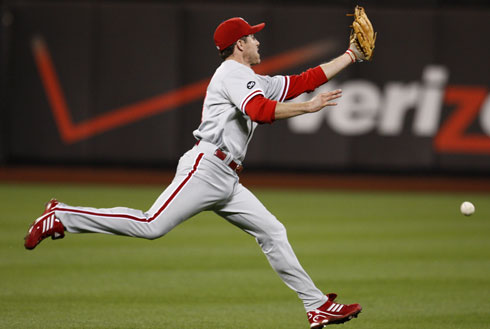
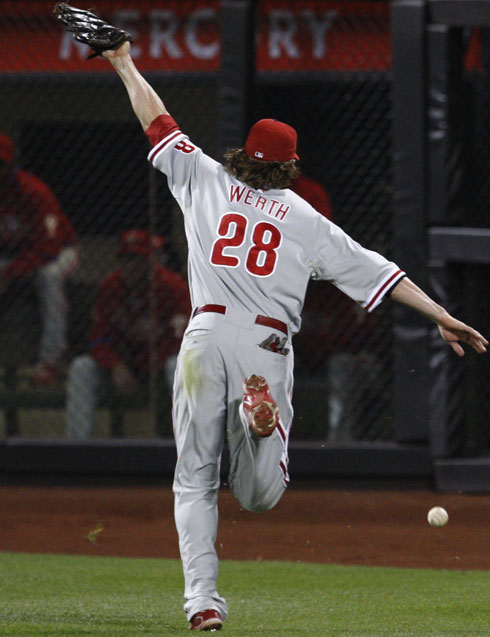
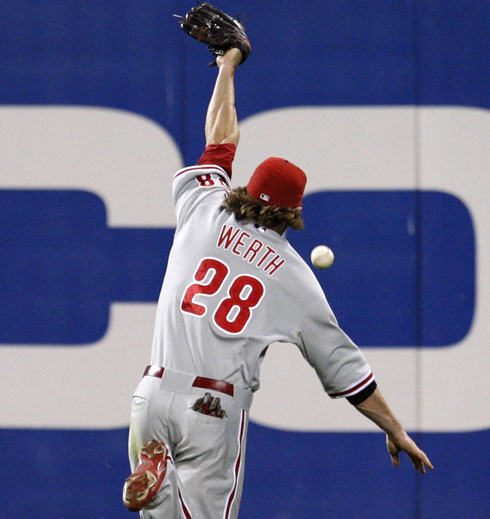
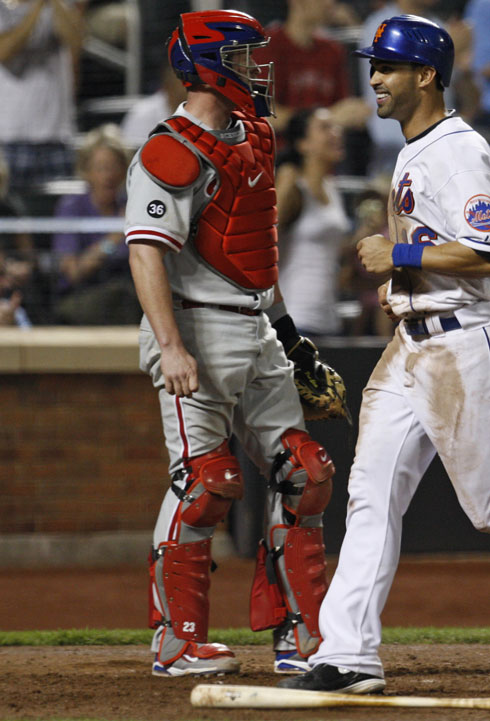
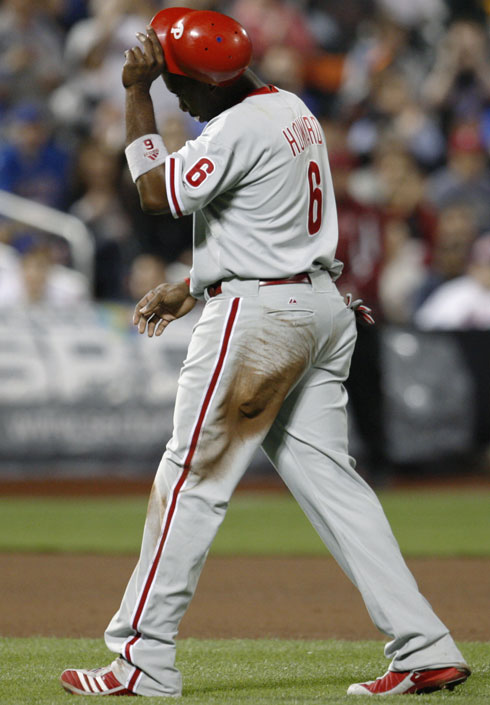
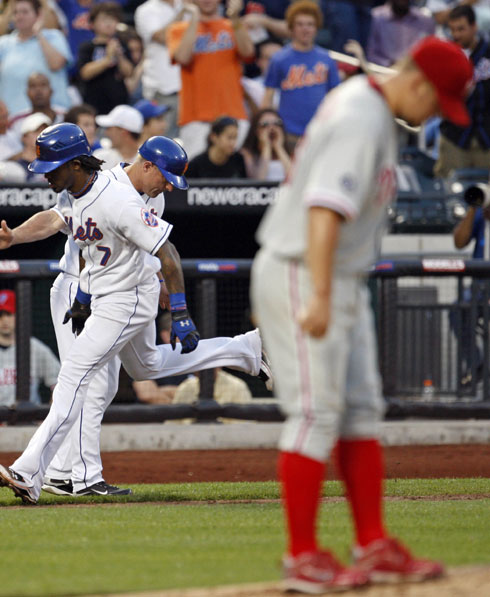
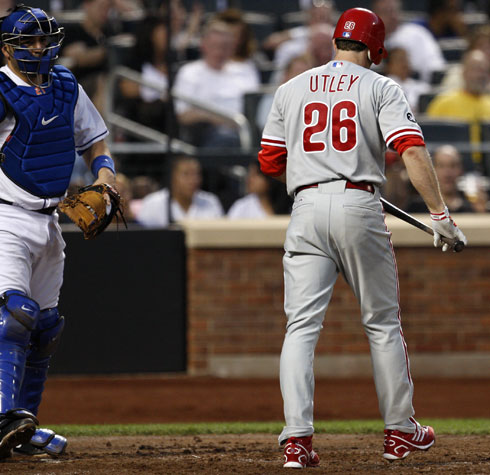
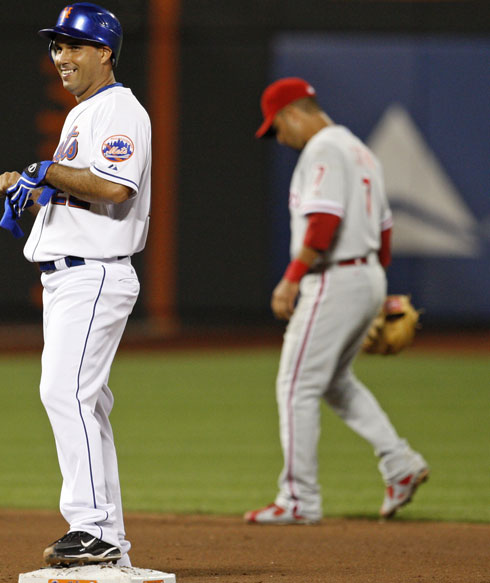
Select photos of Phillies from the AP photo wire
You know, I kind of felt bad for all the anti-Phillie sentiment I spewed earlier, so I figured I’d make it up to them and their fans by compiling this photo album of Phillies highlights from the series this week.
Sorry if they’re a little big:
Straight trolling. But we should enjoy this while we can.
Angel Pagan: Still good
No man but Carlos Beltran is Carlos Beltran, and there’s some chance Carlos Beltran is not a man at all. The jury is still out on if he’s superhuman.
But it is not reasonable to say, “oh, well, one center fielder who is not Carlos Beltran is the same as any other center fielder who is not Carlos Beltran,” which, by suggesting he’ll platoon switch-hitting Gary Matthews Jr. and switch-hitting Angel Pagan based on favorable matchups, is what Jerry Manuel is doing.
It has been three long years since Matthews posted a season as good as the one Pagan provided the Mets in 2009, and Matthews spent the final two of those toiling comfortably below the Major League replacement level. Perhaps there’s something to be said for a change of scenery, not to mention the switch to the easier league, but to think Matthews, at 35, could suddenly start again performing as well as Pagan did just last year on either side of the ball represents the type of logic that– oh, right. The Mets.
My apologies for the back-patting but I want to make a point. I’m going to do this Harper’s Index style.
Games Gary Matthews Jr. has started in center field: 8
Mets’ record in those eight games: 2-6
Number of the six losses that were by one run: 3
Matthews’ line in the one-run losses he started in center: .111/.333/.222
There are obviously a lot of small samples in play in that data. And because Angel Pagan ultimately replaced Matthews in one of those games and Matthews has started games at other positions, it’s difficult to quantify what type of difference Pagan might have made if he started all those contests.
But it’s not unreasonable to guess that the Mets might have a win or two more already if they had just inserted Pagan into the starting lineup on Opening Day, as just about everyone besides Jerry Manuel (and presumably Omar Minaya) was certain they should.
Because Angel Pagan is good. Better than Matthews even. By Fangraphs.com‘s WAR, Pagan has been the fifth-best player in the National League this season. By baseball-reference.com‘s version of the same stat, he’s third.
Pagan leads all center fielders in UZR in a season highlighted by several spectacular diving grabs. On offense, he has maintained a very similar level of production to his impressive 2009 campaign. And all over the field, he has avoided the type of mental mistakes that earned him the vitriol of a large fraction of Mets fans and media last season.
And according to Cot’s MLB Contracts, Pagan is arbitration-eligible and under the Mets’ control through the 2012 season. That’s excellent news.
The young outfielder has been plagued by a series of random and unfortunate injuries in his career, but Mets fans clamoring for the team to enter a bidding war for Carl Crawford next offseason should probably bite their tongues. Pagan and Crawford both play great defense and are nearly exactly the same age. Crawford’s having a great season, but his career line is .296/.336/.440. Pagan’s is .283/.337/.440.
Crawford steals a lot more bases and has been good for way longer, so he’s a more valuable commodity than Pagan. But Pagan has developed into a remarkably similar player, and granted health, the difference between the two in on-field production won’t come close to matching the difference in their salaries.
So in conclusion, Angel Pagan is better than Gary Matthews Jr. Hooray.

Is it me, or are the sunrays brighter and the subways cleaner this morning?
So the Mets have won five straight from the Yankees and the Phillies. They shut out the Phillies for three full games, something they haven’t done since 1969 and something that has only happened six times in the last 20 years.
My baseball-fueled mood swings are pathetic. When the Mets win like this, everything improves. Food tastes better, body aches subside, and the Metro North train from Westchester appears swamped with gorgeous women eager to smile at me. I recognize that it’s all in my mind, but I can’t separate the authentic from the surreal and awesome. I am the Crown Prince of Utopia: The Mets just shut out the Phillies — the big, bad, stupid Phillies — for 27 straight innings.
Last night, when SNY’s cameras caught Johan Santana and Hisanori Takahashi holding baseballs and discussing their craft, I almost choked up a little. It’s the type of thing I’d ignore or just shrug at if the Mets were losing but when they’re going like this, it’s devastatingly beautiful: Here’s a guy from the mountains of Venezuela and a guy from Tokyo sitting in a dugout in New York communicating fluently, sharing knowledge. That’s amazing.
But despite all that and no matter how spectacular the Mets have looked this past week, we must remember to temper our enthusiasm or we’ll drive ourselves batty. This is still a team with big holes in its lineup and question marks in the back of its rotation. Sure, Takahashi and R.A. Dickey showed this week that they’re at least capable of pitching in ways that John Maine and Oliver Perez apparently are not, but neither is a known quantity. Upgrades for certain, but certainly not certain things.
And the Phillies are not as bad as they looked this week. (That might not be possible.) The Phillies still feature mostly the same lineup that steamrolled the N.L. East and they’re still in first place. They’ve got some question marks in their rotation and bullpen too, but what happened these last three games is more likely a reflection of randomness than the Phillies falling apart. Too many of their best hitters hit a rough stretch at the same time, they matched up with a hot team, and they embarrassed themselves. These things happen in baseball. Not often to these extremes, but they happen.
The Mets will allow some runs again, and they’ll lose a few more games too. Probably Jerry Manuel’s seat will heat up again and there’ll be more closed-door meetings and front-office votes of confidence and all that nonsense. Things will not always be this great.
But for now, I’m content to pretend they will be. Let’s look at the damn bright side for once. The Mets just shut out the Phillies for three straight games. There’s fortune involved, like there always is in baseball. But the lingering thrill is real. Suck it down, Philadelphia. And way to destroy your awesome beard, Jayson Werth.
Awesomestock concludes awesomely
Baseball Show with Nelson Figueroa
OK, so on the surface level Nelson Figueroa doesn’t necessarily fit with today’s theme. But I’ve talked with Figueroa a few times now, and he’s a pretty awesome dude to chat up about baseball. Plus he says in this interview that he’s read Moneyball and thinks about going into an MLB front office when he’s done. So maybe Nelson Figueroa will be responsible for a whole lot of awesome yet to come:
As Jose Reyes goes…
I could probably write an entire post about SNY’s broadcast team for Awesomestock. I won’t because I don’t want to seem like an abject shill, plus I don’t know that there are many Mets fans who disagree with me. I watch a ton of out-of-town games through the absurdly amazing MLB Extra Innings package, and I can easily argue that no booth in baseball so ably balances detailing the intricacies of the game and conveying appropriate amounts of excitement without delving into pathetic homerism.
But Gary, Keith and Ron, awesome though they are, mentioned several times recently that the Mets win 80 percent of games in which Jose Reyes scores two or more runs. That’s a misleading stat. The Mets win 77 percent of games in which David Wright scores two or more runs and 85 percent of games in which Luis Castillo or Carlos Beltran scores two or more runs. Basically, once a player amasses a large enough sample of multiple-run games for his team, you should expect that the team won a huge percentage of them. For a variety of reasons, if one guy scores multiple runs it probably means the rest of his team scored a few more.
The reason I quibble with the stat and how frequently it is cited on the broadcast is simple: There’s no need to quantify what Jose Reyes means to the Mets beyond the obvious. The Mets, for the bulk of Reyes’ tenure with the club, have been a top-heavy offensive team fueled by the contributions of a few legitimately excellent players. Jose Reyes is one of those excellent players. He is part of what makes the team top-heavy. He’s a heavy near the top.
I overhead a couple of reporters talking about Reyes in Citi Field’s tunnels yesterday. I couldn’t make out all of their conversation, but what I heard sounded something like this:
“Robble robble Reyes robble robble about time.”
“Robble Spring Training robble robble two months already.”
“Robble robble excuse robble.”
That’s not to call out these two anonymous reporters or even the New York media for its frequent impatience with Reyes. If you surveyed all Mets fans to gauge general perception of their shortstop, I imagine the summary statement would read something like, “Jose Reyes robble robble robble!”
And there might be something about immaturity or injury or unrealized potential in there too, because we all love to believe we know Reyes from what little he divulges of himself during games and to the press, and because so many people forget he spent the four seasons before last year almost entirely healthy and the last three of them as one of the very best players in baseball.
Reyes has not been one of the very best players in baseball this season. He has a .238/.279/.324 line for the year, totals languishing in the Rey Ordonez realm.
But Reyes has put together four straight multi-hit games and five in his last six. He homered last night and ended the game with a leaping snag on a sinking liner.
And he torched that triple Tuesday, a slicing liner that stole past Jayson Werth and one-hopped the wall in Citi Field’s deepest cavern. Reyes bounded around the bases and slid headfirst into third ahead of the throw, and everyone watching remembered the way the Mets drew it up when they built the place.
Reyes looked like Reyes again, and then again last night. I could reasonably contend that missing Spring Training after missing most of 2009 slowed Reyes’ start in 2010, and that a month-long immersion program into full-fledged baseball is a whole lot different than working up to speed at the same time as everyone else back in March.
But I won’t bother, because this isn’t a day for figuring out why things go wrong. This is Awesomestock, a day for celebrating the awesome. And Jose Reyes is awesome. Celebrate him.
All-Star Fail
Look: I usually don’t get too broken up over All-Star voting. The massive bulk of voting fans tend to be poorly informed, so the outcome becomes more of a pageant for the most famous baseball players than a contest between the very best players in each league.
And I hardly aspire to speak for Mets fans, or, worse yet, tell them what to do. The views here reflect the thoughts of only one Mets fan — me, this guy — and I’ve never been much for groupthink or rah-rahism or any of that stuff.
But I think it’s safe to say, today, that we all need to get up out of our seats right now, walk over to the nearest mirror, and take a long look at ourselves. Placido Polanco is leading NL third basemen in All-Star voting. Placido Polanco.
It’s infuriating enough that five Phillies lead their positions after the first ballot count, and frustrating just to imagine all the drunk, filthy Philadelphians taking time away from vomiting on little girls, hands shaky from all the Tasering, punching in the holes next to every single Phillie on the ballot.
And then, insult to injury, to know they’re actually succeeding in their depraved mission? No. I won’t stand for it.
Placido Polanco’s OPS, even playing half his games in that ridiculous ballpark, is nearly 100 points lower than David Wright’s. Sure, he may play slightly better defense, and Wright’s certainly not having his best year, but holy crap, people. This is David Wright. Handsome golden boy face of the franchise. And we root for a New York team; we’re supposed to be the ones who overvalue our stars and send undeserving players to the All-Star game.
Pathetic. Just pathetic.
Did you know that Wright, despite all the fuss about his struggles, is still tied for first in WAR (per baseball-reference) among NL third basemen with Ryan Zimmerman? It’s true. After them on the list come David Freese, Jorge Cantu, Casey McGehee, Scott Rolen, Chase Headley, Chipper Jones, Casey Blake, Mark Reynolds and Ian Stewart. And then, 12th among NL third basemen, is Placido Polanco.
Congratulations, bro. You’re playing better than Pedro Feliz and Andy LaRoche. You know what that says to me? All-Star.
I voted for Wright five times this morning. Took me all of ten minutes, tops. Gotta support the team, like David Puddy might say.
I also wrote in Angel Pagan a bunch of times, because somehow, in 2010, Major League Baseball still hasn’t managed to get the names of all the guys who are actually playing on the ballot. I know that’s the way it’s always been, and I recognize that it probably takes a lot of time to print and distribute those things to every stadium, but c’mon. Just, c’mon.
Oh, and I voted for Carlos Beltran on every ballot, just because.

On Castillo and Murphy
While watching the Subway Series tilt with my wife Friday night, she pointed out that I almost never mention Luis Castillo here. And indeed, since Opening Day I’ve only mentioned Castillo in passing, and usually only when detailing a specific game situation he was part of or when listing his defensive struggles among the Mets’ various problems.
In the waning days of the preseason, I half-joked that Castillo was my favorite player in baseball, for a variety of reasons. That’s not why I’ve laid off him here, though, even as he has struggled to do that one thing he still might do well — get on base.
Maybe that’s part of the reason I lay off Castillo. Plus, he became such a frequent target of Mets-fan vitriol that I think he may have actually become vaguely underrated at some point in the last couple years. He’s not like Jeff Francoeur or someone; no Mets fan believes Luis Castillo is a great player enduring a rough stretch. And far too many blame Castillo for his contract, which isn’t really his fault. I feel no need to pile on.
Plus, there’s something inspiring about watching Castillo persevere with his limited skill set and nagging injuries. Watch him walk around the dugout or the clubhouse, or even off the field on an out, and he’s hobbling. I’ve never been Luis Castillo so I can’t know how much pain he’s enduring, but there’s no doubt from his halting limp that he aches in all sorts of awful ways. And yet he’s out there every time he can be, slapping at strikes and lunging awkwardly at grounders. It’s damn near Sisysphean.
But Castillo’s apparently hurting now, even more than he usually is. And every game he misses is another game closer to Alex Cora’s vesting option doing just that.
So with Daniel Murphy now optioned to Triple-A, the Mets need to revisit the idea of shifting their former first baseman one spot to the left, and pronto. Murphy probably won’t ever be a good defensive second baseman, for sure. But he took to a new position last year with surprising aplomb, and demonstrated enough range in the infield that it’s reasonable to expect he could be nearly as good as Castillo out there in short order.
He won’t turn the double play like Castillo or position himself as well or do any of the myriad little things the veteran has picked up in his 1642 games as a Major League second baseman. But if Murph can just cover some ground on the right side of the infield, it’s not hard to imagine he’ll be a more valuable player than Castillo if he can produce something reasonable offensively.
That’s another matter entirely, as Murphy didn’t exactly inspire a lot of confidence with his bat in 2009. But he’s young yet and likely improving, and, again, it’s not like anyone’s asking him to replace Joe Morgan.
At the very least, trying Murphy at second — if it’s even a little bit successful — enhances his trade value and buys the team time while middle infield prospects like Ruben Tejada and Reese Havens develop. With the Triple-A Bisons overwhelmed with corner players as it is, Murphy should get every opportunity to show he can handle second.
Of course, the Mets picked up second baseman Justin Turner off waivers from the Orioles today and assigned him to Buffalo. So, really, who knows what the plans are for Murph? If the Mets see him as a possible Mark DeRosa-type super sub, though — as Jerry Manuel suggested this offseason — they should get about teaching him how to do that.