I asked him to do Tsuyoshi Shinjo just for you, TedQuarters readers:
Baseball Show with Batting Stance Guy
2

I asked him to do Tsuyoshi Shinjo just for you, TedQuarters readers:
Top prospect Jenrry Mejia, whose dazzling Grapefruit League performance prompted the Mets to place him on the Opening Day roster as a reliever, is expected to head to the minors to resume being used as a starting pitcher. That could be timed with R.A. Dickey’s activation before Wednesday’s start, a team source told ESPNNewYork.com….
The Mets could be facing major rotation issues behind Johan Santana and Mike Pelfrey, so stretching out Mejia for starting work makes sense. Oliver Perez has been dispatched to the bullpen, John Maine — while largely producing of late — doesn’t have the zip he had in 2007 and Jon Niese has a mild right hamstring strain. The Mets will have Dickey face the Washington Nationals on Wednesday and use Hisanori Takahashi in place of Niese on Friday.
Well, good. Stretching Mejia out in the Minors is the right move, even if it appears the Mets may have been forced into it by all the shakiness in their rotation. And Mejia’s stint as a Major League reliever will keep his innings total down for the season, plus — for whatever this is worth — give him a taste of big-league hitters and the confidence to know he can get them out.
 Some will suggest that this was the plan all along, but, without any inside knowledge of the Mets’ thinking, I’d guess otherwise. I doubt that a team with a well-conceived and conservative plan for developing its best pitching prospect would ever allow him to pitch in four games in five nights, as he did in mid-April, or three games in a row as he did last week.
We can point to the examples of Johan Santana, Adam Wainwright and Francisco Liriano, but neither Wainwright nor Liriano ever endured those offenses, and Santana pitched in three consecutive games only once in parts of four seasons as a reliever. So it’s probably best that Mejia will now be out of the hands of a desperate manager prone to overusing relievers.
I’m not certain, though, that success will come as readily for Mejia the starter as it did for Mejia the reliever. It’s much, much easier to pitch well in one-inning stints than in six- or seven-inning ones, especially when you’ve got one dominant pitch. Mejia wasn’t great as a starter in Double-A last year and struggled in the Arizona Fall League. He looks like a good bet to be excellent eventually, but it might take some time. Developing and commanding a secondary arsenal is no small feat.
As for talk that the Mets are now somehow screwing with Mejia? I say this: Whatever. Maybe he never should have been in the bullpen in the first place, but if moving him back into a starting role now requires jerking him around, then the Mets should jerk him around. Starting pitchers are worlds more valuable than relievers, and top pitching prospects should be starting until they prove they can’t.
So all’s well that ends well. Here’s hoping Mejia quiets my doubts, dominates the Minors and makes a quick trip back to the Mets to reinforce their beleaguered rotation.
I revived my SNY.tv column today. The new post is here. As I’ve mentioned before, I never meant to let that spot lay dormant so long. I figured it would be shut down or replaced by this blog by now, but for a variety of reasons, it’s still there. And since I’m the editor of SNY.tv, I recognize that it reflects poorly on the site to have a column on the site without any new posts for six months.
As is often the case, I didn’t say all I wanted to say. I had noble intentions, but I think I missed my mark a bit. It’s about the picture below, but also about omens and signs and hexes and all that stuff, which comes up here sometimes too.
If I grapple with all that too frequently in this space or others, I apologize. For a while now, baseball has seemed microcosmic, like a chalkboard that helps me sort out so many big-picture issues in a more digestible fashion. And I initially aimed to construe that through the column. I think I’m a little rusty on longer-form writing.
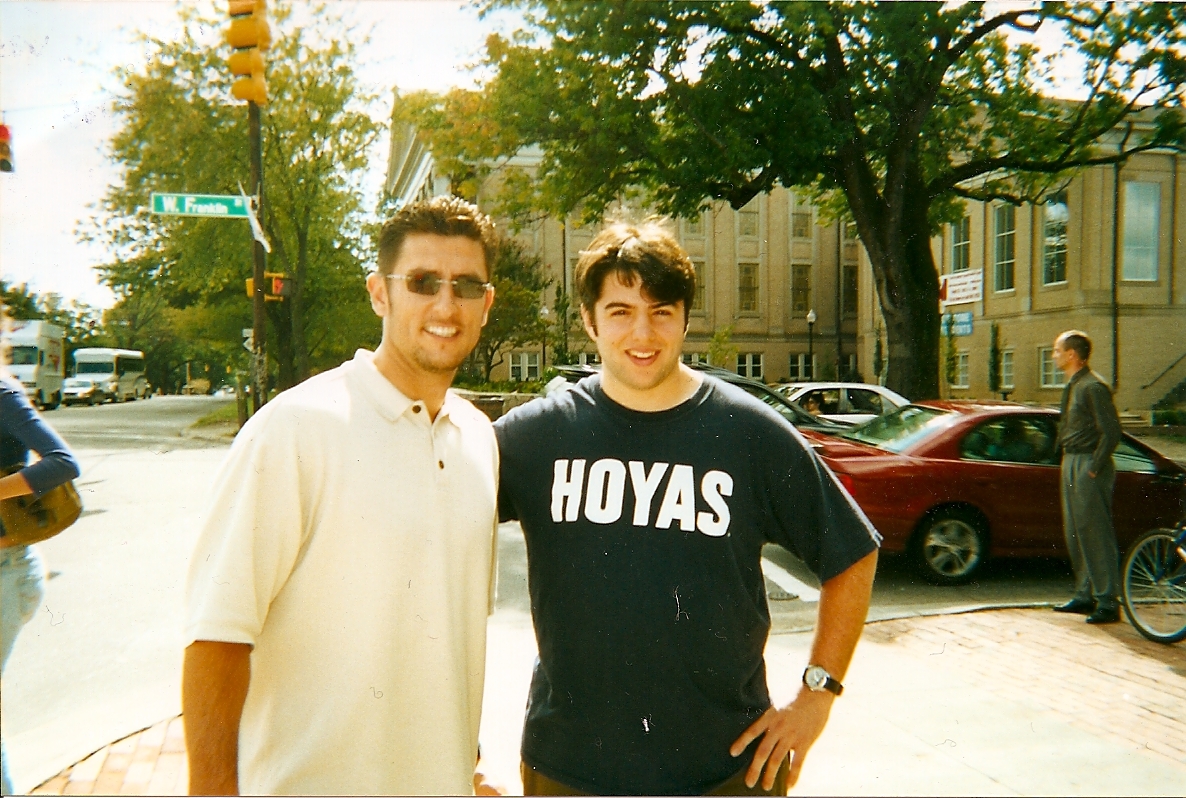
Anyway, here’s the photo of me and Nomar Garciaparra that prompted the column. If you look really closely, you can see Mia Hamm reflected in Nomar’s sunglasses. She took the picture. Also, I needed a haircut:
Here’s your chance to meet me in real life: I’ll be at the Blue and Orange Open Mic on Thursday at River in Hell’s Kitchen. I’m not sure I’ll get on the microphone, but look for a handsome guy standing in the corner muttering all the same things you read here. That’ll be me.
The Mets game will be on and there’ll be booze there. So there’s a pretty solid chance it will be no different from your regular Thursday night, only you’ll be surrounded by other people watching the Mets who also have access to booze.
Here’s the second part in the two-part series on at-bat music. This time, I talk to Rod Barajas and Ike Davis about their choices. I like this one:
I’m hoping to finish an SNY.tv column that’s been in the hopper for way too long. That may or may not happen. For now, here’s Cannonball Adderly:
But the first one (or 122nd or 196th one, depending on how you want to count ’em) is special:
I read what young baseball fans write on their blogs and various comment sections. I get the sense they aren’t haven’t fun with the game, but rather analyzing the game. It’s ok to do that, but it gets to a point where they bog everyone, including themselves, down. Years from now they won’t have stories for their kids, like a Greg Prince, but print outs of graphs of David Wright’s pitch recognition.
Ironically the volume of information, as much as it has helped the game in the front office, has hurt the quality of the fan in the stands. It used to be fun scouring the internet for good baseball discussion. Now I feel like I should be sitting in a classroom with a #2 pencil. I don’t want to be dramatic and say this is the “day the music died”, but with advanced stats and information it very well may be the day it became harder to have fun, dream, and enjoy a summer rooting for your favorite team.
– Mike Silva, NY Baseball Digest.
Look: I’m not out to tell anyone how they should enjoy baseball. I can only speak for myself, and I don’t feel much need to defend my love for the sport. You’ll just have to trust me on this one: I love baseball. Absolutely f@#$ing love it.
 I love every in and out and up and down, every dribbler up the middle and crushed foul ball, every called strike three on the outside corner and every ill-timed mound meltdown. Baseball is meant for entertainment, and it is great theater. So I even love it when the Mets blow a seven-game lead in September or trot out a lineup filled with Triple-A caliber players. Heartbreak, as torturous as it can feel, is entertaining too.
And my enjoyment is only furthered by understanding — or trying to understand — the various metrics used to quantify every element of the sport.
I recognize that plenty of people are probably content to appreciate the natural beauty of a sunrise without bothering to learn that it’s caused by the earth spinning on its axis. And I don’t begrudge them that right. I just happen to think understanding the elegance of the mechanisms prompting that sunrise makes the effect even more spectacular.
The numbers driving baseball are dictated by very subtle differences. Anyone can watch a few basketball games and recognize that the guy who put up 30 points in each is probably the best player on the court. But the distinction between a great hitter and a crappy one is as small as safely reaching base once more in every ten plate appearances. If you think you will notice that a .320 hitter gets one more hit over 20 at-bats than a .270 hitter, well, good for you.
I don’t think I can, though, and so trying to know the tendencies and probabilities involved in every play help me better appreciate both the completely predictable events and the staggeringly improbable ones.
Knowing that Rod Barajas has a .275 on-base percentage doesn’t in any way diminish the awesome aesthetics of his moonshots. It does, however, help me realize how unlikely he is to continue homering at such a ridiculous rate, and watching a player triumph over the odds is pretty spectacular, too.
And that’s — to me at least — the redeeming thing about statistics, and maybe about baseball as a whole. We get to watch people succeed against the odds all the time. Adam Kennedy once hit three home runs in a playoff game. If you only watched the games and never studied the numbers, you wouldn’t realize how crazy that was. But just glance once at the back of Kennedy’s baseball card and you recognize it as a beautiful, hilarious, unbelievable, uplifting feat.
That makes baseball more fun.
Maybe other fans don’t care to know more or understand more thoroughly every aspect impacting a baseball game. Again, I can only speak for myself.
I know this: When I come across something that excites me like baseball does, I want to know everything about it. And part of what has made following baseball and writing about baseball so enjoyable, to me, is that every time I think I know everything, someone uncovers some new, deeper way of understanding the game.
It can be frustrating sometimes, and the breadth of information available can be overwhelming, for sure. But the time spent learning to sort through that information to better appreciate all the wonderful intricacies of the game creates a positive feedback loop: Everything I learn about baseball just makes me like baseball more.
Jeff Francoeur produced another 0-fer, and now has a slash line of .230/.295/.393. He’s like that friendly obese friend who has spent a lifetime eating fast food, then goes on a two week crash diet in an attempt to change his ways. Everyone around him is excited and supportive, happy that the all-around good guy is getting his act together. Then one day you drive by Wendy’s, see him sitting in the front window with three Baconators and realize it’s just not meant to be. Yes, Frenchy has loads of potential but after 3,000+ plate appearances actual results are expected.
– James Kannengieser, Amazin’ Avenue.
In May, Frenchy has a .296 OPS. Not OBP, OPS. Tiny sample and all, but that’s abysmal.
 Yes, Francoeur was good for the last few months of the 2009 season and excellent for the first couple weeks of 2010. But every day it looks more and more like that success was the exception and the rest is the rule.
After all, the Frenchman’s .230/.295/.393 line is awfully similar to the .239/.294/.359 mark he posted in 2008 and not terribly off the .250/.282/.352 pace he maintained with the Braves in 2009 before the trade. The May stats represent a small sample. The bulk of his career does not.
Like James suggests, it doesn’t make him a bad guy or a bad teammate, it just makes him a bad person to count on for production out of a corner outfield spot.
Judging by the eye and the stats, he’s been good in right field, but not good enough to compensate for his complete lack of offensive production. At some point soon, Chris Carter should see some starts against right-handed pitchers. And again, that’s not to call Carter a savior. It’s just to assume he can at the least be something better than an offensive black hole.
Why get on Francoeur and give Jose Reyes a pass? Pretty simple, really: Besides the fact that Reyes competently fields a defensive position, there’s no overwhelming evidence to suggest Reyes is anything like this bad of a hitter.
He has posted OBPs around .355 with some power in every season since 2006, and smart money says Reyes returns to at least that level — if not better — when he finds his stroke. He missed most of last season and a big chunk of Spring Training. Unless he’s injured again, Reyes is likely still sorting things out. And Jerry Manuel’s not doing Reyes any favors when he forces his new third hitter to give up strikes.
The Camden Riversharks announced today that designated hitter, Valentino Pascucci has signed a contract with the New York Mets organization. He will join New York’s AAA team, the Buffalo Bisens, of the International League.
“Valentino was a team leader for us. He came in as a former major league payer and worked hard to reprove himself,” Team Manager, Von Hayes said.
Hat tip to Phil Hoops from NJ.com for the news.
 You’re never going to hear me rail against Val Pascucci’s return to the Mets’ organization. I will go to my grave believing he should have been with the big-league club in 2008 when Marlon Anderson was getting so many pinch-hit opportunities, and that he could probably be a decent enough Major League hitter if given an adequate sample of at-bats, despite concerns about his ability to hit big-league breaking stuff.
And Boss is probably being called to duty in Buffalo because Chris Carter’s up with the Mets and Fernando Martinez is hurt, and the Mets and Bisons want a slugger beyond Mike Hessman and Mike Jacobs to put baseballs and asses in the seats. Organizational soldiers Jesus Feliciano and D.J. Wabick — neither of whom has any appreciable power — have been manning the corner outfield spots in Buffalo since the Fernanchise got hurt and Carter left town, so it’s not like Pascucci will be taking at-bats away from any prospects.
Still, now that the club appears to be progressing prospects through the Minors in the traditional fashion, it will likely want to find Triple-A playing time for at least one of several dudes crushing the ball in Binghamton eventually. Nick Evans, Zach Lutz and Lucas Duda are all maintaining OPSes around .950 or above, and all play corner positions currently manned by the likes of Hessman, Jacobs, Wabick, Feliciano and now, presumably, Pascucci.
Signing Pascucci doesn’t prevent any of that from happening, of course, and since I haven’t seen or been following the B-Mets that closely, I’ll defer to the Mets on the decision of when to promote any of those three. It’s early yet, after all.
Probably Daniel Murphy’s forthcoming rehab factors into the shuffling as well, and almost certainly forebodes more Minor League roster shakeups to come. If it’s true that the Mets will look to play Murph at multiple positions, it could be that they don’t want to clog up too many spots in Buffalo with guys that should be getting regular at-bats somewhere.
In any case, this is a good day for the city of Buffalo and fans of Quad-A mashers everywhere. Welcome back, Val Pascucci.
 Tedquarters