Here’s today’s Baseball Show, chatting up the guys who operate the soundboard and Home Run Apple at Citi Field:
For a later show — I think Monday’s — I talk to Rod Barajas and Ike Davis about their choices.

Here’s today’s Baseball Show, chatting up the guys who operate the soundboard and Home Run Apple at Citi Field:
For a later show — I think Monday’s — I talk to Rod Barajas and Ike Davis about their choices.
Somebody maybe ought to check the Mets if they did that. Their [bleeping] home record is out of this world and they’re losing on the road. Sometimes that’s a good indicator of getting signs and [crap]. I see somebody setting there at (14-7) at home and (4-8) on the road, I’d get concerned about that. That kind of crosses my mind.
I’m not accusing them, but you look at that and – damn. We’re about the same home and road. I’m just saying their record is much better at home and they hit better.
– Phillies manager Charlie Manuel, as told to CSNPhilly.com.
OK, a lot of stuff here: First of all, who put “[bleeping]” in to replace the expletive there? I mean, I carefully dance around including curses on this blog as best I can, and I realize it probably looks stupid sometimes. But “[bleeping]”? Why not “[freaking]” or just straight up “[expletive]”?
 Second, while it’s true that the Mets have a better home record than road record, a) that’s often true for lots of teams, b) it’s almost entirely fueled by the Mets’ 9-1 homestand against the then-struggling Cubs, Braves and Dodgers, and c) it’s just way, way too early in the season to suggest the Mets are playing to any sort of massive home-field advantage, especially since they’ve played so few games on the road.
Also, a pretty great way to accuse someone of something is to just flat-out deny that you’re doing so. Now, make no mistake: I’m not accusing Charlie Manuel of subterfuge or of haphazardly lashing out at the Mets because he’s defensive about his team getting caught stealing signs. That’s just something that crosses my mind.
For all I know, the Mets are breaking the rules to steal signs, and the Phillies were too. My stance on the matter is the same it has always been: It’s not cheating if you don’t get caught.
Ask Leo Durocher. Baseball players are hard-wired to compete, and stealing signs is a way to gain a competitive advantage. This is why the game has written rules: It’s not the players’ or coaches’ responsibility to police themselves. That falls on opposing teams and, in cases like the Phillies’, the league.
If the story’s true, the Phillies thought they could get away with the binoculars-in-the-bullpen scheme. They didn’t, so the league made them stop. The system worked. There are plenty of things to fault the Phillies for without assuming some sort of moral high ground against sign-stealing.
To quote Manuel: “I’m sure if teams could steal signs they would, and if we can we will, too, if we can get them legally…. If you’re dumb enough to let us get them, it’s your fault. It’s been going on in the game a long time. If you’re dumb enough to let us get them, that’s your problem.”
This data suggests that Wright does not actually directly struggle with the slider on the lower/outside corner as previously speculated. It seems more likely this pitch is priming Wright to not swing at the four-seam fastball on the outer corner of the plate. On the plus side, he is not flailing wildly at fastballs outside the strike zone. Furthermore, Wright almost never swings at curveballs on the inner half of the plate, except for curves which are well below the strike zone which he seems to swing at frequently whether they are inside or outside. Finally Wright almost always swings at changeups in the middle of the zone, but also frequently swings at changes in the dirt. He also tends to swing and miss on the changeup more often than any other pitch….
To Wright’s credit, he has adapted to his difficulty recognizing these pitch types by taking a lot more pitches. He waits for a pitch to drive and if he doesn’t see what he’s looking for he’ll accumulate balls and strikes until he is forced to protect the plate. He can still hit a ball in the zone a ton when he swings at it, but he is swinging less than he has in any other season to date (42.1%) and swinging at fewer pitches in the zone (64.0%, lowest of career) while swinging at more outside of the zone (25.4% highest of career).
– KeithsMoustache, FanPost to Amazin’ Avenue.
KeithsMoustache does a tremendous job here interpreting a whole slew of pitchFX data. It’s a lot to read and sort through, but I heartily recommend it.
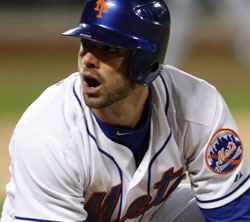 It just so happens I was discussing Wright’s 2010 approach with Matt Cerrone this morning and poring over Wright’s FanGraphs page. To KeithsMoustache’s last point — about Wright swinging less than he ever has before but swinging at more pitches outside the zone — I’ll add this: Wright is seeing well fewer pitches inside the strike zone than he ever has before (43.5 percent as compared to 48.8 percent last season and 50.9 percent for his career).
So it stands to reason that he’d be swinging at a higher percent of pitches outside of the zone while swinging at fewer pitches in general. He’s not seeing as many strikes. I’m not certain the data reflects an adaptation on Wright’s part so much as on the part of opposing pitchers, although I guess there’s a chicken-and-egg aspect to that.
Regardless, all of this is across only a fraction of the season, and the important thing to remember is that Wright — lots of strikeouts or not — has still been awesome.
Check it out: In 2007, Wright’s best full season, he slashed .325/.416/.546. This year, he’s got a .291/.417/.552 line. Nearly identical, except for the slight decrease in hits and increase in walks, which can probably be explained by him getting fewer pitches to hit.
As for Wright’s perceived struggles in the clutch? He hasn’t had a reasonable sample of at-bats in any particular situation, but his numbers with runners in scoring position are very similar to his season line: .281/.390/.563.
Will any of it continue? I have no idea. It seems unlikely that Wright can maintain a .397 batting average on balls in play, but he posted a .394 mark last season.
And it seems crazy to expect him to keep whiffing at this pace, but as frustrating as they can be to fans, the strikeouts are not enough to make him anything besides one of the best players in baseball. Still.
Plus he’s got a pretty sweet beard going, which is cool.
Now look: One clutch double from Chris Carter means very little in the grand scheme of things. It was totally awesome, though, and perhaps enough to quiet the skeptics that say a Triple-A lifer like Carter might not be able to hit (or that he can hit but not pinch-hit) in the Major Leagues.
First impressions massively impact perception, so Carter’s double could be enough to win over dubious Mets fans and media for the time being — at least until he amasses an adequate number of at-bats for anyone to make a reasonable evaluation of his talents.
If Carter struck out in that spot, it wouldn’t mean he never should have been called up or that Frank Catalanotto could do better. It wouldn’t make him more or less likely to hit a go-ahead double his next time up. Dae Sung Koo once doubled off Randy Johnson. One at-bat means almost nothing.
But Carter succeeded and the Mets won. The latter part is most important, but it’s certainly nice that Carter took a big step toward earning labels like “clutch” and “gamer” and “deserving Major Leaguer” that will make the work of all of us long advocating his promotion much easier.
From the @NewYorkMets twitter, via Talking About Baseball. Only Mr. Met looks like he’s having fun:

I’m at Citi Field shooting some video stuff for SNY.tv today, and a few minutes ago I was in the stadium’s in-game production booth talking with the guys that cue up at-bat and bullpen music.
I convinced them to let me crank a song throughout the stadium. Obviously I cued up “RB 1” on their board, signifying the song Rod Barajas uses for his first at-bat.
Meanwhile, unbeknownst to me, Jeff Francoeur was filming a Pepsi commercial in a faraway corner of Citi Field.
Apparently, soon after the camera started rolling, in the middle of Frenchy’s first line, the free-swinging right fielder was interrupted by the sweet sounds of “California Love” pumping through Citi Field’s countless speakers.
A Mets employee came running over to squash my fun, and I’m sure Francoeur nailed it the next time through. After all, he’s not a guy who will stand for too many takes (Ed. note: HEYOOO!).
I’m not certain what he was instructed to say in the commercial, but if anyone asks me for input — which they won’t — I’ll suggest the greatest line in commercial history: “I’m jonesin’ for something different.”
Fast forward through the first 13 seconds of dead air from when our intern couldn’t figure out how to convert a VHS tape to a digital format. Also, uploading stuff like this is exactly the type of industry-relevant, career-forwarding activity SNY.tv interns sign up for:
The news came down last night after the Mets lost to the Nationals, not long after Gary Matthews Jr. whiffed in his pinch-“hitting” appearance in the seventh and Frank Catalanotto grounded out in his in the ninth: Chris Carter is joining the Mets today, replacing Smithtown’s Finest on the roster and, presumably, as the team’s primary left-handed bench bat. The Animal is out of his cage.
 You set yourself up for criticism and snark when you fret about the margins of a team’s roster. In comments sections sometimes, the great Val Pascucci campaign from 2008 is derided with all sorts of snark, even if the Mets fell short of the playoffs by a single game that season while entrusting most of their pinch-hit at-bats to a bunch of dudes who couldn’t hit even a little.
And in truth, no one ever seriously deemed Pascucci a savior, just like no one is now saying Chris Carter will come up and teach Ollie Perez how to throw strikes or Luis Castillo how to cover more ground in the infield.
Carter’s promotion merely represents better roster optimization. Not a cure-all, just an upgrade. Since Catalanotto and Carter both bat left-handed and play the same set of positions and Carter appears to be the better hitter, there was no good reason to keep Catalanotto around any longer.
It seems pretty simple, but it’s something the Mets have struggled with under Omar Minaya.
So maybe Carter’s promotion represents a new mindset or indicates that someone with access to Omar’s ear is paying closer attention than whoever was in that role a couple years ago, in the days of the Abraham Nunez Axiom. Maybe Minaya himself is learning from past mistakes, or maybe Minaya and Jerry Manuel recognize they don’t have time to be patient with struggling veterans with the much-rumored specter of unemployment looming.
Whatever the case, this is a good thing. Carter likely will not soon get an adequate sample of at-bats to show whether he’s Major League worthy, but he will probably inspire a heck of a lot more confidence in late-game pinch-hitting situations than Catalanotto did.
And Carter has traditionally mashed right-handers, so the Mets would be wise to try him out spelling Jeff Francoeur against tougher righties. Whether Francoeur is currently just struggling or simply returning to being Jeff Francoeur, he has a lifetime .710 OPS against right-handed pitching. Carter will not provide what Frenchy does defensively, but it’s a good bet his bat will be an upgrade in certain spots.
This is a good thing. Now we sit back and hope Carter makes good.
Here’s me talking to Wilmer Flores, and talking to Mets Minor League Field Coordinator Terry Collins about Wilmer Flores.
Rod Barajas leads the Mets with nine home runs. He is hitting .233 despite a .164 batting average on balls in play, a mark that likely reflects a little bit of misfortune and a whole, whole lot of fly balls.
 Barajas swings hard. Not sure if you’ve noticed that yet. And he swings often.
To date, Barajas has only walked twice. He has a very respectable .823 OPS with a downright bizarre .253/.570 on-base/slugging split.
How bizarre (Ed. note: How bizarre! How bizarre!)? In the history of baseball, no one with enough bats to qualify for the batting title has ever finished a season with an OBP below .275 and a slugging above .550. In fact, no qualifier has ever finished with an OBP below .275 and a slugging above .500.
In fact, if you restore those first parameters and lower the plate-appearance minimum to 50 — arbitrary, no doubt — the search returns only two players: pitcher Don Drysdale in 1958 and Rod Barajas so far in 2010.
This is something I’ve covered before: If you’re swinging at a whole lot of the pitches you see and crushing a fair share of them, you’re not going to continue seeing a lot of good pitches to hit.
It seems like Barajas covers a whole lot of territory with his bat and can put some bad balls in play, but every hitter has his limit. Pitchers will eventually put enough balls in places Barajas can’t reach to either force him into a more patient approach or retire him at an even more frequent pace.
In other words, this won’t continue. Barajas will still hit home runs, but there’s almost no way he will maintain this pace. Of course, if you think Rod Barajas is going to hit 50 home runs this season you’re either heavily medicated or probably should be, so it’s probably silly to even bother explaining why he won’t keep up this pace.
Either way, Barajas has been awesome so far. For a discounted rate, he is providing all the power and staff-handling acumen the Mets could have hoped for from Bengie Molina. Plus, as noted, he has excellent taste in music and comes to the plate to “California Love” and “Low Rider.” So file Rod Barajas under cool.
Cool, and valuable, but not likely to keep hitting this many home runs. It should be interesting to monitor whether he can total more homers than walks this season, an accomplishment that should probably be named for Dave Kingman.
Only in the eighth, when Aaron Rowand hit a two-run homer over the right field wall off Jennry Mejia – who really needs to go back to Triple-A and hone his starting skills – did the wind finally blow a favor to the Giants.
– Bill Madden, N.Y. Daily News.
Emphasis mine. It’s not particularly surprising, but it’s certainly amusing that the city’s newspaper columnists now appear to unanimously agree that Jenrry Mejia should be starting games in the Minors. I don’t recall any newspaper writer but Joel Sherman making so much as a peep about it during Spring Training, when countless Mets blogs were furiously lobbying on behalf of Mejia’s longterm development.
 That quibble aside, as far as I’m concerned it’s the more the merrier on the let-Mejia-grow bandwagon. The Mets seem to react to media pressure as much as any team in baseball, so it’s good when the media clamors for something that will actually benefit the team.
Anyway, here’s the thing: Not only is Mejia’s development likely being hindered by irregular work in short bursts — he has thrown 83.7 percent fastballs — he’s also being questionably handled, given his youth. Both appearances and bullpen sessions tax relievers’ arms. Mejia has pitched in 15 of the Mets’ 31 games, but warmed up in plenty more.
For all I know, the Mets do have some sort of Jenrry Rules governing Mejia’s usage, but they certainly don’t manifest themselves in his game logs. And that’s a bit worrisome, because Jerry Manuel’s overuse of certain bullpen arms is one of the aforementioned early-season trends very likely to continue.
It’s nothing new. And with the proverbial axe perpetually hanging over his head, Manuel has little motivation to concern himself with the condition of his relievers late in the season.
Fernando Nieve has pitched in 20 games, putting him on pace for 104 appearances. Pedro Feliciano has pitched in 18, putting him on pace for 94 — a career high even for the guy who has led the league in appearances two years running. And like Mejia, both guys have been “dry-humped” numerous times.
Granted, at least some of the blame lies on the Mets’ starting pitchers — the Mets are second in the Majors in relief innings. But Manuel’s team leads the league by a pretty wide margin in relief appearances on zero days’ rest. Mets pitchers have 35. The league average is 18.
In all likelihood, this will eventually catch up with the club.
 Tedquarters