
The order of business

In the comments section this week, someone brought up a potential batting order for the Mets this year and it got me thinking.

Specifically, it got me thinking: “Hey, I should run the Mets hitters through David Pinto’s Batting Order Optimizer and see what comes.”

Pinto’s tool, based on the work of Cyril Morong, Ken Arneson and Ryan Armbrust, uses players’ on-base and slugging percentages to generate the optimal lineup for each team, by runs per game. It’s fun to play with, though since it actually involves plugging player names and stats into a spreadsheet, it’s one of the nerdiest baseball-related pursuits you’ll ever enjoy.

Anyway, I probably should have considered platoon splits and all, but it’s Friday. I simply plugged in the Mets’ position players’ CHONE projections for 2010 and a .150/.150 line for “Pitcher McGee” and this is what it spit out, a lineup that would, it claims, score 4.78 runs per game:

1. David Wright .391 / .502
2. Jason Bay .376 / .514
3. Angel Pagan .334 / .428
4. Daniel Murphy .328 / .429
5. Jose Reyes .360 / .458
6. Jeff Francoeur .317 / .435
7. Omir Santos .296 / .359
8. Pitcher McGee .150 / .150
9. Luis Castillo .367 / .350

Before you freak out, I’m not saying that’s what should happen. Obviously it won’t, for one thing — there’s no way the Mets will hit Wright leadoff and Bay second — and it’s all based on the CHONE projections, which are only projections. It doesn’t account for handedness or egos or anything else. This is merely what would be optimal for that group of guys based on Morong’s assessment of how to best weight OBP vs. SLG with respect to batting-order positions. Wright bats first because he projects to have the highest OBP, simple as that.

I imagine the Mets’ actual lineup to start the season will look something more along the lines of:

1. Reyes
2. Castillo
3. Wright
4. Bay
5. Murphy
6. Francoeur
7. Pagan
8. Santos
9. McGee

I have no evidence that will be the order, plus there’s always a chance someone gets hurt. This was just my best guess at how it will shake out. Francoeur and Murphy are flip-floppable, but I figured hypothetical Jerry Manuel would want to use Murph to break up the righties in the order.

That lineup, according to the Baseball Musings tool, would average 4.536 runs per game if the players held to their CHONE projections, which they probably won’t.

Here’s something, though: All of the top suggested lineups for the 2010 Mets, according to the optimizer, include the pitcher batting eighth and Luis Castillo batting ninth.

I remember when Tony La Russa first started batting his pitchers eighth a couple of years ago. I ripped him apart for it. Not in print, thankfully, but man, I called him all sorts of nasty things to anyone who would listen. What kind of moron would voluntarily give his pitcher an at-bat earlier in the game than a position player, and more at-bats total?

But Tom Boorstein, in the midst of one of my rants, told me there was a lot of evidence that showed that, indeed, there was an advantage to batting the pitcher eighth and a high-OBP, low-SLG guy ninth. I don’t remember exactly what article he pointed me to online — it might have been this one — but I’ve since come to realize that the idea actually makes a lot of sense.

After all, a team tends to concentrate its very best hitters near the top of the order — as it should — to maximize their at-bats and increase its chances of scoring runs early in the game.

But after one time through the lineup, it’s no safe bet the batting order will reset with the leadoff hitter starting off the inning. Putting a hitter like Castillo in the ninth slot decreases the odds that the top of the Mets’ order — the best hitters — comes up with outs on the board and ups the chances they’ve got someone on base to drive in.

Since Jose Reyes has pretty decent power for a leadoff man, having Castillo hitting ahead of him the second turn through the order would give Reyes more opportunities to drive runs in, rather than forcing him to hit after Omir Santos and the pitcher, near-automatic outs.

Plus, part of my original argument — that moving the pitcher up in the order ultimately gives more at-bats to pitchers — is just silly. Starting pitchers rarely bat four times in a game, and when they do, they’re probably pitching well enough that it doesn’t really matter that they’re hitting so frequently.

More likely, a starting pitcher is being replaced in the lineup by a far superior hitter after his second or third at-bat, and every time his spot in the order comes up after that.

Going back to the Baseball Musings tool, I plugged in this lineup:

1. Reyes
2. Pagan
3. Wright
4. Bay
5. Murphy
6. Francoeur
7. Santos
8. McGee
9. Castillo

The outcome? 4.737 runs a game, .21 higher than the one I’m guessing the Mets will actually go with, and about 34 runs more over the course of a 162-game season.

That’s all just in theory, of course, and I’m just having fun with some nerdery on a Friday afternoon. So calm yourselves down.
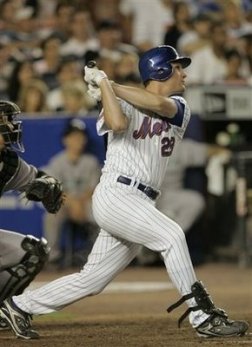
The devil you don’t

The fun thing about Daniel Murphy — or maybe the frustrating about Daniel Murphy, depending on whom you’re talking with — is that you can make about 100 different arguments about what role he should play for the 2010 Mets and not really be wrong.

You can use Sabermetrics 101, point to his .266/.313/.427 line from 2009 and say that’s unacceptable for a Major League first baseman. And you could add that he really only had one good partial season in the Minors — in Double-A Binghamton as a 23-year-old in 2008.

Or you can dive a little deeper into his Fangraphs page, as Sam Page has, to show that, despite all his reputation, some hiccups and a tiny sample size, Murphy demonstrated enough range at first base to indicate he might be a good enough defender to make up for any offensive shortcomings.

And you can claim — as I have — that we haven’t seen enough of Murphy to know how good he’ll be moving forward, and that 707 Major League plate appearances are not enough to judge a 24-year-old hitter.

A less convincing argument, I think, is the one that says Mike Jacobs deserves to start over Murphy on the strength of his 99 Major League home runs and 308 RBIs. Sam does a pretty good job tearing that apart in the Amazin’ Avenue piece linked above, and Patrick Flood goes to town on Jacobs’ defense here.

As I wrote yesterday, I don’t even know that it’s worth the time because I can’t imagine the Mets really would consider starting Jacobs at first base. But the Mets have blown my mind plenty of times before, so here’s this:

We don’t know yet that Daniel Murphy is not good. We certainly don’t know that he is good, but we don’t know that he’s not good either. He has yet to fully embarrass or distinguish himself at the Major League level.

We do know that Mike Jacobs is not good. I’m sorry. I know he hits home runs. He also plays terrible defense and never gets on base. And he’s 29, so he’s probably not getting any better.

Murphy, opening the season at 25, could be. As hard as it may be to believe considering how long it seems like we’ve been watching him play, he is the devil we don’t know, which, as far as I’m concerned, is better than the devil we know isn’t very good.

All sorts of Mets stuff from SNY.tv

The debate rages on in the comments section on yesterday’s qualified defense of the Mets’ offseason. It’s currently 49 comments deep and no one’s compared anyone else to Hitler yet, so that’s awesome. One guy called me a shill, but other than that, it was good work all around.

Anyway, I want to reiterate a point I made in the post but that I think got missed, at least based on the thrust of most of the comments. I in no way meant to excuse the Mets for their general lack of moves on the big-league level this year, but only to commend them for not selling the farm. As I wrote:

The Mets had opportunities to inexpensively improve their chances for 2010 without jeopardizing their future and missed them. I don’t know if there’s truth to the reports of budget constraints or bureaucratic inefficiency, or if the problem stems from either or both or is simply an innocent — and damning — misreading of baseball’s marketplace, but whatever it is, it isn’t good.

To that point, Howard Megdal wrote a good column for SNY.tv on Monday about how the Mets could have upgraded their roster for little more than the money they offered to Bengie Molina.

Sam Borden touched on a similar note today, pointing out that, as nice as it is that the Mets are playing up their past, it’d be nice if they did a little more to improve their present.

And if that weren’t all depressing enough, Mike Salfino uses the Bill James Handbook and catches up with Gene McCaffrey of Wise Guy Baseball to project how the Mets’ pitching staff will fare in 2010.

Because, you know, these websites are all about shilling for corporate interests. That’s precisely what we do here. (I honestly don’t know why I get so burned up by that, except, I guess, that it couldn’t be further from the truth, and I hate that anyone might think anything I write could be disingenuous.)

Anyway, Sam argues that my post yesterday defending the Mets for not destroying their future was akin to commending a man for not falling down the stairs on his trip to the basement, and maybe to some extent he’s right. Maybe that’s just how low my expectations have sunk.

I’m not sure, though. I’m still holding out hope that the Mets made a conscious decision to not trade prospects, and that it represents some sort of fundamental philosophical shift for the organization. And that could be very optimistic, I realize.

Regardless, now reports have it that the Mets have no money left. If that’s true, it’s both extremely bad and completely baffling, because, you know, what happened to that money they were ready to offer Bengie Molina and Joel Pineiro and all that?

And it’s a shame because, if it’s true, it would prevent one of the inexpensive moves the Mets could still make to upgrade their 2010 roster: signing Felipe Lopez.

Mike Jacobs: Whatever

I don’t want to burst anyone’s bubble here, because I got plenty of comments and e-mails this offseason from Mets fans eager to see the return of Mike Jacobs to Flushing.

And I don’t want to waste too many words on the subject, because I don’t really want to imagine a situation wherein Jacobs plays too big a role with the big-league club.

But Mike Jacobs is about as one-dimensional a baseball player as could possibly survive in the Major Leagues. He is a power hitter. He does not hit for average, he does not get on base, he does not steal bases in the rare event he gets on, and he is not a good defender. Mike Jacobs sometimes crushes the ball. That’s his game.

It is not enough to make him a good Major Leaguer, or even really a capable Major Leaguer. By WAR, Jacobs has been below replacement-level for the past two seasons, and only barely above it in 2007.

That’s not to say it’s a bad move for the Mets to scoop him up on a Minor League deal. It’s a Minor League deal, after all. It will likely be a bad move if they cite his Major League experience and 32 home runs in 2008 and give him a 25-man roster spot over a more capable and deserving player, but since they haven’t done that yet, I’ll wait on it.

What’s a little bit baffling is where Jacobs fits in with the Buffalo club he’s likely destined for, since Ike Davis seemed destined to be the team’s starting first baseman. Plus the Bisons already have corner bats in Val Pascucci and Mike Hessman, and also Nick Evans and/or Chris Carter if they don’t stick with the big club out of Spring Training.

I guess Davis could be heading back for another go-round at Double-A to start the season, but given the way he torched that level in his half-year there in 2009, I can’t imagine he needs much more time there.

This is speculation upon speculation and I have no idea that it could be the case, but it would sure be neat if adding Jacobs to the Triple-A mix had something to do with giving Davis some time in right field. Davis played two games in right field at Double-A Binghamton last year and supposedly has a great arm — he was a pitcher in college — so having him take some turns in right could give the Mets some flexibility in their future handling of Davis.

Of course, since Hessman, Pascucci, Evans and Carter all have plenty of experience at first, I have no idea why Jacobs would change the way the team uses Davis in Buffalo. I’m just fantasizing, really.

On the whole, Jacobs is a low-cost, low-risk pickup. Since he’s unlikely to post a Major League on-base percentage north of .300, I wouldn’t call him a potential “high-reward” guy, but who knows?

This might be more of the Mets’ whole “doing better by the city of Buffalo” thing they pledged last season. But if that’s the case, man. I sure wish they’d have paid as much attention to the Major League roster as they did to the Triple-A one.

The contingency plan

Bear with me: The Mets have had, to date, a successful offseason.

Before you click away or jump to the comments section to accuse me of abject shillery or horrifying optimism, check out what I wrote in October, after the fateful press conference where Mets brass called 2009’s results “unacceptable” and pledged change for 2010.

I argued then, as I have since, that the Mets — faced with so much uncertainty coming off the injury-addled 2009 campaign — should prioritize the future above all. I said that their offseason mantra should read:

First, do no harm.

That’s not to excuse all the minor failures of the winter, of course. The Mets had opportunities to inexpensively improve their chances for 2010 without jeopardizing their future and missed them. I don’t know if there’s truth to the reports of budget constraints or bureaucratic inefficiency, or if the problem stems from either or both or is simply an innocent — and damning — misreading of baseball’s marketplace, but whatever it is, it isn’t good.

But the Mets haven’t traded a Minor Leaguer since they sent Greg Veloz to the Nationals for Anderson Hernandez in August. And considering how tempting it must have been for the team to package prospects for veteran help this offseason, I will call that a victory.

Because the Mets are in no position to mortgage any little bit of the future for the success of the 2010 team.

I know what you’ll say: You must win every year in New York. This city won’t abide a rebuilding process. I hear you.

That’s not what this needs to be, though. The Mets don’t need to rebuild anything in 2010, they need to reassess. Entering the season with question marks at nearly every position, the Mets must figure out what they’ll get from all the players who were injured, ineffective or irregular last year.

If Jose Reyes, Johan Santana, Oliver Perez and John Maine are healthy, and Mike Pelfrey, David Wright and Francisco Rodriguez perform more like they did in 2008 than they did in 2009, and Jeff Francoeur plays like he did for the Mets and not for the Braves, and Daniel Murphy and Omir Santos prove they’re Major League regulars, and Carlos Beltran comes back healthy as soon as we hope he does, the Mets will be just fine.

That’s a lot of ifs, of course, and should some of them not pan out, the Mets will be less fine. The more ifs that don’t, the less fine they’ll be.

Fans have killed the team for the lack of clear-cut contingency plans, and to some extent, that’s fair. The Mets probably should have found a more capable backup shortstop than Alex Cora for the event that Reyes gets hurt again and another starting pitcher for the brigade.

But to me, the biggest contingency plan for the 2010 Mets is the 2011 Mets.  Because if things go horribly awry this season — and after 2009, we’d be foolish to dismiss that possibility — the team at least won’t have to look far to see the future. Top prospects Ike Davis, Fernando Martinez, Josh Thole and Jon Niese — should he not earn the fifth starter’s role in Spring Training — should all start the year in Triple-A.

Behind them, the team will have another crop of talented young players entering their first full seasons in the high Minors at Double-A Binghamton. The Mets may not be able to boast a star-studded crop of prospects on par with the Rangers or Rays, but theirs is hardly the dreck it’s been made out to be in the local media. ESPN’s Keith Law recently ranked the Mets’ system 15th out of the 30 Major League clubs.

And much of the Mets’ young talent is concentrated in the upper Minor League levels. Seven of Law’s top 10 Mets’ prospects should start the season at Double- or Triple-A, as should Kirk Nieuwenhuis, who missed Law’s list but ranked ninth on Fangraphs’, and Ruben Tejada, who placed ninth in Baseball America’s ranking.

Now I can’t say if this was all held intact by accident or design. For all I know, the Mets were eager to trade all their best prospects for one year of Bronson Arroyo but couldn’t get the paperwork in order.

But I’m hoping that’s not the case, and that there’s real reason for optimism here. I’m hoping someone in the front office — and who knows who it is — recognizes that the best way to develop a sustainable winner is to build one from within.

And so I’m hoping that the Mets’ biggest failure this offseason was not in roster construction, but merely in communication when they threw around terms like “unacceptable” and “change” and “spend” and “trade.” Maybe they would’ve been better off starting with the slogan I suggested back in September:

The 2010 Mets: Please Be Patient While We Get Our S@#$ Together

Instead, we’ve got, essentially, “The 2010 Mets: Losing is unacceptable, so here’s Jason Bay,” and a very angry fanbase.

I can’t imagine that’ll do much for ticket sales or advertising dollars, but I’ll chalk it up to another of the small losses that have shrouded the offseason’s larger win.

More of the same?

Murray Chass wrote an interesting blog post today about the Mets’ offseason process:

But more than one agent cited the Mets’ inability to deal with more than one free agent at a time as the primary reason they lost out on free agents. “We’re interested in your guy,” more than one agent recalled the Mets saying, “but we have to deal with this other guy first.”

In one instance, the Mets were a player’s first choice, an agent said, but he was one or two down on the Mets’ pecking order – a phrase used by another agent – and the player and the agent weren’t going to wait for the Mets to deal with them. They went elsewhere….

Another agent called the process frustrating. I have other names for it: foolish, wasteful, destructive, irresponsible, to suggest a few. Surely, a general manager is capable of talking to more than one agent simultaneously, working on parallel tracks, even if one signing depends on another.

I’ve used this space to rip Chass a bit in the past, but getting on the horn with agents to dig up dirt on the Mets is definitely the type of thing he spent a long time training to do, and everything he writes here seems to fit with everything we’ve already heard about the Mets this offseason.

But what I don’t get is why so anybody’s acting like this is an altogether new problem. Remember that last year Omar Minaya said, on the record, “we’re not in the position-player market, we’re in the starting-pitcher market.

It’s certainly possible — and entirely likely — that the issues have been amplified by the rumored hedges on Minaya’s power that might now be in place, but it doesn’t seem like operating with a narrow and myopic focus is exclusive to the 2010 version of the Mets’ front office.

Pascucci heroics in Japan

This is another clip from Takashi, in which Val Pascucci hits a game-winning pinch-hit home run for Bobby Valentine’s Marines. Now that I think about it, I’m pretty sure Pascucci himself described to me the way the Pascucci cheer went on all at-bat long, but I guess I never really considered how strange that would sound until I actually saw it on video. To be honest, it seems like it would be distracting, but it’s awesome regardless:

Things to remember about Fernando Martinez

Fernando Martinez spoke to Jesse Sanchez of MLB.com at the Caribbean Series, and some of his comments lit the Mets blogosphere on fire:

“When [Carlos] Beltran had surgery, I thought I had a chance, and maybe they would give me a chance at center,” Martinez said. “But they get [Gary] Matthews Jr., and now I’m not sure where I am. I just can’t give up.”

“I know I’m a big league player, and I can perform at a high level,” Martinez said. “It’s in my hands, so I have to keep working hard and maybe earn a spot. Maybe I make it to the big leagues with the Mets or maybe another team, but I know I can do it. I just have to keep working and waiting for my opportunity.”

I’m not going to read too much into the quotes, because they read to me like, pretty simply, a confident 21-year-old speaking honestly about his situation. Would anyone prefer it if Fernando Martinez was all, “Did you see me last year? I suck! I don’t deserve to be anywhere near the big-league roster”?

Judging from Mets fan reaction, it seems like many see the comments as just that — appropriate confidence — while others have used them to deem him “the next Lastings Milledge” and other such expletives.

Either way, here are a couple of important things to remember about Fernando Martinez:

He’s still very, very young: We’ve been hearing about him forever, so it feels like it’s put-up-or-shut-up time for the outfielder. But in truth, Martinez was the youngest position player in the Majors in his stint last season, and has been the youngest or among the youngest at his level in every one of his Minor League campaigns. I’d guess a big part of the reason he hasn’t put up huge numbers on the farm is that the Mets have — for better or worse — promoted him so aggressively. A .772 OPS in Double-A, like Martinez posted in 2008, is nothing to write home about. It is for a 19-year-old, though. As John Sickels has pointed out, Martinez would have been a college sophomore last year.

100 Major League plate appearances are not an adequate sample: Sample size. Sample size, sample size, sample size. Now I’m not saying Martinez is certainly ready to produce at the big-league level, but his failures there in 2009 should not be taken to mean much of anything. They’re not a good sign, granted, but they fell so far below his expected Major League equivalency that it’s almost certain he would’ve picked it up at the plate with a little more experience.

Clearly, the biggest concern with the Fernanchise is his inability to stay healthy to this point in his career, not only because it could be a harbinger of more injuries to come, but because, as Keith Law (subscriber-only) points out, it may have already hindered his development by limiting his at-bats.

And I’m not arguing that Martinez shouldn’t spend more time in Triple-A. He almost certainly should. Plus, I’m not sure why I’m bothering to argue against the small contingent of Mets fans who seem to have given up on the guy when I know that, if and when he starts putting up Minor League numbers again, everyone will go back to overrating him as a prospect — as is customary.

But it’s a slow news day and I sometimes feel like I’m the last guy in New York still excited about the kid’s chances. And I’m psyched that, in an offseason that was practically begging the Mets to go out and trade a bunch of prospects in some myopic move, they didn’t.

BREAKING NEWS: Pascucci returns

According to BA’s prospect blog, the Mets have signed Val Pascucci to a Minor League deal.

Hat tip to the great Nate Freiberg and Bobby Valentine in the comments section for the heads up.

Nate is, I should mention, the person who first tipped me off to Pascucci’s existence in the first place, long before he ever signed on with the Mets.

Boss, if you’ll recall, is a large, right-handed three-true-outcomes masher that plays first base and the outfield corners. He earned folk-hero status among certain Mets fans — mostly me and John Peterson of Blastings! Thrilledge fame — by dominating Triple-A pitching in 2008 while the Mets were carrying Marlon Anderson as a bench “bat” all season.

By most accounts, he’s not much of a fielder, and since most of the higher-ups in the Mets organization didn’t seem to even bother learning his name the last time around, I can’t imagine he’ll see any time on the Major League roster in this one. But he’ll put asses in seats in Buffalo, for sure, and should he hit well enough and the Mets carry enough dead weight on the 25-man roster — spoiler alert: it’s a reasonable bet — you can bet I’ll be banging that drum again.

Pascucci endured a down year with Padres’ and Dodgers’ PCL teams in 2009, posting a .793 OPS for the season. But at 31, he’s probably not quite declining yet, and it’s reasonable to expect him to return toward his career Triple-A mean, an impressive .906 mark.

Also, when I tracked him down for a phone interview back in 2008, Pascucci tipped me off to this, a Japanese baseball cheer in his honor. So he’s got that going for him, which is nice:

This Putz thing

I’m still trying to process this whole J.J. Putz thing.

The Mets’ much-heralded eighth-inning guy who wasn’t, the dude for whom they traded a slew of young players, came out yesterday and said that the Mets never gave him a physical immediately after the trade, despite the bone spur in his elbow that hampered his 2008 season. Putz called the exam he received during Spring Training “a formality,” and insisted that the Mets convinced him to pitch through pain rather than undergoing surgery recommended by Dr. David Altcheck.

The Mets, in turn, released this statement:

In our review of the player’s medical records in the acquisition of J.J. Putz, we were aware that he had a bone spur before the trade.  He had the same condition in 2008 and was able to pitch with it.  J.J. underwent an exam during Spring Training and an additional exam and MRI before he was cleared to play in last year’s World Baseball Classic.  Unfortunately the spur did flare up again in May, and he missed the rest of the season.

OK. For what it’s worth, Putz did spend time on the disabled list in 2008 with an injury in the elbow, probably the type of thing worth checking out when giving up so many players. But to the Mets’ credit, Putz did pitch pretty well after returning from the injury in late July, so most likely the Mets were guilty, once again, of looking only at the bright side.

It’s worth noting that Putz stands only to gain by throwing the Mets under the bus now. The Amazins have become league-wide whipping boys, so blaming the team for his struggles in 2009 is probably a pretty easy way for Putz to put his best foot forward for his new fanbase in Chicago.

After all, if Putz was in so much pain, why’d he agree to pitch in the World Baseball Classic?

Still, it’s hard to give the Mets the benefit of the doubt in the situation, since everything Putz says seems to jive with everything else we’ve heard about the way the Mets handled injuries last season.

More of the same. It’s Groundhog Day.

Anyway, while it’s certainly bad, it’s also certainly last year’s issue. It reflects poorly on Mets management, for sure, but just about everything from last season already reflects poorly on Mets management. As Matt Cerrone just pointed out to me, the real concern will be when this keeps happening, now that they’ve promised to make changes.

Still, that Putz was injured — and that the Mets knew he was injured — at the time of the deal only thrusts that trade upward in the ranks of epic Omar Minaya failures. Few criticized the deal at the time — I was ambivalent — but the most valuable cog the Mets ultimately got out of the trade was Sean Green.

And — and I’m not sure if the credit should go to Seattle’s scouting or Seattle’s good fortune here — one of the Minor Leaguers the Mets gave up in the deal, Ezequiel Carrera, emerged as a prospect. The outfielder posted a .441 on-base percentage at Double-A last year, and could be better than Gary Matthews Jr. right now.