
The issue here

OK, so we’ve got the details: The Mets have traded Brian Stokes to the Angels for Gary Matthews Jr. and $21.5 million of the $23.5 million remaining on the two years left on his contract.
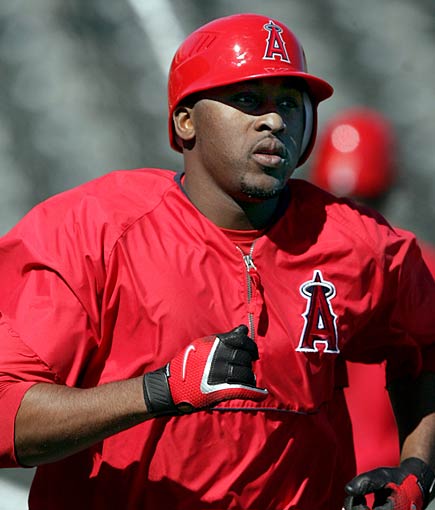
So it’s Brian Stokes for the right to have Gary Matthews Jr. on the team at the massively discounted rate of $2 million over two years.

Whoop-dee-doo.

The good news is that Angel Pagan hasn’t gone anywhere, and theoretically he will still have every opportunity to establish himself as the club’s starting center fielder until Carlos Beltran returns from injury. And Pagan should do that, because he’s a much better player, at this point, than Matthews.

The Mets needed someone to back up Pagan, and so they went out and got a player who, in their eyes, has proven he can play center field at the Major League level.

And that’s the issue here: Gary Matthews Jr. has spent the last three seasons proving that he cannot play center field at the Major League level.

Both UZR and plus/minus say Matthews has been a significantly below average defensive outfielder since joining the Angels in 2007.

Of course the talent evaluators the Mets employ apparently disagree with those imperfect but valuable tools, and here’s hoping they’re right.

Because other than some vague reputation for good defense, Matthews doesn’t bring a whole lot to the table. He had a nice year at the plate in 2006 — earning him a giant contract — but has been a bad hitter since, rocking a .708 OPS in his time with the Angels.

You might even say he’s been below replacement level. And the Mets just went out and traded something to get him.

And that’s the issue here.

Not that Stokes was any great shakes. For whatever reason, he was overrated by some Mets fans — this one included — simply because it appeared Jerry Manuel entirely forgot he existed for stretches of the 2009 season. But Stokes was probably lucky to have a sub-4.00 ERA in 2009 with his high 1.564 WHIP, and he never had overly impressive peripheral stats.

Still, as a hard-throwing relief pitcher who posted 108 ERA+ in 103 2/3 innings over two seasons with the Mets, Stokes was something of value. And they just traded something of value for something of arguably no value, since Matthews has done little over the past three years to show that he’s any better than the readily available replacement.

Make no mistake: This is a deal of a seventh reliever for a fifth outfielder. That’s nothing. This means very little in the grand scheme of things.

But it’s frustrating and a little frightening because it shows, once again, how the Mets seem to judge talent in a way that departs so severely from the stats they should now have at their disposal, then overpay to acquire that talent.

Tatis apparently back in mix

Mike Puma reports in today’s New York Post that the Mets could pursue Fernando Tatis if they decide not to sign Carlos Delgado.

Cool. I’ve been singing Tatis’ praises this offseason; he’s been a versatile and productive player for the Mets, and I could get on board with his return.

The article says that Tatis’ double-play groundouts last season are more notable than his other stats, but I would argue — and have argued — that they were merely a weird, flukish run of terrible luck.

What is funny, though, is that the story says “the team could look to Tatis for a platoon with Daniel Murphy.”

That’s well and good, and I guess since Tatis has a career .808 OPS against lefties, he’d represent an upgrade over Daniel Murphy when opposing southpaws are on the hill.

But interestingly enough, Tatis doesn’t really demonstrate a huge platoon split — he has a career .782 OPS against righties. Ryan Garko, whose career .792 OPS only barely trumps Tatis’ .790, demonstrates a much more severe split: He has an .887 lifetime figure against lefties against a .755 OPS versus righties.

If Garko’s looking for significantly more money than Tatis, it’s probably not worth rewarding him for the slight upgrade offensively against left-handers, given how infrequently teams really face lefties anyway plus Tatis’ defensive flexibility. Plus, if the Mets value Tatis’ versatility and hope to exploit it, he’s worth pursuing over Garko.

But if they’re exclusively looking for the platoon bat to pair with Murphy, Garko’s the–

Holy crap, apparently the Mets have just landed Gary Matthews Jr. I’m assuming this is bad, but I’m going to cut off this Fernando Tatis/Ryan Garko post right here while I find out more.

Why Sheets over Garland, quick and dirty

I just ran into a smart dude and good Mets fan who told me he thought the team should pursue Jon Garland, and definitely not Ben Sheets. He said they needed more certainty in the rotation, given how shaky things were after Johan Santana, and that Sheets did nothing to shore anything up.

That’s hard to argue with, but I did. Here’s why:

Jon Garland is just OK. He’s one of the most reliable bets in the Major Leagues to pitch 200 innings, and that’s definitely worth something. But they won’t be 200 great innings, or even 200 very good innings. They’ll just be 200 innings.

I think Garland would be a great guy to have around if the Mets knew they were going to get healthy seasons out of Carlos Beltran and Jose Reyes and a productive one out of David Wright. Garland is the type of pitcher who can win games for a good offense, but probably not the type of pitcher who can win games on his own.

Ben Sheets, when he’s right, is precisely that type of pitcher. Sheets is coming off elbow surgery and hasn’t pitched since 2008 and so represents a pretty sizable risk. But he pitched like an ace in 2008 and the potential reward is much larger than anything Garland could offer.

Garland is the safer move, sure. But the Mets, as currently constructed, shouldn’t be making the safer move. With the Phillies, Braves and, to a lesser extent, the Marlins all poised to contend in the NL East in 2010, the Mets’ best shot at a playoff run is to take big bets on upside and hope they pay off.

Sure, it’d be nice if that weren’t the case, and the Mets had a roster full of sure things and just needed a steady back-of-the-rotation innings-eater like Garland to complete the package.

But the Mets, instead, have question marks basically everywhere.

Plus, as I’ve written before, they could probably scrap together something similar to the 200 decent Major League innings Garland would provide from a combination of Nelson Figueroa, Fernando Nieve and Jon Niese. One minor benefit to 2009 was that it forced the Mets to accumulate some much-needed depth.

What they likely won’t get from that group, though, is the type of dominance Sheets might provide. And they wouldn’t get that from Garland, either.

Obviously money is a big factor, and rumors earlier this offseason said Garland wanted to stay on the West Coast and Sheets wanted to go to Texas, so this could be an entirely pointless blog post. Plus if Sheets wants an Oliver Perez contract, then, well, screw it.

That’s all I’ve got.

More on Snyder

Nick Piecoro at AZCentral.com reports that there’s nothing new on the Chris Snyder front, but I wanted to discuss it a little further.

I mentioned Luis Castillo in my post yesterday, but I was mostly kidding (hence the reference to fingers and toes being crossed, and the rare use of the double question mark). But when Mets fans consider their favorite team taking on another team’s unwanted salary, they instinctively hope Castillo can somehow be pawned off in the deal.

But though the money and years owed to Castillo and Snyder are actually quite similar — Castillo is owed $12 million through 2011 and Snyder $10.5 plus a $750,000 buyout, so $11.25 million total — there’s a huge, huge difference in their contracts. It’s this:

If Snyder is healthy and playing the way he did in 2007 and 2008, he is a bargain at that rate. If Castillo is healthy and playing the way he did in 2009, he is still overpaid.

So think about it this way: Snyder, especially to a team without a catcher, offers a ton of upside, despite the injury-related risk. Castillo, to the Diamondbacks, offers the possibility he’ll play like Luis Castillo. And lest we forget, he still brings a fair share of injury-related risk, too.

Plus, if the Diamondbacks believe Snyder will return to full strength after back surgery, it could behoove them to hold off on trading him and wait to see if Miguel Montero continues his success. Then, if he does, Snyder could be dealt during the season, once he’s proven his health and his value has risen.

Also, it would seem strange for Arizona to deal Snyder, presumably to free up payroll, only to take on more payroll in Castillo. Plus they’ve already added one shaky-fielding second baseman this offseason in Kelly Johnson.

Piecoro offers a great rundown of the Diamondbacks’ potential motivation to trade or not trade Snyder, and I recommend reading it. It’s always important to keep in mind that two teams need to sign off on deals. I forget too often myself.

Ricco, try and understand

Everytime I hear Mets assistant GM John Ricco’s name, I think of the following NOFX song, from one of my favorite albums ever, Punk in Drublic.

And I realized that there’s a whole lot about this song and the Mets’ current situation that seems to fit, really.

Things we never tried to disallow
have come back to haunt us now

Regarding Chris Snyder

According to Marty Noble, the Mets will go with Omir Santos and Henry Blanco at catcher and use the money they would have spent on Bengie Molina elsewhere. But according to Mike Francesa on WFAN today, the Mets could be targeting Diamondbacks catcher Chris Snyder in a trade.

I don’t necessarily believe either of them, following my standard procedure of not really believing anybody. But I kind of hope Francesa’s right in this case, because Snyder would be an intriguing pickup.

Snyder, you may recall, was rumored to be dealt to the Blue Jays earlier this offseason, but ultimately sent back to Arizona when the Jays vetoed the deal over concerns about Snyder’s surgically repaired back. So that’s bad. Put that down under “bad.”

And Snyder — possibly due to the bulging disc in his back that ultimately required surgery — struggled in 2009 and lost his starting job to Miguel Montero. He hit .200 with a .333 on-base percentage and .352 slugging. More for the “bad” column.

But before that, Snyder appeared to be one of the better young catchers in baseball. As the Diamondbacks’ regular backstop in 2007 and 2008, Snyder posted OPSes of .775 and .800, well above average for a catcher, and by all accounts played competent defense.

Snyder will be 29 on Opening Day, so if he’s healthy it’s not unreasonable to expect him to return to form. Of course, it does seem a bit risky to go out and acquire a catcher coming off back surgery, especially one another team has already vetoed the same offseason.

I have no clue how well Snyder handles staffs, but Brandon Webb did not appear to have any trouble dominating National League hitters under Snyder’s guidance in 2007 and 2008.

Clearly, Snyder would be worth taking a flyer on if it were just that. But of course, it’s not just that.

I have no idea what it would take to land Snyder. The deal with the Blue Jays that fell through was for Lyle Overbay, but since it fell through, I have to assume Snyder would cost the Mets something less valuable than Lyle Overbay.

The Diamondbacks were said then to be looking to part with Snyder’s contract — he is owed about $10.5 million over the next two seasons — to free up payroll to sign other players.

I can’t speak to whether they have any more budget flexibility, but it does appear they could still use some depth in the starting rotation behind Webb, Dan Haren and Edwin Jackson (a mighty trio, no doubt), so I wonder if Arizona will be tempted to move Snyder to be able to lock down a familiar innings eater like Jon Garland.

Still, even under those circumstances, teams don’t give away 29-year-old catchers one season removed from two productive years for free, and I have no idea what the Diamondbacks would want from the Mets for Snyder. A prospect? A relief arm? (Fingers and toes crossed) Luis Castillo??

Snyder is definitely someone the Mets should be targeting, but obviously it’s impossible to just say “go get him” without considering the cost. He’s probably a safer bet than Santos to be an effective starting Major League catcher in 2010, though, so it can’t hurt the Mets to inquire.

Chicken game ends, winner is unclear

Twitter is positively exploding with reports that Bengie Molina has re-signed with the San Francisco Giants to a one-year, $4.5 million deal.

Suck it down, Dailey.

Actually, given the terms of the contract, it’s not a terrible signing for Brian Sabean’s team, and to be honest, I find it difficult to believe the Mets didn’t offer Molina more than that.

If anything, I wouldn’t be surprised to learn that the Mets did, in fact, offer at least that much, but when they were unwilling to guarantee a second year, Molina opted to stay in San Francisco. I suppose more details will follow.

Anyway, good for the Mets for holding firm. Guaranteeing a second year would have been bad.

Plus, as Tom Boorstein just pointed out to me, whenever the guy you were trying to sign ends up signing with the Giants, it means you probably didn’t want that guy.

Maybe this whole handcuffed general manager plan will work out for the Mets yet.

Nobody seems to think the Mets need Bengie Molina except the Mets and Bengie Molina

I kind of figured Bengie Molina and the Mets had agreed on something by now and were just holding off on announcing it, but according to Buster Olney, Bengie Molina rejected the team’s latest offer.

So if you’re a pessimist, you think this makes the Mets more likely to up the amount of dollars or years in their offer to Molina. If you’re an optimist, you think this makes the Mets more likely to sign someone else or use some combination of the catchers they already have.

Unless, of course, you’re hoping the Mets sign Molina, in which case, reverse all that.

But only a small fraction of Mets fans appear to think the Mets could actually benefit from adding Molina, and, of those, few seem particularly excited about the possibility.

My favorite argument for signing Molina was summed up well recently in a FoxSports.com blog entry:

Beltran’s unavailability for Opening Day places a greater emphasis on adding a player who can hit in the middle of the order. And Molina batted cleanup for the Giants through most of the 2009 season.

While it’s true that Molina hit cleanup for the Giants in 2009, it’s also true that the Giants had the worst offense in the Major Leagues last year. Signing Bengie Molina to hit in the middle of your order just because he hit in the middle of the 2009 Giants’ order is like signing Luis Ayala to be your closer because he finished out games for the 2008 Mets.

Anyway, until Molina signs elsewhere, the Mets sign a different catcher, or someone on the team comes out and confirms that some combination of Henry Blanco, Chris Coste, Josh Thole and Omir Santos will start behind the plate in 2010, we can only assume that the world’s slowest game of chicken is still underway and that all that happened today was Molina announcing his intention not to flinch.

Rock bottom

While stumbling around the Mets’ blogosphere this weekend, I came upon a poll that I, disappointingly, cannot now find for linking. It asked what users thought was the low point of the 2009 season for the Mets.

The leaders were the obvious choices: Luis Castillo’s dropped pop-up, Jose Reyes’ injury, Mike Pelfrey’s yips, Fernando Martinez’s faceplant and the like.

My answer wasn’t provided as an option.

I suspect not many people were watching the Mets on the afternoon of Aug. 5. For one, I realize not many people work in settings where they are encouraged to watch baseball games from their desks.

Plus, by early August, half the roster was on the disabled list, the other half was playing uninspiring ball and the Tony Bernazard saga was still shrinking in the rear-view mirror.

But I was excited to tune in that day because the Mets were starting Jon Niese, who seemed, at that point, the team’s lone remaining person of interest.

Fernando Martinez, the team’s other near-ready prospect, was already done for the year after hamstring surgery. So Niese, who had posted impressive peripherals in Triple-A, represented the only promising new Met, the one guy who could cull meaning out of the lost season’s final months and prove he belonged in the big leagues.

No one thinks Niese will be a Major League ace anytime soon — or anytime at all, really — but I knew then that if he pitched well for the Mets down the stretch, they could go into Spring Training 2010 with a decent and inexpensive young starter for the middle of their rotation. He was the very last glimmer of hope that something good could come out of an awful, awful year.

Then, an inning and two-thirds later, he did a full split while covering first base on a groundout and appeared to tweak something.

Then, one warmup pitch later, he was on the ground, writhing in pain.

That was it for me: rock bottom. That’s when I stopped thinking “terrible luck” and “a series of unfortunate events” and started thinking “inarguable hex” and “black magic.” The Mets weren’t even going to have a chance to assess their best young players, because their best young players couldn’t escape whatever strange, vengeful Phillies-fan deity had already wreaked havoc on their established stars.

Niese was expected, at the time, to be fully recovered from his injury by the upcoming Spring Training. So here’s hoping that happens.

But we would know so much more about Niese and what he could be expected to contribute tot he 2010 Mets if it hadn’t happened, obviously, and for me, it was the lowest point in a year full of them.

Old man Hairston’s kid

According to Ken Rosenthal, the Mets have contacted Jerry Hairston (Jr., I hope), the only free agent who plays both center field and shortstop.

This is an excellent point.

Old man Hairston’s kid has capably fielded both positions in his career, according to both UZR and plus/minus. Those are both in pretty small samples, mind you, but given the fact that he’s also been a decent defensive second baseman, it’s safe to say he’d be a nice addition to the roster as a utility man to a team with defensive question marks in the middle infield and general lack of range in the outfield, Angel Pagan notably excepted.

Hairston made $2 million last year with the Reds and Yankees, a figure he more than earned with his defensive flexibility. I can’t imagine he’ll require much more this year, though I have no inside information.

The problem? Hairston can’t really hit. He has had random spurts of success in short bursts — most notably when he posted an .871 in 261 at-bats for the Reds in 2008. But other than that, he’s hit like the utility infielder that he is. He has a .701 OPS for his career.

And the Mets already have a 34-year-old, weak-hitting utility infielder under contract for $2 million. His name is Alex Cora, and though he can’t really hit or field as well as Hairston, nor play as many positions, he’s loaded up on intangibles.

So there’s that.

The Mets’ best route to recouping some of Beltran’s offensive production is by adding platoon bats to pair with Daniel Murphy and Jeff Francoeur. That likely won’t cost them money, but it will cost them roster spots and so they probably won’t be able to afford to carry multiple replacement infielders, even if one can handle the outfield.

Assuming 12 pitchers and two catchers, plus Murphy, Luis Castillo, Jose Reyes, David Wright, Cora, Jason Bay, Angel Pagan and Francoeur, the Mets have three roster spots to work with.

Hmm… I started this one way and now I’m changing my mind a little. Maybe, maybe, if the Mets could find a right-handed bat and a left-handed bat (Nick Evans and Chris Carter, perhaps? Ryan Garko?), Hairson could slot in as the 25th man and super sub. He’d sort of render Cora redundant, of course, but Alex Cora transcends redundancy, or something.

Twitter’s telling me I’m wrong though, so I’m open to changing my mind. Feel free to explain what I’m missing.

And that’s all fun and games anyway, since I’m sure there’ll be a handful more changes before the Mets even get to Spring Training.